
Type & Discipline
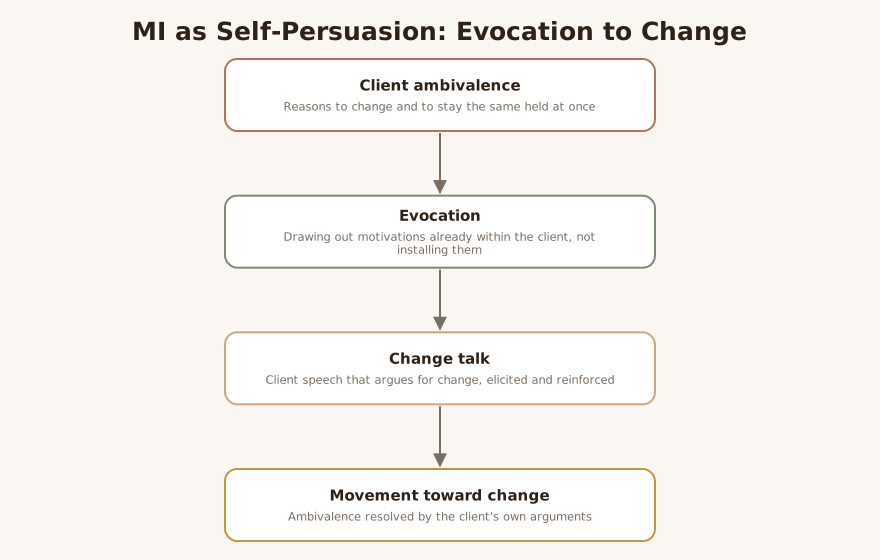
Motivational interviewing (MI) is a clinical method and counseling style within clinical psychology and the addictions field, not a school of personality theory or a stand-alone diagnostic system 1. Its developers define it as a collaborative, person-centered form of guiding to elicit and strengthen motivation for change 5. The framing this article adopts — MI “as persuasion” — needs immediate clarification, because it is easy to misread LLM. MI is emphatically not the therapist arguing a client into change; it is a structured way of helping clients persuade themselves, by evoking and reinforcing the client’s own reasons for changing 1. In MI, the person who voices the argument for change is the client, and the clinician’s craft is to make that self-persuasion more likely 1.
This reframing matters clinically because it locates the active ingredient in the right place LLM. Decades of process research that informed MI suggest that when clinicians push and clients defend, change stalls; when clients hear themselves articulate why and how they might change, movement follows 1. So MI sits in the discipline as a directive-yet-nondirective hybrid: directive about the destination (resolving ambivalence toward a target behavior) while honoring the client’s autonomy about whether and how to get there 1. It is best understood as a way of being with people rather than a bag of tricks done to them 6.
Creators & Lineage
MI was originated by William R. Miller and developed jointly with Stephen Rollnick, the two clinicians most associated with the method and its successive editions 5. Miller first articulated the approach in the early 1980s out of his work with problem drinkers, and Rollnick helped extend and formalize it for broader clinical use 8. The current canonical statement is the fourth edition of their text, Motivational Interviewing: Helping People Change and Grow, which refines the method’s spirit and processes 5.
The lineage is explicitly Rogerian 8. MI grew out of Carl Rogers’s person-centered tradition — accurate empathy, unconditional positive regard, and the conviction that clients hold the resources for their own change — but it departs from classical client-centered work by being consciously directive toward a particular change goal 1. Where Rogers was nondirective, Miller and Rollnick added strategic guidance: the clinician selectively attends to, reflects, and reinforces the client’s own change-oriented speech 1. MI also developed in dialogue with the transtheoretical (stages of change) model of Prochaska and DiClemente, and the two are often taught together, though they are distinct: stages of change is a model of how change unfolds, while MI is a method for facilitating it, most useful when a person is ambivalent or not yet ready 8. More recently, MI’s emphasis on autonomy and intrinsic motivation has been linked conceptually to self-determination theory, which provides a motivational-science rationale for why honoring autonomy and competence promotes durable change LLM.
Core Principles
The heart of MI is ambivalence — the simultaneous holding of reasons to change and reasons to stay the same — treated not as pathology or denial but as a normal, workable feature of human decision-making 1. The MI clinician assumes ambivalence is where most stuck clients live, and that resolving it in the direction of change is the central task 1.
MI is animated by an underlying spirit, without which the techniques become hollow 1. The fourth edition describes this spirit through four qualities: partnership (an active collaboration between two experts, not an authority dosing a passive recipient), acceptance (which includes honoring absolute worth, accurate empathy, autonomy support, and affirmation), compassion (actively prioritizing the client’s welfare), and evocation (drawing out what is already within the client rather than installing what is missing) 5. Evocation is the principle that converts MI into self-persuasion: the assumption is that clients already possess motivations and reasons for change, and the clinician’s job is to call them forth 1.
The mechanism MI cares about most is change talk — any client speech that argues for change — and its counterpart, sustain talk, which argues for the status quo 1. A guiding empirical premise of MI is that people tend to become more committed to what they hear themselves say; eliciting and strengthening change talk, while not amplifying sustain talk, tilts the internal balance toward action 1. The original four principles — express empathy, develop discrepancy (between current behavior and broader goals or values), roll with resistance, and support self-efficacy — remain a useful summary of the stance, even as the method has been reorganized around its spirit and processes 2.
Interventions & Techniques
The conversational engine of MI is summarized by the acronym OARS: Open-ended questions, Affirmations, Reflective listening, and Summaries 2. Open questions invite elaboration and create room for change talk; affirmations recognize the client’s strengths and efforts without being empty praise; reflections — especially complex reflections that add meaning or selectively emphasize the change side of ambivalence — are the workhorse, both demonstrating empathy and steering toward self-motivating speech; and summaries gather the client’s own change talk and play it back, so they hear their own case for change assembled 2.
MI organizes the work into four overlapping processes: engaging (building the relationship and a working alliance), focusing (agreeing on a direction or change target), evoking (eliciting and strengthening the client’s own change talk — the distinctive heart of MI), and planning (developing commitment and a concrete plan once readiness emerges) 5. Crucially, evoking is where self-persuasion happens: the clinician asks evocative questions (“What might be the good things about cutting back?”), uses importance and confidence rulers, explores values, looks back and looks forward, and then differentially reflects and summarizes the change talk that surfaces 1.
Equally important is what MI tells clinicians not to do LLM. MI cautions against the righting reflex — the well-intentioned urge to fix, warn, persuade, and supply all the arguments for change — because doing so typically provokes the client to voice the other side, defending the status quo 1. When the client argues against change, change becomes less likely; the clinician who “wins” the argument loses the outcome 1. So instead of confrontation, MI uses strategies to soften discord: reflecting the sustain talk, emphasizing autonomy (“It’s really up to you”), reframing, and coming alongside rather than opposing 2.
LLM-generated illustrative example (not a guideline): A client says, “Everyone keeps telling me to quit vaping, and honestly it’s the only thing that calms me down.” A righting-reflex response — “But it’s destroying your lungs, you have to stop” — would likely pull a defense of vaping. An MI response evokes self-persuasion: “It really helps you manage stress, and at the same time something brought it up today. What, if anything, makes you wonder about it?” The clinician then reflects and summarizes whatever change talk the client offers, letting the client build their own case LLM.
Evidence Base
The honest summary is that MI is an established method with a large evidence base and genuine, if uneven, effects 4. It is one of the most widely studied counseling approaches and has been recommended in clinical guidance for substance use and health-behavior change 2. Its strongest and most replicated support is in the addictions field — alcohol and other substance use — where it was born, and in health-behavior change such as smoking cessation and treatment adherence 4. A consistent practical finding across reviews is that MI can produce benefits in relatively brief contacts, which makes it attractive in primary care and time-limited settings 4.
Maturity, however, should not be confused with uniform potency LLM. Critical appraisals note that average effect sizes are often modest, that results vary considerably across studies and target behaviors, and that effects can attenuate over time without continued contact 4. Outcomes also depend heavily on fidelity: MI delivered without its spirit — checklist-style OARS bolted onto a confrontational stance — does not reliably work, and clinician differences account for meaningful variance 4. There is also active inquiry into MI’s mechanism: the theory that in-session change talk mediates outcome has support but is not settled, which is part of the ongoing “living up to its promise” conversation in the literature 4. Extensions of MI to major mental health problems — depression, anxiety, and as a prelude or adjunct to CBT for clients who are ambivalent about engaging — show promise and a developing evidence base, but are less mature than the addictions literature and are best framed as a way to bolster engagement and resolve treatment ambivalence rather than as a stand-alone cure 3.
Populations & Indications
MI is indicated wherever ambivalence about a behavior change is the rate-limiting step 1. Its home population is people with substance use disorders, including alcohol use disorder and other substance use, for whom it was developed and is most validated 2. It is widely used with adults ambivalent about behavior change of any kind and with primary care patients facing health-behavior targets such as diet, activity, medication adherence, and smoking cessation, where brief MI fits the clinical workflow 4.
MI is particularly valued with mandated and justice-involved clients and with adolescents, precisely because its explicit honoring of autonomy reduces the reactance these clients often bring to coerced or authority-driven contexts 8. For clients with chronic illness — diabetes, cardiovascular disease, HIV — MI supports the sustained self-management and adherence that medical regimens demand LLM. And in mental health settings, MI is increasingly used with clients showing low intrinsic motivation or resistance to treatment, including ambivalence about starting or staying in therapy for anxiety and depression, where it can be woven in before or alongside a more action-oriented modality 3.
Problems-for-Work
Ambivalence about change is the prototypical target: the clinician maps both sides without taking the change side as an advocate, then selectively evokes and reinforces the client’s own change talk 1. For alcohol use disorder and other substance use disorders, MI is used to build motivation and commitment, often as a brief stand-alone intervention or as an engagement front end to fuller treatment 2.
Treatment nonadherence and resistance to treatment are worked by treating “resistance” as a signal of discord or sustain talk to be rolled with — through reflection and autonomy support — rather than a trait to be overcome 1. For low intrinsic motivation, MI deliberately shifts the locus of argument from clinician to client, so motivation is grown from within rather than imposed 1.
LLM-generated illustrative example (not a guideline): A client with type 2 diabetes who “forgets” their medication is asked, on a 0–10 ruler, how important taking it daily feels, and answers 6. The MI move is not “Why only 6?” but “Why a 6 and not a 2?” — which pulls the client to voice their own reasons it matters, turning a confrontation about noncompliance into the client’s own statement of why adherence is worth it LLM.
For health-behavior change broadly — smoking cessation, activity, diet — MI is used to evoke the personal relevance of change and to elicit a self-generated plan, which tends to predict follow-through better than clinician-supplied plans 4. In relapse prevention, MI’s autonomy-supportive, nonjudgmental stance is useful for re-engaging clients after a lapse without the shame that can drive disengagement, reframing the lapse as data and re-evoking commitment LLM.
Contraindications, Cautions & Cultural Humility
MI is generally low-risk, but it is not a universal tool LLM. Its central caution is one of timing and fit: when a client has already resolved their ambivalence and is ready to act, spending sessions evoking change talk can feel patronizing or stalling, and a more action- and skills-oriented approach is indicated LLM. MI is a method for the ambivalent and not-yet-ready; for the committed, move to planning and execution 1.
MI is not a substitute for indicated care in acute or high-risk situations LLM. Active psychosis, severe cognitive impairment, acute intoxication or withdrawal, and acute safety crises (active suicidality, danger to others) call for stabilization, structure, and risk management, not motivational exploration LLM. MI may also be insufficient as a stand-alone treatment for severe, chronic disorders, where its best role is to build engagement with the evidence-based treatment those conditions require 3.
A fidelity caution doubles as an ethics caution LLM. Because MI is, in a sense, a method for influencing what clients say, it can be misused as manipulation — steering a person toward a goal the clinician has chosen while wearing the costume of collaboration LLM. Miller and Rollnick are explicit that MI is done for and with a person, never to them, and that autonomy is genuinely respected, including the autonomy to choose not to change 6. Cultural humility is essential: the autonomy-forward, individual-decision framing of MI reflects particular cultural assumptions, and clinicians should attend to how family, community, collectivist values, language, and the meaning of a given behavior shape what “change” means for each client, adapting the spirit rather than imposing a script LLM.
Treatment-Plan Suggestions & SMART Objectives
| Goal | SMART objective (example) | Mechanism |
|---|---|---|
| Strengthen engagement and working alliance | Within 2 sessions, client and clinician collaboratively name 1 agreed change focus, with client confirming it is their own goal | Engaging + focusing processes; partnership and autonomy support 5 |
| Resolve ambivalence about target behavior | Over 4 sessions, client articulates at least 3 of their own reasons for change (change talk) elicited via open questions and rulers | Evocation; client self-persuasion increases commitment 1 |
| Increase importance of change | Within 3 sessions, client’s self-rated importance on a 0–10 ruler rises by ≥2 points and they state why it moved | Developing discrepancy between behavior and values 2 |
| Build confidence (self-efficacy) for change | Over 4 weeks, client identifies 2 past successes and 1 personal strength supporting change, reflected and affirmed in session | Supporting self-efficacy; affirmation 2 |
| Reduce discord / “resistance” in session | Across the next 3 sessions, clinician responds to sustain talk with reflection/autonomy emphasis rather than persuasion, tracked via session review | Rolling with resistance; avoiding the righting reflex 1 |
| Develop a concrete change plan | By session 6, client drafts a self-generated change plan with a first step and a target date | Planning process; intrinsic commitment 5 |
| Improve treatment adherence | Over 4 weeks, client reports ≥80% adherence to one agreed health behavior and reviews barriers nonjudgmentally | Autonomy-supportive engagement reduces reactance 4 |
| Re-engage after a lapse | Within 1 session of a lapse, client reframes it as information and re-states one reason to continue | Nonjudgmental stance preserves motivation in relapse prevention LLM |
Common Misconceptions
The most consequential misconception is that MI means cleverly persuading clients — that the therapist marshals better arguments and talks people into change LLM. The opposite is true: in MI the client supplies the arguments, and the therapist’s overt advocacy (the righting reflex) is the thing most likely to backfire 1. A second error is reducing MI to OARS techniques without the spirit; OARS delivered from a confrontational or covertly coercive stance is not MI and does not reliably work 1. A third is conflating MI with the stages-of-change model, when MI is a method usable across stages and the transtheoretical model is a separate framework 8.
A fourth misconception is that MI is purely nondirective Rogerian listening; it is directive about resolving ambivalence toward a change goal, which is what distinguishes it from classical client-centered therapy 1. A fifth is treating MI as a complete treatment for severe disorders, when its best-validated role is building motivation and engagement, often as a prelude or adjunct to fuller, action-oriented treatment 3. Finally, some assume MI is “being nice” or simply rapport-building; the empathy is real, but it is strategically deployed in service of eliciting and reinforcing change talk 2.
Training & Certification
There is no protected license called “motivational interviewer”; MI is practiced by licensed mental health and health professionals — counselors, psychologists, social workers, physicians, nurses, peer specialists — who add it to their existing scope LLM. Foundational learning comes from Miller and Rollnick’s text, now in its fourth edition, and from practitioner-oriented summaries and explainers 56. Many clinicians first encounter the method through workshops, recorded demonstrations, and case-based teaching, and a substantial international training community exists around it 7.
Because MI’s effects depend on fidelity, training emphasizes practice with feedback rather than reading alone: workshops, coding of recorded sessions against fidelity measures, and ongoing coaching are the recognized path to competence, since brief one-off trainings tend not to produce durable skill on their own LLM. Clinicians integrating MI should represent their competence honestly and keep their primary credential and scope of practice as the basis for the services they deliver LLM.
Key Terms
Ambivalence — simultaneously holding reasons to change and reasons not to; the normal state MI is designed to resolve 1. Change talk — any client speech favoring movement toward change; the target MI evokes and strengthens 1. Sustain talk — client speech favoring the status quo; rolled with rather than amplified 1. MI spirit — the underlying stance of partnership, acceptance, compassion, and evocation 5. Evocation — drawing out the client’s own motivations rather than installing them 1. Righting reflex — the clinician’s urge to fix and persuade, which tends to provoke defense of the status quo 1. OARS — Open questions, Affirmations, Reflections, Summaries; the core micro-skills 2. Four processes — engaging, focusing, evoking, planning 5. Develop discrepancy — surfacing the gap between current behavior and the client’s broader goals and values 2. Autonomy support — explicitly affirming that the choice belongs to the client 2.
Resources & Further Reading
▶ Watch — a video introduction to this concept:
- Chapter 3 — Motivational Interviewing as a Counseling Style (TIP 35, SAMHSA, NCBI Bookshelf)
- Advisory: Using Motivational Interviewing in Substance Use Disorder Treatment (SAMHSA, based on TIP 35)
- Extending Motivational Interviewing to the Treatment of Major Mental Health Problems (Westra, Aviram & Doell, 2011, Canadian Journal of Psychiatry)
- Motivational Interviewing: Living Up to Its Promise? (BJPsych Advances, Cambridge Core)
- Motivational Interviewing: Helping People Change and Grow, 4th Edition — Miller & Rollnick (Guilford Press)
- Q&A with William Miller and Stephen Rollnick about Motivational Interviewing (Psychwire)
- Motivational Interviewing (MI) with William Miller (YouTube)
- Motivational Interviewing (Wikipedia)
Reflective / Supervision Questions
- When I notice myself wanting to supply the client’s reasons for change, am I serving their motivation or my own need to fix — and can I catch the righting reflex before it provokes sustain talk? LLM
- How do I know whether a client is genuinely ambivalent (an indication for MI) versus already committed and ready for action (a cue to move to planning or a skills-based modality)? LLM
- Where is the line between evoking self-persuasion and subtly manipulating a client toward a goal I chose for them, and how do I keep autonomy genuine rather than performed? 6
- Am I delivering MI with its spirit, or have I drifted into checklist OARS layered over a confrontational stance? 4
- How do my client’s cultural, family, and community values reshape what “change” and “autonomy” mean here, and am I adapting the method rather than imposing a script? LLM
- When MI is not moving a particular client, what is my plan — more fidelity, a different process, or a different treatment entirely? 3