
Type & Discipline
Naikan is a structured method of guided introspection that originated in Japan and is most accurately classified as an indigenous Japanese psychotherapy and reflective practice rather than a Western clinical protocol 2. The word naikan translates roughly as “inside-looking” or “introspection,” and the practice asks the participant to examine their life through a disciplined, repeatable lens rather than through free association 1. It sits at the intersection of clinical psychology, contemplative practice, and moral self-examination, which is part of why it does not map cleanly onto the diagnostic-and-protocol architecture most Western therapists are trained in LLM.
For practicing clinicians, the most useful framing is that Naikan is a self-reflection technology: a fixed set of questions, applied systematically to specific relationships and time periods, that reliably reorganizes attention away from grievance and toward recognition of what one has received 1. It is closely associated with, but distinct from, Morita therapy, the other major indigenous Japanese psychotherapy, and the two are frequently taught and practiced together in Japan and by Western teachers who have adapted them 2. Because its roots are contemplative and Buddhist as much as clinical, Naikan is sometimes presented as a spiritual discipline and sometimes as a psychotherapeutic intervention, and the clinician should be clear with themselves and the client about which framing they are using 5.
Creators & Lineage
Naikan was developed in Japan by Ishin Yoshimoto (1916–1988), a devout Jodo Shinshu Buddhist and businessman who systematized the method in the 1940s and 1950s 2. Yoshimoto derived Naikan from a rigorous, ascetic Buddhist self-examination practice called mishirabe, which he stripped of its harsher ascetic elements (such as deprivation of food and sleep) to make it accessible and humane for ordinary people 2. The result was a secularized, repeatable structure that could be taught widely and applied in prisons, schools, hospitals, and businesses across Japan 2.
The practice was introduced to the English-speaking clinical world largely through David K. Reynolds, an American medical anthropologist who studied and wrote extensively about Japanese psychotherapies and brought both Naikan and Morita therapy to Western audiences 2. In the contemporary period, Gregg Krech has been the most prominent Western teacher and popularizer, particularly through his book Naikan: Gratitude, Grace, and the Japanese Art of Self-Reflection, which frames the practice in terms of gratitude, grace, and the everyday examination of one’s relationships 4. Krech situates Naikan explicitly within a Buddhist path toward gratitude, grace, and faith, while also presenting it in accessible, non-sectarian terms for general practitioners and lay readers 5. His teaching emphasizes that Naikan reveals how thoroughly each of us is supported by others and by the world, a recognition he treats as both psychologically corrective and spiritually significant 6.
Core Principles
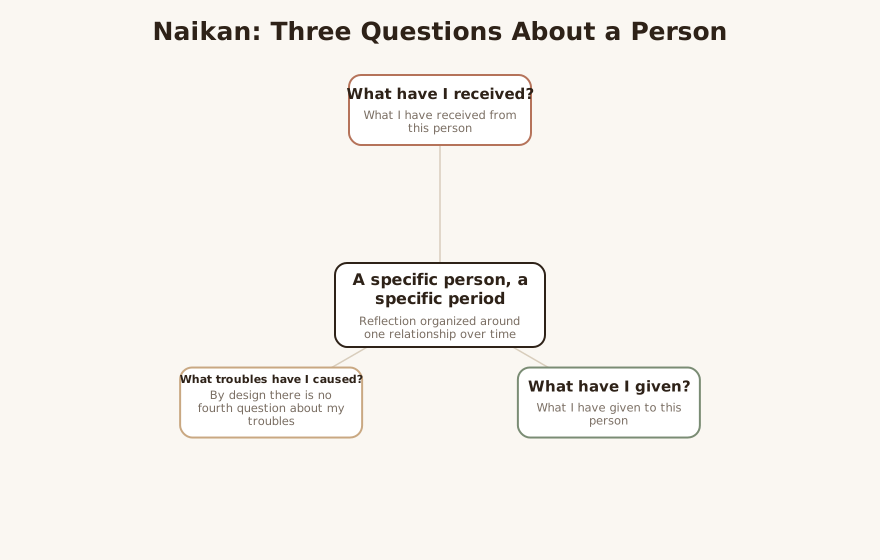
The structural heart of Naikan is three questions, asked about a specific person over a specific period of time: What have I received from this person? What have I given to this person? What troubles and difficulties have I caused this person? 1 These three questions are the load-bearing element of the entire method, and almost everything else is scaffolding around answering them honestly and concretely 1.
The deliberate design feature most worth noting clinically is the asymmetry built into the third question 3. Naikan asks what troubles I have caused others, but it pointedly does not include a fourth question about the troubles others have caused me 3. This is intentional: most of us already keep a detailed, well-rehearsed ledger of how others have wronged us, so the practice does not need to reinforce that account and instead corrects the imbalance by directing attention to the other side of the ledger 3. The aim is not self-flagellation but a more accurate and complete accounting of one’s actual web of relationships 1.
A second core principle is specificity and concreteness 1. Naikan resists vague generalities (“my mother loved me”) in favor of concrete, itemized recollections (the meals cooked, the laundry washed, the rides given), because the felt sense of having received is built from particulars, not abstractions 1. A third principle is that the self is fundamentally relational and supported rather than self-made; the cumulative effect of the three questions is to dismantle the illusion of the self-sufficient individual and to surface how much one has been given and how much one’s existence depends on others 6. The emotional outcome the practice is designed to produce is genuine gratitude, often accompanied by a softening of resentment and a more honest reckoning with one’s own conduct 4.
Interventions & Techniques
The most intensive form is intensive Naikan (sometimes called residential or shudan Naikan), traditionally conducted over about a week, often seven days, in a retreat-like setting 2. The participant sits in relative isolation, frequently in a quiet space partially screened off by a folding screen, and spends long hours each day reflecting on the three questions, typically working chronologically through their relationship with their mother first, then father, then other significant people across successive periods of life 2. At regular intervals, a guide or facilitator (the mensetsusha) comes to the participant, bows, and listens without judgment as the participant reports what they have reflected on; the interview is brief, structured, and non-interpretive, and then the guide withdraws and reflection resumes 2.
The more portable form, and the one most relevant to outpatient clinicians, is daily Naikan (sometimes nichijo Naikan), a brief reflective practice the client performs at home, often at the end of each day 1. In daily Naikan the person reviews the day through the three questions, frequently in writing, asking what they received, what they gave, and what troubles they caused 1. Krech and others teach several accessible variations of this, including reflecting on a single relationship, on an ordinary object one habitually uses, or on a specific past period, as a way of training the mind to notice the constant, unacknowledged flow of support one receives 5.
LLM-generated illustrative example (not a guideline): A clinician introduces daily Naikan as a between-session practice for a client stuck in resentment toward a co-parent. Each evening the client writes three short lists about that day’s interactions with the co-parent: what was received (the child was picked up on time; a text about the school form), what was given (sent the medication, said thank you), and what troubles the client may have caused (replied curtly, arrived ten minutes late). Over two weeks the client reports the co-parent “isn’t only the villain in the story anymore,” which opens room for the session work LLM.
Reflection on concrete objects and on the natural and social systems that sustain daily life is a recognized Naikan technique, used to make the abstract idea of interdependence experientially vivid 6. The non-judgmental, witness-style interview is itself a technique: the guide does not analyze, advise, or reframe, but simply receives the report, which models a stance of acceptance that the client is meant to internalize toward their own history 2.
Evidence Base
Naikan’s evidence base should be described to clients and supervisees honestly. As a practice, Naikan is well-established and has a long institutional history in Japan, where it has been applied for decades in clinical, correctional, educational, and occupational settings 2. That longevity and breadth of use is real and meaningful, and it is the primary sense in which the method is “established” 2.
However, established use is not the same as a robust modern controlled-trial literature, and clinicians should not overstate the empirical case LLM. The accessible English-language sources present Naikan largely through explanatory, contemplative, and practitioner-oriented framings rather than through randomized controlled trials, and they emphasize its conceptual lineage and its kinship with gratitude and mindfulness interventions more than quantified outcome data 1. The strongest indirect support comes from adjacent literatures: structured gratitude practices and mindfulness-based approaches, to which Naikan is closely related, have a substantially larger Western evidence base, and Naikan can reasonably be understood as a structured, relationally targeted gratitude intervention 1. The honest summary for clients is therefore: a long-established practice with a strong rationale and a credible mechanism, but a thin modern controlled-trial base in the West, so it is best used as an adjunct rather than a primary, first-line treatment for a serious disorder LLM.
Populations & Indications
Naikan has been applied across a wide range of populations, and the provided literature and its institutional history point to several where it is most clearly indicated 2. It is fundamentally an adult practice that depends on the capacity for sustained, honest self-reflection, so it fits motivated adults seeking deeper self-examination and meaning particularly well 1. People in recovery from substance use are a notable population, both because of Naikan’s historical use in correctional and rehabilitative settings and because its accountability-and-gratitude structure aligns with the relational repair central to recovery 2.
It is well suited to clients struggling with resentment, guilt, and interpersonal or relationship conflict, because the three questions directly target the lopsided ledger that maintains those states 3. Clients reporting low gratitude, chronic self-centeredness, or a felt sense that their lives are joyless despite adequate circumstances are natural candidates, since the practice is explicitly designed to surface unnoticed support and generate gratitude 4. People grappling with existential concerns and questions of meaning may also benefit, given the practice’s contemplative and Buddhist framing of interdependence and grace 5. For Japanese and Japanese-heritage clients, Naikan can carry the added value of cultural congruence, offering a healing framework rooted in their own tradition rather than an imported Western one LLM.
Problems-for-Work
Resentment and a one-sided grievance narrative. The third question (troubles I have caused) plus the deliberate omission of a “what others did to me” question directly counterbalances rumination on being wronged 3. A client looping on a parent’s failures is asked to also itemize what that parent provided, and the resulting fuller picture loosens the grip of the grievance 3.
Guilt without repair. For clients carrying diffuse guilt, the structure converts vague self-blame into a specific, bounded accounting of what was received, given, and caused, which can move guilt toward concrete amends rather than self-punishment 1.
Substance use and recovery. Naikan’s accounting of harms caused and support received maps onto the relational repair and accountability work of recovery, and it has historical roots in rehabilitative settings 2.
Low gratitude and anhedonic flatness. By forcing attention to the constant, itemized flow of what one receives, daily Naikan functions as a structured gratitude intervention for clients who report joylessness despite adequate circumstances 4.
Relationship conflict and interpersonal problems. Applying the three questions to a partner, co-parent, or estranged family member reorganizes the client’s view of the relationship from a one-sided to a reciprocal account 1.
LLM-generated illustrative example (not a guideline): A client in early sobriety uses intensive-style reflection on his relationship with his sister across the years of his active addiction. Working the third question concretely (missed her wedding toast, borrowed and never repaid money, frightened her with late-night calls) he arrives, for the first time, at specific amends he wants to make rather than the global shame that had been keeping him stuck LLM.
Contraindications, Cautions & Cultural Humility
The clearest caution concerns the third question. In clients prone to harsh self-criticism, depressive rumination, or self-blame, repeatedly cataloguing the troubles one has caused others can deepen guilt and self-attack rather than producing the intended balanced gratitude LLM. Because the literature presents Naikan as established practice rather than as a controlled-trial-validated treatment for severe disorders, it should not be substituted for evidence-based first-line care in acute depression, active suicidality, trauma with significant dissociation, or acute psychosis, and intensive isolated reflection in particular may be destabilizing for such clients LLM. Naikan is best positioned as an adjunct within a broader, monitored treatment plan rather than a stand-alone intervention for serious pathology LLM.
Cultural humility cuts in two directions. Naikan is a Japanese, Buddhist-derived practice, and clinicians outside that tradition should avoid stripping it of context, misrepresenting its lineage, or presenting an improvised version as authentic Naikan; acknowledging its origins and Yoshimoto’s debt to Buddhist self-examination is a matter of basic respect 2. At the same time, the practice’s emphasis on what one has received and the troubles one has caused can land very differently across cultures and power dynamics; for clients in oppressive, abusive, or systemically unjust situations, an uncritical focus on one’s own faults and on gratitude can pathologize legitimate grievance and reinforce harmful self-blame, so the clinician must hold the client’s real circumstances alongside the practice LLM. The practice’s spiritual framing should also be offered, not imposed, and adapted to the client’s own worldview 5.
Treatment-Plan Suggestions & SMART Objectives
| Goal | SMART objective (example) | Mechanism |
|---|---|---|
| Reduce resentment toward a specific person | Client completes the three Naikan questions about one identified relationship for 10 minutes nightly, 5 of 7 days/week, for 3 weeks, and reports shift in narrative balance | Asymmetric attention counters one-sided grievance ledger 3 |
| Increase felt gratitude | Client records 3 concrete things received each day, 6 of 7 days, for 4 weeks, with weekly review in session | Itemized noticing of received support generates gratitude 4 |
| Convert diffuse guilt into repair | Client itemizes specific troubles caused to one person and identifies 2 concrete amends within 4 weeks | Concrete accounting replaces global self-blame with bounded action 1 |
| Support relational repair in recovery | Client applies the three questions to one relationship harmed during active use, weekly, for 6 weeks | Accountability-and-gratitude structure aligns with recovery repair 2 |
| Reduce self-centered framing | Client practices daily Naikan reflection on an everyday object/support each day for 2 weeks and journals the interdependence noticed | Reflection on received support dismantles self-made-self illusion 6 |
| Improve perspective in relationship conflict | Client and clinician review one partner-focused Naikan reflection per session for 4 sessions | Reciprocal accounting reorganizes one-sided relational view 1 |
| Build a sustainable reflective habit | Client establishes a 5-minute end-of-day Naikan review, 5 days/week, sustained for 6 weeks | Daily structured introspection trains habitual gratitude attention 1 |
Common Misconceptions
A frequent misconception is that Naikan is simply “thinking positively” or generic gratitude journaling 1. In fact it is a precise, structured method built on three specific questions applied to specific relationships, and its distinctive power comes partly from the omission of a grievance question rather than from positivity per se 3. A second misconception is that the third question makes Naikan a guilt-inducing or self-punishing practice; the intended outcome is balanced, accurate self-understanding and gratitude, not shame, and the method assumes the client already over-attends to being wronged 3.
A third misconception is that Naikan must be done as a week-long retreat to count; in reality the brief daily form is a legitimate and widely taught practice suitable for ordinary outpatient life 1. A fourth is that it is purely a religious or strictly Buddhist ritual; while it has Buddhist roots and Krech presents it within a Buddhist path, Yoshimoto deliberately secularized it from the harsher ascetic mishirabe, and it is practiced in secular clinical, correctional, and occupational settings 2. Finally, some assume it is interchangeable with Morita therapy; the two are related Japanese psychotherapies often taught together but are distinct in method and aim 2.
Training & Certification
There is no single universally recognized licensing body or formal certification that gates the practice of Naikan in the way Western clinicians may expect for a branded therapy LLM. The practice has historically been transmitted through Naikan centers in Japan and through teachers who studied within that lineage, with David K. Reynolds and later Gregg Krech serving as primary bridges to the English-speaking world 2. Krech’s organization and writings, including his book and recorded dharma talks, are accessible entry points for clinicians wanting structured instruction in both the daily and intensive forms 4.
A reasonable training pathway for a Western clinician is to first study the method through the primary accessible texts and talks, ideally undertake the practice personally (including, where feasible, an intensive Naikan experience), and only then introduce it to clients, framed honestly within one’s existing licensed scope and modalities 5. Personal practice is especially important here because Naikan’s effects are experiential and hard to convey credibly to clients without firsthand familiarity 6.
Key Terms
Naikan — Japanese for “inside-looking” or introspection; the structured self-reflection method itself 1. The three questions — What have I received from X? What have I given to X? What troubles/difficulties have I caused X? — the core of the practice 1. Mishirabe — the intensive Buddhist self-examination practice from which Yoshimoto derived and secularized Naikan 2. Intensive (residential) Naikan — the week-long, isolated, retreat form with periodic facilitator interviews 2. Daily Naikan — the brief, often written, end-of-day reflective form suitable for ongoing outpatient use 1. Mensetsu / mensetsusha — the structured, non-interpretive interview and the guide who conducts it 2. Morita therapy — the other major indigenous Japanese psychotherapy, related to and often taught alongside Naikan 2.
Resources & Further Reading
▶ Watch — a video introduction to this concept:
- Naikan Therapy: Applying the Japanese Art of Self-Reflection — PositivePsychology.com
- Naikan — Wikipedia
- How to Practice Naikan Therapy — Tricycle: The Buddhist Review
- Naikan: Gratitude, Grace, and the Japanese Art of Self-Reflection — Gregg Krech (book)
- The Japanese Art of Self-Reflection with Gregg Krech — Tricycle Dharma Talk
- Gregg Krech, “Naikan: Gratitude, Grace and the Buddhist Art of Self-Reflection” (2018) — YouTube
Reflective / Supervision Questions
- When I introduce Naikan’s third question to a self-critical or depressively ruminating client, how will I monitor for deepening guilt rather than balanced insight, and what is my plan if it tips the wrong way? LLM
- Am I representing Naikan’s lineage and Buddhist roots honestly to my client, or have I quietly repackaged it as generic gratitude journaling? 2
- For this particular client’s circumstances, does an emphasis on “troubles I have caused” and gratitude risk pathologizing a legitimate grievance or excusing a genuinely harmful situation? LLM
- Within which of my actually-billable, evidence-based modalities am I delivering this technique, and is my documentation clear about that framing? LLM
- Have I practiced Naikan myself enough to teach it credibly, and how is my own relationship to gratitude and grievance shaping how I present it? 6
- How honestly am I communicating the evidence status — an established practice with a strong rationale but a thin modern controlled-trial base — when I propose it to a client? 1