
Type & Discipline
Modified Labeling Theory (MLT) and its successor, the Stigma Components Model, are explanatory theories drawn from sociology, specifically the subfield of medical sociology and the sociology of mental health 1. They are not therapeutic modalities; they are conceptual frameworks that explain how and why stigma harms people who carry a deviant or illness label, and they belong to the broader family of stigma theory 3. For practicing therapists, their value is diagnostic and orienting rather than procedural: they name a mechanism — the social processing of a label — that frequently underlies the demoralization, withdrawal, and treatment avoidance clinicians observe in stigmatized clients LLM.
The discipline matters here because it sets the level of analysis. Classical labeling theory locates the problem not in the individual’s behavior but in society’s reaction to that behavior 5. MLT inherits this sociological commitment but adds a psychological pathway, and the Stigma Components Model widens the lens further to include structural power 4. Clinicians used to thinking in intrapsychic terms should expect this literature to keep pointing outward — toward audiences, reactions, and resources — even as it explains inward-facing symptoms LLM.
Creators & Lineage
The intellectual lineage begins with the labeling theory of deviance developed in the 1960s by sociologists such as Howard Becker, Edwin Lemert, and Thomas Scheff, who argued that deviance is not a quality of the act but a consequence of others applying rules and sanctions to an “offender” 6. Lemert’s distinction between primary deviance (the original behavior) and secondary deviance (behavior that results from being labeled and treated as deviant) is foundational, as is the idea that a deviant label can become a “master status” that overrides all other social identities 5. Applied to psychiatry, Scheff’s strong claim was that labeling could itself be a primary cause of chronic mental illness 6.
That strong claim drew sustained criticism, most notably from Walter Gove, who argued that psychiatric symptoms, not labels, drive outcomes 6. Bruce Link and Jo Phelan’s Modified Labeling Theory was the response that rescued the insight while conceding the criticism: they agreed that labeling does not cause mental disorder, but argued it still produces real and damaging consequences through socialization and internalized expectations 4. Link and Phelan then authored the field’s most cited synthesis, the 2001 Annual Review of Sociology paper “Conceptualizing Stigma,” which advanced the Stigma Components Model and is the canonical reference for this entry 1. Their later work, including “Stigma and Status,” integrated stigma with theories of status and power 4. Erving Goffman’s 1963 Stigma — defining stigma as an attribute that is “deeply discrediting” and reduces the bearer “from a whole and usual person to a tainted, discounted one” — is the other indispensable forebear 3.
Core Principles
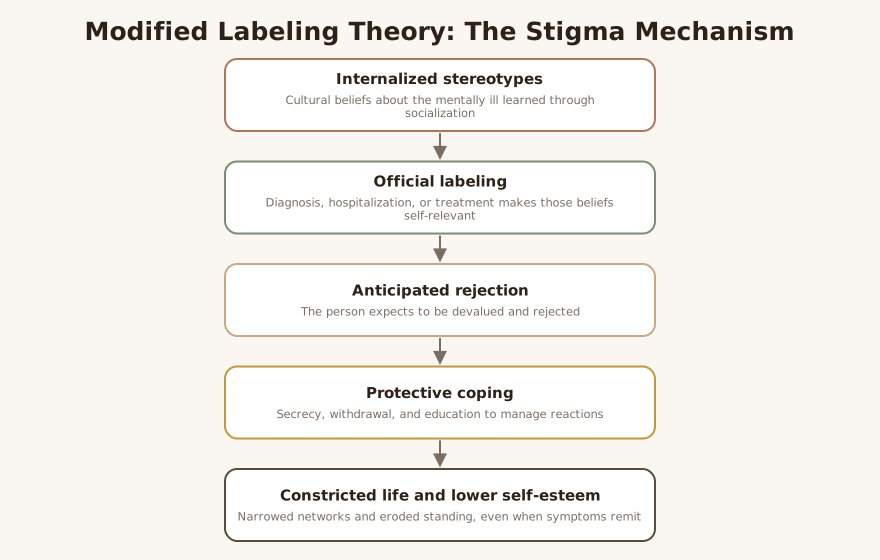
Modified Labeling Theory rests on a developmental, expectations-based mechanism. Through ordinary socialization, people internalize cultural conceptions of what it means to be a “mental patient” long before they ever become one 4. When a person is then officially labeled — through diagnosis, hospitalization, or treatment — those pre-existing beliefs about how “others” will devalue and reject the mentally ill suddenly become personally relevant and self-referential 4. The individual anticipates rejection, and this anticipation drives protective coping responses: secrecy (concealing treatment history), withdrawal (limiting contact to “safe” others), and education (preemptively trying to manage others’ reactions) 4. These strategies, though defensive, tend to constrict social networks, undermine employment and relationships, and erode self-esteem — producing exactly the disadvantage the person feared, regardless of clinical symptoms LLM.
The Stigma Components Model generalizes this into a definition of stigma as the co-occurrence of five interrelated components 1. First, people distinguish and label human differences, selecting which differences will count as socially salient 1. Second, dominant cultural beliefs stereotype the labeled persons by linking them to undesirable characteristics 1. Third, labeled persons are placed in distinct categories so as to accomplish a degree of separation of “us” from “them” 1. Fourth, labeled persons experience status loss and discrimination that lead to unequal outcomes 1. The model’s decisive contribution is the fifth condition: stigmatization is entirely contingent on access to social, economic, and political power that allows the components to unfold 1. Without a power differential, the same processes (one group labeling and stereotyping another) do not produce stigma in the consequential sense 1.
Interventions & Techniques
These theories do not prescribe a technique manual, but they generate clear targets for intervention, and clinicians can translate each component into therapeutic work LLM. Because the harm proceeds through internalized expectations of rejection, a primary target is the cognitive-affective layer: helping clients notice, articulate, and test the catastrophic predictions about how others will respond to their label LLM. This dovetails naturally with cognitive restructuring and behavioral experiments drawn from established modalities, where avoidance and secrecy are treated as maintaining factors rather than necessary protections LLM.
A second technique cluster targets the coping responses MLT identifies. Because secrecy and withdrawal are central mediators of harm, graded disclosure work — deciding what to share, with whom, and to what end — directly addresses the mechanism rather than only the mood 4. The model also legitimizes externalizing and consciousness-raising approaches: naming status loss and discrimination as real social facts, not personal failings, can interrupt the self-blame that fuses the deviant label to a master status 5. Finally, because the Stigma Components Model foregrounds power, interventions that rebuild status and social capital — peer support, advocacy, vocational re-engagement — are theoretically coherent responses, not merely adjuncts 1.
LLM-generated illustrative example (not a guideline): A client recently discharged after a first psychiatric hospitalization declines a job offer, telling the clinician, “They’ll find out and let me go anyway.” The clinician frames this aloud as anticipated rejection (an MLT prediction), then collaboratively designs a behavioral experiment: returning one work-related email to test, in a low-stakes way, whether the feared rejection actually occurs. LLM
Evidence Base
The maturity of this body of work is best described as established within sociology: the Stigma Components Model is among the most widely cited frameworks in the field, and Modified Labeling Theory has accumulated decades of supporting observational research 1. The evidence is strongest for the consequences of labeling and stigma — reduced self-esteem, network constriction, demoralization, and disadvantage — and for the claim that these effects are at least partly independent of symptom severity 4. This was MLT’s original empirical wedge: it demonstrated that stigma-related harms persist even after accounting for psychopathology, answering Gove’s objection without resurrecting Scheff’s overreach 4.
Clinicians should hold the evidence honestly. These are sociological theories validated largely through survey and observational designs, not randomized trials of an intervention; they explain a pathway of harm rather than certify a treatment 1. The frameworks themselves acknowledge limitations — Link and Phelan note that stigma research had often been individualistic and decontextualized, which is precisely why they reintroduced power as a constitutive condition 1. The strong original labeling claim that societal reaction causes enduring mental illness is not well supported and was substantially abandoned in the modified version 6. What is robust is the more modest, more useful claim: labeling and stigma independently worsen the lives of already-affected people 4.
Populations & Indications
The frameworks were developed primarily with people who have serious mental illness and psychiatric service users, and that remains the population where the evidence is densest 4. They are highly indicated whenever a client carries a socially devalued, concealable-or-visible status that shapes how others respond to them 1. This includes people with substance use disorders, for whom moralized stereotypes and “us/them” separation are especially pronounced, and people with chronic illness whose conditions invite devaluation LLM.
The Stigma Components Model’s emphasis on power makes it equally applicable to stigmatized minority groups, where labeling, stereotyping, and separation are embedded in durable status hierarchies 1. The indication is not the diagnosis per se but the social predicament: a client whose distress is organized around anticipated or experienced rejection, concealment, and status loss is a strong fit for case conceptualization through this lens LLM. Conversely, where a client’s difficulties have little to do with social devaluation, the framework adds less and should not be forced LLM.
Problems-for-Work
The theories map cleanly onto a set of recurring clinical problems-for-work, each traceable to a specific component of the model LLM. Internalized stigma and self-stigma arise when the labeled person turns culturally shared stereotypes against the self; the work is to separate the social label from self-worth 4. Social withdrawal and social isolation are the behavioral signature of anticipated rejection; the work is to test predictions and gradually re-expand the network 4.
LLM-generated illustrative example (not a guideline): A client with an opioid use disorder has stopped attending family gatherings, saying “they look at me like I’m the addict now.” The clinician identifies this as status loss plus separation (“us/them”), and works on one bounded re-entry — attending a single short family meal with an exit plan — to interrupt the isolation spiral. LLM
Demoralization and low self-esteem follow from status loss and repeated devaluation, and respond to work that restores agency and reframes setbacks as discrimination rather than deficiency 5. Treatment avoidance is itself a stigma effect — people avoid care to avoid the label — making the therapeutic alliance both the intervention and the thing at risk 4. Discrimination-related distress is addressed by validating the reality of unequal treatment while building coping and, where possible, collective or advocacy responses 1.
Contraindications, Cautions & Cultural Humility
There are no contraindications to using this lens for case conceptualization, but there are cautions in how it is applied LLM. The chief risk is overextension: the discredited strong-labeling claim that diagnosis causes chronic illness can, if revived carelessly, lead clinicians to under-treat genuine psychopathology in the name of avoiding “labeling” 6. MLT explicitly rejects this; it holds that labels harm in addition to, not instead of, illness, and treatment should not be withheld on anti-label grounds 4.
A second caution concerns invalidation in the other direction. Telling a client that their experienced discrimination is “just a cognitive distortion” misuses the theory and re-stigmatizes; the model insists that status loss and discrimination are real social facts grounded in power 1. Cultural humility is therefore intrinsic to the framework rather than an add-on: because stigma operates through who holds social, economic, and political power, the clinician must attend to the client’s actual position in those hierarchies and to the clinician’s own 1. What counts as a stigmatizing label, and how severe its consequences are, varies across communities, so the meaning of a diagnosis should be explored with the client rather than assumed LLM.
Treatment-Plan Suggestions & SMART Objectives
| Goal | SMART objective (example) | Mechanism |
|---|---|---|
| Reduce internalized stigma | Within 8 weeks, client will verbalize 3 distinctions between the diagnostic label and personal identity, rated weekly | Decouples self-worth from internalized stereotype 4 |
| Decrease social withdrawal | Within 6 weeks, client will initiate 2 planned social contacts per week and log the actual (vs. predicted) response | Tests anticipated-rejection predictions that drive avoidance 4 |
| Build adaptive disclosure | Within 4 weeks, client will develop a written disclosure plan specifying what, to whom, and why for 1 relationship | Replaces blanket secrecy with selective, goal-directed sharing 4 |
| Counter demoralization | Within 8 weeks, client will reframe 2 recent setbacks as discrimination/status loss rather than personal deficiency, in session | Interrupts self-blame from repeated devaluation 5 |
| Reduce treatment avoidance | Over 12 weeks, client will attend ≥80% of scheduled sessions and name 1 stigma-related barrier each time it arises | Surfaces label-avoidance as a maintaining factor 4 |
| Restore status and social capital | Within 12 weeks, client will engage 1 peer-support or vocational activity and attend ≥3 times | Rebuilds standing eroded by status loss 1 |
| Manage discrimination-related distress | Within 6 weeks, client will apply 2 coping responses to a documented discriminatory event without disengaging from goals | Validates real inequity while preserving agency 1 |
Common Misconceptions
The most persistent misconception is that labeling theory claims diagnoses cause mental illness; the modified theory explicitly does not, holding instead that labeling worsens outcomes for people who are already ill 4. A related error is the belief that the solution is simply to stop diagnosing — but the model targets the social processing of labels and the power behind it, not the clinical act of naming a condition 1. Clinicians sometimes assume the theory is purely psychological (about self-esteem); in fact its defining move is sociological, insisting that stigma cannot exist without a power differential 1.
Another misconception is that stigma is a single attribute or feeling rather than a process; the Stigma Components Model deliberately reframes it as the co-occurrence of five distinct components, which is why interventions targeting only one (e.g., self-esteem) often underperform 1. Finally, some read the theory as letting individual behavior off the hook entirely; the more defensible reading distinguishes the original behavior (primary deviance) from the cascade produced by society’s reaction (secondary deviance), without denying either 5.
Training & Certification
There is no certification in Modified Labeling Theory or the Stigma Components Model, because these are scholarly frameworks rather than proprietary or manualized treatments LLM. Competence is acquired through reading the primary sociological literature — above all Link and Phelan’s “Conceptualizing Stigma” — and through graduate coursework in medical sociology, sociology of mental health, or social work 1. Clinicians most often encounter the constructs operationalized within anti-stigma program training, peer-support models, and recovery-oriented practice LLM. The appropriate path for a practicing therapist is to integrate the lens into existing, separately-credentialed modalities rather than to seek a standalone credential LLM.
Key Terms
- Modified Labeling Theory (MLT): Link and Phelan’s revision holding that labeling does not cause mental illness but produces real harm through internalized expectations of rejection 4.
- Stigma Components Model: The framework defining stigma as the co-occurrence of labeling, stereotyping, separation, status loss, and discrimination within a context of power 1.
- Primary vs. secondary deviance: Lemert’s distinction between the original behavior and the further deviance produced by being labeled and treated as deviant 5.
- Master status: A label so dominant it overrides a person’s other social identities 5.
- Status loss: Downward movement in the social hierarchy that follows from being labeled and stereotyped 1.
- Power dependence: The model’s claim that stigmatization can only occur where one group holds the social, economic, and political power to enact it 1.
Resources & Further Reading
▶ Watch — a video introduction to this concept:
- Conceptualizing Stigma — Link & Phelan, Annual Review of Sociology (2001)
- Conceptualizing Stigma — full-text PDF (Montefiore Einstein)
- Labeling and Stigma (Ch. 29) — Handbook for the Study of Mental Health, Cambridge
- Stigma and Status: The Interrelation of Two Theoretical Perspectives — PMC
- Labeling Theory — Simply Psychology
- Labeling theory — Wikipedia
Reflective / Supervision Questions
- For a current client, which of the five stigma components (labeling, stereotyping, separation, status loss, discrimination) are most active, and how would naming them aloud change the case formulation? LLM
- Where might I be treating a client’s accurate report of discrimination as a cognitive distortion, and what would it look like to hold both the social reality and the maladaptive coping at once? LLM
- How do my own diagnoses and documentation participate in the labeling process, and what would harm-reducing labeling practice look like in my notes and my language? LLM
- When a client avoids treatment, how often do I consider label-avoidance (stigma) versus ambivalence or symptom severity as the driver, and how could I check? LLM
- Given the model’s emphasis on power, what do I actually know about this client’s standing in their relevant social, economic, and cultural hierarchies, and how does my own position shape the alliance? LLM