
Type & Discipline
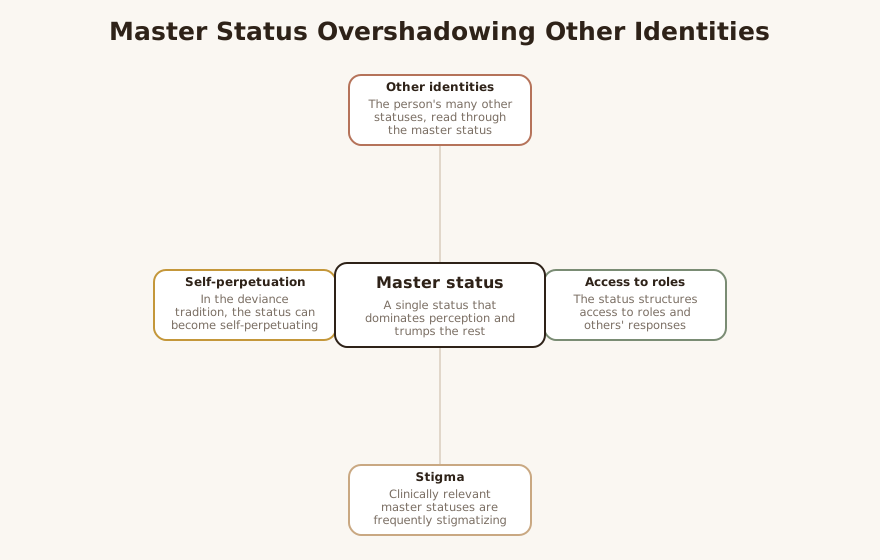
Master status is a sociological construct, not a treatment, diagnosis, or therapeutic modality 1. It originates in sociology, within the symbolic-interactionist tradition and the sociology of deviance, and it names a feature of how identity is socially perceived rather than prescribing any intervention 3. A master status is a single status that dominates how a person is perceived, overshadowing all of their other statuses and organizing the way others respond to them 1. The classic clinical-adjacent examples are labels such as “schizophrenic,” “ex-con,” or “addict,” each of which can define a person in the eyes of others so completely that their other roles — parent, worker, neighbor, friend — recede into the background 1.
For a practicing therapist, the value of master status is not that it is something one delivers in session, but that it supplies a precise vocabulary for a recognizable mechanism of stigma: the collapse of a whole person into a single, usually devalued, identity marker LLM. Because it is a descriptive construct rather than a modality, it informs how a clinician reads the experience of a client who feels reduced to a diagnosis, a record, or a condition, rather than constituting a therapy in itself LLM. Its central claim is that not all statuses carry equal weight; one can become so salient that it functionally overrides every other status a person holds 3.
Creators & Lineage
The concept was developed by the American sociologist Everett C. Hughes, who introduced “master status” (often paired with “master status-determining trait”) in his work on the social organization of statuses, most influentially in the mid-1940s 2. Hughes’s paradigmatic concern was the way certain ascribed characteristics, such as race, could override achieved statuses such as professional standing, so that being identified as a member of a racial group could dominate perception even of a person who had attained a respected occupation 2. He observed that every status tends to carry a set of expected “auxiliary” traits, and that when a person’s master status conflicts with those expectations, the contradiction produces social friction and exclusion 2.
The construct’s most consequential extension came through the sociology of deviance and labeling theory LLM. Howard S. Becker, in Outsiders, adapted Hughes’s idea to argue that the label “deviant” can itself function as a master status: once a person is publicly identified and treated as a deviant, that label tends to override their other identities and to control how others interpret everything else about them 4. His analysis of “career deviance” describes how being caught and labeled can set in motion a self-reinforcing trajectory, because the master status of “deviant” closes off conventional opportunities and pushes the person toward the very behavior the label names 4.
Master status therefore sits at the intersection of several mid-twentieth-century traditions concerned with how social settings construct and degrade identity LLM. It is a near-relative of Erving Goffman’s theory of stigma, which describes the same reduction of a person to a discrediting attribute, and it is structurally allied with labeling theory, symbolic interactionism, and social role theory 1. That it remains a standard entry in sociological reference works and continues to be taught and applied marks it as established and durable, though it is an explanatory construct rather than a settled empirical law 7.
Core Principles
The first principle is that statuses are not equal in their power to organize perception 5. A person occupies many statuses at once, but in any given interaction one of them can become dominant, coloring how all the others are read; the master status is the one that “trumps” the rest and becomes the lens through which the person is seen 1. The construct insists that this dominance is a social fact, produced in interaction and in the surrounding culture, rather than a property of the individual alone 5.
The second principle is that a master status can be ascribed or achieved, and that the most clinically relevant ones are frequently stigmatizing LLM. Hughes’s original cases centered on ascribed traits such as race that the person did not choose, while later applications emphasized acquired labels — “ex-offender,” “addict,” “mental patient” — that operate with the same overriding force 2. In each case the defining feature is the same: the status organizes others’ responses, structures access to roles, and is difficult for the person to set aside at will 4.
The third principle, drawn from the deviance tradition, is that a master status can become self-perpetuating 4. Once a label takes hold and shapes how others treat the person, it constrains their options and can pull them toward confirming the label — the dynamic Becker traced in deviant careers, and the mechanism behind what clinicians recognize as a self-fulfilling prophecy 4. Importantly, the construct locates the engine of this process in social response, not in any inherent quality of the labeled person, which is why it is useful as a non-pathologizing lens LLM.
Interventions & Techniques
Because master status is a sociological construct rather than a therapy, there are no “master-status techniques”; it works by shaping formulation and is operationalized through recognized modalities LLM. The first practical move is recognition — noticing when a client has come to experience themselves, or to be treated, as fundamentally and only their diagnosis, record, or condition, so that “I’m an addict” functions less as a description of one part of life than as a totalizing identity LLM. The construct gives the clinician a name for this collapse and a way to mark it as a social process acting on the client rather than a true account of who they are 1.
A second move is externalizing and separating the person from the label, which maps closely onto narrative practice LLM. Where a master status fuses the person with a single attribute, the task is to loosen that fusion — to help the client articulate the many statuses the label has overshadowed and to author an identity in which the stigmatized status is one strand among several LLM. A third move is anticipating the social field: because a master status lives in the responses of others, work often includes rehearsing how the client will manage disclosure and counter the self-fulfilling pull of being treated as the label predicts 4. These moves are delivered through the clinician’s primary modality; the construct supplies the why and what to look for, while the modality supplies the how LLM.
LLM-generated illustrative example (not a guideline): A client in early recovery says she has stopped attending her daughter’s school events because “everyone there just sees the addict.” Using the master-status frame, the clinician names how a single stigmatized status has overshadowed her standing as a mother, neighbor, and employee, and structures the work toward re-asserting those identities — not by denying the substance use history, but by refusing to let it be the only true thing about her LLM.
Evidence Base
The honest appraisal is that master status is an established sociological construct — a standard, durably cited idea in the sociology of identity and deviance — but it is a conceptual framework, not an intervention with its own outcome trials LLM. Its continued citation and inclusion in reference works is the form “evidence” takes for a construct of this kind: explanatory reach rather than randomized efficacy data 7. Its empirical lineage is qualitative — Hughes’s analyses of status and Becker’s ethnographic studies of labeling and deviant careers — which is rich for theory-building but interpretive rather than experimental 4.
What gives the construct clinical traction is its convergence with adjacent, better-studied work LLM. The closely related phenomena of stigma and internalized stigma have a substantial empirical literature in mental health and chronic illness, and master status offers a clean mechanism — totalizing reduction to one status — for effects those literatures document LLM. Two implications follow LLM. First, master status should be offered as a map of how a stigmatized label can take over identity, not as a validated treatment for any disorder LLM. Second, its reliability is greatest as a formulation heuristic and weakest if applied as though every salient identity were necessarily damaging; the same status that wounds one client can be a source of pride for another, and the construct does not by itself tell you which LLM.
Populations & Indications
The construct’s natural populations are people who carry a socially salient, frequently stigmatized status that others use to define them 1. It maps directly onto common clinical presentations among people with mental illness, for whom a psychiatric diagnosis can become the lens through which clinicians, family, and the person themselves read everything else 1. It applies to individuals with criminal records and ex-offenders, for whom the label “ex-con” can override employment history and family role long after release, and to people with substance use disorders, for whom “addict” can function as a totalizing identity 4. People with stigmatized chronic illness, such as HIV, encounter the same dynamic when a diagnosis becomes the first thing others see LLM.
The construct is also indicated for understanding the experience of racial and ethnic minorities and of disabled individuals, where an ascribed characteristic can override achieved statuses in exactly the way Hughes described, structuring access to opportunity and shaping daily interaction 2. A clinically important application appears in the domestic and sexual violence field, where being identified as a “victim” or “survivor” can itself become a master status that overshadows the rest of a person’s identity and affects how services, courts, and communities respond to them 6. The construct is most indicated when a client’s distress appears organized around being reduced to a single label rather than around a freestanding symptom cluster LLM.
Problems-for-Work
Master status maps onto a recognizable cluster of problems centered on the costs of being defined by one overshadowing status 1. Stigma is the core target: the construct names the precise mechanism by which a discrediting attribute comes to dominate perception, useful when a client reports being treated as their diagnosis or record 1. Internalized stigma follows when the client absorbs the external label and begins to see themselves through it, so that the master status becomes self-applied — a translation a clinician can help reverse by separating the person from the label LLM.
Discrimination, social marginalization, and social exclusion are the structural consequences — the closing-off of roles and opportunities that follows when others respond to the label rather than the person 4. Identity foreclosure and spoiled identity name the way a single status can crowd out a fuller self-concept, while shame and low self-esteem are the affective residue of being reduced to a devalued category 1. The self-fulfilling prophecy of deviance is the paradigmatic deviance-tradition application: being treated as a deviant can pull a person toward confirming the label, the dynamic Becker traced 4. Loss of social roles completes the cluster, naming the practical erosion of the parent, worker, or community-member identities the master status overshadows LLM.
LLM-generated illustrative example (not a guideline): A man returning from incarceration describes interviews where “the second they see the record, that’s all I am to them.” Formulated through master status, the clinician hypothesizes that the “ex-con” label is functioning as an overriding status that forecloses other identities, normalizes the discouragement, and orients the work toward both managing the external field and rebuilding a narrative in which the record is one chapter rather than the whole story LLM.
Contraindications, Cautions & Cultural Humility
The foremost caution is conceptual restraint: master status is a lens for understanding how a label can dominate identity, not a verdict to be pronounced over a client LLM. Telling someone “your illness has become your master status” risks reproducing the very reduction the construct critiques; the framing is most useful when offered as a shared way of understanding a felt experience rather than as a clinician’s label LLM. It must never displace differential diagnosis, risk assessment, and indicated evidence-based care, and where a client’s distress is acute or dangerous, stabilization and safety take priority LLM.
A second caution is that not every salient identity is a wound LLM. A status that functions as a stigmatizing master status in one setting may, in another, be a source of pride and meaning, and many people who hold a stigmatized identity experience it as affirming rather than imposed LLM. Applying the construct as though every dominant identity were oppressive can pathologize identities the client values and substitute the clinician’s judgment for the client’s lived experience LLM.
A third caution concerns cultural humility and power LLM. The lived meaning of a master status is shaped by race, class, immigration status, gender, and history, and an ascribed status such as race operates very differently from an acquired label such as a diagnosis 2. In the violence and trauma field, whether being seen as a “victim” or “survivor” is experienced as overshadowing or validating depends on the person and context, and the clinician should not assume which 6. Cultural humility requires interpreting a client’s salient statuses against their own values, checking the clinician’s inference rather than asserting it, and remaining alert to the therapist’s own power in framing which identity counts as the “real” one LLM.
Treatment-Plan Suggestions & SMART Objectives
| Goal | SMART objective (example) | Mechanism |
|---|---|---|
| Recognize the label as a social process, not a true identity | Within 3 sessions, client will identify 2 settings where they are reduced to a single status and name the process as external labeling rather than fact | Relocates the cause from inside the person to social response, reducing shame 1 |
| Surface overshadowed identities | Over 4 weeks, client will list 5 roles or statuses the dominant label has eclipsed and describe one valued activity tied to each | Counters totalizing reduction by re-asserting a fuller self-concept 3 |
| Reduce internalized stigma | Within 8 sessions, client will reframe 3 self-critical statements that equate the whole self with the stigmatized status | Loosens the fusion of person and label that drives internalized stigma LLM |
| Interrupt the self-fulfilling pull of the label | Over 6 weeks, client will identify 2 situations where being treated as the label pushes them toward confirming it and rehearse an alternative response | Disrupts the deviant-career dynamic in which labeling produces the labeled behavior 4 |
| Manage disclosure and anticipated prejudice | Within 6 sessions, client will develop and practice 2 disclosure scripts for high-stakes settings (employment, family, services) | Gives the client agency over the social field where the master status operates 4 |
| Re-author identity narrative | Over 10 sessions, client will produce a written self-statement in which the stigmatized status is one strand among several | Rebuilds an identity foreclosed by spoiled-identity dynamics 1 |
| Rebuild eclipsed social roles | Within 12 sessions, client will re-engage 1 community role the label had caused them to withdraw from | Reverses the loss of social roles that follows marginalization LLM |
Common Misconceptions
A frequent error is treating master status as a synonym for “most important role”; the construct is specifically about a status that overrides and overshadows others in social perception, usually to the person’s disadvantage, not simply the role a person cares about most 3. A second misconception is that a master status is fixed and inherent to the person, when the construct locates its power in social response, which is why the same attribute can be overriding in one setting and unremarkable in another 1.
A third misconception is that master status is always a stigma; Hughes treated it as a structural feature of how statuses are organized, and while the clinically salient cases are typically stigmatizing, the construct itself describes dominance, not necessarily disgrace 2. A fourth is collapsing Hughes and Becker into a single idea — Hughes originated the construct around ascribed traits such as race overriding achieved standing, while Becker extended it to argue that the deviant label operates as a controlling master status, and the two should be kept distinct 4. Finally, master status is sometimes mistaken for a therapy one “does,” when it is a descriptive construct that informs interventions delivered through other modalities LLM.
Training & Certification
There is no certification in “master status”; the construct is foundational theory studied within sociology, social psychology, and the sociology of deviance rather than a credentialed clinical technique LLM. Clinicians typically encounter it through graduate coursework in the social context of mental health or stigma studies, where Hughes’s work on status and Becker’s Outsiders are the standard primary references 4. Accessible secondary summaries situate the construct, its origins, and its relationship to stigma and labeling for quick orientation 3.
For applied competence, the relevant training lives in the modalities that operationalize the frame — narrative and identity-focused therapy for separating the person from the label, and stigma- and trauma-informed approaches for the harms of being reduced to a devalued status LLM. Sector-specific resources, such as those in the domestic and sexual violence field, model how to apply the construct responsibly where a “victim” or “survivor” label can become overshadowing 6. Generalist therapists can legitimately use master status for formulation provided they represent its evidentiary status honestly and deliver care through modalities in which they are trained LLM.
Key Terms
Master status — a single status that dominates how a person is perceived, overshadowing all of their other statuses and organizing others’ responses to them 1. Master status-determining trait — Hughes’s term for a characteristic powerful enough to override the other statuses a person holds, such as an ascribed trait that trumps achieved standing 2. Auxiliary status traits — the cluster of expected characteristics conventionally attached to a status, whose violation by a person’s master status produces social friction and exclusion 2. Labeling theory — the sociological account, developed by Becker and others, of how social reaction to behavior, rather than the behavior itself, creates deviance 4. Career deviance — Becker’s model of how being labeled deviant sets in motion a self-reinforcing trajectory by foreclosing conventional opportunities 4. Spoiled identity — Goffman’s allied term for an identity discredited by a stigmatizing attribute, closely related to how a stigmatizing master status operates 1. Self-fulfilling prophecy of deviance — the dynamic in which being treated as the label predicts pulls a person toward confirming it 4. Internalized stigma — the process by which a person absorbs an external stigmatizing label and applies it to themselves LLM.
Resources & Further Reading
▶ Watch — a video introduction to this concept:
- Master status — Wikipedia
- The Origins and Evolution of Everett Hughes’s Concept: “Master Status” (The Anthem Companion to Everett Hughes, ch. 7)
- Master Status — Encyclopedia.com
- “Career Deviance” (excerpt from Howard S. Becker, Outsiders)
- Master Status: Its Dominance in Social Identity — Sociology.Institute
- Master Status Fact Sheet — VAWnet (National Resource Center on Domestic Violence)
- Master Status — Blackwell Encyclopedia of Sociology (DOI)
Reflective / Supervision Questions
- When a client describes feeling reduced to “the addict,” “the patient,” or “the record,” am I helping them separate the person from the label, or am I unintentionally reinforcing the overshadowing status 1?
- Whose judgment am I using to decide that a client’s salient identity is a wound rather than a source of meaning, and have I checked it against the client’s own experience LLM?
- Am I distinguishing an ascribed master status the client did not choose from an acquired label, and adjusting my formulation accordingly 2?
- Where a label seems to be pulling a client toward confirming it, can I help interrupt that self-fulfilling dynamic rather than treating the behavior as fixed character 4?
- In the violence and trauma context, am I assuming that being seen as a “victim” or “survivor” is overshadowing when the client may experience it as validating, or vice versa 6?
- In team or supervision discussions, am I noticing when a client is being discussed entirely through one status, and can I offer the master-status frame to widen the picture 3?