
Type & Discipline
Adaptive Disclosure (AD) is a brief, manualized, individual psychotherapy for military-related trauma, situated in clinical psychology within the family of trauma and moral injury treatments 4. It is trauma-focused and experiential, but it departs from the dominant cognitive-behavioral protocols by refusing to treat all war trauma as a single phenomenon 6. Its central move is diagnostic before it is technical: AD asks the clinician to first identify which kind of injury a service member is carrying, then to match the strategy to that injury 4. In its original form, AD comprises eight 90-minute sessions designed to “plant healing seeds” rather than deliver a fixed curative dose 6. A subsequently developed and tested enhanced version, Adaptive Disclosure–Enhanced (AD-E), runs to roughly twelve sessions and adds several components 1.
For practicing therapists, the useful framing is that AD sits alongside — not in opposition to — Prolonged Exposure and Cognitive Processing Therapy, sharing their commitment to confronting avoided material while arguing that fear-extinction logic is incomplete for guilt, shame, and grief 6LLM.
Creators & Lineage
Adaptive Disclosure was developed by Brett Litz and colleagues, with the foundational text authored by Brett Litz, Lila (Leslie) Lebowitz, Matt Gray, and William Nash, published by Guilford Press in 2016 4. William Nash, a former Navy psychiatrist, brought operational military experience to the conceptualization of moral injury, and Shira Maguen has been a central figure in the broader moral-injury research program from which AD draws LLM. The Litz Lab at Boston University remains the primary site of ongoing AD research and the source of the enhanced protocol 5.
Conceptually, AD descends from cognitive-behavioral exposure therapies but was built explicitly to address what its authors saw as their blind spots 6. The widely accepted manualized CBT-based treatments were designed around fear and danger; AD’s developers argued that loss and moral transgression generate distinct post-traumatic syndromes that require distinct mechanisms of change 6. The lineage therefore runs from classical exposure and emotional-processing theory, through the emerging moral-injury literature, into a hybrid that retains imaginal exposure but layers in meaning-making and corrective experiential dialogue 4LLM.
Core Principles
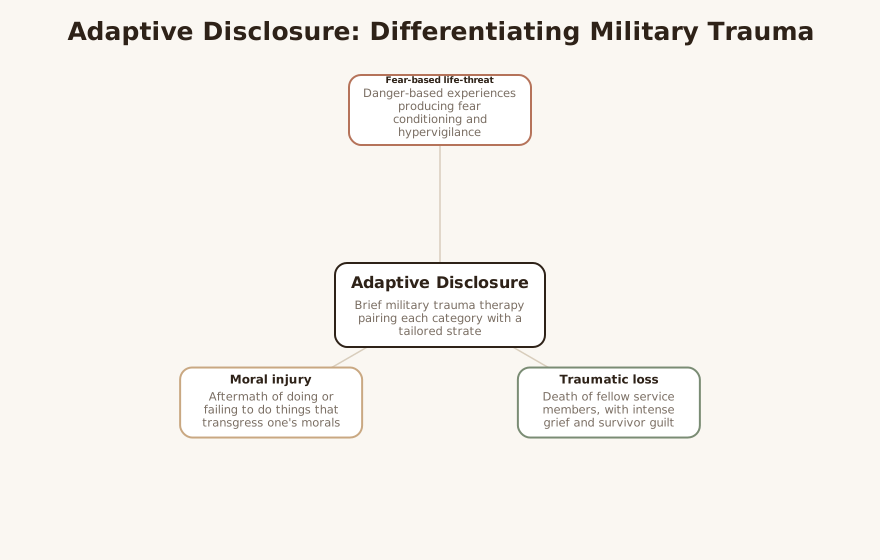
The organizing principle of Adaptive Disclosure is that combat-related trauma is not one thing. AD differentiates three categories, each with a different etiology and a different treatment need 46.
The first is fear-based, life-threat trauma — the danger-based experiences that produce classic fear conditioning and hypervigilant PTSD presentations 6. AD’s developers note that service members often assimilate these expected occupational hazards with relatively less disruption to their self-concept, and that conventional exposure logic applies most cleanly here 1.
The second is traumatic loss — the death of fellow service members, which generates intense grief and survivor guilt bound up in unit cohesion and the sacred expectation to protect comrades 1. The treatment literature describes this loss as comparable in intensity to the violent loss of a family member 1.
The third is moral injury — “the lasting aftermath of doing things or failing to do things that transgress deeply held moral beliefs” 1. The VA frames moral injury as the distress that follows participating in, failing to prevent, or witnessing events that violate one’s morals or values 3. Critically, moral injury is not itself a diagnosis, frequently co-occurs with PTSD and depression, and may intensify PTSD severity when present 3. Its signature emotions are guilt, shame, disgust, and anger, often with an inability to self-forgive, self-punishment, withdrawal from relationships out of perceived unworthiness, and spiritual crisis 3.
The shared premise across all three is that healing requires disclosure — bringing the unspoken, avoided, or sequestered experience into a relational space — but that what the disclosure is for differs by injury type 4LLM. Fear demands corrective learning about safety; loss demands grieving and continued bonds; moral injury demands a route back to a tolerable moral identity 4LLM.
Interventions & Techniques
AD retains imaginal exposure as its engine for fear-based trauma, using exposure exercises to facilitate emotional processing of the most threatening memories 6. Where AD becomes distinctive is in its experiential strategies for loss and moral injury 1.
The signature technique is the imaginal dialogue. For moral injury, the clinician guides a real-time imagined conversation in which the patient voices their guilt to a compassionate moral authority — a benevolent figure of the patient’s choosing — and then speaks that figure’s affirming, directive response aloud, opening a pathway toward self-forgiveness and amends 13. For traumatic loss, the same structure is used to address unfinished business with the deceased, allowing the patient to say what was left unsaid and to imagine a response 1. The VA describes AD precisely as a treatment that “helps people process moral injury through imaginary discussion with a compassionate moral authority,” addressing blame and amends-making 3.
The enhanced protocol (AD-E) adds several components intended to reduce therapist burden and broaden the change mechanisms: structured, serially ordered letter-writing exercises (a confession of the event, a description of its lasting impact, and an imagined compassionate response), read aloud in session; loving-kindness meditation and mindfulness to cultivate acceptance of shared humanity; and a behavioral “Healing and Repair Plan” that contracts for specific daily activities — behavioral activation, in vivo exposure, and morally corrective actions — to restore functioning across work, relationships, and family 1.
LLM-generated illustrative example (not a guideline): A Marine carries unrelenting guilt over a split-second decision during an ambush. Rather than treating the memory only as a fear cue to extinguish, the clinician invites an imaginal dialogue with the Marine’s late grandfather — a figure the Marine names as morally trustworthy. The Marine speaks his self-condemnation, then voices the grandfather’s response: not absolution that erases the act, but a recognition of his humanity and a charge to live in a way that honors the dead LLM.
Evidence Base
The evidence base for Adaptive Disclosure is best described as emerging: there are randomized signals of efficacy, but durability and replication remain open questions LLM.
A randomized controlled non-inferiority trial in deployed Marines and sailors compared Adaptive Disclosure to Cognitive Processing Therapy 2. By design, a non-inferiority trial tests whether AD is not meaningfully worse than an established treatment — it cannot establish superiority, and a non-inferiority result should never be read as “AD beats CPT” LLM.
The more recent and more informative study is the multisite controlled trial of Adaptive Disclosure–Enhanced (AD-E), conducted across five VA sites (Minneapolis, San Diego, San Francisco, Waco, Boston) in 174 post-9/11 veterans with combat-related PTSD involving traumatic loss and/or moral injury 1. Note the comparator difference: this trial pitted AD-E against Present-Centered Therapy (PCT), a credible non-trauma-focused control, not against CPT 1. At post-treatment, AD-E outperformed PCT — roughly 57% of AD-E participants achieved clinically significant improvement in disability versus 36% in PCT, with parallel advantages on clinician-rated PTSD severity 1.
The honest headline, however, is durability. The between-group advantages did not persist at the 3- and 6-month follow-ups 1. This is the defining feature of the current evidence: a real post-treatment signal that did not clearly hold over time LLM. The samples to date are also military-specific — predominantly male, post-9/11, combat-exposed — so generalization to civilian moral injury, first responders, or healthcare workers is theoretical rather than demonstrated 1LLM. AD’s distinctive components (the moral-injury and loss dialogues) are theorized mechanisms that have not been isolated through dismantling studies LLM.
Populations & Indications
AD was built for and tested in military populations: active-duty service members, deployed Marines and sailors, and post-9/11 combat veterans 12. It is indicated when the clinical picture is dominated not by fear and hypervigilance alone but by moral injury (guilt, shame, self-condemnation, loss of meaning) or traumatic loss (survivor guilt, grief over fallen comrades) 13.
The differential matters at intake. A presentation organized around danger and threat may be well served by standard exposure or CPT; a presentation organized around “what I did, or failed to do” or “who I lost” is where AD’s tailored strategies were designed to add value 4LLM. Because moral injury frequently co-occurs with PTSD and depression and can amplify PTSD severity, AD is often considered for complex, treatment-resistant presentations where prior fear-focused work stalled on guilt 3LLM.
Problems-for-Work
-
Combat-related moral injury (perpetration type): A veteran who took a life in a way that violated his own code presents with shame and self-punishment. The imaginal dialogue with a compassionate moral authority targets the route back to a livable moral identity 13LLM.
-
Traumatic / survivor loss: A service member who survived an attack that killed her closest unit member is immobilized by guilt at being alive. AD’s loss-focused dialogue addresses the unfinished bond and the sacred-duty narrative 1LLM.
-
Moral injury by failure to prevent or witnessing: A medic who could not save a patient, or who witnessed an act he believed was wrong, carries betrayal-based distress and spiritual crisis; the disclosure and repair work targets self-forgiveness and amends 3LLM.
-
Functional collapse after deployment: Where the presenting problem is withdrawal and occupational impairment, the Healing and Repair Plan operationalizes behavioral re-engagement 1LLM.
Contraindications, Cautions & Cultural Humility
The first caution is specificity of evidence. AD’s support comes from active-duty and post-9/11 veteran samples, and its between-group advantage did not persist at follow-up 1. Clinicians should not present AD as an established, durable treatment, nor extrapolate uncritically to civilian trauma, first responders, or non-military moral injury, where it has not been tested 1LLM.
Second, moral injury is not a DSM diagnosis 3. Framing a client’s guilt as a discrete “injury” can be validating, but it can also pathologize a morally appropriate response or imply that the goal is to erase accountability — neither of which AD intends 3LLM. The aim is a tolerable moral identity and constructive amends, not cheap absolution LLM.
Third, the compassionate-moral-authority technique is culturally and spiritually loaded LLM. The benevolent figure may be a religious one, an ancestor, a mentor, or a secular ideal; humility requires eliciting the client’s own moral framework rather than importing the clinician’s 3LLM. For clients whose moral injury involves betrayal by institutions or leaders, a poorly chosen authority figure can re-injure rather than repair LLM.
Standard trauma-treatment cautions apply: acute risk, severe dissociation, or destabilizing substance use may require stabilization before disclosure-based work LLM. As always, the safest stance is to ground claims in the specific population studied and to defer to the client’s lived moral and cultural context 3LLM.
Treatment-Plan Suggestions & SMART Objectives
| Goal | SMART objective (example) | Mechanism |
|---|---|---|
| Reduce combat-related guilt | Within 8 sessions, client will complete two imaginal dialogues with a self-chosen compassionate moral authority and report a ≥2-point drop in guilt intensity (0–10) 13 | Corrective experiential disclosure; meaning revision 4 |
| Process traumatic loss | Over 6 weeks, client will articulate “unfinished business” with the deceased in session and identify one continuing-bond ritual to practice weekly 1 | Grief processing; imaginal dialogue with the deceased 1 |
| Lower shame and self-condemnation | By session 10, client will complete the serial letter-writing sequence and read the compassionate response aloud without leaving the room 1 | Disclosure; self-compassion induction 1 |
| Reduce PTSD symptom severity | Within 12 sessions, client will reduce CAPS-5 / PCL-5 score by a clinically meaningful margin from baseline 1 | Emotional processing; imaginal exposure 6 |
| Restore daily functioning | Over treatment, client will complete a Healing and Repair Plan and re-engage in two valued activities per week 1 | Behavioral activation; in vivo exposure 1 |
| Increase self-forgiveness and amends | By session 11, client will name one concrete morally corrective action and report on its completion 1 | Amends-making; identity repair 3 |
| Build acceptance of shared humanity | Across treatment, client will practice loving-kindness meditation 4x/week and rate self-directed compassion weekly 1 | Compassion cultivation; mindfulness 1 |
Common Misconceptions
“AD is just exposure therapy for veterans.” AD retains imaginal exposure for fear-based trauma but adds distinct experiential strategies for loss and moral injury that exposure logic alone does not address 6LLM.
“AD has been proven superior to CPT.” The Marines/sailors trial was a non-inferiority design, which can show AD is not meaningfully worse than CPT — not that it is better 2LLM.
“AD cures moral injury.” Its developers framed AD as planting healing seeds, not delivering a curative dose, and the controlled-trial advantages did not persist at follow-up 61.
“Moral injury is a diagnosis you treat.” It is a construct, not a DSM diagnosis, that co-occurs with and can worsen PTSD 3.
“The compassionate moral authority must be a religious figure.” It is any benevolent figure the client trusts — religious, ancestral, secular, or symbolic 3LLM.
Training & Certification
There is no widely recognized formal certification body for Adaptive Disclosure of the kind associated with some trauma protocols LLM. The primary training resource is the foundational treatment manual, Adaptive Disclosure: A New Treatment for Military Trauma, Loss, and Moral Injury (Litz, Lebowitz, Gray, & Nash, 2016) 4. Ongoing protocol development, including the enhanced version, is housed at the Litz Lab at Boston University, which publishes the trial materials 5. Clinicians adopting AD should already be competent in trauma-focused, exposure-based therapy and in basic grief and shame work, and should pursue consultation given the experiential and culturally sensitive nature of the dialogues LLM.
Key Terms
- Moral injury: The lasting emotional and spiritual distress after participating in, failing to prevent, or witnessing acts that transgress deeply held moral beliefs; not a DSM diagnosis 13.
- Traumatic loss: Grief and survivor guilt following the death of fellow service members, bound up in unit cohesion and protective duty 1.
- Fear-based / life-threat trauma: Danger-based experiences producing classic fear conditioning, most amenable to exposure logic 61.
- Compassionate moral authority: A benevolent figure with whom the client conducts an imaginal dialogue to voice guilt and receive an affirming, directive response 13.
- Imaginal dialogue: A real-time imagined conversation, spoken aloud, with the deceased or a moral authority, used to process loss and moral injury 1.
- Healing and Repair Plan: A behavioral contract in AD-E specifying daily corrective and re-engagement activities targeting functional recovery 1.
- Adaptive Disclosure–Enhanced (AD-E): The roughly twelve-session enhanced protocol adding letter-writing, loving-kindness meditation, mindfulness, and the Healing and Repair Plan 1.
Resources & Further Reading
▶ Watch — a video introduction to this concept:
- A Controlled Trial of Adaptive Disclosure–Enhanced to Improve Functioning and Treat PTSD (Litz et al., PMC)
- Adaptive disclosure vs cognitive-processing therapy in deployed Marines and sailors: a randomized controlled non-inferiority trial
- Moral Injury and PTSD (VA National Center for PTSD)
- Adaptive Disclosure: A New Treatment for Military Trauma, Loss, and Moral Injury (Guilford Press)
- Brett Litz Lab — Adaptive Disclosure–Enhanced publication (Boston University)
- Review of Adaptive Disclosure (Trauma Psychology News, APA Div. 56)
Reflective / Supervision Questions
- When a client’s presentation blends fear, loss, and moral injury, how do I decide which injury to target first, and what evidence am I using to prioritize? LLM
- Am I clear with myself and the client that the goal of moral-injury work is a tolerable moral identity and constructive amends — not absolution that erases accountability? 3LLM
- Whose moral framework is shaping the choice of “compassionate moral authority” — the client’s, or mine? 3LLM
- Given that AD’s between-group advantages did not persist at follow-up, how will I plan for maintenance and relapse prevention rather than assuming durable gains? 1LLM
- This client is not an active-duty service member; what am I assuming when I extend a military-tested protocol to them, and how do I hold that humility? 1LLM
- How do I monitor for re-injury when a disclosure or dialogue touches betrayal by trusted institutions or leaders? LLM