
Type & Discipline
Explanatory style is a theory and an associated assessment construct, not a self-contained psychotherapy LLM. It sits at the intersection of clinical and positive psychology and belongs to the broader family of cognitive-vulnerability and attribution models of psychopathology LLM. The construct names the habitual way a person explains the causes of the events that happen to them, and it became central to a reformulation of the learned helplessness theory of depression 1. For practicing clinicians, it functions less like a manualized protocol and more like a lens: a way of hearing the causal stories clients tell themselves about good and bad outcomes, and a target you can address inside an established modality such as cognitive therapy LLM.
The reason the construct matters clinically is that it is predictive, not merely descriptive. A habitually pessimistic explanatory style behaves as a diathesis that, in combination with negative life events, raises the probability of depressive onset 4. That diathesis-stress framing is what gives the theory its clinical traction and distinguishes it from a simple personality trait LLM.
Creators & Lineage
The roots lie in Martin Seligman’s original learned helplessness experiments of the late 1960s with Steven Maier and J. Bruce Overmier 6. Dogs exposed to inescapable shock later failed to escape shock even when escape became possible, while dogs that had earlier been able to control the shock readily escaped; the uncontrollable condition produced passivity, reduced motivation, and difficulty learning that responding now mattered 26. Seligman proposed that organisms learn that outcomes are independent of their responses, and that this learned expectation of uncontrollability transfers to new situations 6.
The original animal model could not, however, explain why some humans facing uncontrollable events became depressed while others did not, or why depressed people so often blamed themselves 1. In 1978 Lyn Abramson, Martin Seligman, and John Teasdale published “Learned helplessness in humans: critique and reformulation,” which grafted attribution theory onto the helplessness model 1. The reformulation argued that it is not the uncontrollable event itself but the causal attribution a person makes about it that determines whether helplessness becomes chronic, generalized, and self-esteem-damaging 1.
This reformulation seeded two major lines of descent. One runs forward into the hopelessness theory of depression, which holds that pessimistic attributions about negative events generate generalized hopelessness about the future, which in turn promotes depression 4. The other runs into positive psychology and Seligman’s later work on learned optimism, which reframed the same dimensions as modifiable habits of thought rather than fixed traits 23. The construct also shares conceptual territory with Beck’s cognitive therapy and with Weiner’s attribution theory, from which the dimensional vocabulary partly derives 6.
Core Principles
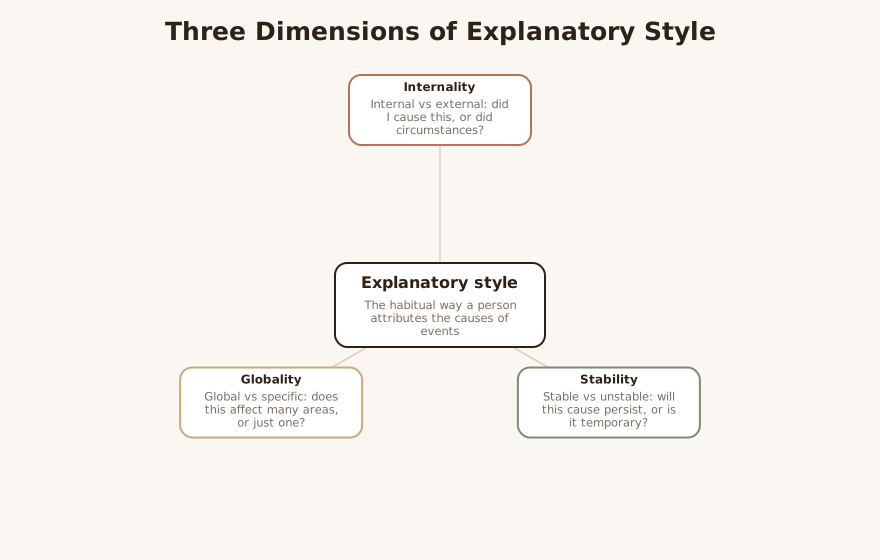
The reformulated model rests on three attributional dimensions along which people habitually explain causes 13.
The first is internality (internal vs. external): did I cause this, or did circumstances 3? The second is stability (stable vs. unstable), sometimes labeled permanence: will this cause persist over time, or is it temporary 3? The third is globality (global vs. specific), sometimes labeled pervasiveness: does this cause affect many areas of my life, or just this one situation 3?
A pessimistic explanatory style explains bad events as internal, stable, and global (“I failed because I am incompetent, I always will be, and it ruins everything”) 23. An optimistic style reverses this for bad events—external, unstable, specific—while crediting good events to internal, stable, global causes 3. Depressed individuals tend to show the full depressogenic inferential pattern: bad events are read as their own fault, permanent, and pervasive, while good events are dismissed as luck, fleeting, and isolated 4.
A central insight of the reformulation is that these dimensions map onto different features of depression 1. Internality governs whether self-esteem takes a hit—personal helplessness (others could have succeeded but I could not) damages self-worth in a way that universal helplessness (no one could have done anything) does not 1. Stability governs the chronicity of helplessness deficits, and globality governs their generality across situations 1. So the theory does not just predict whether depression occurs; it predicts its texture LLM.
A useful recent refinement comes from neuroscience: Maier and Seligman’s 2016 update argued that the brain’s default response to prolonged adversity is to assume control is absent, and that the presence of control is what actually has to be learned 6. This reframes intervention as teaching detectable contingency between action and outcome rather than merely removing a learned belief LLM.
Interventions & Techniques
Because explanatory style is a target rather than a therapy, the techniques used to shift it are largely borrowed from cognitive and behavioral practice and from Seligman’s learned-optimism work 23.
The foundational move is psychoeducation and self-monitoring: helping clients recognize their attributional patterns as habitual interpretations rather than facts about the world 4. Naming the three dimensions gives clients a vocabulary to catch themselves mid-attribution LLM.
Attributional retraining then targets the content directly—disputing internal/stable/global readings of setbacks and rehearsing more accurate, often more external/unstable/specific alternatives 3. Retraining pessimistic thinking toward a more optimistic style has been associated with reduced incidence of depression 3.
Beyond content, the literature points to a process target. Explanatory flexibility—the capacity to vary attributions according to context rather than applying one rigid causal lens—is nearly uncorrelated with explanatory style itself and may be a distinct lever 5. Building flexibility (generating multiple plausible causes, weighing context) may yield more durable outcomes than swapping one fixed belief for another 5.
Behavioral methods complement the cognitive work: arranging genuine experiences of mastery and control directly counters the expectation of uncontrollability, consistent with the “control must be learned” reframing 26. In practice, attributional work is typically integrated with cognitive restructuring, behavioral activation, acceptance and mindfulness strategies, and interpersonal work rather than delivered in isolation 4.
LLM-generated illustrative example (not a guideline): A client who lost a job says, “I always ruin everything—I’m just a failure.” The clinician slows the moment down, labels the attribution as internal-stable-global, and asks the client to generate two more situation-specific, time-limited readings of the layoff (a department-wide restructuring; a skills gap that is trainable). The aim is not forced positivity but a more accurate and flexible causal account LLM.
Evidence Base
The evidence base is best described as established but bounded LLM. Longitudinal studies support the core prediction: a pessimistic explanatory style measured before adversity predicts later depressive onset, particularly when combined with significant negative life events 4. This is a genuine prospective, diathesis-stress finding rather than a cross-sectional correlation, which is what earns the construct its standing 4.
Several honest caveats matter for clinicians. First, the predictive relationship appears relatively specific to depression—attributional style does not reliably predict anxiety or other disorders in the same way 4. Second, pessimistic style is a contributory but not necessary cause; biological, environmental, and interpersonal factors all contribute, and many depressions occur without a pronounced pessimistic style 4. Third, the more recent work on explanatory flexibility complicates the simple “fix the pessimism” story: clients with major depressive disorder and generalized anxiety disorder show low flexibility (rigid attributions), suggesting that processing rigidity, not just negative content, is part of the vulnerability 5.
So the construct is well-supported as a vulnerability marker and a therapy target, but it does not function as a complete account of depression, and shifting explanatory style is one ingredient of treatment rather than a freestanding cure LLM.
Populations & Indications
The framework is most directly indicated for people with depression and those at elevated risk for it, where pessimistic attributions and hopelessness are prominent 4. It has been studied and applied across the lifespan, including children and adolescents, for whom the Children’s Attributional Style Questionnaire (CASQ) was developed 3.
Students are a recurring population: helplessness patterns can drive a downward academic spiral in which setbacks are read as proof of fixed inability 6. Adults under chronic stress and people managing chronic illness are also relevant, given the model’s roots in how organisms respond to prolonged, seemingly uncontrollable adversity 6. Across these groups, the common indication is the same: a habitual internal-stable-global reading of bad events accompanied by reduced motivation and hopelessness 14.
Problems-for-Work
The construct gives clinicians concrete handles on several presenting problems LLM.
For major depressive disorder and hopelessness, the work is identifying and loosening the depressogenic inferential pattern that feeds expectations of a bleak, uncontrollable future 4. For learned helplessness and reduced resilience, the work pairs attributional retraining with arranged mastery experiences that re-establish a perceived link between action and outcome 26.
For pessimism and low self-esteem, the internality dimension is the lever: helping a client see that a bad outcome was not uniquely their personal failing protects self-worth, since it is personal (not universal) helplessness that erodes esteem 1. For rumination, the stability and globality dimensions matter—“this will never end and touches everything” is exactly the fuel rumination runs on, and reframing toward time-limited, situation-specific causes can interrupt it LLM3.
For depressive relapse vulnerability, attributional style functions as a residual risk factor worth assessing even in remitted clients, since the habitual style can persist between episodes 4. For anxiety, the clinician should hold the construct more loosely, given that explanatory style’s predictive specificity is to depression rather than anxiety 4.
LLM-generated illustrative example (not a guideline): A graduate student who fails a qualifying exam concludes, “I’m not smart enough to be here, and I never will be.” Working the stability dimension, the clinician helps reframe the cause as a temporary, addressable preparation problem, and pairs this with a concrete study-plan mastery task—targeting both the attribution and the perceived controllability LLM.
Contraindications, Cautions & Cultural Humility
There is no formal contraindication to assessing explanatory style, but there are real cautions in how it is applied LLM. The most serious is the risk of sliding into invalidation or “toxic positivity”: pushing a client to reattribute a genuinely uncontrollable or unjust event as merely their own changeable thinking can be harmful and can replicate the original silencing LLM. The reformulation’s own distinction between universal and personal helplessness is the safeguard—sometimes the accurate attribution is external and stable (structural barriers, discrimination, abuse), and the clinical task is to validate that reality rather than dispute it 1.
Cultural humility is essential here because attributional norms are not universal LLM. What reads as “external” or “internal,” and how much personal causal agency is even expected, varies across cultural contexts; the ASQ and CASQ were developed and validated largely in Western samples, so scores should be interpreted as hypotheses, not verdicts 3LLM. With clients facing real, ongoing adversity—poverty, abusive relationships, chronic illness—the helplessness may be an accurate appraisal of a genuinely low-control situation, and intervention should focus on building actual control and support rather than reframing perception alone 6LLM.
Treatment-Plan Suggestions & SMART Objectives
| Goal | SMART objective (example) | Mechanism |
|---|---|---|
| Build attributional awareness | Client will log at least 4 negative events per week and label each attribution as internal/external, stable/unstable, global/specific for 4 consecutive weeks | Self-monitoring renders habitual attributions visible and treatable 4 |
| Reduce pessimistic content | Client will generate 2 alternative, more accurate causal explanations for each logged setback in 80% of sessions over 6 weeks | Attributional retraining shifts internal-stable-global readings 3 |
| Increase explanatory flexibility | Client will produce 3 context-dependent attributions for the same event type in 3 of 4 weekly exercises | Targets rigidity/process, a distinct vulnerability from content 5 |
| Restore perceived control | Client will complete 1 graded mastery task per week and rate perceived control (0-10) for 5 weeks | Direct experience of action-outcome contingency counters learned uncontrollability 26 |
| Reduce hopelessness | Client will identify 2 time-limited, changeable features of a feared future scenario each session for 4 weeks | Loosens stability/globality of negative-future expectations 4 |
| Protect self-esteem | Client will distinguish personal vs. universal helplessness for 3 self-blaming events per week over 4 weeks | Internality reattribution buffers self-worth deficits 1 |
| Interrupt rumination | Client will apply a “temporary and specific” reframe within 10 minutes of noticing a rumination episode, logged 4x/week | Reframing stability/globality removes rumination’s fuel 3LLM |
Common Misconceptions
A first misconception is that explanatory style is a fixed personality trait; the learned-optimism tradition treats it explicitly as a modifiable habit of thought that can be retrained 23. A second is that “optimistic equals accurate” or that the goal is positive thinking—the clinical aim is accurate and flexible attribution, and the theory itself reserves room for valid external, stable causes through the personal-versus-universal distinction 1LLM.
A third misconception is that pessimistic style causes depression on its own; the evidence supports it as a contributory, not necessary, cause operating within a diathesis-stress framework 4. A fourth is that changing thought content is the whole job—the flexibility research suggests that rigid processing is a separate target and that altering content while leaving rigidity intact may not produce durable change 5. Finally, learned helplessness is sometimes taught as the brain “learning to be helpless,” whereas the 2016 update reframes helplessness as the default and control as the thing that must be learned 6.
Training & Certification
There is no certification specific to explanatory style, because it is a construct embedded in broader practice rather than a branded therapy LLM. Clinicians typically encounter it within cognitive-behavioral and cognitive therapy training, where attributional work overlaps with cognitive restructuring 4. Familiarity with the measurement tradition—the Attributional Style Questionnaire (ASQ) for adults and the CASQ for children—is the main technical prerequisite for applying it rigorously 3. Reading the primary reformulation source and the clinical-bridge literature is the most direct path to using the construct competently 14.
Key Terms
Explanatory style — the habitual pattern of causal explanations a person offers for events 3. Learned helplessness — passivity and motivational deficit following exposure to uncontrollable outcomes 26. Internality (internal/external) — whether the cause is attributed to self or circumstance; governs self-esteem effects 13. Stability (stable/unstable, permanence) — whether the cause is enduring or temporary; governs chronicity 13. Globality (global/specific, pervasiveness) — whether the cause affects many domains or one; governs generality 13. Personal vs. universal helplessness — whether the person believes others could have succeeded where they could not (personal, esteem-damaging) versus no one could have (universal) 1. Depressogenic inferential style — the internal/stable/global reading of bad events plus discounting of good ones 4. Explanatory flexibility — variability in attributions across contexts; a process construct distinct from style content 5. Learned optimism — Seligman’s retraining of pessimistic attributions toward more optimistic ones 23.
Resources & Further Reading
▶ Watch — a video introduction to this concept:
- Abramson, Seligman & Teasdale (1978), Learned helplessness in humans: critique and reformulation
- Cognitive Attributions in Depression: Bridging Research and Clinical Practice (PMC4956086)
- Explanatory flexibility and explanatory style in treatment-seeking clients with Axis I psychopathology (PMC4684804)
- Learned Helplessness: Seligman’s Theory of Depression (SimplyPsychology)
- What Are Attributional and Explanatory Styles in Psychology? (PositivePsychology.com)
- Learned helplessness (Wikipedia)
Reflective / Supervision Questions
- When you hear a client explain a setback, can you reliably locate it on all three dimensions—internal/external, stable/unstable, global/specific—before you intervene 1?
- How do you distinguish a pessimistic attribution that is distorting reality from one that accurately reflects a genuinely uncontrollable or unjust situation, and how does that distinction change your response 16?
- Are you targeting the content of attributions, the flexibility of attributions, or both, and what is your rationale for the balance 5?
- With clients whose cultural background frames agency and causation differently from the Western samples the ASQ was built on, how do you avoid imposing an attributional norm 3LLM?
- Finally, where in your treatment plan does the work of arranging real experiences of control sit relative to the cognitive reframing, given that control may be the thing that has to be learned 6?