
Type & Discipline
The hopelessness theory of depression is an etiological theory within clinical psychology, not a manualized treatment or a standalone billable modality LLM. It belongs to the family of cognitive diathesis-stress models, which hold that a pre-existing cognitive vulnerability (the diathesis) interacts with stressful life events (the stress) to produce depression 7. Its specific claim is narrower and more testable than “negative thinking causes depression”: it proposes that a particular causal chain produces a particular subtype of depression called hopelessness depression 1. Understanding it as a model of how a depression develops rather than a protocol for treating depression is the single most useful framing for clinical work, because every intervention you derive from it is borrowed from cognitive therapy and CBT rather than from the theory itself LLM.
Creators & Lineage
The theory was articulated by Lyn Abramson, Gerald Metalsky, and Lauren Alloy in their 1989 Psychological Review paper, “Hopelessness Depression: A Theory-Based Subtype of Depression” 1. It grew directly out of the learned helplessness tradition begun by Martin Seligman, who proposed in the early 1970s that organisms exposed to uncontrollable stressors learn they are helpless and that this expectation of uncontrollability produces depression-like deficits 4. That original model could not explain why people in objectively identical helpless circumstances differed so widely in whether they became depressed 7.
The 1978 reformulation by Abramson, Seligman, and Teasdale answered this by importing attribution theory: how a person explains a negative, uncontrollable event matters, and the explanation can be characterized along three dimensions — internal versus external, stable versus unstable, and global versus specific 4. A pessimistic explanatory style that attributes bad events to internal, stable, and global causes was linked to vulnerability to depression 7. The 1989 hopelessness theory is the third generation of this lineage; it shares conceptual roots with Aaron Beck’s cognitive model, which locates depression in negative views of self, world, and future 7. The Gettysburg historical review traces this same progression from Seligman’s helplessness work through the attributional reformulation to the hopelessness model 3.
Core Principles
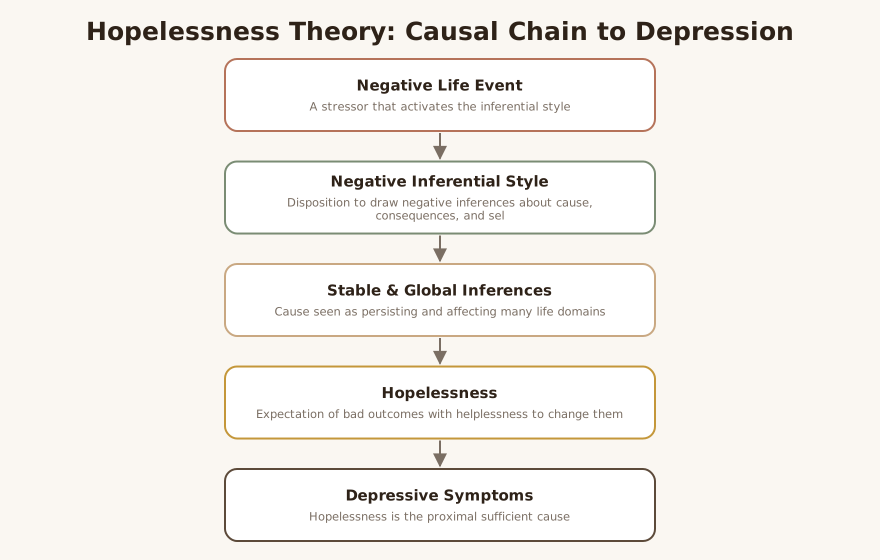
The theory posits a causal chain. A negative life event occurs; a person high on a negative inferential (cognitive) style draws three kinds of negative inference about it — inferences about its cause, about its consequences, and about the self 1. When the inferred cause is seen as stable (will persist) and global (will affect many domains of life), and when the event’s consequences are seen as important and unchangeable, the person concludes that aversive outcomes are likely and that nothing they do can change them 1. That state — the expectation that highly desired outcomes will not occur or aversive ones will, combined with helplessness to change the situation — is hopelessness 1.
The pivotal claim is that hopelessness is the proximal sufficient cause of the depressive symptoms; everything earlier in the chain (the inferential style, the life event, the specific inferences) are distal, contributory causes that operate by producing hopelessness 1. A crucial and frequently misremembered detail: in the 1989 theory, it is stability and globality of the causal inference that drive hopelessness, while internality is not required to produce hopelessness depression LLM. Internal attribution matters only for whether the low-self-esteem symptom is present, marking a deliberate departure from the internal-stable-global emphasis of the 1978 reformulation LLM. The proposed symptom cluster of hopelessness depression includes retarded initiation of voluntary responses, sad affect, suicidal ideation, low energy and apathy, psychomotor retardation, sleep disturbance, difficulty concentrating, and — when internality is present — lowered self-esteem 1.
Interventions & Techniques
The theory does not prescribe a treatment, so the techniques below are clinical inferences derived from its causal chain and delivered within cognitive therapy or CBT for depression LLM. Each intervention targets a specific link in the chain LLM.
- Inferential / attributional retraining. Because stable and global causal inferences feed hopelessness, the therapist helps the client generate more unstable and specific explanations for negative events — examining evidence, testing whether a cause is truly permanent and truly pervasive, and rehearsing alternative attributions LLM.
- Restructuring consequence inferences. Catastrophic, fixed predictions about what a setback “means” for the future are surfaced and tested against evidence, reducing the perceived importance and inevitability of negative outcomes LLM.
- Restructuring self inferences. When internal global self-attributions are present and self-esteem is depressed, the work addresses the inference that one is globally deficient rather than that a specific behavior in a specific situation fell short LLM.
- Behavioral activation against helplessness. Scheduling mastery and pleasure activities provides disconfirming experiences of controllability, directly countering the helplessness component of hopelessness LLM.
- Hope-building and problem-solving. Identifying domains the client can still influence rebuilds an expectation that some desired outcomes remain attainable LLM.
LLM-generated illustrative example (not a guideline): A graduate student fails a qualifying exam and concludes, “I’m just not smart enough — I’ll fail at everything I try” (internal, stable, global). The clinician uses guided discovery to test the inference: the student studied the wrong material under acute insomnia (an unstable, specific cause), and the exam can be retaken. Reattributing the cause and identifying a concrete study plan reduces the sense that failure is permanent and pervasive LLM.
Evidence Base
The evidence base is best described as established for the model, not as evidence for a therapy LLM. The 25-year review by Liu, Kleiman, and colleagues found consistent empirical support for several major components of the hopelessness theory 2. The anchor for its predictive validity is the Temple-Wisconsin Cognitive Vulnerability to Depression Project, a prospective design in which individuals high on negative cognitive style were followed over time; cognitive vulnerability prospectively predicted the later onset of depression, which is the kind of evidence a true diathesis-stress model requires LLM.
Three honest caveats matter clinically. First, the theory aims to explain a subtype — hopelessness depression — not all depressions, so a negative test of the full chain does not necessarily indict the theory and not every depressed client fits it 1. Second, the review identified persistent conceptual confusion between the hopelessness theory and the reformulated learned helplessness theory as a major obstacle to progress in the literature 2. Third, the authors noted that more work is needed to assess the theory in relation to clinically significant phenomena, meaning the strong basic-science support has not fully translated into validated clinical applications 2. The cognitive therapy that operationalizes the theory’s targets, by contrast, has strong research support as a treatment for depression 6.
Populations & Indications
The model has been studied and applied across adolescents and adults, and is conceptually relevant to older adults and people with chronic illness whose stressors include realistic constraints on control LLM. It is most indicated when a depressed client presents with marked hopelessness, pervasive pessimism, and a pattern of explaining setbacks as stable and global LLM. Because hopelessness is a well-replicated correlate of suicidal ideation, the theory is particularly relevant to assessment and intervention with individuals at risk for suicide, where reducing hopelessness is itself a clinical priority 1. Adolescents are a developmentally important population because cognitive style is still consolidating, making the period a candidate window for vulnerability and for prevention LLM. The theory’s developmental and “weakest-link” elaborations were specifically developed to address how vulnerability forms and operates across the lifespan 2.
Problems-for-Work
- Hopelessness and major depressive disorder. The core target: identify the stable/global inferences sustaining hopelessness and test them, while activating behavior to disconfirm helplessness LLM.
- Suicidal ideation. Treat hopelessness as a direct, modifiable driver of ideation; building even partial expectation of changeable outcomes is protective work 1.
- Negative cognitive style and pessimism. Use the three-dimensional attribution frame to make the client’s explanatory habits explicit and shift them toward unstable, specific alternatives 4.
- Learned helplessness and anhedonia. Counter the expectation of uncontrollability with graded mastery experiences that restore a sense of agency 4.
- Low self-esteem. When internal global self-attributions are present, target the inference of global self-deficiency specifically 1.
- Rumination. Rumination amplifies and prolongs negative inferences; interrupting it limits how stable and global those inferences become LLM.
- Dysthymia / persistent depressive disorder. A chronically stable, global inferential style maps onto the chronicity of persistent depression and is a plausible maintenance target LLM.
Contraindications, Cautions & Cultural Humility
The model has no formal contraindications because it is a theory rather than a procedure, but several cautions apply to its use LLM. Acute suicide risk requires safety planning and risk management first; cognitive reattribution does not substitute for risk assessment LLM. The theory should not be used to imply that a client’s depression is “their faulty thinking,” which can become subtle blame; the diathesis-stress structure explicitly requires a real stressor, and many stressors are genuine and uncontrollable 7. This is where cultural humility is essential: when a client faces racism, poverty, discrimination, or unsafe conditions, attributing adversity to external, stable, global causes can be an accurate appraisal of structural reality, not a distortion to be corrected LLM. The clinician’s task is to distinguish realistic appraisal of constrained control from generalized hopelessness, and to validate the former while working on the latter LLM. Causal explanation is also culturally shaped, so what counts as an “adaptive” attribution cannot be assumed to be universal LLM.
Treatment-Plan Suggestions & SMART Objectives
| Goal | SMART objective (example) | Mechanism |
|---|---|---|
| Reduce hopelessness | Client reduces Beck Hopelessness Scale score by a clinically meaningful margin over 8 weeks | Hopelessness is the proximal sufficient cause of symptoms 1 |
| Shift causal inferences | Client logs 3 negative events/week and generates an unstable, specific alternative explanation for each, weekly for 6 weeks | Targets the stable/global inferences that feed hopelessness 1 |
| Restructure consequence inferences | Client identifies and tests one catastrophic prediction per session, achieving 70% completion over 8 sessions | Reduces perceived importance and inevitability of negative outcomes 1 |
| Rebuild agency | Client completes a daily behavioral-activation schedule of 1 mastery and 1 pleasure activity, 5 days/week | Disconfirms helplessness via experiences of controllability 4 |
| Address self-attribution | Client reframes one global self-criticism into a situation-specific statement each session for 6 weeks | Targets internal global self-inference linked to low self-esteem 1 |
| Reduce rumination | Client uses a worry/rumination-interruption skill at 2 logged triggers daily for 4 weeks | Limits consolidation of stable, global negative inferences LLM |
| Reduce suicidal ideation | Client and therapist complete a safety plan and rate ideation weekly, with hopelessness-focused work each session | Lowering hopelessness reduces a direct driver of ideation 1 |
Common Misconceptions
The most consequential misconception is conflating the hopelessness theory with the reformulated learned helplessness theory; the 25-year review named this exact confusion as a primary obstacle in the field 2. A related error is assuming internal attributions are required for hopelessness depression — in the 1989 theory, stability and globality drive hopelessness, and internality bears only on the low-self-esteem symptom LLM. A third is treating the theory as a claim that all depression is caused by hopelessness; it explicitly describes a subtype 1. A fourth is reading it as “depression is just negative thinking,” which ignores the diathesis-stress requirement that a real stressor be present 7. Finally, clinicians sometimes assume the theory comes with its own therapy; in practice its interventions are drawn from cognitive therapy and CBT LLM.
Training & Certification
There is no certification in the “hopelessness theory of depression,” because it is a model rather than a treatment package LLM. Clinicians who want to apply it competently should pursue training in cognitive therapy or CBT for depression, the empirically supported modality that contains the relevant techniques 6. Foundational reading in the source literature — the 1989 theory paper, the 1978 reformulation, and the 25-year review — builds the conceptual fluency needed to use the model in case formulation and supervision 1 5 2.
Key Terms
- Diathesis-stress: the framework in which a pre-existing vulnerability interacts with a stressor to produce a disorder 7.
- Negative inferential (cognitive) style: the trait tendency to infer stable, global causes, negative consequences, and negative self-characteristics from bad events 1.
- Hopelessness: the expectation that desired outcomes will not occur or aversive ones will, combined with helplessness to change this — the proximal sufficient cause in the theory 1.
- Proximal sufficient cause: the immediate cause whose presence is enough to produce the symptoms; distal causes act through it 1.
- Attributional dimensions: internal-external, stable-unstable, global-specific — the axes along which causes are explained 4.
- Hopelessness depression: the theory-defined subtype characterized by retarded initiation of responses, sad affect, suicidal ideation, low energy, and (with internality) low self-esteem 1.
Resources & Further Reading
▶ Watch — a video introduction to this concept:
- Abramson, Metalsky & Alloy (1989). Hopelessness depression: A theory-based subtype of depression
- Liu, Kleiman et al. — The Hopelessness Theory of Depression: A Quarter-Century in Review (PubMed)
- The History and Development of the Hopelessness Theory (Gettysburg College student scholarship)
- Learned Helplessness: Seligman’s Theory of Depression — Simply Psychology
- Abramson, Seligman & Teasdale (1978). Learned helplessness in humans: Critique and reformulation (PDF)
- Cognitive Therapy for Depression — Society of Clinical Psychology (APA Division 12)
- Behavioral and cognitive theories of depression — Wikipedia
Reflective / Supervision Questions
- For a given depressed client, can you locate the specific negative inferences (cause, consequence, self) sustaining their hopelessness, and which dimensions — stability, globality, internality — are most active? LLM
- How do you distinguish a client’s accurate appraisal of limited control over a genuinely uncontrollable stressor from a generalized hopelessness that warrants reattribution? LLM
- When you reattribute a client’s causal explanations, are you ever inadvertently invalidating a realistic perception of structural adversity? LLM
- How does your hopelessness-focused work integrate with formal suicide risk assessment and safety planning rather than substitute for it? LLM
- Are you using the theory as a case-conceptualization lens within an evidence-based modality, or have you drifted into treating it as a freestanding protocol? LLM