
Attribution theory is one of the few social-psychology frameworks that translates directly into the consulting room. It is not a therapy. It is a model of how the mind manufactures causal explanations, and because so much clinical suffering is built out of the explanations people give for events, it sits quietly underneath cognitive therapy, motivational work, and couples interventions alike LLM.
Type & Discipline
Attribution theory is a descriptive and motivational theory drawn from social psychology, specifically the study of social cognition: how people perceive, interpret, and explain the causes of behavior and events 2. Its central claim is that human beings are “naive psychologists” who try to make sense of the social world by assigning causes to what they and others do 2. The foundational distinction is between internal (dispositional) causes, which locate the source of behavior in a person’s character, ability, or intent, and external (situational) causes, which locate it in circumstances, luck, or environmental pressure 2. Although it originated as a basic-science account of everyday reasoning, the theory has been extended into clinical psychology, education, health, sport, and law 1. For clinicians, the relevance is that attributions are not merely intellectual judgments; they drive emotion, motivation, and self-concept, which is precisely where the model becomes a treatment target LLM.
Creators & Lineage
Fritz Heider is described as the “father of attribution theory” 1. In The Psychology of Interpersonal Relations (1958), Heider proposed that ordinary people behave like naive scientists, and he introduced the idea of a perceived “locus of causality” to distinguish internal from external explanations 17. Heider’s core insight was that perception of cause is itself a psychological act, not a neutral readout of reality 7.
Edward Jones and Keith Davis extended the model with correspondent inference theory, which holds that observers infer stable personal characteristics most strongly when an action is freely chosen, is unexpected, and produces a small number of distinctive (non-common) effects 1. Harold Kelley then offered the most systematic account with his covariation model, treating the observer as a logical detective who weighs three kinds of information: consensus (do other people behave the same way toward the same stimulus?), distinctiveness (does the person behave differently toward other stimuli?), and consistency (does the behavior recur over time with the same stimulus?) 2. Kelley summarized his covariation principle as attributing an effect “to that condition which is present when the effect is present and which is absent when the effect is absent” 1.
Bernard Weiner brought attribution into the motivational and achievement domain, the strand most useful to therapists 3. More recently, Bertram Malle has reviewed and critiqued these classic theories, arguing that the simple internal-versus-external dichotomy underrepresents how people actually explain behavior 4. The clinical lineage runs forward from this social-psychology base into the reformulated learned-helplessness model of depression and, through it, into Beck-style cognitive therapy and CBT, where maladaptive causal explanations became explicit objects of treatment 1.
Core Principles
Weiner organized causal explanations along three dimensions. Locus of control distinguishes internal from external causes 3. Stability captures whether a cause is seen as changing over time or as fixed 3. Controllability contrasts causes a person can control, such as skill or effort, with causes they cannot, such as aptitude, mood, others’ actions, or luck 3. Weiner identified four causes that dominate explanations of achievement outcomes: ability, effort, task difficulty, and luck 3.
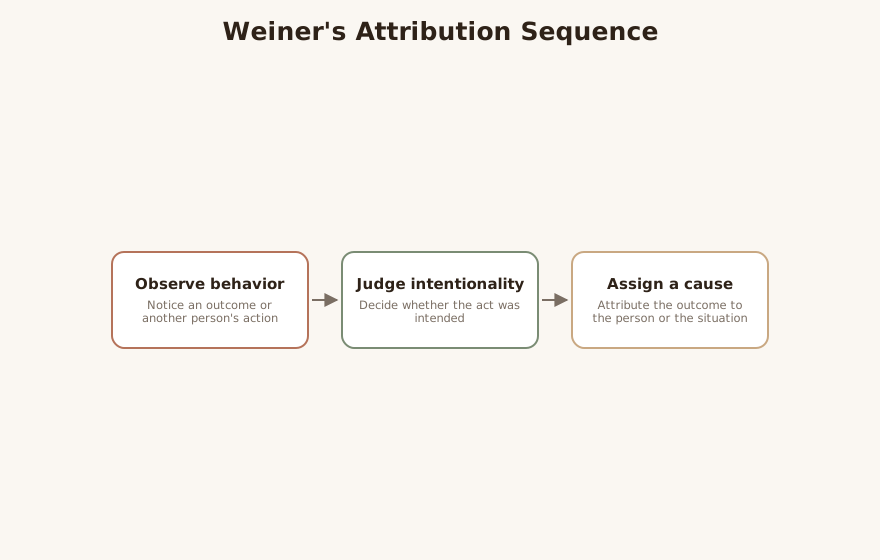
These dimensions matter because they map onto emotion and motivation. Weiner described attribution as moving through stages: observing behavior, judging whether it was intentional, and then assigning a cause to the person or the situation 3. High achievers tend to attribute success to internal factors such as ability and effort while attributing failure to external factors, which protects self-esteem; low achievers do the reverse, doubting their ability and crediting success to forces beyond their control, which drains the reward from achievement 3.
Two further principles round out the model. Kelley’s covariation framework explains how observers use patterns of information to land on internal versus external causes 2. And the theory predicts systematic, non-random errors in this reasoning, which are often the clinically interesting part because they are stable, patterned, and modifiable LLM.
Interventions & Techniques
Attribution theory does not prescribe a protocol, but its principles support several techniques that clinicians already use LLM. Attributional reframing invites a client to consider alternative causes for an event, shifting, for example, a failure attributed to fixed internal inability toward an attribution of unstable, controllable effort or strategy 3. Because Weiner’s model ties controllable and unstable attributions to greater motivation, this reframing targets hope and behavioral persistence rather than mere positive thinking 3.
A second technique uses Kelley’s three questions as a structured Socratic tool: clinicians can ask whether others respond the same way (consensus), whether the client reacts differently in other settings (distinctiveness), and whether the pattern is consistent over time (consistency), to test an over-personalized explanation against the evidence 2. A third draws on the fundamental attribution error: naming the tendency to over-attribute others’ behavior to disposition while ignoring their situation can soften hostile or self-blaming interpretations 5. These methods are delivered inside cognitive and behavioral frameworks rather than as a freestanding therapy LLM.
LLM-generated illustrative example (not a guideline): A student who failed an exam says, “I’m just stupid.” The clinician helps re-attribute: “stupid” is internal, stable, and uncontrollable, the worst combination for motivation. Together they test whether the cause might be unstable and controllable, “I studied the wrong material and ran out of time,” which preserves agency and points to a next step LLM.
Evidence Base
Attribution theory is an established theory within social psychology, supported by decades of experimental work and broad application across clinical, educational, health, and legal settings 16. The fundamental attribution error was demonstrated in the classic Jones and Harris (1967) study, in which participants attributed pro-Castro essays to genuine attitudes even when told the writers’ positions were assigned by a coin toss 5. The covariation and achievement models are likewise well characterized 23.
The honest caveat for clinicians is that “established theory” is not the same as “established therapy.” Attribution concepts are robustly described, but as a treatment they operate downstream, embedded within CBT and the reformulated learned-helplessness account of depression rather than as a standalone evidence-based modality 1LLM. The link to psychopathology is the best-validated clinical extension: a depressive attributional style, attributing negative events to internal, stable, and global causes, correlates with depression, anxiety, and post-traumatic stress, and with pessimism, rumination, hopelessness, and self-criticism 1. Malle’s critique adds a further nuance: the strict internal-external dichotomy may oversimplify how people genuinely explain behavior, so clinicians should treat the dimensions as useful heuristics rather than literal taxonomy 4.
Populations & Indications
The framework is broadly applicable across adults, adolescents, and students, and has obvious purchase with depressed individuals and other clinical populations whose distress is organized around causal explanations 13. Weiner’s achievement focus makes it especially apt for students and anyone facing repeated performance evaluation, where attributions for success and failure shape motivation 3. Couples are a natural target because partners routinely explain each other’s behavior, and the slide toward dispositional, character-based explanations of a partner’s actions is a recognized engine of conflict LLM. The strongest single indication is a maladaptive attributional style accompanying depression or hopelessness, where the internal-stable-global pattern is both measurable and modifiable 1.
Problems-for-Work
Attribution concepts give clinicians a vocabulary for a cluster of common presenting problems LLM.
- Depression, hopelessness, and learned helplessness. The internal-stable-global style for negative events is a hallmark of depressive cognition and a direct treatment target 1.
- Low self-esteem and self-blame. Attributing failures to fixed internal inability while crediting successes to luck erodes self-worth; reversing this pattern is core work 3LLM.
- Negative attributional style and cognitive distortions. Personalization and overgeneralization can be reframed as faulty attributions and tested against Kelley’s covariation evidence 2LLM.
- Relationship conflict. Partners’ tendency to attribute each other’s failures to internal traits such as laziness or inattention, while excusing their own with situational factors, mirrors the actor-observer difference and fuels resentment 1.
- Anger and hostility. A hostile attribution bias, reading ambiguous behavior as deliberately hostile, drives reactive aggression and can be made explicit and challenged 1.
- Anxiety. Attributing threat to stable, uncontrollable causes amplifies helplessness; shifting toward controllable, situational appraisals supports coping 1LLM.
LLM-generated illustrative example (not a guideline): A partner comes home late. One spouse thinks, “He’s selfish and doesn’t care,” a stable, internal, dispositional attribution. The clinician introduces the actor-observer difference: the spouse excuses their own lateness as “traffic” but reads the partner’s as character. Considering a situational cause does not excuse the behavior; it reopens curiosity instead of contempt LLM.
Contraindications, Cautions & Cultural Humility
Attribution reframing is contraindicated when it slides into invalidation. Pushing a trauma survivor or an abuse victim to “re-attribute” responsibility can replicate harm, and a client’s self-blaming attribution sometimes protects against a more frightening sense of helplessness, so it should be approached gently LLM. Clinicians should also avoid using the theory to rationalize away genuine external adversity; encouraging a client facing real discrimination or material hardship to view their situation as merely a thinking error is both inaccurate and harmful LLM.
Cultural humility is essential because attribution patterns are culturally shaped. Miller’s (1984) research found that children in India based explanations more on situations, while American children increasingly relied on dispositional factors with age, reflecting collectivist versus individualist orientations 5. The fundamental attribution error itself appears to be stronger in individualist cultures 5. What a Western clinician might label a “distortion” may be a culturally normative, even adaptive, situational reading LLM. Malle’s caution that the internal-external dichotomy oversimplifies real explanation reinforces the need to hold these categories loosely 4.
Treatment-Plan Suggestions & SMART Objectives
| Goal | SMART objective (example) | Mechanism |
|---|---|---|
| Reduce internal-stable-global attributions for setbacks | Within 6 sessions, client will identify and reframe at least 3 negative-event attributions per week in a log, citing an alternative situational or unstable cause | Shifts depressive attributional style toward hope 13 |
| Increase controllable attributions for failure | By week 8, client will attribute at least one recent failure to effort or strategy (controllable) rather than ability (uncontrollable) in session | Controllable attributions raise motivation 3 |
| Reduce self-blame | Within 8 weeks, client will distinguish responsibility from causality in 2 recurring situations using a written exercise | Separates global self-blame from specific external factors 1LLM |
| Soften hostile attributions toward a partner | Over 6 sessions, client will generate one plausible situational explanation for a partner’s behavior before reacting, recorded 4x/week | Counters actor-observer asymmetry and hostile attribution bias 1 |
| Build balanced success attributions | By week 10, client will credit at least two recent successes to internal effort/ability in session | Reverses self-defeating attributional pattern that drains achievement reward 3 |
| Increase situational perspective-taking | Within 5 sessions, client will name the fundamental attribution error and apply it to one conflict per week | Reduces dispositional over-attribution of others 5 |
| Test catastrophic causal beliefs | By week 6, client will apply Kelley’s consensus/distinctiveness/consistency questions to 3 over-personalized events | Uses covariation evidence to correct faulty attribution 2 |
Common Misconceptions
A frequent error is treating “internal versus external” as a clean, binary fact about the world rather than a perceptual judgment that is often mistaken; Heider’s point was precisely that causality is perceived, and Malle argues the dichotomy itself is an oversimplification 47. A second misconception is that internal attributions are always healthy and external ones always defensive; in depression, the harmful pattern is internal-stable-global for negative events, so more “taking ownership” can worsen, not improve, the picture 1. A third is that the self-serving bias, attributing successes to internal factors and failures to external ones, is simply dishonesty; it is a widespread, self-esteem-protective pattern, and its absence may itself signal depressive cognition 2LLM. Finally, clinicians sometimes assume attribution reframing means insisting on optimism; the goal is accuracy and flexibility, not relentless positivity LLM.
Training & Certification
There is no certification in attribution theory, and none is needed; it is a conceptual model rather than a credentialed therapy LLM. Clinicians typically encounter it within graduate social-psychology coursework and within CBT training, where its principles are absorbed into cognitive-restructuring skills 1LLM. Competence comes from supervised CBT practice and familiarity with the reformulated learned-helplessness literature rather than from a standalone course 1LLM.
Key Terms
- Internal (dispositional) attribution: explaining behavior by the person’s character, ability, or intent 2.
- External (situational) attribution: explaining behavior by circumstances, task, or luck 2.
- Locus, stability, controllability: Weiner’s three causal dimensions 3.
- Fundamental attribution error: over-emphasizing dispositional and under-emphasizing situational causes when judging others 5.
- Actor-observer difference: attributing others’ failures to internal factors while attributing one’s own to the situation 1.
- Self-serving bias: crediting success to internal causes and blaming failure on external ones 2.
- Hostile attribution bias: reading ambiguous behavior as intentionally hostile 1.
- Covariation (consensus, distinctiveness, consistency): Kelley’s information criteria for assigning cause 2.
- Depressive attributional style: internal, stable, and global explanations for negative events 1.
Resources & Further Reading
▶ Watch — a video introduction to this concept:
- Attribution (psychology) — Wikipedia
- Attribution Theory in Psychology: Definition & Examples — Simply Psychology
- Attribution Theory (B. Weiner) — InstructionalDesign.org
- 4 Attribution Theories: How People Make Sense of Behavior — Malle (Brown University, PDF)
- Fundamental Attribution Error Theory in Psychology — Simply Psychology
- Attribution Theory — TheoryHub, Newcastle University
- The Psychology of Interpersonal Relations (Heider, 1958), overview — ScienceDirect
Reflective / Supervision Questions
- When a client offers a causal explanation, do I reflexively assume it is distorted, or do I test it against the actual evidence, including the possibility that their situational reading is accurate? LLM
- How do my own attributional habits shape my case formulation; am I committing a fundamental attribution error about a “non-compliant” client by reading disposition where situation may be operating? 5
- With this client, would more internal attribution increase agency or deepen self-blame, and how do I tell the difference? 1LLM
- How might this client’s cultural background make a situational explanation normative rather than avoidant? 5
- Am I framing attribution work as cognitive restructuring within a recognized modality, or am I treating it as a therapy in its own right? LLM