
Type & Discipline
Internal working models (IWMs) are a developmental construct, not a treatment, a diagnosis, or a billable modality LLM. The term names the mental representations of self and others that an individual builds from repeated experiences with attachment figures, and that subsequently guide expectations, appraisals, and behavior in close relationships 3. Within developmental psychology, IWMs sit at the explanatory core of attachment theory: they are the proposed cognitive-affective mechanism that carries the influence of early caregiving forward into later life 1. Because the construct describes an internal representational system rather than a procedure a clinician performs, its clinical value lies in case formulation, assessment, and the selection and shaping of interventions delivered through recognized therapies LLM. Put simply, an IWM is a working template for relationships — a set of largely implicit expectations about whether the self is worthy of care and whether others can be relied upon to provide it 1.
Creators & Lineage
The concept is John Bowlby’s, developed as part of his broader attachment theory and elaborated across his work on the formation, maintenance, and disruption of affectional bonds 5. Bowlby borrowed the phrase “working model” to convey that the representation is not a static picture but a dynamic, predictive model the child uses to simulate and anticipate the behavior of attachment figures and to plan their own responses 2. His later clinical writing, collected in A Secure Base, applied this thinking directly to psychotherapy, framing the therapist’s task in part as helping the patient examine and revise outdated representations of self and others formed in childhood 4.
Mary Ainsworth supplied the empirical scaffolding: her Strange Situation procedure operationalized individual differences in attachment behavior, and the resulting secure, avoidant, and resistant patterns were understood to reflect differing underlying working models 1. Mary Main extended the construct into adulthood and into the representational domain, shifting the level of analysis from observed infant behavior to “states of mind with respect to attachment” assessed through discourse, and reframing security as coherence of the working model rather than any single behavior 2. The lineage runs forward into object relations theory, whose internalized self- and object-representations are close conceptual cousins; into mentalization-based treatment, which targets the reflective capacity that allows working models to be updated; and into emotionally focused therapy, which works to revise relational expectations in real time within the couple bond LLM.
Core Principles
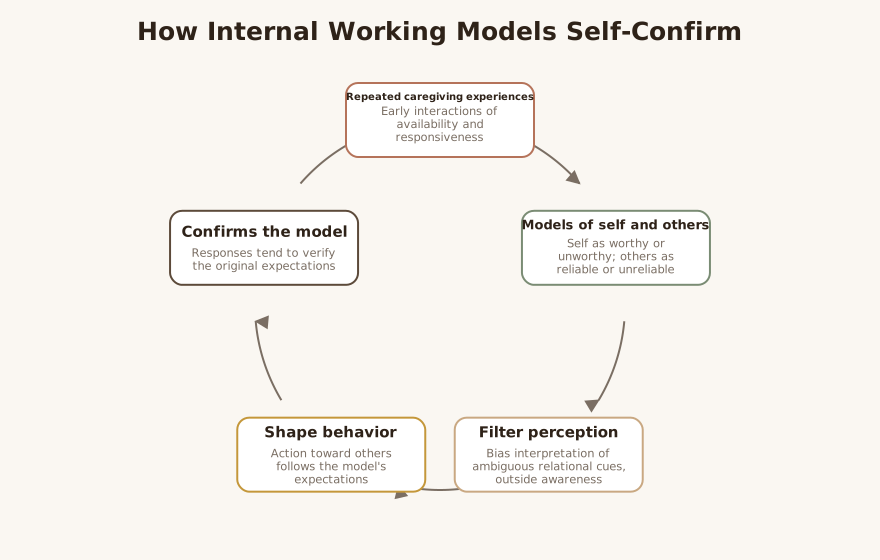
The first principle is representational: through repeated interactions, the child abstracts and internalizes expectations about caregiver availability and responsiveness, forming complementary models of the self (as worthy or unworthy of care) and of others (as reliable or unreliable) 3. These two facets are linked — a child consistently met with sensitive care tends to build a model of others as available and of the self as worth caring for, while inconsistent or rejecting care builds the inverse 1.
The second principle is guidance: once formed, IWMs operate largely outside awareness to filter perception, bias interpretation of ambiguous relational cues, and shape behavior, so that the model tends to confirm itself 2. The third principle is continuity: Bowlby proposed that early models template later relationships, providing a developmental pathway by which the quality of first attachments influences functioning across the lifespan 2. The fourth principle qualifies the third — models are “working” precisely because they can be updated by new experience, including corrective relational experience in therapy, even if they show meaningful stability and resist revision once established 4. The fifth principle is hierarchy and multiplicity: a person may hold several models tied to different relationships, and these can conflict, which is part of why relational behavior is not perfectly consistent across contexts 2.
Interventions & Techniques
Because IWMs are a construct rather than a therapy, there is no set of “internal-working-model techniques” in the way there are exposure techniques or cognitive restructuring techniques LLM. The construct’s clinical work is done upstream, in formulation, and downstream, in giving recognized interventions a coherent rationale LLM. Bowlby’s own clinical application is instructive: he cast the therapeutic relationship as a secure base from which the patient can explore painful representations, and the therapist’s role as helping the patient recognize that current models of self and others were built in, and may now be outdated relics of, earlier relationships 4.
Three intervention logics follow directly from the construct LLM. First, the therapeutic relationship itself can function as a source of disconfirming experience — a reliable, attuned, non-retaliatory other who does not behave as the model predicts, gradually loosening the model’s grip 4. Second, reflective or mentalizing work makes the implicit model explicit, so that the client can notice when they are reacting to the template rather than to the person in front of them LLM. Third, in couple and family work, in-session enactments can be used to create new relational events that revise each partner’s expectations of how the other will respond under vulnerability LLM. The construct also travels into less conventional formats; one psychodynamic line of work has used models of self and others as the explicit organizing frame for equine-assisted psychotherapy, where the relationship with the animal and the handler surfaces the client’s relational expectations 7.
LLM-generated illustrative example (not a guideline): An adult client in individual therapy repeatedly assumes the therapist is “about to give up on them” after missing a session, reads a neutral email as rejection, and pre-emptively withdraws; the clinician names this as a working model speaking — an old prediction that closeness ends in being dropped — and treats each instance where the therapist reliably stays as a small piece of disconfirming evidence the client can register and weigh against the template LLM.
Evidence Base
The honest appraisal is that the internal working model is an established, foundational construct in developmental psychology, not a fringe idea — but one whose measurement is genuinely contested LLM. The continuity claim that early caregiving shapes later relational functioning has substantial empirical support, and the construct is treated as theoretically grounded across decades of attachment research and standard reference overviews 3. The two-dimensional anxiety/avoidance structure that organizes much adult attachment research is understood as a downstream operationalization of the underlying working models of self and others 1.
At the same time, the field is candid that the construct is hard to measure well 6. A central methodological critique asks, in effect, whether coding internal working models of attachment has to be so difficult, drawing attention to the labor, training demands, and inferential leaps involved in moving from observed behavior or discourse to a claimed internal representation 6. Because the model is by definition internal and largely implicit, no measure observes it directly; researchers infer it from behavior in the Strange Situation, from adult interview coherence, or from self-report, and these methods do not always converge 2. The defensible clinical stance is therefore to treat IWMs as a robust and clinically useful organizing construct with strong support for its broad continuity claims, while holding measurement-level and individual-prediction claims more loosely than popular usage implies LLM. The construct earns its place in formulation; it does not license deterministic statements about a particular client’s fate from their childhood LLM.
Populations & Indications
The construct’s primary developmental population is children, in whom the models are first forming and most open to influence through the caregiving environment 1. It extends naturally to adolescents and to adults with attachment difficulties, where entrenched relational expectations are a presenting concern and the representational, interview-based level of analysis applies 2. It is especially relevant to survivors of childhood maltreatment, in whom frightening or unreliable care can install models of others as dangerous and of the self as unworthy of protection LLM.
Couples are a key indicated population, because each partner brings working models that shape how they interpret the other’s bids for closeness and reactions to distress, and because the couple relationship is itself a powerful site for revising them LLM. Parents and caregivers are indicated on both sides of the generational pathway: their own working models shape the care they provide, making caregiver-focused and dyadic work a route to influencing the next generation’s models 2. Across these groups, the construct indicates where attachment-informed assessment and relationally focused intervention are likely to be most useful, and where purely symptom-focused work may miss the relational template driving the symptoms LLM.
Problems-for-Work
The construct maps onto a recognizable cluster of clinical problems LLM. Insecure attachment is the most direct, since divergent working models are the proposed substrate of the insecure patterns themselves, and naming the underlying expectations can make an otherwise diffuse “attachment issue” workable 1. Relationship conflict and broader interpersonal difficulties follow, because models bias the reading of a partner’s or friend’s behavior, so that neutral or ambiguous acts are interpreted through an expectation of rejection or unavailability and conflict escalates around the misreading 2.
Low self-esteem connects through the self-side of the model — a representation of the self as unworthy of care, laid down early, shows up clinically as pervasive unlovability or expectation of abandonment 3. Trust difficulties and abandonment fears reflect the other-side of the model, an expectation that closeness will end in being let down or left LLM. Emotion dysregulation is implicated where the model offers no reliable expectation of comfort, leaving the person without an internalized template for being soothed by others under distress LLM. The construct is also routinely invoked in formulating posttraumatic stress disorder, borderline personality disorder, and the broader sequelae of childhood maltreatment, where fear within close relationships and unstable representations of self and other are central — though here it functions as a formulation lens informing trauma- and personality-focused treatment, not as a stand-alone explanation LLM.
LLM-generated illustrative example (not a guideline): A client presents with recurrent relationship conflict, describing partners as “always pulling away”; tracing the pattern, the clinician and client find she tests partners by withdrawing and then reads their confused response as confirmation she will be abandoned — a self-fulfilling working model — and the work shifts from cataloguing partners’ faults to noticing and interrupting the prediction-driven testing LLM.
Contraindications, Cautions & Cultural Humility
The foremost caution is against deterministic use: an IWM is a probabilistic, revisable template, and reading a client’s childhood as a fixed sentence for their adult relationships overstates both the construct and the evidence 4. Clinicians should also resist over-confident inference from limited data, because the model is internal and not directly observed, and even rigorous research-grade coding of working models is demanding and contested — informal “diagnosis” of a client’s working model from casual observation overreaches 6. Using the construct to assign blame to caregivers is a further error; the developmental account describes a pathway, not a verdict on a parent, and shaming caregivers undermines the very dyadic work the model implies LLM.
Cultural humility is essential, because the construct and its measures were developed largely within Western, individualistic frameworks, and culturally normative caregiving arrangements, expectations about independence and proximity, and the role of extended kin all shape what a “secure” or “insecure” model looks like in context 2. Behavior should be interpreted against the family’s own cultural frame and relational values rather than a single normative standard, and the clinician should hold the construct as a sensitive lens rather than a culture-neutral instrument LLM. Finally, when working models surface frightening early material, the relevant standard is trauma-informed practice within the clinician’s scope, with referral where specialized attachment or trauma treatment is indicated LLM.
Treatment-Plan Suggestions & SMART Objectives
| Goal | SMART objective (example) | Mechanism |
|---|---|---|
| Make the implicit model explicit | Within 8 sessions, client will identify and describe 3 recurring relational expectations (“they will leave,” “I am too much”) in their own words, logged between sessions | Brings the working model into awareness so it can be examined rather than enacted 4 |
| Build a felt sense of a reliable other | Over 12 weeks, client will report 2 specific instances where another person’s response disconfirmed a negative expectation, rated for emotional impact | Supplies corrective relational experience that loosens the model 4 |
| Reduce rejection-biased interpretation | Within 10 sessions, client will pause and generate 1 alternative reading of an ambiguous relational cue before reacting, in 70% of logged instances | Targets the perceptual filtering by which models confirm themselves 2 |
| Strengthen reflective/mentalizing capacity | Over 10 sessions, client will accurately name the likely mental state behind 2 confusing interactions per week | Enables the model to be updated rather than automatically applied LLM |
| Repair self-representation | Within 12 sessions, client will articulate and provide evidence for 1 revised statement about their own worthiness of care | Revises the self-side of the working model 3 |
| Revise couple-level expectations | Across 8 conjoint sessions, each partner will complete 2 in-session vulnerability-and-response sequences that contradict their prior expectation of the other | Creates new relational events that update each partner’s model LLM |
| Increase tolerance of safe closeness | Within 12 sessions, client will remain engaged (no pre-emptive withdrawal) through 3 structured closeness exercises and name the strategy used | Counters abandonment-driven withdrawal sustained by the model LLM |
Common Misconceptions
A frequent error is treating an internal working model as a fixed, unchangeable trait set in childhood; the construct is explicitly “working,” meaning revisable through new experience, even though models show real stability and resist change once established 4. A second misconception collapses the model into a single self-report “attachment style” that a brief quiz reveals, when the construct is a multifaceted internal representation that different methods — behavioral, interview-based, and self-report — capture only partially and imperfectly 6. A third is assuming the model is fully conscious; much of its operation is implicit, which is precisely why it can drive behavior the person cannot easily explain 2.
A fourth misconception is that a person holds one global model; the construct allows for multiple, relationship-specific, and sometimes conflicting models, which helps explain inconsistent relational behavior across contexts 2. A fifth is reading the continuity claim as strict determinism — early caregiving shapes a developmental pathway, but it is one of several influences and is open to later revision, not a guarantee of adult outcome 4. Finally, clinicians sometimes treat the construct as precisely measurable; the methodological literature is candid that moving from observable data to a claimed internal representation is genuinely hard, and certainty about a given client’s “model” is rarely warranted 6.
Training & Certification
There is no license or credential in “internal working models”; it is a research construct used by trained clinicians and developmental researchers within their existing scope LLM. Where the construct is operationalized for research or specialized assessment — coding the Strange Situation, or assessing adult states of mind regarding attachment through structured interview — reliable use requires formal training and inter-rater reliability rather than casual observation 6. The methodological difficulty of such coding is itself a recognized issue in the field, which reinforces that confident classification is a trained skill, not a clinical intuition 6.
For clinical application, the relevant training lives in recognized attachment-informed therapies: Bowlby’s own model of attachment-oriented psychotherapy as set out in his clinical writing, mentalization-based treatment as a related lineage, and emotionally focused therapy for couples 4. Generalist therapists can legitimately use the construct for formulation provided they represent their competence honestly and pursue specialized training, or refer, where structured attachment assessment or dyadic and couple treatment is indicated LLM. Practitioners exploring adjunctive formats, such as psychodynamic equine-assisted work that uses models of self and others as its frame, should ensure the format is delivered within an appropriately trained and supervised structure 7.
Key Terms
Internal working model (IWM) — a mental representation of self and others, built from repeated attachment experiences, that guides expectations and behavior in later relationships 3. Working model of self — the self-facet of the representation, concerning whether one is worthy of care and protection 1. Working model of others — the other-facet, concerning whether attachment figures are available, responsive, and reliable 1. Secure base — the attachment figure’s function as a reliable platform from which to explore, which Bowlby extended to the therapeutic relationship 4. Continuity hypothesis — Bowlby’s proposal that the first attachment forms a working model that templates later relationships 2. States of mind regarding attachment — Main’s representational, discourse-based extension of the construct into adulthood, where security is indexed by coherence 2. Corrective relational experience — new, disconfirming relational events that allow an outdated model to be revised 4. Mentalization — the capacity to understand behavior in terms of mental states, which supports updating the model rather than automatically enacting it LLM.
Resources & Further Reading
▶ Watch — a video introduction to this concept:
- Internal Working Models of Attachment — Simply Psychology
- Internal working model of attachment — Wikipedia
- Internal Working Model — ScienceDirect Topics overview
- A Secure Base: Clinical Applications of Attachment Theory — John Bowlby (Google Books)
- John Bowlby and Attachment Theory — The Attachment Project
- Does coding internal working models of attachment have to be so hard? (PubMed)
- The Relevance of Internal Working Models of Self and Others for Equine-Assisted Psychodynamic Psychotherapy (PubMed)
Reflective / Supervision Questions
- When a client misreads a neutral relational cue, am I helping them see it as an old working model speaking, or am I quietly treating the misreading as the truth of the relationship 2?
- How do I use the therapeutic relationship itself as a source of disconfirming experience without overpromising that I will never disappoint, and what do I do with the inevitable ruptures 4?
- Am I holding the construct as a revisable, probabilistic template, or am I drifting toward a deterministic story in which the client’s childhood fixes their relational fate 4?
- Given that working models are internal and hard to measure, how confident am I really about my formulation of a particular client’s model, and where might I be over-reading limited data 6?
- How do I distinguish culturally normative caregiving and proximity patterns from genuinely insecure models before I reach any formulation, and whose standard am I using 2?