
Type & Discipline
Equine-assisted psychotherapy (EAP) is an experiential, relationship-based psychotherapy delivered in partnership with horses, sitting within the broader family of adjunctive and experiential therapies rather than constituting a stand-alone theoretical school 4. It is one strand of a wider and frequently confused field — “equine-assisted services” (EAS) — that also includes therapeutic horseback riding, equine-assisted learning, and hippotherapy; the systematic-review literature explicitly catalogues these as distinct intervention categories (EAP, EAT, EAS, EAAT, THR) that are too often collapsed together 2. For the purposes of this article, EAP means the mental-health application specifically: activities with horses conducted under the supervision of a mental health professional working alongside an equine specialist 7. The most clinically structured and most-studied expression of this is the EAGALA model, which the trauma-focused literature describes as “the most robust model of EAP” 4. The defining feature that separates EAP from most of its neighbors is that it is ground-based — therapeutic work happens beside the horse, not on its back 5.
This modality is experiential in the technical sense: change is sought through doing and noticing rather than primarily through verbal interpretation, which is part of why it is offered to clients for whom “traditional talk therapies” have proven insufficient 4. Conceptually it overlaps heavily with somatic, relational, and attachment-oriented work, and a clinician can reasonably understand it as a structured way of staging interpersonal and regulatory dynamics in a low-verbal, high-stakes, present-moment field LLM.
Creators & Lineage
The institutional anchor of contemporary EAP is the Equine Assisted Growth and Learning Association (EAGALA), an international non-profit that the explainer literature describes as having “over 20 years of experience and research” and that standardizes how the model is delivered and taught worldwide 8 5. EAGALA’s contribution was to formalize a previously loose field into something with “a clear theoretical base, standardized implementation, and ongoing training for practitioners” — a structure deliberately built so the approach could be evaluated rigorously rather than practiced idiosyncratically 4. The figures most associated with founding and shaping EAGALA-model practice are Lynn Thomas and Ann Trotter; the provided sources establish the organization and its model but do not document their individual biographies, so they are named here as associated lineage figures rather than via sourced detail LLM.
The intellectual lineage of EAP runs through animal-assisted therapy (AAT) more broadly — the veterans review notes there is “substantial evidence in the literature supporting the use of AAT for people with trauma-related disorders,” within which equine work is a comparatively young specialization 2. Thematically, EAP draws on attachment theory, affect-regulation and somatic models, and experiential and solution-focused traditions, all of which surface in how practitioners describe its mechanisms 2 4. These are convergences of clinical theme rather than a single traceable theoretical descent; EAP is better understood as an applied, model-driven practice than as a school of thought with one originating theorist LLM.
Core Principles
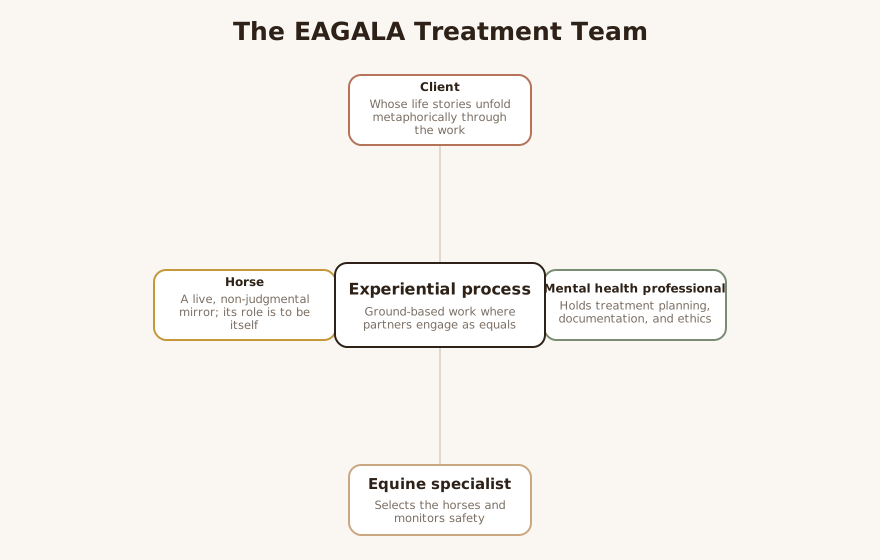
The first core principle is the treatment team. EAGALA-model EAP requires three participants beyond the client: a licensed mental health professional, a qualified equine specialist, and the horses themselves, working “as equal partners in an experiential process” 5. The division of labor is concrete — the mental health professional is “responsible for treatment planning, documentation, and ethics,” the equine specialist “selects horses and monitors safety,” and the horses’ role is “to simply be themselves” 8. This two-professional structure is not incidental; it is what allows the clinical frame to be held safely while a large, unpredictable animal is in the room LLM.
The second principle is that the work is ground-based and metaphor-driven. EAGALA states plainly that it “is a ground-based therapy — there is no riding of the horses,” and that the goal “is not to teach riding or horsemanship but to provide an opportunity for the client’s life stories to unfold metaphorically” 5. Because all work occurs on the ground, “anyone can benefit even with no prior horse knowledge” 8. The horse functions as a live, non-judgmental mirror: a prey animal exquisitely sensitive to body language, arousal, and intention, whose behavior externalizes the client’s relational and regulatory patterns in real time 5 LLM.
The third principle is experiential self-discovery over instruction. Sessions emphasize “experiential learning, reflection, projection, and self-discovery” with “considerably less speaking” than conventional therapy 8. The horses are framed as offering “an environment for clients to discover their answers within themselves” rather than as a vehicle for the therapist’s interpretations 5. The client interacts; the horse responds; the team helps the client notice and make meaning of what just happened.
Interventions & Techniques
A typical session pairs simple, concrete horse-directed tasks with reflective processing. Common activities include “basic caretaking activities with the horse … grooming the animal, feeding it, and leading it around an enclosure,” after which “the mental health professional and the client will usually discuss what occurred, what was learned, and what behaviors or emotions they might target” 7. In EAGALA-model work, structured ground activities are typically set up inside an arena, and the client’s interactions with the horse(s) become the raw material for reflection, projection, and self-discovery 8.
Beyond caretaking tasks, the field has produced more specified protocols. The veterans review describes “Whispers with Horses,” “a new model of EAS intervention” that combines “mindfulness and self-compassion into a six-session psychotherapy and horse (PIH) program tailored for traumatized veterans” — an example of how generic equine work is being manualized into time-limited, mechanism-targeted formats 2. Across studies, outcomes are tracked with standard instruments rather than bespoke scales, including the PTSD Checklist (PCL-5, PCL-M), the Clinician-Administered PTSD Scale (CAPS-5), the Beck Depression Inventory, and quality-of-life measures 2. Notably, some studies have also captured physiological signals such as “reduced heart rate,” with the effect most prominent “on days when the veterans were more sedentary and spent more time grooming and petting the horses” 2.
LLM-generated illustrative example (not a guideline): A hypervigilant client is asked simply to lead a horse across the arena and through a low obstacle. The horse balks and drifts; the client’s frustration spikes and their commands get sharper, and the horse disengages further. In processing, the team helps the client notice the parallel to how their controlling demands escalate when a partner pulls away — a relational pattern made visible by the horse rather than narrated from memory. LLM
Evidence Base
The honest summary is that EAP is an emerging evidence base with encouraging but methodologically weak support. The authors of the veterans review state directly that “the field of equine-assisted psychotherapy (EAP) is still in its infancy” and that “because EAS interventions are in the initial phases of scientific development, thorough investigations are generally insufficient, and there is no standardized intervention strategy” 2. The trauma-focused social-work literature echoes this, positioning EAP as “an emerging trauma-informed intervention” that shows “strong, positive effects” while explicitly emphasizing the need to “build the evidence base in the field” 4.
The signal is real but should not be overstated. The veterans systematic review identified 10 studies (from 85 screened), spanning roughly 333 veteran participants, and reported that “across the board, regardless of the specific equine intervention applied, all veterans with PTSD exhibited benefits,” with six of the studies “conclusively” establishing efficacy while “two did not yield definitive results” 2. The methodological caveats are substantial and candidly stated: “the majority of experiments were constrained by small sample sizes,” randomization was frequently absent so “the potential for selection bias was evident,” and “open trials may yield inflated results, and observed symptom changes could merely be attributed to the passage of time” 2. Durability is also uncertain — some studies “observed symptom recurrences and elevated test questionnaire scores after a three-month interval,” and “only a minority of the studies reviewed incorporated follow-up assessments” 2. The review’s bottom line is appropriately measured: equine-assisted intervention “has been shown to be effective, but further research is merited” 2. Consistent with this, some commentators “caution that the evidence in favor of equine therapy is lacking or inconclusive, and that it should not be used in place of traditional therapy” 7. For a clinician, the defensible stance is that EAP is a promising adjunct whose benefits may operate substantially through recognized common factors — engagement, embodiment, novelty, and the therapeutic relationship — and not yet a first-line, trial-validated treatment LLM.
Populations & Indications
The strongest concentration of study is in trauma and PTSD, particularly among veterans, where the bulk of the systematic-review evidence sits 2. More broadly, EAP targets “children, adolescents and adults who have experienced trauma,” with particular relevance for “trauma and stressor-related disorders” and for vulnerable populations 4. Explainer-level descriptions extend the typical clinical reach to “ADHD, addiction, autism, PTSD, anxiety, and depression,” plus “common life challenges such as grief or low self-esteem,” generally for adults and children over about age six 7. EAGALA-model programs similarly list “depression, anxiety, PTSD, grief, addiction, trauma, and behavior modification” among their applications 8.
The populations most likely to benefit are those for whom verbal, insight-oriented work has stalled — clients whose trauma “render[s] traditional talk therapies ineffective,” who are avoidant or alexithymic, or who are more reachable through doing than through talking 4. From a clinical standpoint, EAP’s low-verbal, high-engagement format makes it a reasonable consideration for trauma survivors with strong avoidance, for adolescents resistant to office-based therapy, and for clients whose presenting difficulties are fundamentally relational LLM. “Indication within the model,” however, is not the same as “clinical indication”: for several of the conditions named above, evidence-based first-line treatments should remain primary, with EAP considered an adjunct LLM.
Problems-for-Work
EAP’s mechanisms map onto a recognizable set of clinical targets. Affect dysregulation is a paradigm case: the literature emphasizes that “through interaction with horses, patients benefit from emotional regulation and reflection,” and that equine work fosters “emotional regulation, mental control, and the mitigation of negative attitudes” 2. Attachment and relational patterns surface through the horse as a responsive partner — interactions “serve as catalysts for the emergence of new ideas and emotions” and help clients “re-establish trust” 2.
LLM-generated illustrative example (not a guideline): A withdrawn adolescent who refuses to make eye contact in office sessions spends three weeks grooming and leading a calm gelding before any “therapy talk” begins. The non-demanding, side-by-side contact lowers the relational threat enough that the eventual processing about distrust of adults can happen at all. LLM
Hyperarousal and physiological reactivity are addressable through the embodied, calming dimension of the contact, consistent with the observed reductions in heart rate during quiet grooming 2. Avoidance and difficulty with verbal processing are met by the experiential format itself, which gives clients “a sensory experience and a sense of control” and bolsters “communication and mindful awareness” without requiring them to narrate 2. Low self-image and self-efficacy can shift as clients succeed at concrete tasks with a large animal, with studies documenting development of “a healthier, stronger self-image” 2.
Contraindications, Cautions & Cultural Humility
The most concrete cautions are practical and physical. Prospective clients are advised to “talk to a mental health professional beforehand to determine whether equine therapy is right for them”; “someone with a serious fear of horses” or with relevant physical limitations may find it unsuitable 7. A large prey animal is inherently unpredictable, which is precisely why the equine specialist’s safety role is non-negotiable and why the work is team-delivered 8 LLM.
Clinically, EAP should not be positioned as a replacement for established care: some researchers caution that the evidence “is lacking or inconclusive, and that it should not be used in place of traditional therapy” 7. For clients with acute trauma activation, severe dissociation, psychosis, or active safety concerns, the novelty and unpredictability of the equine field could destabilize rather than help, and standard evidence-based stabilization should take precedence LLM. Access and equity are also real considerations: EAP requires horses, land, arenas, and dual-professional staffing, making it resource-intensive and geographically limited, which raises fairness questions about who can actually receive it LLM. Cultural humility includes attending to clients’ varied relationships to animals and to the outdoors, never assuming the horse is universally experienced as benign or meaningful LLM. Finally, scope-of-practice matters: the mental health professional, not the equine specialist, owns the clinical formulation, documentation, and ethics 8.
Treatment-Plan Suggestions & SMART Objectives
The objectives below translate EAP’s mechanisms into documentable goals delivered within the model’s standard structure — a licensed clinician working with an equine specialist — and framed as an experiential intervention, not a replacement for first-line trauma care LLM.
| Goal | SMART objective (example) | Mechanism |
|---|---|---|
| Improve affect regulation | Client will identify and name one rising emotion during a ground activity and use a paced-breathing skill to down-regulate it in 3 of 4 sessions over 8 weeks | Experiential emotion regulation and reflection during horse interaction 2 |
| Reduce trauma-related avoidance | Client will complete one new horse-directed task they previously declined within 6 weeks, with self-rated distress (SUDS) logged before and after | Graded, embodied exposure in a non-verbal field 2 4 |
| Strengthen relational trust | Client will describe one parallel between a horse interaction and a real relationship in 4 sessions over 8 weeks | Horse as responsive partner catalyzing new relational insight 2 |
| Lower physiological hyperarousal | Client will engage in 10 minutes of quiet grooming per session and report reduced felt tension over 4 weeks | Calming, sensory contact associated with reduced heart rate 2 |
| Increase self-efficacy / self-image | Client will independently lead a horse through a 3-element obstacle course by week 6 and articulate one competence statement | Mastery of concrete tasks builds “a healthier, stronger self-image” 2 |
| Build present-moment awareness | Client will note 2 in-the-moment body or emotion observations per session, logged over 6 weeks | Mindful awareness bolstered by experiential, sensory engagement 2 |
| Generalize gains to daily life | Client will apply one regulation skill practiced with the horse to a named real-world trigger weekly over 8 weeks | Transfer of experiential learning to context 4 LLM |
Common Misconceptions
“Equine therapy means riding horses.” EAGALA-model EAP is explicitly ground-based: “there is no riding of the horses,” and “the goal is not to teach riding or horsemanship” 5. Riding “is not often a component of mental health treatment, but may occur during equine-assisted physical therapy or occupational therapy” 7. “EAP and hippotherapy are the same thing.” They are not; the literature treats them as distinct categories, and hippotherapy is a physical/occupational therapy use of the horse’s movement, separate from EAP’s mental-health, ground-based focus 2 7. “You need to be a horse person to benefit.” Because all work is on the ground, “anyone can benefit even with no prior horse knowledge” 8. “It’s the therapist talking; the horse is decoration.” The model is deliberately low-verbal — built on “experiential learning, reflection, projection, and self-discovery” with “considerably less speaking” — and the horse is an active partner, not a prop 8 5. “The evidence is solid and EAP can replace standard therapy.” The evidence is emerging, with small and often uncontrolled studies, and some researchers caution it “should not be used in place of traditional therapy” 2 7.
Training & Certification
The dominant credentialing pathway is through EAGALA, which delivers “comprehensive training” at “training locations” worldwide and certifies practitioners in its model 5. Training is one part of a deliberately standardized package — “a clear theoretical base, standardized implementation, and ongoing training for practitioners” — designed so the model can be evaluated and reproduced consistently 4. In practice, EAP is a two-professional enterprise: the clinical role is filled by a licensed mental health professional who owns “treatment planning, documentation, and ethics,” while the equine specialist who “selects horses and monitors safety” is separately qualified for the equine side 8. The crucial point for a licensed clinician is that an equine-model certification governs how to run EAP, not clinical scope — the credentials that authorize psychotherapy practice remain the clinician’s licensure LLM.
Key Terms
- Equine-assisted psychotherapy (EAP): mental-health treatment using activities with horses, supervised by a mental health professional with an equine specialist 7.
- EAGALA model: the standardized, ground-based, team-delivered EAP model described as “the most robust model of EAP” 4 5.
- Ground-based: all therapeutic work done beside the horse, with no riding 5.
- Equine specialist: the qualified team member who selects horses and monitors safety, distinct from the mental health professional 8.
- Equine-assisted services (EAS): the umbrella field encompassing EAP, equine-assisted learning, therapeutic riding, and related activities 2.
- Therapeutic horseback riding (THR): a riding-based equine intervention, distinct from ground-based EAP 2.
- Experiential learning: change pursued through doing, reflection, and projection rather than primarily verbal interpretation 8.
- Metaphor / projection: the use of the client’s interactions with the horse as a live mirror of their relational and emotional patterns 5.
Resources & Further Reading
- Equine-assisted interventions for veterans with PTSD: a systematic review (PMC)
- Equine-Assisted Psychotherapy: An Emerging Trauma-Informed Intervention — Advances in Social Work
- Equine Assisted Growth and Learning Association (EAGALA) — official site
- Equine-Assisted Therapy — Psychology Today
- What Is EAGALA Equine Therapy? — Equine Assisted Development
Reflective / Supervision Questions
- When I refer or co-treat with an EAP program, how do I keep clinical formulation, documentation, and ethics clearly owned by the licensed clinician rather than diffused across the team? 8 LLM
- Given that the evidence base is emerging and dominated by small, uncontrolled studies, how do I present EAP to a client with honest expectations and informed consent? 2 7 LLM
- For which of my clients would the novelty and unpredictability of a large animal be activating rather than regulating, and how would I screen for that before referral? 7 LLM
- How do I distinguish, in my own thinking and in client conversations, between EAP, hippotherapy, and therapeutic riding so I am referring to the right service for the right goal? 2 7 LLM
- Considering the resource and access demands of EAP, how do I weigh equity when only some of my clients can realistically reach it? LLM
- When a horse interaction surfaces a powerful relational pattern, how do I help the client translate that experiential insight into durable change outside the arena? 4 LLM