
Homophily is the principle, old enough to live in a proverb, that similarity breeds connection: people preferentially form and keep ties with others who resemble them 12. Clinicians meet its consequences constantly without naming the construct, in the isolated client whose whole world is three people exactly like them, in the recovering client whose every friend still uses, in the support group that quietly sorts itself by class or diagnosis LLM. Homophily gives that pattern a name, a mechanism, and a literature precise enough to put into a formulation LLM. This article treats it honestly, because homophily is a robust descriptive finding about how networks form, not a therapy, and the distance between those two things is where clinicians can go wrong LLM.
Type & Discipline
Homophily is a construct, not a modality: a descriptive principle from network science and social psychology that names a regularity in how social ties form and persist 12. The core claim, captured in the adage “birds of a feather flock together,” is that contact between similar people occurs at a higher rate than contact between dissimilar people 12. In network science the same idea is called assortative mixing, the tendency of connected nodes to share attributes, quantified by an assortativity coefficient that runs from strong homophily through random mixing to heterophily, the preference for dissimilar ties 2.
The disciplinary home is therefore plural. The construct sits in sociology and social psychology, where Lazarsfeld and Merton first formalized it, and in modern computational social science and social-network analysis, where it is measured and modeled 124. This matters for how a clinician should hold it. Homophily describes populations and networks; it was never built to explain an individual’s psychopathology, and its clinical value is entirely inferential, helping a practitioner understand why a client’s social world has the shape it does rather than prescribing what to do about it 1LLM.
Creators & Lineage
The term homophily was coined by Paul Lazarsfeld and Robert Merton in 1954, who established it as a foundational sociological concept and gave it the conceptual scaffolding that still organizes the field 12. The word itself is built from the Greek for “same” and “friendship,” and Lazarsfeld and Merton drew the distinction that remains central: status homophily, similarity on socially significant characteristics, both ascribed traits such as race, ethnicity, sex, and age, and acquired ones such as religion, education, and occupation, versus value homophily, similarity in internal attitudes, beliefs, and values regardless of status 12.
The modern synthesis is the much-cited review by Miller McPherson, Lynn Smith-Lovin, and James Cook, Birds of a Feather: Homophily in Social Networks (2001), which assembled more than a hundred network studies into a single account of how pervasively similarity structures human ties 1. The lineage then runs forward into computational and agent-based work that treats homophily not merely as a static correlation but as a dynamic process generating network structure, as in the formal modeling of Talaga and Nowak 4. A parallel applied lineage, represented by the computer-mediated-teams literature, connects homophily to the social-capital tradition, asking what homophilous versus heterophilous ties do for cohesion, trust, and access to resources 3. The construct sits intellectually adjacent to social network theory, social contagion, social-capital theory, and the social-identity tradition, all of which a clinician will find braided through any serious use of it 34LLM.
Core Principles
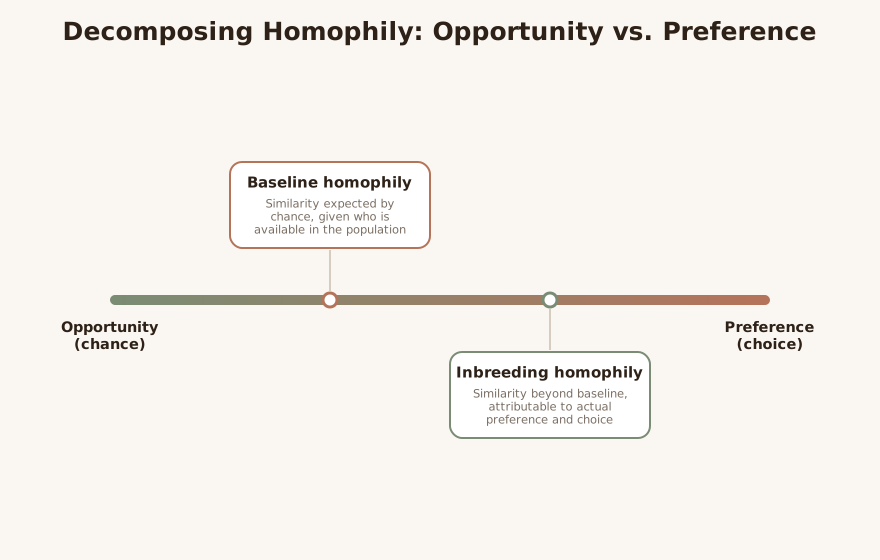
The first and most clinically important distinction is between baseline homophily and inbreeding homophily 12. Baseline homophily is the similarity you would expect by chance, given that the surrounding population is itself unevenly distributed; if a group is small, its members will encounter and connect with each other at high rates simply because of who is available 2. Inbreeding homophily is the similarity that exceeds that baseline, the portion attributable to actual preference and choice rather than mere opportunity 2. This separation is the heart of clinical humility about homophily: a client’s homogeneous network may reflect a constrained environment far more than any personal bias, and the two have very different implications 1LLM.
The second principle is that homophily operates across many dimensions and not equally across them. Across networks, similarity on race and ethnicity tends to divide social worlds most sharply, with smaller minority groups showing higher baseline homophily, while similarity on sex, age, religion, education, occupation, and social class each contribute their own gradients 12. Family of origin seeds substantial baseline homophily in education and class, and clear divides separate the college-educated from the non-college-educated and white-collar from blue-collar networks 2.
The third principle, sharpened by recent theory, is that homophily can be read as either a pattern or a process 4. As a snapshot it is “a correlational statement” that any two connected agents are on average more similar than any two disconnected agents, “irrespective of any causal/dynamic processes that might have produced it” 4. As a process, homophily operationalized as a distance-dependent connection probability naturally generates the clustering, assortativity, and sparsity seen in real networks 4.
The fourth principle is the selection–influence confound, which a clinician must keep in view. Similarity between connected people “may result not only from selection (homophily), but also from influence, as when two individuals are initially dissimilar, but with time become more alike,” and it is “usually very difficult to disentangle these two effects” 4. Homophily (we chose each other because we were alike) and contagion or socialization (we grew alike because we are connected) produce the same observed correlation 4LLM.
Interventions & Techniques
Homophily is a descriptive construct, so it supplies no protocol; its clinical uses are inferential, embedded inside other interventions rather than freestanding LLM. The most direct application is network mapping that distinguishes baseline from inbreeding homophily. Helping a client draw their actual social world and then asking which homogeneity reflects constrained opportunity versus active preference turns an abstract principle into a concrete, individualized picture of where a network might be safely widened 12LLM.
A second application works through the bonding–bridging distinction from the social-capital tradition. Homophilous ties tend to build bonding social capital, “the type that brings closer together people who already know each other,” fostering cohesion and trust, while heterophilous ties build bridging social capital, connections “that bring together people or groups who previously did not know each other” and supply access to novel resources and opinions 3. A clinician can frame the goal not as abandoning a client’s homogeneous, trusted core but as deliberately cultivating a few bridging ties that import what a closed network cannot generate on its own 3LLM.
A third application is attention to homophily in the therapeutic dyad and in group composition. Client–clinician similarity and the makeup of a therapy group are homophily questions, and a facilitator who knows members will gravitate toward similar others can intervene to foster cross-subgroup contact rather than let the room self-segregate 1LLM.
LLM-generated illustrative example (not a guideline): A client in early recovery maps a network composed almost entirely of people who still drink heavily. Rather than framing this as a character flaw, the clinician names it as homophily and distinguishes the baseline part (these were simply the people around) from the inbreeding part (active preference for drinking company). They set a single bridging goal: add one recovery-oriented tie this month, without severing the trusted bonds that still meet real needs LLM.
Evidence Base
The evidence base is established but must be held in layers 1LLM. The descriptive finding itself, that human networks are pervasively homophilous, is among the most robust regularities in social science, documented across more than a hundred network studies and corroborated by the computational literature 12. As basic social-network science, homophily is not seriously in dispute 14.
What is far less established is any clinical claim built on top of it, because homophily is a population- and network-level construct with no standalone treatment evidence LLM. There is no “homophily therapy,” no randomized trial of a homophily intervention, and every clinical inference in this article is exactly that, an inference, tagged accordingly LLM. The same caution that governs importing any social-psychology theory into the consulting room applies here: an established construct is not an established therapy LLM.
A specific evidentiary subtlety deserves emphasis. The applied social-capital research warns against assuming that diverse, heterophilous ties automatically outperform homophilous ones; in at least one study of distributed teams, “only bonding social capital significantly predicted performance” while bridging capital did not, leading the authors to conclude that “building a cohesive team is of primary importance” 3. The honest reading is that homophily “simultaneously builds and divides a community,” unifying those who share characteristics while dividing them from those who do not, so neither homogeneity nor diversity is a clinical good in itself 3. And the selection–influence confound means that even when a client’s network and their distress covary, the construct alone cannot tell you which caused which 4.
Populations & Indications
The construct is most clearly indicated for socially isolated clients, whose networks are often small and highly homogeneous, where distinguishing constrained opportunity from preference, and bonding from bridging capital, can guide concrete network-widening goals 23LLM. It is highly relevant to clients in recovery from substance use, whose existing ties frequently share the very behavior they are trying to change, making the pull of homophily a direct clinical target 1LLM.
Adolescents are a paradigm population, since school-age networks show strong inbreeding homophily and peer similarity shapes norms, identity, and risk 2LLM. Members of marginalized or minority groups are doubly relevant: smaller group size raises baseline homophily, and a homogeneous in-group can be both a stigma-related constraint and a vital source of bonding capital, belonging, and mutual aid that should not be reflexively pathologized 12LLM. Couples and families sit at the dense, high-similarity core of any network, where homogamy, the tendency to partner with similar others, and shared values are the norm rather than the exception 2LLM. Finally, the construct speaks to clients embedded in online echo chambers, where algorithmic reinforcement of ideological matching produces homogeneous personal networks and “limited social worlds” that narrow information and harden attitudes 2.
Problems-for-Work
Homophily gives clinicians language for a cluster of presenting problems organized around the shape of a client’s social world LLM.
- Social isolation and loneliness. A small, homogeneous network may meet some needs while starving the client of bridging ties that supply novel support, opportunity, and perspective; the work is to add bridges without shaming the existing bonds 3LLM.
- Substance use and relapse risk. When a client’s network is homophilous around use, the construct frames peer context as a legitimate, non-moralizing target, supporting the cultivation of recovery-oriented bridging ties 1LLM.
- Echo-chamber rigidity and polarization. Restrictive homophilic patterns “limit minority inclusion and access, exacerbate polarization, maintain disagreement, and foster echo chambers,” which is directly relevant to clients whose rigid worldviews are reinforced by homogeneous online and offline networks 2.
- In-group/out-group bias and intergroup difficulty. Because homophily “divides people with different characteristics” even as it unifies the similar, it underlies the relational distance a client may feel toward those unlike them 3.
- Limited social mobility and opportunity. Class- and education-based homophily channels information and access along homogeneous lines, so a client’s blocked opportunities may be partly a network-structure problem rather than a motivation problem 23LLM.
- Couple and family formation concerns. Homogamy and value homophily shape who clients partner with and the friction that can arise across status or value lines within a family 2LLM.
LLM-generated illustrative example (not a guideline): A socially anxious client reports having “no one,” yet network mapping reveals a tight cluster of long-standing friends who are near-identical demographically and attitudinally. The clinician reframes the felt isolation: the client has strong bonding capital but almost no bridging ties, so novel opportunities rarely reach them. The goal becomes one modest bridging connection through an existing interest, leveraging rather than abandoning the homophilous core LLM.
Contraindications, Cautions & Cultural Humility
The first and most important caution is not to read homogeneity as pathology or as the client’s fault LLM. Much of what looks like a “closed” network is baseline homophily, the product of an unevenly distributed environment rather than personal bias or avoidance, and minority clients in particular face structurally higher baseline homophily simply because of group size 12LLM. Telling such a client their network is “too insular” can mistake a structural constraint for a character flaw LLM.
The second caution is the selection–influence confound as a brake on causal stories 4. Because similarity among connected people can arise from choosing each other or from growing alike over time, and these are “usually very difficult to disentangle,” a clinician should resist confident narratives like “your friends made you this way” or “you only picked them because you were already like this” 4LLM. The construct describes a correlation; it does not license a one-directional causal claim about an individual 4LLM.
The third caution is not to treat diversity as an unqualified good or bonding ties as inferior 3. Homophilous bonding capital supplies cohesion, trust, and belonging, and in some settings predicts outcomes better than bridging capital, so the clinical aim is usually balance, preserving protective bonds while adding bridges, rather than dismantling a homogeneous core 3LLM. Culturally, strong identification with family, faith, ethnic, or community ties is for many clients a healthy and expected form of social life, and a clinician from an individualist orientation should be wary of reading culturally normative homophily, dense same-group networks, in-group marriage, religious community, as enmeshment or a deficit to be corrected 2LLM. Used carelessly, the construct imports the clinician’s own assumptions about what a “good” network looks like LLM.
Treatment-Plan Suggestions & SMART Objectives
| Goal | SMART objective (example) | Mechanism |
|---|---|---|
| Add bridging ties to a homogeneous network | Within 8 weeks, client will initiate contact with 2 people outside their usual circle through an existing interest and log each | Heterophilous ties build bridging social capital, supplying novel resources and perspective 3 |
| Build a recovery-supportive network | Over 6 weeks, client will add one recovery-oriented relationship and reduce contact with one use-cuing tie, reviewed weekly | Counters homophily around substance use by shifting peer context 1 |
| Distinguish constrained opportunity from preference | By session 4, client will map their network and label each cluster as baseline (opportunity) or inbreeding (choice) | Separates structural from preferential homophily to target effort accurately 12 |
| Loosen echo-chamber rigidity | Over 4 weeks, client will identify 2 homogeneous information sources and add 1 differing credible source, tracked weekly | Interrupts homophilic reinforcement that hardens attitudes and fosters echo chambers 2 |
| Preserve bonding capital while widening the network | Within 10 weeks, client will name what their close, similar ties provide and protect that contact while adding 1 bridge | Balances cohesion-giving bonding capital against access-giving bridging capital 3 |
| Reduce out-group distance | Over 6 sessions, client will have one sustained conversation with someone across a salient difference and reflect on it | Counters the dividing face of homophily that separates dissimilar people 3 |
| Normalize culturally rooted same-group ties | By week 6, client will articulate the support their family/faith/community network provides without framing it as a problem | Recognizes adaptive, culturally normative homophily as a resource, not a deficit 2 |
Common Misconceptions
The most consequential misconception is that a homogeneous network reflects the client’s prejudice or social failure; much of observed similarity is baseline homophily driven by an uneven environment, not personal choice, and minority status mechanically raises that baseline 12. A second is that homophily proves influence, that similar friends “made” the client a certain way; the selection–influence confound means similarity can come from choosing alike others or from growing alike, and the two are “usually very difficult to disentangle” 4. A third is that diversity is always better than similarity; homophilous bonding ties build cohesion and trust and can outperform bridging ties on some outcomes, so neither is categorically superior 3. A fourth is that homophily is only about visible demographics; Lazarsfeld and Merton’s value homophily, similarity in attitudes and beliefs, is just as real and often more clinically salient than status homophily 12. A final misconception is that homophily is a settled clinical intervention; it is an established descriptive construct with no standalone treatment evidence, and every clinical use is an inference 1LLM.
Training & Certification
There is no certification in homophily, and none would be appropriate, because it is a research construct rather than a credentialed modality LLM. Clinicians typically encounter it within graduate social psychology, sociology, and any coursework touching social-network analysis, and they put it to use inside training in group psychotherapy, family and couple work, community and social-network interventions, and recovery-oriented practice 1LLM. Competence here is less a course than an accurately held idea: knowing the baseline-versus-inbreeding distinction, the bonding-versus-bridging tradeoff, and the selection–influence confound well enough to use the construct for formulation without overclaiming what it can prove about any one client 134LLM.
Key Terms
- Homophily: the tendency for contact and tie formation between similar people to occur at a higher rate than between dissimilar people 12.
- Baseline homophily: the similarity in ties expected by chance given an unevenly distributed surrounding population 2.
- Inbreeding homophily: similarity in ties that exceeds the baseline, attributable to preference and choice rather than mere opportunity 2.
- Status homophily: similarity on socially significant characteristics, both ascribed (race, sex, age) and acquired (religion, education, occupation) 12.
- Value homophily: similarity in internal attitudes, beliefs, and values regardless of status 12.
- Assortative mixing: the network-science term for connected nodes tending to share attributes, measured by an assortativity coefficient 2.
- Selection vs. influence: the confound between similarity arising from choosing alike others (selection/homophily) and from growing alike through interaction (influence), “usually very difficult to disentangle” 4.
- Bonding vs. bridging social capital: resources from cohesive ties among similar, already-connected people versus resources from ties linking previously unconnected, dissimilar people or groups 3.
- Echo chamber: a homogeneous personal network in which ideologically similar individuals interact, narrowing information and hardening attitudes 2.
Resources & Further Reading
▶ Watch — a video introduction to this concept:
- Birds of a Feather: Homophily in Social Networks (McPherson, Smith-Lovin & Cook, 2001) — Annual Review of Sociology
- Birds of a Feather: Homophily in Social Networks (2001) — open-access reproduction
- Homophily — Wikipedia
- Homophily of Network Ties and Bonding and Bridging Social Capital in Computer-Mediated Distributed Teams — Journal of Computer-Mediated Communication
- Homophily as a Process Generating Social Networks (Talaga & Nowak, 2020) — JASSS
Reflective / Supervision Questions
- When I notice a client’s network is homogeneous, am I distinguishing baseline homophily (constrained opportunity) from inbreeding homophily (active preference), or am I reading it reflexively as the client’s failing? 12LLM
- Am I respecting the selection–influence confound, or am I telling a confident causal story about whether this client chose similar others or was shaped by them? 4
- For this client, what does their bonding capital provide that I would harm by pushing too hard for diversity, and what specific bridge would actually import something they lack? 3LLM
- When a client identifies strongly with a same-group network of family, faith, or community, am I reading it as adaptive belonging or as enmeshment, and whose cultural frame is doing that reading? 2LLM
- For an isolated or recovering client, what is one realistic bridging tie we could build this month without severing the bonds that still meet real needs? 3LLM
- Where might my own homophily, the pull toward clients similar to me, be shaping the therapeutic relationship and my formulation? 1LLM