
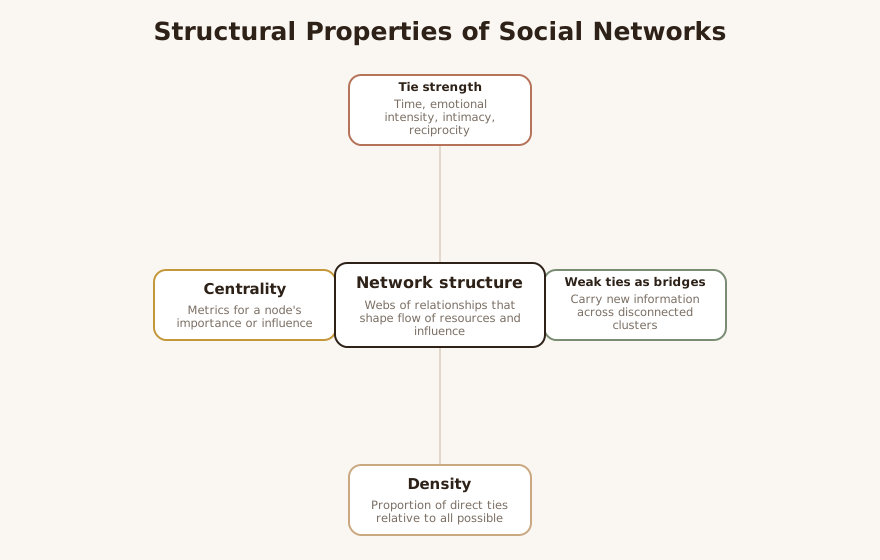
Social network theory is not a therapy. It is a lens — a way of seeing the patient not as an isolated unit of symptoms but as a node embedded in a structured web of relationships whose shape governs what reaches them and what does not LLM. For clinicians who routinely write “limited social support” or “socially isolated” in an assessment, this body of work supplies a precise, testable vocabulary for what those phrases actually mean LLM.
Type & Discipline
Social network theory is a theory drawn from sociology and network science, sitting within the family of structural and relational sociology LLM. Its analytic arm, social network analysis, “examines social structures through networks and graph theory,” characterizing them as nodes (individual actors) and ties (the relationships connecting them) 5. It is structural in emphasis: the claim is that the pattern of connections, somewhat independent of the individuals occupying them, drives outcomes LLM. This distinguishes it from intrapsychic theories that locate causation inside the person and from dyadic theories that stop at the single relationship LLM.
Creators & Lineage
The intellectual roots run through early sociologists such as Georg Simmel and Émile Durkheim, with Jacob Moreno and Helen Jennings introducing the first formal analytic methods — sociometry — in 1934 5. Harrison White and his students at Harvard reformulated the field in mathematical-structural terms, and Linton Freeman gave rigor to the family of centrality measures still used today LLM. The single most cited contribution for clinicians is Mark Granovetter’s “The Strength of Weak Ties,” which argued that loose acquaintance ties, not close intimate ones, are what connect otherwise separated social clusters and carry novel information across them 1. Granovetter revisited and defended the theory a decade later, refining it against criticism and accumulating evidence 4. From the 1970s onward, scholars including Ronald Burt, Mark Granovetter, and Barry Wellman expanded the field’s reach substantially 5. The lineage overlaps directly with social support theory, systems and ecological-systems thinking, and the sociometric tradition that clinicians may already recognize from genograms and ecomaps LLM.
Core Principles
The first principle is that ties vary in strength, and strength is a combination of “time, emotional intensity, intimacy, and reciprocity” 5. Strong ties — family, closest friends — tend toward homophily and proximity; weak ties — acquaintances, colleagues-of-colleagues — are associated with bridges, the connections that link otherwise disconnected segments of a network 5.
The second, and counterintuitive, principle is the strength-of-weak-ties hypothesis: because close contacts tend to know one another and the same things, the genuinely new information and opportunity reaches a person through weaker, more distant ties 1. A bridge between two clusters is almost always a weak tie, so weak ties do disproportionate structural work in diffusing information across a community 1.
The third set of principles is structural-positional. Density is “the proportion of direct ties in a network relative to the total number possible,” indexing how interconnected a network is overall 5. Centrality is “a group of metrics that aim to quantify the ‘importance’ or ‘influence’ of a particular node within a network,” including degree, betweenness, closeness, and eigenvector centrality 5. Structural holes are the gaps between parts of a network, positions that confer informational advantage to whoever spans them 5. Homophily describes the tendency of actors to form ties with similar others — by age, values, occupation, and so on 5. Together these constructs let us describe a person’s social world quantitatively rather than impressionistically LLM.
A fourth principle, often implicit, is social contagion: because networks are conduits, behaviors, norms, moods, and even health states tend to travel along ties, which is why the company a person keeps is clinically load-bearing rather than incidental LLM.
Interventions & Techniques
Social network theory does not prescribe interventions; it supplies an assessment frame that several modalities operationalize LLM. The most direct clinical translation is network mapping — an adaptation of the genogram and ecomap in which the clinician and client jointly diagram ties, mark each as strong or weak, and note direction of support and conflict LLM. A simple egocentric map (the client at the center, ties radiating out) surfaces density, isolated nodes, and missing bridges at a glance LLM.
From the map, three intervention logics follow LLM. Densification aims to add or strengthen supportive ties for an isolated client whose network is sparse LLM. Bridging deliberately cultivates weak ties — a class, a volunteer role, a peer-support group — to import novel resources and opportunities that a dense, closed network cannot supply 1. Pruning and restructuring addresses networks saturated with high-conflict or substance-involved ties, where the structural goal is to reduce exposure to harmful contagion while protecting the client’s remaining support LLM. Because much of the theory’s empirical support concerns information and opportunity flow rather than emotional outcomes, the bridging logic is best framed around concrete access — to jobs, housing, services — where the evidence is strongest 1.
Evidence Base
Here clinical honesty matters. Social network theory is established — but as social science, not as a treatment LLM. The strength-of-weak-ties hypothesis is one of the most influential and replicated ideas in modern sociology, and a large-scale experimental re-test reported in 2022 provided causal evidence that weak ties affect outcomes such as job mobility, broadly supporting Granovetter’s original claim while refining where the benefit peaks 3. The structural constructs — density, centrality, bridges, structural holes, homophily — are well-validated descriptive tools with decades of methodological development 5.
What the provided evidence base does not establish is therapeutic efficacy LLM. The seminal sources concern information diffusion, opportunity, and job-finding, not symptom reduction or mental-health recovery 14. Translation of the theory into clinical mechanisms — that strengthening or diversifying a client’s network reduces depression, loneliness, or relapse — is plausible, clinically intuitive, and partly supported by adjacent social-support research, but it is an extrapolation rather than a direct finding of these sources LLM. Clinicians should therefore use the theory as an assessment and case-formulation frame whose structural claims are solid, while treating its therapeutic payoff as a working hypothesis to be tested with each client LLM.
Populations & Indications
The frame earns its keep wherever the social environment is central to the clinical picture LLM. People with serious mental illness often have small, dense, kin-dominated networks vulnerable to collapse when a single tie is lost, making structural mapping directly relevant LLM. Older adults face network attrition through bereavement and retirement, a structural form of isolation the theory names precisely LLM. Substance use recovery populations live inside networks where contagion runs both ways — toward use and toward recovery — so tie composition is a recovery variable, not a backdrop LLM. People with chronic illness and their families navigate caregiving loads that the map can make visible and distribute LLM. And socially isolated individuals are, almost by definition, the population whose problem the theory is built to describe LLM.
Problems-for-Work
Social isolation and loneliness become tractable when reframed structurally: a near-empty egocentric map points to densification, while a small but closed map may point to bridging toward weak ties 1. Application: a client reporting “no one” usually has more nodes than they name, and mapping recovers them LLM.
Lack of social support is differentiated by the map into the absence of ties versus the presence of ties that do not provide the needed kind of support LLM. Substance use disorder and relapse risk are addressed by examining how saturated the network is with using ties and how reachable recovery-supportive bridges are LLM. Caregiver burden appears as a single overloaded central node, suggesting redistribution across underused ties LLM. Depression and treatment engagement difficulties both track with isolation and with the absence of bridges to services, giving the clinician structural levers alongside symptom-focused ones LLM.
Contraindications, Cautions & Cultural Humility
There are no physical contraindications to drawing a map, but there are real cautions LLM. Pushing a client to expand or prune their network before they are ready can feel coercive and rupture the alliance, particularly for clients whose few ties are precious to them LLM. The theory’s individualistic, opportunity-oriented origins reflect a Western framing of networks as instrumental resources; many clients hold collectivist or kin-centered models in which a dense, closed network is a value, not a deficit to be “bridged” away from LLM. Homophily is descriptive, not prescriptive — clinicians must not treat a client’s culturally homogeneous network as pathology 5. For clients facing structural disadvantage, “just build more weak ties” can blame the individual for barriers — poverty, discrimination, immigration status — that constrain network formation in the first place, a point implicit in Granovetter’s own attention to who can and cannot access bridging ties 4. Cultural humility means asking what a healthy network looks like to this client before importing the theory’s defaults LLM.
Treatment-Plan Suggestions & SMART Objectives
| Goal | SMART objective (example) | Mechanism |
|---|---|---|
| Reduce social isolation | Client will co-create an egocentric network map and identify 3 existing ties to re-engage within 4 weeks | Surfacing latent nodes; densification |
| Diversify support | Client will initiate 2 new weak-tie activities (class, group, volunteer role) over 8 weeks | Bridging to novel resources 1 |
| Strengthen one supportive tie | Client will increase contact with one identified strong tie to weekly over 6 weeks | Increasing tie strength via reciprocity 5 |
| Reduce harmful contagion | Client will map using-related ties and develop a plan to limit exposure to 2 of them within 30 days | Pruning high-risk contagion paths |
| Improve service access | Client will connect with 1 peer-support or case-management bridge within 3 weeks | Spanning a structural hole to services 5 |
| Redistribute caregiver load | Caregiver will delegate 2 caregiving tasks to underused network ties within 4 weeks | Offloading from an overloaded central node |
| Increase treatment engagement | Client will invite 1 supportive tie to participate in a session or safety plan within 6 weeks | Recruiting network support for adherence |
Common Misconceptions
The first misconception is that “more ties are always better” — the theory is about structure and composition, not raw count, and a dense network of conflictual ties can be worse than a sparse healthy one 5. The second is that strong ties matter most for opportunity; Granovetter’s whole point is that weak ties do disproportionate work in carrying novel information across a community 1. A third is that social network theory is itself a therapy that can be “delivered” — it is a descriptive and explanatory frame that modalities operationalize, not a manualized treatment LLM. A fourth is that the sociological evidence proves clinical efficacy; it establishes how networks move information and opportunity, not that network interventions reduce symptoms 3. A fifth is that homophily is unhealthy — it is simply the well-documented tendency toward similarity in ties, neither good nor bad on its own 5.
Training & Certification
There is no certification in “social network theory” as a clinical credential LLM. Clinicians acquire the relevant skills through training in modalities that already incorporate network thinking — family systems therapy, interpersonal psychotherapy, and community-reinforcement approaches — and through the genogram and ecomap competencies taught in most social-work and family-therapy programs LLM. For the analytic side, social network analysis is taught in sociology, public health, and data-science settings, where the formal measures of density and centrality are learned with software tools 5. For most practitioners, foundational fluency comes from reading Granovetter’s original and revisited papers and practicing egocentric mapping in session 14.
Key Terms
Tie — a relationship connecting two actors; node — an actor in the network 5. Tie strength — the blend of time, emotional intensity, intimacy, and reciprocity in a relationship 5. Weak tie — a low-intensity acquaintance relationship, often a bridge 1. Bridge — a tie that links otherwise disconnected parts of a network, usually weak 1. Density — the proportion of actual ties to all possible ties 5. Centrality — metrics of a node’s importance or influence, including degree, betweenness, closeness, and eigenvector 5. Structural hole — a gap between network segments that confers advantage to whoever spans it 5. Homophily — the tendency to form ties with similar others 5. Egocentric map — a network diagram centered on one focal person LLM.
Resources & Further Reading
▶ Watch — a video introduction to this concept:
- The Strength of Weak Ties (Granovetter, 1973) — American Journal of Sociology, full-text PDF
- The Strength of Weak Ties: A Network Theory Revisited (Granovetter, 1983) — PDF
- The strength of weak ties — Stanford Report (2023 retrospective)
- Experimental evidence of the effects of weak ties (2022) — large-scale re-test
- Social Network Analysis — Wikipedia
Reflective / Supervision Questions
- When you write “limited social support,” what structural features of the client’s network are you actually observing — sparse density, missing bridges, or overloaded central ties LLM?
- Where in your caseload might you be pathologizing a dense, culturally valued network as isolation LLM?
- For a given client, is the clinical goal densification, bridging, or pruning — and how would you know it worked LLM?
- How do you reconcile the theory’s instrumental, opportunity-oriented framing with clients for whom kinship and closeness are the point LLM?
- And where are you treating a sociological claim about information flow as if it were settled evidence for symptom change, and how would you test that assumption with this client LLM?