
Social contagion is one of those constructs that practicing clinicians use intuitively long before they can name it. The depressed adolescent whose mood tracks a friend group, the inpatient unit where one act of self-harm is followed by a cluster, the couple in which one partner’s anxiety reliably ignites the other’s: each is a contagion phenomenon. Emotional and social contagion give that intuition a mechanism, a literature, and a vocabulary precise enough to put into a formulation LLM. This article treats both honestly, because the science ranges from well-established, that people automatically “catch” each other’s affect, to genuinely contested, whether moods and behaviors propagate across whole networks the way the most-cited papers claim 5LLM.
Type & Discipline
Emotional contagion is, at its narrowest, a phenomenon of social psychology: a process by which one person’s emotions and related behaviors directly trigger similar emotions and behaviors in others 6. The classic definition frames it as “the tendency to automatically mimic and synchronize expressions, vocalizations, postures, and movements with those of another person and, consequently, to converge emotionally” 6. So defined, it is a low-level, often pre-conscious transfer of affect rather than a conscious appraisal of how someone else feels 1.
Social contagion is the broader sociological and network-science umbrella: the spread not just of momentary affect but of moods, attitudes, norms, and behaviors, smoking, eating patterns, even reported happiness or loneliness, across the ties of a social network 4. The disciplinary home is therefore dual. The affect-transfer mechanism sits in social and affective psychology, while the network-propagation claims sit in sociology, social epidemiology, and computational social science 45. This duality matters clinically, because the two halves do not carry the same evidentiary weight, and a clinician who treats “contagion spreads through three degrees of separation” as settled fact is on far shakier ground than one who notes that two people in a room tend to synchronize their faces 5LLM.
Creators & Lineage
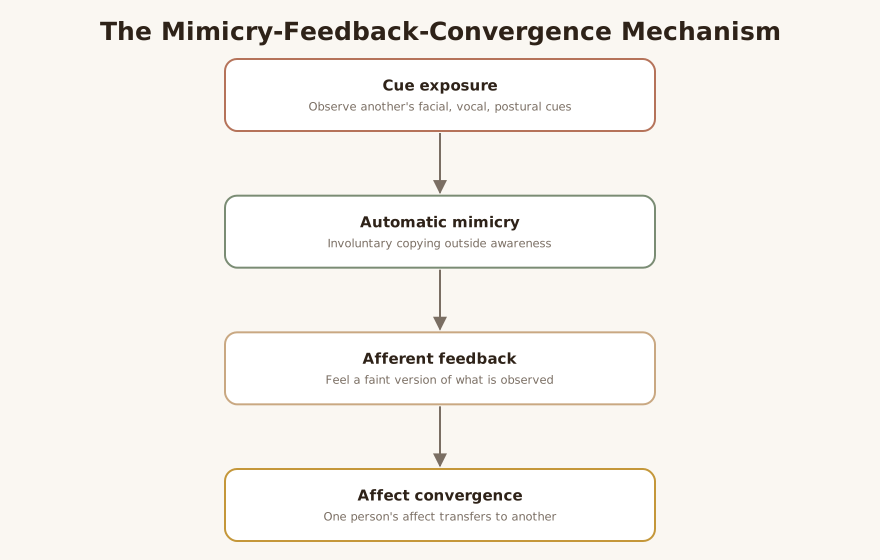
The modern psychological account of emotional contagion was crystallized by Elaine Hatfield and colleagues John Cacioppo and Richard Rapson in their 1994 book Emotional Contagion, which assembled the mimicry-feedback-convergence model into a coherent theory 1. Their “primitive emotional contagion” describes a fast, automatic three-step sequence, mimic, generate matching afferent feedback, converge, that does not require conscious empathy to operate 16. This work drew on much older observations, the eighteenth-century notion of sympathy and the facial-feedback hypothesis among them, but Hatfield’s group gave it experimental and theoretical structure 6.
The network-level lineage runs through James Fowler and Nicholas Christakis, who in a series of high-profile analyses argued that obesity, smoking, happiness, and loneliness spread through social networks across multiple degrees of separation 4. Their loneliness work, with Cacioppo, framed loneliness itself as a contagious and “health-relevant” state that propagates along network ties 4. A parallel computational lineage tested contagion at internet scale: Coviello and colleagues used rainfall as a natural instrument to show that emotional states expressed in Facebook posts influenced friends’ later posts, while Kramer, Guillory, and Hancock ran a controversial experimental manipulation of the Facebook News Feed to test the same claim 23. The intellectual context for all of this includes social network theory, social learning theory, affective empathy, and the much-debated mirror-neuron hypothesis 56.
Core Principles
The first principle is automaticity. Primitive emotional contagion is, in the Hatfield tradition, largely involuntary and outside awareness: people mimic the facial, vocal, and postural cues of those around them and, through afferent feedback, come to feel a faint version of what they observe 6. Contagion in this sense is not the same as empathy; one can “catch” an affect without any deliberate perspective-taking, and the two can dissociate 16.
The second principle is the distinction between simple and complex contagion. Some things spread on a single exposure, like the flicker of a smile, while others require reinforcement from multiple sources in one’s network before they take, a pattern that better fits the spread of behaviors and norms than of momentary affect 5LLM. The third is network structure as a transmission medium: position in a network, density of ties, and degrees of separation are proposed to govern how far a state travels, which is the central claim of the Christakis–Fowler program 4.
A fourth and increasingly important principle is skepticism about the homophily–contagion confound. When two connected people share a mood or behavior, it may be because one transmitted it (contagion), because they were similar to begin with and chose each other (homophily), or because they share an environment, and observational network data struggle to separate these 5. Recent theoretical work goes further, questioning whether “psychological contagion” is a unified phenomenon at all or a loose metaphor stretched across very different processes 5. Holding both the phenomenon and this critique at once is the mature clinical stance 5LLM.
Interventions & Techniques
Social contagion is a descriptive theory, not a treatment package, so its clinical uses are inferential and adjunctive rather than protocolized LLM. The most direct application is harnessing the clinician’s own affect. Because affect transfers automatically, a clinician’s regulated, calm physiology can become a source of co-regulation, and conversely a clinician who is anxious or activated may, without intending it, seed that state in the client 6LLM. Naming this in supervision and deliberately steadying one’s own expression and prosody is a contagion-informed technique 6LLM.
A second application is contagion-aware milieu and family work. On inpatient units, in schools, and in families, recognizing that distress, agitation, and self-harm can cluster lets a team structure the environment to interrupt transmission, for example by reducing exposure to vivid modeling and by strengthening positive, prosocial norms that can spread in the same channels 4LLM. A third is psychoeducation about positive contagion: the same mechanism that spreads low mood can spread warmth, calm, and hope, and helping a client curate their relational and online “emotional diet” follows directly from the network findings 23LLM.
LLM-generated illustrative example (not a guideline): A clinician notices that sessions with a particular client reliably leave the room “buzzing” with the client’s agitation. Rather than treating this only as countertransference, the clinician reframes it as emotional contagion, deliberately slows their own breathing and speech, and uses that downshift as a co-regulating signal. Over several sessions the client’s arousal at the close of session decreases, and the pair name the dynamic together as a shared, catchable state rather than the client’s failing alone LLM.
Evidence Base
The evidence base is established but stratified, and a clinician should hold the layers separately 5LLM. The narrow claim, that humans automatically mimic and emotionally converge with one another, is among the more robust findings in affective psychology and is the foundation of the Hatfield, Cacioppo, and Rapson model 16. At this level, emotional contagion is well supported 6.
The large-network claims are more contested. The Kramer, Guillory, and Hancock (2014) Facebook study was a genuine experiment, randomly reducing positive or negative content in users’ News Feeds, and reported that emotional states are contagious at massive scale, with people who saw less positive content producing fewer positive and more negative posts 2. It is the strongest causal evidence for online emotional contagion, but its effect sizes were extremely small and it became a landmark ethics controversy because users did not consent to the manipulation 2LLM. Coviello and colleagues (2014) addressed causality differently, using rainfall as an instrumental variable to argue that emotional content spreads through Facebook networks without manipulating anyone, and likewise found real but modest effects 3. The Christakis–Fowler network studies on loneliness, happiness, obesity, and smoking are influential but rest on observational data and have drawn sustained methodological criticism over the homophily–contagion confound and the difficulty of proving transmission across “three degrees” 45.
A 2025 theoretical review goes further still, scrutinizing the very construct and arguing that “psychological contagion” is often invoked loosely and may conflate distinct mechanisms 5. The honest clinical bottom line: the moment-to-moment affect transfer you can observe in your own office is well-evidenced, while sweeping claims about behaviors rippling across whole networks are plausible, partially supported, and legitimately disputed 56LLM.
Populations & Indications
The framework is most clearly indicated for adolescents, whose susceptibility to peer influence and norm transmission makes them a paradigm case, and for whom clustering of mood, self-harm, and disordered eating within peer groups is a recurring clinical concern 4LLM. It is highly relevant to social media users of any age, given that the strongest experimental and quasi-experimental contagion evidence comes from online platforms 23.
Families and couples are natural units of analysis, because dense, high-contact ties are exactly where automatic affect transfer and behavioral modeling are strongest 6LLM. Groups in inpatient or school settings are indicated because these are the classic environments in which clustering, of agitation, panic, or self-injury, is observed and must be managed at the milieu level 4LLM. Finally, caregivers are a key population in two directions: they can transmit calm or distress to those they care for, and they are themselves vulnerable to catching the chronic distress of the people they support, a pathway to burnout 46LLM.
Problems-for-Work
- Suicidal ideation and self-harm / non-suicidal self-injury. Clustering of self-harm and suicidality, especially among adolescents and in closed settings, is a recognized contagion concern; the framework supports vigilance about modeling and exposure while staying within established risk-management practice rather than treating contagion as the whole story 4LLM.
- Major depressive disorder and low mood. Mood states show network and dyadic transmission, so a depressed client’s relational and online environment becomes a legitimate target of inquiry and intervention 23LLM.
- Anxiety and emotion dysregulation. Anxious arousal transfers readily in families, couples, and groups via automatic mimicry, making co-regulation and contagion-awareness directly applicable 6LLM.
- Disordered eating. Eating attitudes and behaviors propagate through peer groups and networks, which is part of why disordered eating clusters socially 4LLM.
- Substance use disorder. Behaviors such as smoking have been described as spreading through social networks, framing peer and network context as relevant to use and recovery 4.
- Mass psychogenic illness. The spread of symptoms through a group without an organic cause is a textbook contagion phenomenon that the framework directly illuminates 6.
- Burnout. Caregivers and clinicians who chronically absorb others’ distress through emotional contagion are at risk of depletion, linking contagion theory to occupational well-being 6LLM.
LLM-generated illustrative example (not a guideline): A school counselor sees three students from the same friend group present with new self-injury within two weeks. Rather than treating each case in isolation, the counselor formulates the cluster partly through a contagion lens, coordinating with the team to reduce vivid peer exposure, to avoid sensationalizing the behavior, and to strengthen help-seeking norms, while still completing a full individual risk assessment for each student LLM.
Contraindications, Cautions & Cultural Humility
The first caution is epistemic humility about the network claims. Because the homophily–contagion confound is unresolved for much of the observational literature, and because a recent review questions the construct itself, a clinician should not present “your depression is contagious and spreading to three degrees” as established fact, nor build a treatment plan on the assumption that population-level findings determine an individual case 5LLM. Effect sizes in the strongest studies were small, and small average effects do not license strong individual predictions 2LLM.
The second caution is avoiding blame and contagion-shaming. A contagion frame can curdle into telling clients their distress is “infecting” loved ones, or that they must cut ties to recover, which can deepen isolation and shame, particularly dangerous in suicidality and depression 4LLM. The third is the ethics shadow cast by the Kramer study: it is a standing reminder that manipulating people’s emotional environments without consent is a serious harm, which should make clinicians thoughtful about any deliberate engineering of a client’s relational or online affect 2LLM.
Culturally, emotional expression, mimicry norms, and the boundaries between self and group vary widely, so the very baseline of what “catching” an emotion looks like differs across cultures, and a clinician should not read culturally normative interdependence or expressive synchrony as pathology 6LLM. With family and collectivist clients especially, the contagion lens should illuminate shared emotional life without pathologizing closeness LLM.
Treatment-Plan Suggestions & SMART Objectives
| Goal | SMART objective (example) | Mechanism |
|---|---|---|
| Reduce absorption of others’ distress (caregiver burnout) | Within 6 weeks, client will practice a named downshift skill after each high-distress contact and log activation 0–10 daily | Interrupts automatic affect transfer that drives caregiver depletion 6 |
| Curate the relational/online “emotional diet” | Over 4 weeks, client will identify 2 mood-lowering and 2 mood-lifting sources in their feed and adjust exposure to each | Emotional states propagate through online networks 23 |
| Build co-regulation in a couple | Within 8 weeks, partners will use a shared calming cue during escalation in ≥3 conflicts per week, tracked in a log | Counters reciprocal anxiety contagion via deliberate convergence on calm 6 |
| Strengthen protective peer norms (adolescent) | Over 6 sessions, client will name 2 friends who model help-seeking and increase contact with them weekly | Leverages positive simple/complex contagion of prosocial behavior 4 |
| Reduce exposure to self-harm modeling | By week 4, client and clinician will identify and reduce 2 sources of vivid self-harm content, reviewed weekly | Limits modeling pathways implicated in self-harm clustering 4 |
| Increase awareness of contagion vs. self-blame | Within 5 sessions, client will distinguish “caught” affect from “my failing” in ≥3 logged episodes | Reframes shared states as catchable, reducing shame 65 |
| Support recovery via network context (substance use) | Over 8 weeks, client will add one recovery-supportive relationship and reduce contact with one use-cuing tie | Behaviors spread through network ties, so context shapes use 4 |
Common Misconceptions
The most consequential misconception is that emotional contagion is the same as empathy. It is not; contagion is the automatic catching of affect, which can occur without any conscious perspective-taking and can dissociate entirely from empathic concern 16. A second is that the network findings are settled science; in reality the cross-network propagation claims rest largely on observational data complicated by the homophily–contagion confound and have been seriously contested 5. A third is that the Facebook studies proved emotions spread powerfully online; both the experimental Kramer study and the rainfall-instrument Coviello study found real but very small effects, and the former is remembered as much for its ethics failure as for its science 23. A fourth misconception is that contagion is always negative; the same channels carry calm, warmth, and prosocial norms, and positive contagion is as real as the negative kind 23LLM. A fifth is that “social contagion” is a single, unified mechanism; recent theoretical work argues the term is often used loosely across genuinely different processes 5.
Training & Certification
There is no certification in social or emotional contagion, and none would be appropriate, because it is a body of theory and findings rather than a credentialed modality LLM. Clinicians typically encounter it within graduate social and affective psychology, within training in family and couple therapy, group and milieu work, and within suicide-prevention curricula that address clustering and safe-messaging practices 4LLM. Competence here is less about a course and more about absorbing the construct accurately, including its limits, so that one can use it for formulation and co-regulation without overclaiming the network science 5LLM.
Key Terms
- Emotional contagion: the tendency to automatically mimic and synchronize expressions, postures, and vocalizations with another person and, as a result, to converge emotionally 6.
- Primitive emotional contagion: the fast, automatic mimic–feedback–converge sequence that transfers affect without conscious empathy 16.
- Social contagion: the broader spread of moods, attitudes, norms, and behaviors across social-network ties 4.
- Simple vs. complex contagion: spread that requires only a single exposure versus spread that requires reinforcement from multiple network sources 5LLM.
- Homophily–contagion confound: the difficulty, in observational network data, of distinguishing genuine transmission from pre-existing similarity or shared environment 5.
- Degrees of separation: the claim, central to the Christakis–Fowler program, that states propagate beyond direct ties to friends-of-friends and further 4.
- Mass psychogenic illness: group-level spread of symptoms in the absence of an organic cause, a paradigmatic contagion phenomenon 6.
Resources & Further Reading
▶ Watch — a video introduction to this concept:
- Emotional Contagion (Hatfield, Cacioppo, & Rapson, 1994) — Cambridge University Press
- Experimental evidence of massive-scale emotional contagion through social networks (Kramer, Guillory & Hancock, 2014, PNAS)
- Detecting Emotional Contagion in Massive Social Networks (Coviello et al., 2014, PLOS ONE)
- Loneliness and social-network contagion overview (Cacioppo, Fowler & Christakis) — PMC
- The spread of mind: psychological contagion in theory and critique (2025, Frontiers in Psychology)
- Emotional Contagion — Wikipedia
Reflective / Supervision Questions
- When I leave a session activated or depleted, am I treating that only as countertransference, or am I also asking whether I “caught” the client’s affect, and what I can do with that information? 6LLM
- Am I distinguishing the well-established claim (two people synchronize affect) from the contested claim (states ripple across whole networks) when I formulate this case? 56
- For an adolescent in a peer cluster of self-harm or disordered eating, how do I attend to contagion pathways without reducing each individual to a node and skipping a full individual assessment? 4LLM
- Where might a contagion frame be sliding into blame, telling a client their distress is “infecting” others, and how do I name shared, catchable states without shame? 46LLM
- For this caregiver or this couple, what would deliberately seeding calm rather than catching anxiety look like in the next two weeks? 6LLM
- Am I reading culturally normative emotional interdependence as healthy shared life, or as pathology? 6LLM