
Social exchange theory is not a therapy and was never built to be one. It is a basic social-science account of how relationships work: a claim that “social behavior is the result of an exchange process, in which people weigh the potential benefits and risks of relationships” 2. For clinicians, its value is conceptual rather than procedural. A great deal of the distress that fills couples, family, and individual caseloads is organized around perceived imbalance, unreciprocated effort, resentment, and the agonized question of whether to stay or go, and social exchange theory supplies a precise vocabulary and a small set of mechanisms for exactly those experiences LLM. Used well, it explains why a client feels short-changed, why a person stays in a relationship they describe as miserable, and why effort that goes unreturned curdles into contempt LLM. Used badly, it reduces love to accounting, and the cautions below take that risk seriously LLM.
Type & Discipline
Social exchange theory is a descriptive, explanatory theory of social behavior, not a treatment, diagnosis, or stand-alone therapy LLM. Its founding proposition is that “behaviour in social groups is a form of exchange,” in which individuals evaluate whether relationships yield sufficient rewards relative to costs and to alternative options 1. The resources traded in these exchanges are not only material; they include “love, status, money, information, services and goods,” so the theory distinguishes socioemotional rewards that enhance self-esteem from economic benefits that meet financial needs 1.
The theory’s disciplinary home is genuinely mixed, which is worth holding in mind when applying it LLM. It emerged from a convergence of sociology, the behaviorist psychology of operant conditioning, microeconomic cost-benefit calculus, and the utilitarian premise that self-interest drives behavior 5. That hybrid origin is why the same theory can be stated in the language of reinforcement, of profit, or of social structure depending on which founder one reads 5. For a clinician, the practical consequence is that social exchange theory originated as basic science about ordinary social life, not as a model of psychopathology, so its clinical relevance is downstream and inferential: it explains the shape of relational problems but does not itself prescribe a treatment LLM.
Creators & Lineage
The theory has several founders working from different angles, which is part of why its constructs are rich but not always perfectly aligned LLM. The sociologist George Homans founded the modern theory in 1958 with “Social Behavior as Exchange,” defining social exchange as “the exchange of activity, tangible or intangible, and more or less rewarding or costing between at least two persons” 5. Homans grounded his account in behaviorism, articulating propositions such as a success proposition (behavior that produces reward tends to be repeated), a value proposition (the more valued an outcome, the more likely the behavior), and a deprivation-satiation proposition (repeated rewards lose value over time) 5. His focus was the “individual behavior of actors in interaction with one another,” especially the dyad 5.
Peter Blau extended Homans’s work using economic terminology and distinguished social from economic exchange: unlike market transactions with fixed prices, “the elements of social exchange are quite varied and cannot be reduced to a single quantitative exchange rate” 5. Richard Emerson added power-dependence theory, in which “the dependence a person has on another brings up the concept of power,” locating power in the structure of exchange networks, and his later synthesis characterized social exchange as “an economic analysis of noneconomic social situations” from which other theories could converge 5.
Running alongside the sociologists, the psychologists John Thibaut and Harold Kelley developed the strand most useful in the consulting room LLM. In 1959 they established that people pursue relationships in which “rewards are greater than cost (net profit)” and tend to abandon those that represent net losses 2. Their work is the direct ancestor of interdependence theory and equity theory, and their cost-benefit logic was later operationalized in behavioral and integrative behavioral couples therapy, where partners’ exchanges of pleasing and displeasing behavior become an explicit target of treatment 2LLM.
Core Principles
The first principle is the cost-benefit calculus itself: relationships are evaluated through a kind of profit equation in which profit equals rewards minus costs, with satisfaction emerging from positive outcomes and dissatisfaction from net losses 2. Rewards are benefits received, abstract like love or concrete like gifts, while costs involve “forfeiting something else of value,” including the opportunity costs of time and energy invested in a relationship that does not develop 2. The theory assumes that humans seek rewards and avoid punishments, are broadly rational, and apply standards that vary from person to person and over time 5.
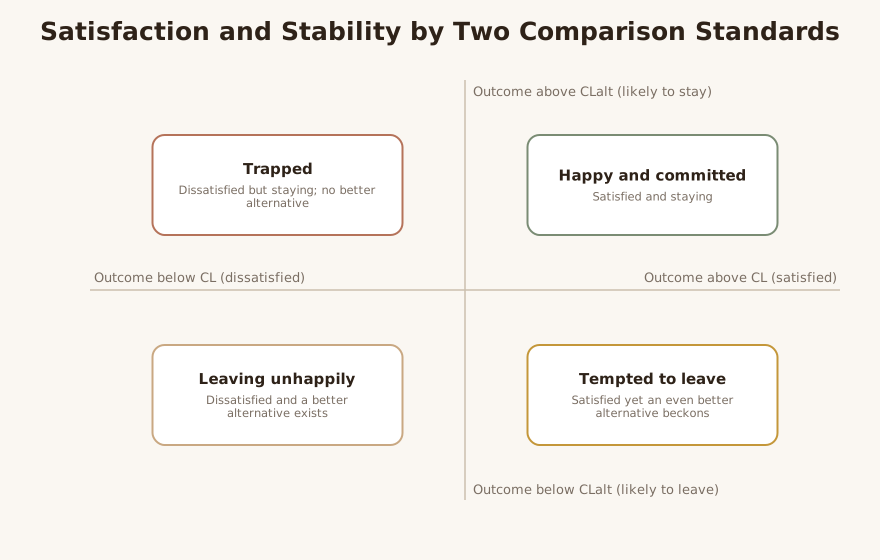
The second and, for clinicians, most important principle is the pair of comparison standards LLM. The comparison level (CL) is “a standard representing what people feel they should receive in the way of rewards and costs from a particular relationship,” shaped by media, past relationships, and self-esteem; it tracks satisfaction 52. The comparison level for alternatives (CLalt) is “the lowest level of relational rewards a person is willing to accept given available rewards from alternative relationships or being alone,” and it tracks stability 5. These two are not the same axis, and their independence is the theory’s central clinical insight: “if people see no alternative and fear being alone more than being in the relationship, social exchange theory predicts they will stay,” even when satisfaction is low 5.
The third principle is reciprocity — “the giving of benefits to another in return for benefits received” — which creates mutual obligation and, in its normative form, holds that a benefit should be returned and that the giver should not be harmed 15. Reciprocal exchange typically operates “without a strict timeframe and conditions,” so trust is required to bridge the gap between giving and being repaid 1. Closely related is equity, the sense that the balance of inputs and outcomes between partners is fair, which motivates continued participation 1. The final principle is interdependence: outcomes depend on both parties’ actions, and relational life is treated as an ongoing process rather than a fixed state 5.
Interventions & Techniques
Because social exchange theory is an explanatory theory rather than a therapy, there are no proprietary “social exchange techniques”; the concept shapes formulation and is then operationalized through recognized modalities LLM. The most direct application is mapping the exchange: helping a couple or individual make explicit what each person is putting in and getting out, which converts a vague sense of unfairness into a workable inventory of rewards, costs, and unmet expectations 1LLM. This maps onto the behavior-exchange and caring-behaviors work of behavioral and integrative behavioral couples therapy, in which partners deliberately increase the frequency of pleasing exchanges 2LLM.
A second move is separating satisfaction from stability by working the CL and CLalt distinction overtly LLM. When a client is anguished about a relationship, asking what they believe they deserve (CL) as a separate question from what they think their alternatives are (CLalt) often clarifies a paralysis that felt like a single, unsolvable problem 5LLM. A third move is renegotiating reciprocity and equity: where one partner perceives chronic under-benefit, the work is to surface the imbalance, test whether it is real or perceived, and rebuild a reciprocity the giving partner can trust will be returned 1LLM.
LLM-generated illustrative example (not a guideline): A partner says, “I do everything and get nothing back.” Rather than adjudicating who is right, the clinician helps the couple list, concretely, the rewards and costs each experiences in a typical week. The under-benefited partner’s resentment becomes legible as a real equity gap, and the work shifts to small, reliable, reciprocal exchanges that the giving partner can actually see being returned LLM.
Evidence Base
Social exchange theory is an established theory across sociology and social psychology, the product of decades of work since Homans’s 1958 founding paper and continuously taught and applied to relationships, caregiving, organizational behavior, and trust 51. As a theory, its core constructs — rewards and costs, comparison level, comparison level for alternatives, reciprocity, equity, and power-dependence — are well characterized and widely used 5.
The honest appraisal for clinicians is the same one that applies to most social-science theories imported into the consulting room: an established theory is not an established therapy LLM. There is no “social exchange therapy” with its own randomized trials, because no such modality exists; the theory’s clinical utility is downstream, embedded within couples and family work, where its constructs help explain mechanism rather than deliver a tested package LLM. What can be said with more confidence is that the modality most directly built on exchange principles is supported: integrative behavioral couples therapy, which uses social-exchange logic, has achieved significant improvement in roughly two-thirds of participating couples 2. The principles are sound and the modality is evidenced; the theory itself supplies the rationale, not the trial data LLM.
The theory also carries internal limitations a clinician should weigh honestly LLM. Critics charge that it “reduces human interaction to a purely rational process that arises from economic theory” and wrongly assumes that “the ultimate goal of a relationship is intimacy when this might not always be the case” 5. Its constructs have been called “non-exhaustive and overlapping,” with terminology that wavers over whether an exchange is a relationship or a transaction and with imprecise rules for reciprocity 1. Perhaps the most practically important critique is that “operationalizing rewards and costs is hugely subjective,” which limits how cleanly the model can be measured or applied 2. These limitations mean the theory is best held as a formulation heuristic, not a precise predictive law LLM.
Populations & Indications
The theory’s natural populations are dyads and small relational systems whose distress is organized around perceived exchange 1. It is most directly applicable to couples and families, where rewards, costs, reciprocity, and fairness are negotiated continuously and where imbalance is a frequent presenting concern 1LLM. It speaks with particular force to people in conflictual relationships, for whom the language of equity and reciprocity can convert a circular blame contest into a shared problem about a lopsided ledger 1LLM. It is also apt for adults navigating friendships and work relationships, since the same exchange logic governs collegial and social bonds, not only romantic ones 1.
Two populations deserve special mention LLM. Caregivers experience an exchange that has become structurally one-directional, pouring out rewards while receiving little reciprocal return, which the theory frames as a chronic equity deficit rather than a personal failing 1LLM. And people considering divorce are, in the theory’s terms, caught precisely at the intersection of a low comparison level (the relationship falls short of what they feel they deserve) and a comparison level for alternatives that may be pulling either way; making those two judgments explicit is often the clinical task 5LLM. The clearest indication for invoking the framework is any presentation in which a client’s distress centers on unfairness, unreciprocated effort, or the stay-or-leave dilemma LLM.
Problems-for-Work
Social exchange concepts give clinicians language for a recognizable cluster of relational problems, most of which turn on the reward-cost ledger and the CL/CLalt distinction LLM.
- Relationship dissatisfaction and marital distress. When current rewards fall below the comparison level — what a person feels they should be receiving — satisfaction drops, and naming the gap between expectation and experience is the first clinical move 52.
- Resentment. Chronic under-benefit relative to what one puts in produces resentment as a predictable equity response; the work is to surface and test the perceived imbalance rather than treat the resentment as a character flaw 1LLM.
- Caregiver burden and burnout. A caregiving relationship is an exchange skewed toward sustained cost with little reciprocal reward, which the theory reframes as a structural equity deficit that calls for restored reciprocity or external support, not simply more endurance 1LLM.
- Codependency and staying in dissatisfying relationships. The model’s signature prediction is that a low comparison level for alternatives — seeing no better option and fearing being alone — keeps people in relationships they openly dislike, which reframes “why won’t they just leave” as a CLalt problem to be worked, not a moral failing 5LLM.
- Communication problems. Much miscommunication is the breakdown of legible reciprocity; making the exchange of pleasing and displeasing behaviors explicit, as behavioral couples work does, gives partners a concrete object to repair 2LLM.
- Trust difficulties and boundary problems. Because reciprocal exchange operates without a strict timeframe, trust is what bridges giving and being repaid; where trust has failed or boundaries are porous, the ledger feels unsafe, and rebuilding reliable reciprocity is the route back 1LLM.
LLM-generated illustrative example (not a guideline): A client who has cared for a parent for three years says she “should be able to handle it” and feels guilty for resenting it. Reframed through exchange, the clinician notes that the caregiving relationship has become almost entirely cost with little return, a structural equity deficit rather than a deficit in her. The work turns toward restoring some reciprocity, recruiting outside support, and naming the imbalance without shame LLM.
Contraindications, Cautions & Cultural Humility
The first and most important caution is against the theory’s own greatest weakness: economic reductionism LLM. The model is fairly criticized for reducing “human interaction to a purely rational process that arises from economic theory,” and a clinician who hands a grieving or devoted client the language of profit and loss can do real harm 5. Love, sacrifice, and commitment are not always rational ledgers, and the theory is explicitly faulted for assuming intimacy is always the goal and for ignoring altruism and role-based obligation that occur without conscious reward calculation 5LLM. The exchange frame is a lens for some relational problems, not a worldview to impose on a client’s intimate life LLM.
A second caution follows from the theory’s own admission that “operationalizing rewards and costs is hugely subjective” 2. What counts as a reward or a cost is profoundly personal and culturally shaped, so a clinician must not assume their own sense of a fair exchange matches the client’s 2LLM. This is where cultural humility becomes load-bearing: in many collectivist and family-centered traditions, sustained one-directional giving toward parents, children, or community is not a pathological equity deficit but a valued expression of duty and love, and reading it through a Western, individualist cost-benefit lens can pathologize what is culturally normative and meaningful LLM. The CLalt prediction also intersects with structural reality — economic dependence, immigration status, caregiving obligations, or safety concerns can make “alternatives” genuinely scarce rather than merely perceived as scarce — and the clinician must attend to those constraints rather than treating them as distorted cognition LLM.
A third caution is clinical triage: relationship distress framed as exchange can co-occur with intimate partner violence, coercive control, depression, or acute risk, and the equity-and-reciprocity narrative must never displace safety assessment LLM. Where there is danger, the exchange frame is set aside, because a “rebalancing” conversation can be unsafe in a coercive relationship, and safety planning takes priority LLM.
Treatment-Plan Suggestions & SMART Objectives
| Goal | SMART objective (example) | Mechanism |
|---|---|---|
| Make the relational exchange explicit | Within 3 sessions, each partner will list the rewards and costs they experience in a typical week and share them in session | Converts a vague sense of unfairness into a workable inventory of rewards and costs 1 |
| Increase positive exchanges | Over 6 weeks, each partner will perform 2 agreed-upon pleasing behaviors per week and log them | Behavior-exchange work raises rewards relative to costs, the basis of net profit 2 |
| Separate satisfaction from stability | Within 4 sessions, client will articulate, as two distinct questions, what they feel they deserve (comparison level) and what their alternatives are (comparison level for alternatives) | Distinguishes the satisfaction axis from the stay-or-leave axis to break paralysis 5 |
| Address resentment from under-benefit | Over 8 weeks, client will name 3 specific equity imbalances and test whether each is actual or perceived | Surfaces and reality-tests the equity deficit driving resentment 1 |
| Rebuild reciprocity and trust | Within 10 sessions, the couple will establish one reliable reciprocal routine the giving partner can see returned | Restores trust that giving will be reciprocated without a strict timeframe 1 |
| Reduce caregiver equity deficit | Over 6 weeks, client will add 2 sources of reciprocal support or respite to a one-directional caregiving load | Reframes burden as a structural equity deficit calling for restored exchange 1 |
| Clarify a stay-or-leave dilemma | Within 6 sessions, client will map the rewards, costs, and realistic alternatives of the relationship without self-judgment | Externalizes the comparison-level and alternatives calculus to support a values-based decision 5 |
Common Misconceptions
The most consequential misconception is that social exchange theory claims people consciously calculate profit and loss in every interaction; the theory is in fact criticized precisely for over-assuming that conscious, rational calculation, and clinicians should treat it as a description of tendencies, not a literal account of how people deliberate 5. A second misconception is that low satisfaction predicts leaving; the theory’s distinctive claim is the opposite — satisfaction (comparison level) and stability (comparison level for alternatives) are separate, so a person can be deeply dissatisfied yet stay because alternatives look worse 5. A third is that “exchange” means money or material goods; the founders were explicit that the resources traded include love, status, information, and services, and that social exchange “cannot be reduced to a single quantitative exchange rate” 15.
A fourth misconception is that reciprocity must be immediate and itemized; reciprocal exchange characteristically operates “without a strict timeframe and conditions,” which is exactly why trust matters 1. A fifth is that the theory endorses a transactional view of love as the right way to live; it is a descriptive account of one set of relational dynamics, repeatedly faulted for ignoring altruism and non-calculative commitment, not a prescription for how relationships should be conducted 5LLM. A final error is treating the framework as a precise predictive law, when its own literature concedes that operationalizing its central terms is “hugely subjective” 2.
Training & Certification
There is no certification in social exchange theory, and none would be appropriate, because it is a conceptual model rather than a credentialed treatment LLM. Clinicians typically meet it within graduate coursework in sociology, social psychology, and family systems, where Homans, Blau, Emerson, and Thibaut and Kelley are standard reading 5. The applied competence that matters lives in the modalities that operationalize the frame — behavioral and integrative behavioral couples therapy for behavior exchange, and the broader skill set of couples and family work — where supervised practice teaches a clinician to use exchange concepts without reducing a relationship to arithmetic 2LLM. Generalist therapists can legitimately use social exchange theory for formulation provided they represent its evidentiary status honestly and deliver care through modalities in which they are trained LLM.
Key Terms
- Reward: a benefit received in an exchange, abstract (love, status) or concrete (money, services, goods) 1.
- Cost: what is forfeited or given up in a relationship, including opportunity costs such as time and energy 2.
- Profit / outcome: rewards minus costs; positive outcomes yield satisfaction, net losses yield dissatisfaction 2.
- Comparison level (CL): the standard for what a person feels they should receive from a relationship; the index of satisfaction 5.
- Comparison level for alternatives (CLalt): the lowest level of rewards a person will accept given their alternatives, including being alone; the index of stability 5.
- Reciprocity: giving benefits in return for benefits received, typically without a strict timeframe, requiring trust 1.
- Equity: the perceived fairness of the balance between each party’s inputs and outcomes 1.
- Interdependence: the condition in which each party’s outcomes depend on the other’s actions 5.
- Power-dependence (Emerson): the principle that one person’s dependence on another generates the other’s power, structured by exchange networks 5.
- Social versus economic exchange (Blau): the distinction that social exchange involves varied, non-quantifiable resources that cannot be reduced to a single price 5.
Resources & Further Reading
▶ Watch — a video introduction to this concept:
- Social Exchange Theory — Newcastle University TheoryHub
- Social Exchange Theory of Relationships — Simply Psychology
- Social Exchange Theory — ScienceDirect Topics
- Social Exchange Theory (Emerson, 1976) — Annual Review of Sociology
- Social Exchange Theory — Wikipedia
Reflective / Supervision Questions
- When this client describes a relationship as unfair, am I helping them distinguish their comparison level (what they feel they deserve) from their comparison level for alternatives (what they think they can get instead), or am I collapsing two different questions into one? 5LLM
- For a client who stays in a relationship they say they hate, am I reading it as a CLalt problem — scarce or feared alternatives — rather than as weakness or irrationality? 5LLM
- Am I importing my own culturally shaped sense of a “fair” exchange, and have I checked whether this client’s sustained giving is an equity deficit or a valued expression of duty and love? 2LLM
- Where a client’s “lack of alternatives” is structural — economic, immigration-related, safety-related — am I attending to that reality rather than treating it as distorted thinking? LLM
- Have I screened for coercive control or violence before inviting a couple to “rebalance” their exchange, given that a rebalancing conversation can be unsafe in a coercive relationship? LLM
- Am I using the exchange frame as a useful lens for this couple’s specific impasse, or am I reducing their intimate life to profit and loss in a way the theory itself is criticized for? 5LLM