
Type & Discipline
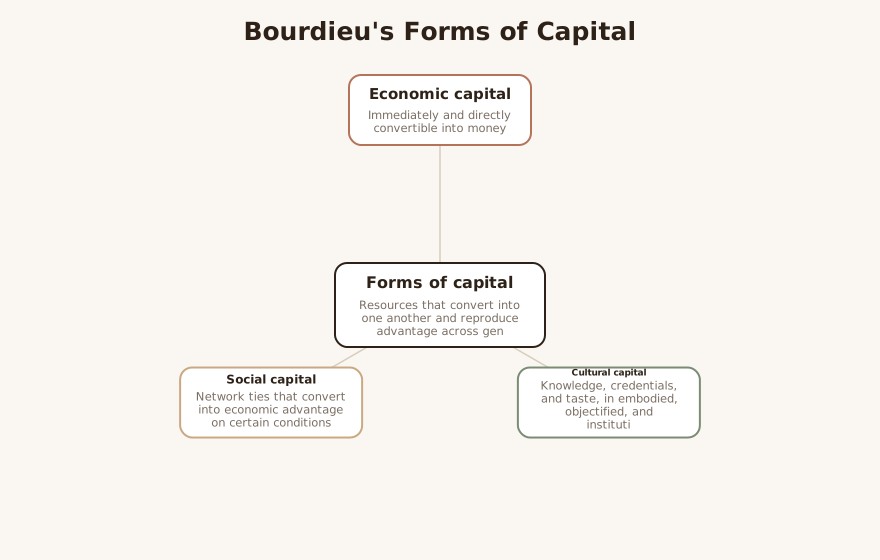
Bourdieu’s forms of capital is a sociological construct, not a psychotherapy modality, and clinicians should hold it as such from the outset LLM. It originates in critical and structural sociology, where it functions as a theory of how advantage is distributed, accumulated, and reproduced across generations 1. The core claim is that “capital” is not only economic but also exists as cultural capital (knowledge, credentials, taste, dispositions) and social capital (durable networks of relationships), and that these forms convert into one another under specifiable conditions 1. For the practicing therapist, the construct offers a vocabulary for naming the structural, non-psychological forces that shape a client’s opportunities, sense of belonging, and self-concept — forces that purely intrapsychic formulations can render invisible LLM. It belongs to the lineage of conflict-oriented and reproduction theory rather than to any clinical evidence base, and nothing in Bourdieu’s own work addresses treatment LLM.
Creators & Lineage
The framework was developed by the French sociologist Pierre Bourdieu, whose 1986 essay “The Forms of Capital” gave the construct its canonical statement 1. The companion concept of cultural capital was introduced by Bourdieu with Jean-Claude Passeron in the 1970s to explain why educational outcomes track social class so reliably 4. The construct sits within a tightly linked conceptual family: habitus — the durable, internalized dispositions and “feel for the game” inculcated by family background and education, which guide perception, judgment, and action 4; field — the structured social arena in which particular capitals are recognized as legitimate and valuable 4; and symbolic capital and symbolic violence, the power to impose recognition and legitimacy, including the institutional devaluation of a person’s home culture that can lead to self-exclusion 24. Relative deprivation — the distress of comparing one’s position unfavorably with others — is a closely allied idea that clinicians will find useful when capital disparities are experienced subjectively LLM. Bourdieu’s project was to expose how meritocracy can disguise inherited advantage, since family transmission of culture is, in his phrase, “the best hidden form of hereditary transmission of capital” 1.
Core Principles
The first principle is plurality of capital: economic capital is “immediately and directly convertible into money,” but cultural and social capital are also genuine resources that convert into economic advantage “on certain conditions” 1. The second is the three states of cultural capital. Embodied cultural capital consists of “long-lasting dispositions of the mind and body” — accent, vocabulary, comportment, taste — acquired slowly through socialization and inseparable from the person; it “cannot be transmitted instantaneously” by gift or purchase 1. Objectified cultural capital is material goods such as books, art, and instruments, which can be owned but yield value only to someone with the embodied capital to appropriate them 1. Institutionalized cultural capital is the credential — the degree or qualification that confers “conventional, constant, legally guaranteed value” independent of the bearer’s actual competence 1.
A third principle is convertibility at a cost: forms convert into one another “only at the cost of a more or less great effort of transformation,” and economic capital underwrites the others by purchasing the free time required to accumulate them 1. A fourth is time and inheritance: embodied cultural capital demands prolonged personal investment, and the family’s economic capital provides the “free time” that is “the precondition for the initial accumulation” 1. Finally, social capital is the aggregate of resources accessible through durable networks; explainer treatments distinguish bonding capital (close-knit groups providing support) from bridging capital (diverse networks offering new opportunities and information) 5. Together these principles describe a mechanism of social reproduction by which advantage compounds across generations 5.
Interventions & Techniques
Bourdieu offered no interventions; what follows is clinical translation, and therapists should label it as such LLM. The most direct clinical use is structural case formulation: mapping a client’s three capitals as part of the biopsychosocial picture, so that financial strain, thin networks, or a mismatch between home dispositions and an institution’s expectations are named as contributors rather than misattributed to character or pathology LLM. A related technique is externalizing the field: helping a client see that the “rules of the game” in a workplace or university reward a particular embodied capital they were never socialized into, which can loosen the self-blame at the heart of imposter experiences 2LLM. Capital inventory — collaboratively listing existing economic, cultural, and social assets — can counter demoralization by making invisible resources visible and identifying convertible strengths LLM. Bridging-network activation translates the social-capital distinction into a concrete behavioral target: deliberately cultivating relationships that supply new information and opportunity rather than only same-position support 5LLM.
LLM-generated illustrative example (not a guideline): A first-generation graduate student reports feeling “like a fraud” in seminars. Rather than treating this only as a cognitive distortion, the clinician reframes it: the seminar is a field that rewards an embodied academic capital the client’s family could not transmit, and the felt “fraudulence” partly tracks a real capital gap, not a defect. Treatment pairs cognitive restructuring with explicit skill acquisition (the missing institutionalized and embodied capital) and bridging-network building LLM.
Evidence Base
The maturity of Bourdieu’s forms of capital as a sociological theory is established: it is among the most cited frameworks in the sociology of education and stratification, with extensive empirical literature showing that students possessing the “desired types of cultural (and linguistic) capital” convert it into advantageous relationships with institutional gatekeepers 4. The construct has well-documented applications to educational achievement, social mobility, and the study of immigration and acculturation, where researchers examine how migrants negotiate cultural hierarchies and may exchange ethnic cultural capital for dominant-culture recognition 4. This is a robust explanatory evidence base, not a treatment-outcome one LLM.
Honesty requires a sharp distinction: there is no clinical trial evidence that applying Bourdieu’s capital framework in psychotherapy improves outcomes, because it is a descriptive social theory rather than an intervention LLM. The construct also carries acknowledged critiques that bear on clinical use. It is charged with determinism — placing strong weight on the persistence of class-based hierarchies and potentially underestimating individual agency and change 4. Its measurement is inconsistent, having been “operationalized in diverse and sometimes inconsistent ways,” often collapsed into narrow “highbrow” participation 4. The cultural omnivores thesis suggests high-status taste is now broad and eclectic rather than exclusively elite, qualifying the original model 4. And critics flag intersectionality gaps, noting that “dominant cultural capital is not equally accessible or rewarded across racial groups” 4. A clinician should therefore treat the framework as a heuristic lens, not a validated assessment instrument LLM.
Populations & Indications
The construct is most illuminating for clients whose distress is entangled with structural position LLM. Low-income individuals and people experiencing socioeconomic adversity face genuine economic-capital deficits that constrain the free time and resources needed to accumulate other capitals, a dynamic Bourdieu makes explicit 1LLM. Immigrants and first-generation individuals, immigrants and first-generation individuals, acculturating individuals, and refugees and forced-migration populations are central cases: migration can strip the value of capital that was legitimate in the home field while the dominant-culture field rewards a capital they are only beginning to acquire, the precise dynamic the immigration-and-acculturation literature studies 4LLM. College and university students — especially first-generation ones — encounter institutions that “operate on middle-class norms,” advantaging peers already socialized into the dominant culture 2. Across these groups the framework indicates a need to assess capital alongside symptoms, so that intervention can target real resource gaps and not only cognition or affect LLM.
Problems-for-Work
The construct maps onto a recognizable cluster of presenting problems, each with a structural reading LLM. Imposter syndrome and chronic self-doubt at work can be reframed when the “field” rewards an embodied capital the client never received, so the felt fraudulence partly indexes a real capital mismatch rather than a personal defect 2LLM. Belonging deficits, loneliness and social isolation map onto thin or homophilous social capital, and the bonding/bridging distinction guides where to intervene 5LLM. Financial stress and material hardship / unmet basic needs are economic-capital deficits that the framework refuses to psychologize away 1LLM. Career stagnation and low self-efficacy can reflect missing institutionalized or bridging capital rather than insufficient effort 4LLM. Cultural and acculturative identity conflict and acculturation difficulty track the experience of holding a home capital devalued by the dominant field — a form of symbolic violence 24LLM. Demoralization and relative-deprivation distress name the affective cost of perceiving oneself as capital-poor relative to a reference group 2LLM.
LLM-generated illustrative example (not a guideline): A refugee who was a respected teacher abroad now does shift work and feels “worthless.” A capital formulation distinguishes his intact embodied and institutionalized capital (which the new field does not yet recognize) from his diminished economic and social capital, separating the structural loss from a global self-judgment and pointing toward credential re-recognition and network repair LLM.
Contraindications, Cautions & Cultural Humility
The framework is a lens, not a treatment, and should never displace evidence-based care for the presenting condition; it supplements, it does not substitute LLM. Its built-in determinism is a clinical hazard: deployed carelessly, capital talk can entrench hopelessness by implying that disadvantage is fixed, the very critique sociologists level at the theory 4LLM. Clinicians must therefore pair structural naming with agency and concrete, attainable change so that validation does not curdle into fatalism LLM. There is also a misattribution risk in both directions — over-structuralizing genuine clinical distress, or, conversely, dismissing a client’s structural reality as mere cognitive distortion LLM.
Cultural humility is essential because the construct itself warns that dominant cultural capital is not equally accessible or rewarded across racial groups, so the therapist must not import their own field’s norms as the standard the client should meet 4LLM. The aim is to validate the legitimacy of the client’s home capital — to resist reproducing the symbolic violence that devalues it — rather than to coach assimilation 2LLM. The therapist’s own substantial cultural and institutional capital can become a hidden source of misattunement if left unexamined LLM. Finally, the measurement inconsistency of the construct means it should never be treated as a quantifiable score; it is a formulation heuristic only 4LLM.
Treatment-Plan Suggestions & SMART Objectives
| Goal | SMART objective (example) | Mechanism |
|---|---|---|
| Reduce imposter-related self-blame | Within 6 sessions, client will identify 3 specific “rules of the field” at work that reward dispositions they were not socialized into, reframing self-doubt as a capital mismatch in 2 of 3 logged instances 2LLM | Externalizing the field; separating real capital gap from global self-defect 2 |
| Counter demoralization via resource visibility | Over 4 weeks, client will co-construct a capital inventory listing at least 5 existing economic, cultural, and social assets and rate hope before/after LLM | Making invisible resources visible to counter demoralization 1 |
| Build bridging social capital | Within 8 weeks, client will initiate 1 new outside-network contact per week tied to opportunity or information 5LLM | Bonding-to-bridging network expansion 5 |
| Address acculturative identity conflict | By session 10, client will articulate which home-culture capital remains valuable to them and identify 2 settings where it is legitimate 4LLM | Resisting symbolic violence; revaluing home capital 24 |
| Convert institutionalized capital after migration | Within 12 weeks, client will complete 2 concrete steps toward credential re-recognition in the new field 4LLM | Re-converting devalued institutionalized capital 14 |
| Reduce relative-deprivation distress | Over 6 sessions, client will track upward-comparison triggers and apply a reframe distinguishing structural position from personal worth in 70% of episodes 2LLM | Decoupling self-worth from comparative capital position 2 |
| Stabilize material hardship as a treatment target | Within 30 days, client and clinician will connect with 2 concrete resources addressing an unmet basic need 1LLM | Treating economic-capital deficit as real, not psychologized 1 |
Common Misconceptions
A frequent error is treating “cultural capital” as merely being cultured or having refined taste; Bourdieu’s point is structural — it is a transmissible, convertible resource that reproduces advantage, not a compliment about sophistication 14. A second misconception is that capital is purely economic; the whole contribution of the framework is to show that cultural and social capital are equally real resources with measurable payoffs 1. A third is conflating the three states — assuming that owning books (objectified) confers the embodied capital to use them, when Bourdieu stresses that objectified goods yield value only to someone already possessing the relevant dispositions 1. Clinically, the most dangerous misconception is that the framework is deterministic destiny: it describes strong tendencies of reproduction, but treating it as fixed fate both misreads the theory’s critics and undermines therapeutic agency 4LLM. Finally, some assume dominant capital is rewarded uniformly; the intersectional critique establishes it is not 4.
Training & Certification
There is no certification in Bourdieu’s forms of capital, because it is an academic sociological construct rather than a credentialed clinical method LLM. Familiarity is typically acquired through sociology, social work, and counseling coursework on stratification and social reproduction, anchored by Bourdieu’s 1986 essay as the primary text 1. Clinicians seeking competence should ground themselves in the original source and a reputable secondary explainer, and should pair the lens with whatever evidence-based modality they are already trained to deliver, since the construct supplies formulation rather than technique 1LLM. Supervision and consultation are the appropriate venues for developing skill in applying a structural lens without slipping into determinism or over-structuralizing clinical distress LLM.
Key Terms
- Economic capital — material wealth, money, and property; “immediately and directly convertible into money” 1.
- Cultural capital — non-financial assets (knowledge, credentials, taste, dispositions) that help people succeed and that perpetuate advantage 24.
- Embodied / objectified / institutionalized — the three states of cultural capital: durable bodily dispositions; material cultural goods; and recognized credentials, respectively 1.
- Social capital — resources accessible through durable networks; bonding (support within close groups) versus bridging (opportunity across diverse ties) 5.
- Symbolic capital / symbolic violence — the power to impose legitimacy, including the institutional devaluation of a person’s home culture that produces self-exclusion 24.
- Habitus — durable internalized dispositions, a “feel for the game,” shaped by upbringing and education 4.
- Field — a structured social arena that determines which capitals are legitimate and valued 4.
- Social reproduction — the process by which capital advantage compounds across generations under a meritocratic guise 15.
Resources & Further Reading
▶ Watch — a video introduction to this concept:
- The Forms of Capital by Pierre Bourdieu (1986)
- Cultural Capital Theory of Pierre Bourdieu — Simply Psychology
- Cultural capital — Wikipedia
- Pierre Bourdieu’s Types of Capital in Sociology — Easy Sociology
Reflective / Supervision Questions
- When a client presents with imposter feelings or self-doubt, how do I distinguish a cognitive distortion from a genuine capital mismatch within their field, and does my formulation hold space for both? LLM
- Whose cultural capital am I treating as the implicit standard in this case, and how might my own institutional and cultural capital be shaping what I read as “healthy” functioning? LLM
- Am I naming structural disadvantage in a way that restores agency and concrete options, or in a way that risks reinforcing the determinism the theory is criticized for? LLM
- For acculturating or migrant clients, am I helping revalue their home capital, or subtly coaching assimilation into the dominant field? 24LLM
- Where in this client’s life is bonding capital ample but bridging capital thin, and is that an appropriate, attainable treatment target? 5LLM
- Have I checked that this structural lens is supplementing — not displacing — the evidence-based care indicated for the presenting condition? LLM