
Type & Discipline
Gender performativity is a theory, not a treatment protocol, and it originates in philosophy and gender studies rather than clinical psychology 1. It belongs to the family of feminist and queer theory and draws heavily on social constructionism and phenomenology 2. The central claim is deceptively simple: gender is not an inner essence that we express outwardly but is instead produced through repeated, stylized acts over time 4. For practicing therapists this distinction matters because it relocates gender from the realm of fixed biological or psychological “truth” into the realm of social practice that is learned, enacted, and—at least in principle—revisable 5.
It is worth naming the limits of the category up front for clinical readers. This is critical theory, which means it offers an interpretive lens and a vocabulary rather than a manualized intervention with outcome data LLM. Its value in the consulting room is conceptual: it can reframe how a clinician and client understand the source and stakes of gender-related distress, and it can underwrite a non-pathologizing stance toward gender variance LLM.
Creators & Lineage
The theory is principally associated with the philosopher Judith Butler, whose 1990 book Gender Trouble: Feminism and the Subversion of Identity is its canonical statement 1. Butler first articulated the core argument two years earlier in the essay “Performative Acts and Gender Constitution,” published in Theatre Journal, which framed gender as a kind of sustained social performance analogous to a theatrical act that has no script existing prior to its enactment 2. Butler has continued to clarify and defend the view in public-facing interviews, including remarks for Big Think in which they describe gender as something created by behavior rather than the reverse 4.
The lineage runs through several intersecting traditions 6. Feminist theory supplies the foundational sex/gender distinction that Butler then radicalizes, and queer theory provides the impulse to denaturalize categories that are treated as self-evident 6. Social constructionism contributes the premise that social reality is produced and maintained through collective practice rather than discovered, and phenomenology—visible in the 1988 essay’s subtitle—supplies the attention to the lived, embodied “doing” of gender in everyday acts 2. Butler’s intervention was to push the sex/gender distinction further than earlier feminists, arguing that even the appearance of a stable gendered “core” is itself an effect of performance rather than its cause 1.
Core Principles
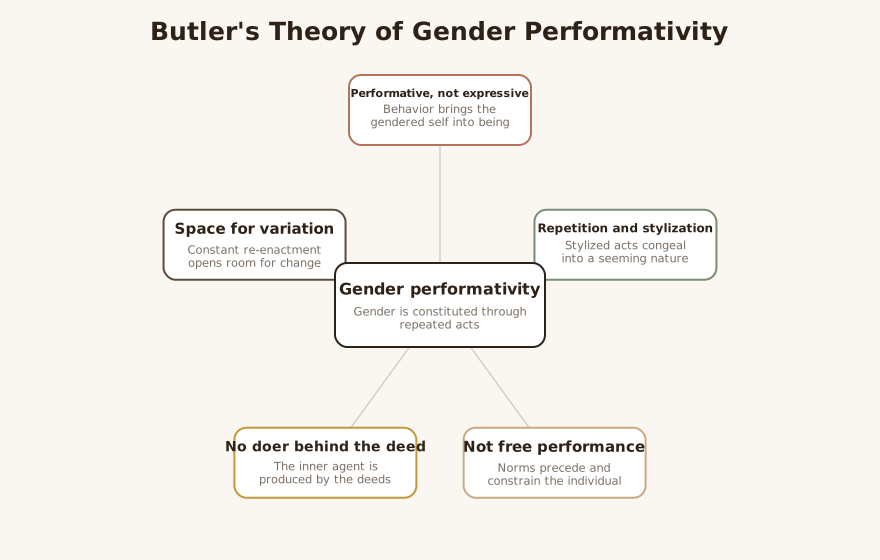
The first principle is that gender is performative rather than expressive 2. An expressive model assumes a pre-existing inner gender that behavior then reveals; the performative model reverses this, holding that the repeated behavior is what brings the gendered self into being 4. There is, on this account, no “doer behind the deed”—the appearance of an inner gendered agent is retroactively produced by the deeds themselves 1.
The second principle is repetition and stylization 2. Gender is constituted not by a single act but by the reiteration of stylized acts—gait, dress, speech, gesture—performed over time until they congeal into the appearance of a natural substance 3. Because the effect depends on constant repetition, it is never finally secured and must be continually re-enacted, which is precisely what opens space for variation and change 6.
The third principle distinguishes performativity from theatrical performance in the ordinary sense 5. Butler is explicit that performativity is not a free choice made each morning by a pre-existing self who selects a gender like a costume; the script of gender norms precedes the individual and constrains what is intelligible 5. The fourth principle is the regulatory function of gender norms: the binary framework is enforced socially, and acts that fall outside it are subject to punishment, exclusion, or pathologization 1. The final principle is subversion: because gender depends on repetition, repetition with a difference—parody, drag, deliberate misalignment—can expose the constructed nature of the supposedly natural and loosen its grip 1.
Interventions & Techniques
Gender performativity does not prescribe techniques, but it can inform several clinically familiar moves LLM. The most direct is depathologizing reframing: helping a client understand gender variance not as a defect to be corrected but as one possible arrangement of acts within a system that presents itself as more fixed than it is 5. This can reduce the self-blame that accompanies the belief that one has failed to be a “real” man or woman LLM.
A second application is narrative externalization. Because the theory holds that the “doer” is produced by the “deed,” the clinician can help a client separate their sense of self from internalized norms and examine those norms as social products rather than personal truths 1. A third is values-guided behavioral experimentation: since identity is consolidated through repeated acts, intentional shifts in everyday gendered behavior—pronouns, presentation, gesture—can be approached as meaningful, identity-shaping practice rather than as mere cosmetic change 4.
LLM-generated illustrative example (not a guideline): A nonbinary client says, “I feel fake whenever I use they/them—like I’m just performing.” A clinician informed by this theory might gently note that, on Butler’s account, all gender is enacted through repetition, so the felt “fakeness” may reflect the newness of the acts rather than their inauthenticity, and that authenticity can grow precisely through repetition LLM.
These moves are not unique to Butler and overlap substantially with narrative therapy, ACT, and affirmative practice; the theory supplies a rationale, not a novel procedure LLM.
Evidence Base
Honesty about maturity is essential here. As a theory, gender performativity is well established and highly influential within philosophy, gender studies, and the humanities, where Gender Trouble is a foundational and widely taught text 1. Its influence on how scholars and clinicians conceptualize gender is substantial and durable 6.
However, “established” in this context means established as theory, not validated as a clinical intervention LLM. There are no randomized trials, effect sizes, or outcome data for “gender performativity therapy” because no such standalone modality exists LLM. Clinicians should therefore treat the theory as a conceptual scaffold that can be delivered within evidence-supported, gender-affirmative frameworks, and should not present it to clients or payers as an evidence-based treatment in itself LLM. The theory is also genuinely contested within its own field, and several of its claims have been the subject of sustained philosophical debate, so it should be held as one influential perspective rather than settled fact 6.
Populations & Indications
The frame is most obviously relevant to transgender and gender-diverse individuals, for whom the depathologizing move—gender as enacted rather than as a fixed essence one has “gotten wrong”—can be clinically useful 5. Nonbinary clients may find particular resonance in the claim that the binary is a regulatory effect rather than a natural fact, which can validate identities that fall outside it 1. The broader LGBTQ+ individuals population is an indicated group given the theory’s roots in queer theory and its account of how norms marginalize non-conforming lives 6.
The lens is not limited to gender-diverse clients LLM. Cisgender individuals examining restrictive gender roles, women confronting gendered expectations, and adolescents actively exploring identity can all benefit from a framework that treats gender as practiced rather than prescribed 4. Adolescence in particular is a developmental period of intense identity experimentation, and the theory’s emphasis on the open-endedness of repeated acts can normalize exploration rather than rushing toward premature foreclosure LLM.
Problems-for-Work
Several presenting problems map onto this frame LLM. For identity confusion and self-concept disturbance, the theory reframes the absence of a fixed gendered “core” as ordinary rather than alarming, which can lower the stakes of uncertainty 1. For gender dysphoria, it can help separate the distress of misalignment from the false belief that one’s gender is invalid, supporting affirmative work without invalidating the very real suffering involved 5.
LLM-generated illustrative example (not a guideline): A client with internalized stigma reports, “Deep down I think people like me are just broken.” A clinician might use the theory to externalize this as an internalized regulatory norm—a socially enforced standard—rather than an objective verdict, and then pursue standard cognitive and self-compassion work to loosen its hold LLM.
For internalized stigma and low self-esteem, locating the punishing standard in social regulation rather than in the self can interrupt shame 1. For body image dissatisfaction, the theory’s attention to the embodied, enacted nature of gender can open conversation about the relationship between body, presentation, and felt identity 2. For role strain, it names gendered expectations as external constructs that can be questioned and renegotiated 4. And for minority stress, it provides a structural explanation—distress arising from a hostile, norm-enforcing environment rather than from the individual—that aligns with affirmative practice LLM.
Contraindications, Cautions & Cultural Humility
The chief caution is misuse: the claim that gender is “constructed” or “performed” can be heard by a distressed client as “your gender isn’t real” or “you’re just choosing this,” which is the opposite of Butler’s point and can be actively harmful 5. Butler is explicit that performativity is not voluntary costume-changing and that the self does not stand prior to and freely select its gender, so clinicians must take care not to deploy the theory in a way that invalidates a client’s lived sense of identity 5. The theory is dense and academic, and importing its vocabulary literally into session is rarely helpful; the clinical task is to use the underlying stance, not to lecture LLM.
Cultural humility is essential because gender norms and their enforcement vary widely across cultures, religions, and communities, and a Western academic frame should not be imposed on clients whose understanding of gender is differently structured LLM. The theory itself insists that gender is socially situated, which should make the clinician more attentive to context, not less 6. The frame is also not a substitute for assessment of medical or psychiatric needs, safety, or co-occurring conditions, and it does not replace established standards of care for gender-related health LLM.
Treatment-Plan Suggestions & SMART Objectives
| Goal | SMART objective (example) | Mechanism |
|---|---|---|
| Reduce identity-related shame | Within 8 sessions, client will identify and verbally reframe at least 3 internalized “norms” as social standards rather than personal failings, rated on a session log | Externalizing the regulatory norm reduces self-blame 1 |
| Build self-concept stability | Over 6 weeks, client will articulate a self-description that does not depend on a fixed gender “essence,” reviewed in session | Reframing the absent “core” as ordinary lowers the stakes of uncertainty 1 |
| Decrease gender dysphoria distress | Within 10 sessions, client will distinguish “misalignment distress” from “invalidity beliefs” in 4 of 5 logged episodes | Separating felt distress from false invalidity reduces secondary shame 5 |
| Support affirmative behavioral steps | Over 4 weeks, client will trial 2 chosen gendered acts (e.g., pronoun use, presentation) and rate comfort weekly | Identity consolidates through repeated, values-aligned acts 4 |
| Reduce minority-stress reactivity | Within 8 sessions, client will attribute 3 stigmatizing experiences to external norms vs. self, tracked in a thought record | Structural attribution interrupts internalization 6 |
| Improve role-strain coping | Over 6 weeks, client will renegotiate 2 specific gendered expectations in a key relationship, reviewed in session | Naming roles as constructs makes them negotiable 4 |
| Strengthen body-image relationship | Within 10 sessions, client will describe the link between presentation and felt identity with reduced distress on a 0-10 scale | Attending to embodied enactment integrates body and identity 2 |
Common Misconceptions
The most common misconception is that “performativity” means gender is a conscious performance—a costume freely chosen each day 5. Butler explicitly rejects this; the norms precede and constrain the individual, so it is not a matter of voluntary play-acting 5. A second misconception is that the theory denies the reality or stability of anyone’s gender, when its actual claim is about the origin of gender (produced through acts) rather than a denial that gender is deeply felt and consequential 1. A third is conflating “constructed” with “fake” or “unreal,” whereas constructionism holds that socially produced realities are entirely real in their effects 6. Finally, some assume the theory applies only to transgender people, when Butler’s argument is universal—all gender, including cisgender identity, is constituted performatively 4.
Training & Certification
There is no certification in gender performativity, because it is an academic theory rather than a credentialed clinical method LLM. Clinicians wanting to engage it seriously should read Butler’s primary texts—the accessible 1988 essay first, then Gender Trouble—rather than relying solely on summaries, since the argument is frequently misrepresented 2. For clinical application, the appropriate credentials are in gender-affirmative care and in the billable modalities (CBT, ACT, narrative, family therapy) through which the stance is actually delivered, supplemented by continuing education in LGBTQ+ individuals and gender-diverse competencies LLM.
Key Terms
Performative — constituted by repeated acts rather than expressing a pre-existing essence 2. Expressive (vs. performative) — the rejected model in which behavior reveals an inner, prior gender 4. Stylized repetition — the reiteration of acts over time that congeals into the appearance of a natural gender 3. The “doer behind the deed” — the illusory inner agent that is actually an effect, not a cause, of the deeds 1. Regulatory norms — the socially enforced standards that police the gender binary 1. Subversion — repetition with a difference (e.g., parody, drag) that exposes gender’s constructed nature 1. Sex/gender distinction — the feminist premise Butler radicalizes by questioning the stability of “sex” itself 6.
Resources & Further Reading
▶ Watch — a video introduction to this concept:
- Butler, J. (1990). Gender Trouble: Feminism and the Subversion of Identity (Routledge) — the canonical text 1
- Butler, J. (1988). “Performative Acts and Gender Constitution,” Theatre Journal (JSTOR) — the more accessible founding essay 2
- Judith Butler’s Theory of Gender Performativity — Perlego Knowledge study guide — concise overview 3
- Judith Butler: Your Behavior Creates Your Gender — Big Think (video) — Butler in their own words 4
- Theorist Judith Butler Explains How Behavior Creates Gender — Open Culture — clarifies the performance/performativity distinction 5
- An Introduction to Judith Butler’s Gender Trouble and Performativity — Media Studies — lineage and context 6
Reflective / Supervision Questions
- When I describe a client’s gender as “constructed” or “performed,” am I using these terms in Butler’s precise sense, or am I at risk of implying the client’s identity is “not real”? 5
- How do I hold the tension between a depathologizing theory and a client’s genuine, sometimes severe, dysphoric distress without minimizing either? LLM
- Whose gender norms am I treating as the default in this work, and how does my own cultural and gendered position shape that? LLM
- Am I using this theory as a clinical stance that informs established billable interventions, or am I drifting into lecturing the client on philosophy? LLM
- Where does this conceptual frame end and the need for medical assessment, safety planning, or referral begin? LLM