
Type & Discipline
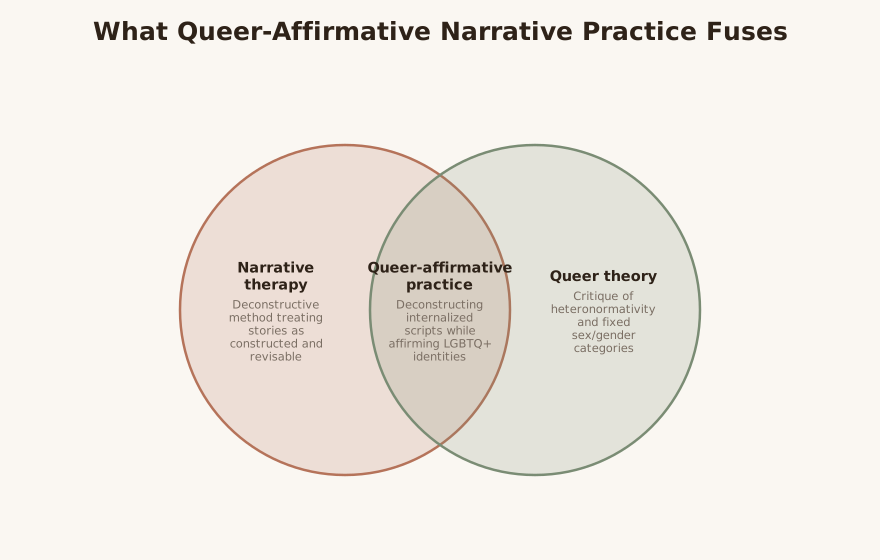
Queer/affirmative narrative practice is best understood as an orienting framework rather than a discrete, manualized treatment LLM. It belongs to the family of narrative practice within counseling and clinical psychology, and it grafts the deconstructive method of narrative therapy onto the conceptual critique supplied by queer theory 46. Narrative therapy itself approaches problems as separate from persons and treats taken-for-granted “truths” as open to deconstruction, a stance Michael White articulated in early work casting therapy within the frame of deconstruction 4. Queer theory contributes a post-structuralist critical lens that treats sex, gender, and sexuality as fluid social phenomena shaped by power, discourse, and repeated performance rather than fixed biological essences 6. The framework also overlaps substantially with affirmative therapy, a clinical approach that validates and advocates for the needs of sexual and gender minority clients while explicitly rejecting any attempt to “fix” or change them 5. For practicing clinicians, the practical implication is that this is a stance and a set of conversational practices you bring into a recognized modality, not a standalone billable therapy in its own right LLM.
Creators & Lineage
The intellectual lineage runs through two streams that this framework deliberately braids together LLM. The first is queer theory, which emerged in the early 1990s from queer studies and women’s studies as a field of post-structuralist critical theory 6. Its foundational figures include Eve Kosofsky Sedgwick, whose Epistemology of the Closet (1990) examined the homo/heterosexual binary through literary analysis; Judith Butler, whose Gender Trouble theorized gender as performative—something performed through repeated actions rather than an innate biological reality; and Michel Foucault, whose work framed sexuality as historically constructed rather than natural 6. The term “queer theory” was itself formalized academically when Teresa de Lauretis organized the first queer theory conference in 1990 6.
The second stream is narrative therapy, whose deconstructive practices were developed by Michael White and his colleagues to surface and loosen the dominant cultural “truths” that shape a person’s identity 4. The bridge between these streams has been built largely by narrative practitioners writing explicitly at the queer–narrative intersection, including Julie Tilsen, whose book Queering Your Therapy Practice connects queer theory, narrative therapy, and the imagining of new identities 2, and David Nylund, whose collaborative work with Tilsen on “resisting normativity” extends the queer lens into clinical and community practice 1. The Dulwich Centre’s course material on narrative practice, queer theory, and language—featuring contributors such as Julie Tilsen, Vikki Reynolds, David Nylund, and Steph Lum—represents an ongoing site where this synthesis is taught and refined 1. The framework’s broader family also includes feminist therapy and gay affirmative therapy, with which it shares a commitment to naming structural oppression as a clinical concern 5.
Core Principles
The first principle is the destabilization of fixed categories: sex, gender, and sexuality are treated as socially constructed and fluid rather than as essential, natural facts 6. The second is the critique of heteronormativity—the assumption that heterosexuality (and, by extension, cisgender identity) is the default and preferred state—which queer theory exposes as ideology rather than nature 6. Affirmative practice extends this by asserting the value of LGBTQ+ individuals identities and experiences specifically within a context of structural inequities, rather than treating identity as a private trait disconnected from social conditions 3.
A third principle is deconstruction as method: narrative practice approaches the taken-for-granted truths of a person’s story as constructed, and therefore as open to examination and revision 4. Applied to gender and sexuality, this means the clinician helps the client notice where a self-description (“I’m broken,” “I’m not really gay/trans enough”) is actually an internalized cultural script rather than a fact about the person LLM. A fourth principle concerns language: gendered language, including pronouns, is treated as a primary site of both oppression and resistance, so attention to language—getting pronouns right, avoiding misgendering—is not etiquette but core clinical practice 1.
A fifth principle is humility about the therapist’s own position. The Dulwich material frames allyship not as a static identity one possesses but as an ongoing process of “becoming”—imperfect, fluid, and never finished 1. Echoing this, affirmative practice research emphasizes that a shared LGBTQ+ individuals identity between clinician and client does not guarantee understanding of that client’s unique experience 3. The framework therefore resists therapist expertise-over-the-client and favors a strengths-based stance that holds critical awareness of oppression alongside genuine hopefulness 3.
Interventions & Techniques
Because this is a stance layered onto narrative practice, its techniques are largely narrative techniques applied through a queer lens LLM. Deconstructive questioning invites the client to trace where a problem-saturated belief came from and whose interests it serves, treating identity claims as constructed rather than fixed 4. Externalizing separates the person from the problem—so that, for instance, internalized transphobia or shame is examined as an external influence operating on the person rather than as the person’s defective core 4.
LLM-generated illustrative example (not a guideline): A clinician working with a young person who says “something is wrong with me for not knowing my gender” might ask, “Where do you think the rule came from that you’re supposed to have this figured out by now?” and “When ‘Certainty’ is bossing you around, what does it stop you from exploring?” This externalizes the pressure and opens space to question the heteronormative timeline being imposed LLM.
Attentive language practice is itself an intervention: using and confirming a client’s pronouns, and repairing misgendering when it happens, materially affirms identity 1. Re-storying around unique outcomes—moments that contradict the dominant problem narrative—lets the client author a thicker, preferred account of self 4. In group formats, affirmative interventions favor mutual aid and peer support over clinician-centered help, with the facilitator resisting the urge to manage anxiety by deploying jargon or controlling the session 3. Across formats, the clinician maintains a strengths-based stance that names oppression honestly while sustaining hope 3.
Evidence Base
The evidence base for this framework is genuinely emerging, and clinicians should represent it as such LLM. The conceptual scaffolding—queer theory and narrative deconstruction—is intellectually substantial and well established within the humanities and within narrative therapy, but it is theory and critical method rather than an outcome literature 46. Affirmative practice as a broader category rests on minority stress theory, which holds that LGBTQ+ individuals individuals report disproportionately high rates of depression, anxiety, and suicidality because of discrimination tied to their minoritized status 3. That theoretical rationale is robust and widely accepted 3.
The direct empirical literature on delivering affirmative practice, however, is still early-stage. The available study on demonstrating LGBTQ+ individuals affirmative practice in groups, for example, was a qualitative analysis of 25 social work students’ reflections on a simulation-based learning activity—work that identifies practitioner competencies rather than testing intervention effectiveness, with no comparison groups and no long-term outcome data 3. In short, the framework has strong theoretical and ethical grounding and a credible mechanism via minority stress, but high-quality controlled outcome evidence specific to the queer/narrative synthesis is not yet established LLM. Honesty about this maturity is itself consistent with the framework’s anti-expert, humble stance 1.
Populations & Indications
The framework is indicated primarily for LGBTQ+ individuals individuals, including gender-diverse and transgender people, sexual minority youth, and adolescents 35. It is also applicable to couples and to people actively questioning their gender or sexual identity, for whom the deconstruction of imposed categories can be especially relevant 56. Affirmative therapy serves these populations both for distress stemming directly from prejudice and bias and for ordinary concerns—relationships, self-esteem, career—that any client may bring 5. The minority stress framing makes the approach particularly apt when presenting concerns are entangled with experiences of discrimination, stigma, or being held to heteronormative expectations 36.
Problems-for-Work
This framework is well suited to clinical problems that sit at the intersection of individual distress and social oppression LLM. Minority stress is the organizing concept: depression, anxiety, and suicidal ideation that arise disproportionately from discrimination are addressed by naming the structural source rather than locating the fault in the client 3. Internalized homophobia/transphobia and shame are natural targets for externalizing and deconstruction, which reframe these as ingested cultural messages rather than truths about the self 4.
LLM-generated illustrative example (not a guideline): With a client carrying coming-out distress and family conflict, the clinician might map how the “dominant story” of the family (“this is just a phase”) competes with the client’s own emerging account, then help the client identify allies and unique outcomes—times they felt fully themselves—to thicken the preferred narrative 4LLM.
Identity confusion and distress around gender dysphoria can be approached by loosening the demand for fixed, on-schedule certainty, drawing on the queer-theoretical view of categories as fluid 6. Low self-esteem, coming-out distress, and discrimination-related distress respond to the affirmative, validating environment in which clients process discrimination and internalized stigma 5. Family conflict can be worked through narrative re-authoring and, where appropriate, attention to the language and pronouns that signal acceptance or rejection within the system 1.
Contraindications, Cautions & Cultural Humility
There are important cautions. First, the framework’s evidence maturity means it should not be presented to clients or payers as an empirically validated standalone treatment; it is a stance delivered within an established modality LLM. Second, a shared LGBTQ+ individuals identity between clinician and client must never be assumed to confer understanding of that particular client’s experience—doing so risks projecting the therapist’s own narrative onto the client 3. Third, clinicians should resist expert positioning and the use of jargon to manage their own anxiety, which can silence rather than empower clients 3.
Cultural humility is built into the framework rather than added on. Allyship is framed as an ongoing, imperfect process of becoming rather than a credential one holds 1. Practitioners are expected to examine their own biases, maintain solid knowledge of gender and sexuality issues, and stay openly willing to learn when unfamiliar topics arise 5. Clinicians should also recognize that distinct populations have distinct needs—for example, intersex experiences differ materially from transgender experiences, with separate advocacy concerns around medical autonomy, and should not be collapsed together 1. Cultural and linguistic context shapes how gender is expressed, so the framework cautions against assuming that one community’s language or norms transfer universally 1.
Treatment-Plan Suggestions & SMART Objectives
| Goal | SMART objective (example) | Mechanism |
|---|---|---|
| Reduce internalized stigma | Within 8 sessions, client will identify and externalize at least 3 internalized messages about their identity and name the cultural source of each | Deconstruction / externalizing 4 |
| Lower minority-stress distress | Over 6 weeks, client will distinguish discrimination-driven distress from self-blame in a daily log, reframing 80% of entries as externally sourced | Minority stress framing 3 |
| Strengthen preferred identity narrative | By session 10, client will articulate 3 “unique outcome” moments of living as their authentic self and incorporate them into a written life story | Narrative re-authoring 4 |
| Affirm identity through language | Within 4 sessions, client and key supports will consistently use the client’s correct name and pronouns in at least 2 settings client chooses | Language-as-affirmation 1 |
| Build supportive connection | Over 12 weeks, client will join one affirming peer/mutual-aid space and report on its impact in session | Mutual aid / peer support 3 |
| Increase coming-out agency | Within treatment, client will design and rehearse a values-based plan for one disclosure decision they control, evaluating outcome afterward | Affirmative, client-led pacing 5 |
| Reduce shame and improve self-esteem | By session 8, client will replace 3 shame-based self-statements with strengths-based statements validated in session | Strengths-based affirmative stance 35 |
Common Misconceptions
A frequent misconception is that affirmative practice means simply being supportive or “nice” to LGBTQ+ individuals clients; in fact it is a specific stance that validates identity while actively analyzing structural inequity and refusing change-oriented “fixes” 35. Another is conflating affirmative therapy with gender-affirming medical care—they are related but distinct, the former being a psychological approach and the latter encompassing medical and social interventions 5. A third misconception is that the framework treats gender and sexuality as merely individual preferences; queer theory’s claim is stronger and more political—that these categories are socially constructed through power and discourse 6. Clinicians sometimes also assume that sharing a client’s identity makes them automatically competent, which the research explicitly contradicts 3. Finally, some treat allyship as a fixed achievement, whereas the framework insists it is a continuous, imperfect process 1.
Training & Certification
There is no single licensing body or formal certification that confers “queer/affirmative narrative practitioner” status; competence is built through narrative therapy training plus dedicated study of queer theory and affirmative practice LLM. The Dulwich Centre offers structured course material specifically on sexualities, genders, and narrative practice, taught by practitioners working at this intersection 1. Julie Tilsen’s Queering Your Therapy Practice serves as a foundational practitioner text linking queer theory, narrative therapy, and identity work 2. Beyond formal study, the framework asks clinicians to cultivate ongoing self-examination of bias, solid working knowledge of gender and sexuality issues, and a posture of continual learning—qualities that affirmative-therapy guidance names as markers of a competent practitioner 5.
Key Terms
- Heteronormativity — the assumption that heterosexuality and cisgender identity are the default and preferred state; exposed by queer theory as ideology rather than nature 6.
- Performativity — Butler’s idea that gender is produced through repeated actions rather than expressing an innate biological reality 6.
- Deconstruction — the narrative-therapy method of treating taken-for-granted “truths” as constructed and therefore open to examination and revision 4.
- Externalizing — separating the person from the problem so that distress (e.g., internalized transphobia) is addressed as an outside influence, not a core defect 4.
- Minority stress — the framework explaining elevated depression, anxiety, and suicidality among LGBTQ+ individuals people as a product of discrimination tied to minoritized status 3.
- Affirmative practice — a therapeutic approach asserting the value of LGBTQ+ individuals identities and experiences within a context of structural inequities 3.
- Allyship as becoming — the view that allyship is an ongoing, imperfect process rather than a fixed identity one possesses 1.
Resources & Further Reading
▶ Watch — a video introduction to this concept:
- Chapter 2: Narrative practice, queer theory and language (Dulwich Centre course)
- Queering Your Therapy Practice: Queer Theory, Narrative Therapy, and Imagining New Identities (Tilsen, Routledge)
- Demonstrating LGBTQ+ individuals Affirmative Practice in Groups (PMC9395481)
- Deconstruction and Therapy — Michael White (Dulwich Centre)
- Affirmative Therapy (Psychology Today, therapy types)
- Queer theory (Wikipedia)
Reflective / Supervision Questions
- Where in my own practice do I treat a client’s gender or sexuality as a fixed category, and where could a more fluid, deconstructive stance open new clinical space? 6
- When I work with a client whose identity I share, how do I guard against assuming I already understand their experience? 3
- How do I notice and repair the moments when my own anxiety pulls me toward expert positioning, jargon, or controlling the session? 3
- In what concrete ways does my use of language and pronouns affirm or undermine the clients in front of me, and how do I repair missteps? 1
- Am I representing this framework’s evidence honestly—as a theoretically grounded, emerging practice rather than a validated standalone treatment? LLM
- What does “allyship as an ongoing process of becoming” require of me this month, given that it is never finished? 1