
The Minority Stress Model is one of the most influential frameworks in the psychology of stigma and health disparities, and it is increasingly relevant to everyday clinical work with marginalized clients LLM. This article orients practicing therapists to the model’s structure, evidence, and concrete application in treatment planning LLM.
Type & Discipline
The Minority Stress Model is a theory — an explanatory framework rather than a packaged treatment protocol — situated at the intersection of social and clinical psychology LLM. Its home discipline concerns health disparities and stigma: it was built to explain why members of stigmatized social categories show worse health outcomes than members of dominant groups 1. One explainer summarizes it as “an explanatory theory to help understand the social, psychological, and structural factors relating to mental health inequalities among sexual minority populations” 5. Because it is a theory of mechanism rather than a manualized therapy, clinicians use it diagnostically — to formulate what is driving a client’s distress — and then select interventions from established modalities accordingly LLM.
Creators & Lineage
The model is most closely associated with Ilan Meyer, who first formulated minority stress in gay men in 1995 and then consolidated and expanded the framework in a landmark 2003 review 21. The 1995 paper identified three minority stressors operating in gay men — internalized homophobia, stigma in the form of expectations of rejection, and actual experiences of prejudice and discrimination — and linked them to psychological distress 2. The 2003 review synthesized a large body of evidence and gave the model the distal-to-proximal architecture that clinicians now recognize 1.
The model’s intellectual lineage is explicit LLM. It draws on stress-and-coping theory in treating prejudice as a stressor that is appraised and coped with, on stigma theory in locating the source of harm in social devaluation, and on a social-determinants-of-health perspective in attributing disparities to structural conditions rather than to anything inherent in the stigmatized identity 1. More recent applications fold in intersectionality, recognizing that a single client may occupy several stigmatized positions at once LLM.
Core Principles
Meyer defines minority stress as “excess stress to which individuals from stigmatized social categories are exposed as a result of their social, often a minority, position” 1. Three properties distinguish it from ordinary life stress: it is unique (additive to the general stressors everyone faces), chronic (tied to stable social structures rather than to one-off events), and socially based (stemming from social institutions and processes rather than from individual circumstance) 1.
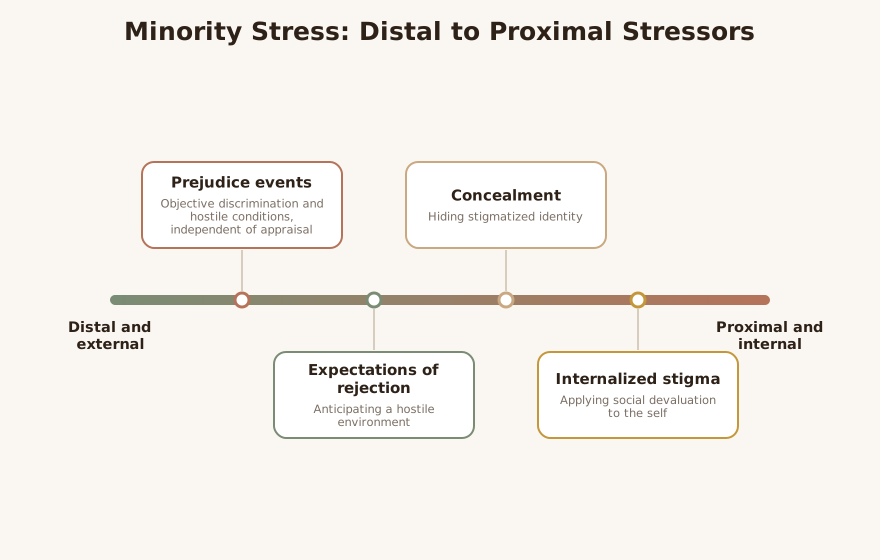
The model’s organizing axis is a continuum from distal to proximal stressors 1. Distal stressors are objective external events and conditions — discrimination, violence, hostile policies, microaggressions, poverty — that “do not depend on an individual’s perceptions or appraisals” 15. Proximal stressors are the internal, subjective processes that arise as the person appraises a hostile environment and applies it to the self 1. As Meyer puts it, “distal social attitudes gain psychological importance through cognitive appraisal and become proximal concepts with psychological importance” 1.
A crucial corollary is that the model is not solely a catalogue of harm LLM. Meyer emphasizes coping and social support, distinguishing personal from group-level resources and arguing that community affiliation, in-group reappraisal of the stigmatized status, and affirming support structures can buffer the impact of minority stress 1. “Stress and resilience interact in predicting mental disorder,” he notes, so the same minority identity can function as both a source of stress and a source of strength 1.
Interventions & Techniques
The model itself prescribes no proprietary technique; it points the clinician toward targets LLM. The most distinctive contribution is the four-process taxonomy of stressors that organizes assessment LLM.
- Prejudice events (distal): discrete experiences of discrimination, harassment, or violence; LGB individuals are “disproportionately exposed to prejudice events, including discrimination and violence” 1. Concrete examples include “being refused service at a restaurant, being called a slur while walking down the street” 6.
- Expectations of rejection (proximal): a learned vigilance in which the person constantly monitors social interactions on the assumption that, “whatever others profess, they do not really ‘accept’ him” 1.
- Concealment (proximal): hiding the stigmatized identity, which functions as both a coping strategy and a stressor because of “the cognitive burden involved in the constant preoccupation with hiding” 1.
- Internalized stigma (most proximal): the person’s “direction of negative social attitudes toward the self, leading to a devaluation of the self and resultant internal conflicts,” classically termed internalized homophobia in the LGB literature 1.
Clinically, each process suggests a leverage point: psychoeducation and validation for prejudice events, cognitive work on rejection expectancies, examining the costs and contexts of concealment, and compassion-focused or cognitive work on internalized stigma LLM. Explainers consistently add a structural prong — connecting clients to “community groups and affirming networks” and reducing isolation, since group-level resources are a core buffer in the model 51.
LLM-generated illustrative example (not a guideline): A bisexual client reports exhaustion at a new job. Mapping the four processes reveals a microaggression from a manager (prejudice event), a habit of scanning every meeting for signs of disapproval (expectation of rejection), the effort of editing pronouns when describing a partner (concealment), and a background belief that being “out” would make him less promotable (internalized stigma). Naming these as minority stressors — rather than as a personal deficit — reframes the case formulation LLM.
Evidence Base
The model’s evidence base is best described as established: a mature, widely replicated observational literature, though not the kind of randomized-trial base that would attach to a specific therapy LLM. Meyer’s 2003 meta-analytic synthesis found LGB individuals about 2.5 times more likely than heterosexuals to meet criteria for any lifetime disorder, with mood disorders roughly 2.5 to 2.7 times more common, elevated anxiety and substance use disorders, and substantially higher rates of suicide attempts 1. He concludes that “the preponderance of the evidence suggests that the answer to the question, ‘Do LGB people have higher prevalences of mental disorders?’ is yes” 1.
The physical-health evidence is more recent and points in the same direction 3. A longitudinal study found that “odds of experiencing a physical health problem at follow-up were significantly higher among LGBs who experienced an externally rated prejudice event,” with conditions documented including flu, hypertension, sexually transmitted infections, tendonitis, and cancer 3. Critically, prejudice-related stressors had a “unique deleterious impact on health that persists above and beyond the effect of stressful life events unrelated to prejudice,” supporting the model’s claim that minority stress is additive rather than reducible to general stress 3. Honesty requires noting a limit: that study “did not assess any pathophysiological mechanisms that would explain these associations,” so the biological pathway from minority stress to disease remains inferred rather than demonstrated 3.
The model has also been extended into trauma and PTSD frameworks, with clinical-research bodies treating minority stress as a lens on trauma exposure and disproportionate health burden across stigmatized groups 4. Two caveats temper the enthusiasm: most of the foundational evidence is cross-sectional or observational and therefore cannot establish causation cleanly, and much of the original work centered sexual minority populations before extension to other groups LLM.
Populations & Indications
Although the model was developed for lesbian, gay, and bisexual populations, it has been applied across a range of stigmatized groups 5. Sexual and gender minorities remain the paradigm case, with sexual and gender minority youth showing elevated rates of anxiety, depression, self-harm, PTSD, and suicidal thoughts 5. Explainers extend the framework to racial and ethnic minorities — for example, chronic race-related stress is described as increasing “rates of hypertension and heart conditions in Black Americans” — as well as to Latino, Asian, and Native Hawaiian communities, immigrants, people with disabilities, and autistic individuals, “where mental health disorders may stem from minority stress due to the discrimination and stigma” 65.
The model is indicated as a formulation tool whenever a client belongs to a socially stigmatized group and presents with distress that may be amplified by chronic, identity-based stressors LLM. It is especially useful when a client’s symptoms have been pathologized in prior treatment without attention to the social context producing them LLM.
Problems-for-Work
The model maps cleanly onto common presenting problems LLM. Below are brief application examples tying the framework to clinical targets LLM.
- Depression and anxiety: elevated mood and anxiety disorders in stigmatized groups are reframed as partly the downstream effect of chronic prejudice and internalized stigma rather than as endogenous deficits 1.
- PTSD and chronic stress: prejudice events can function as traumatic stressors, and the framework links minority stress to trauma and disproportionate health 43.
- Suicidal ideation: given the markedly elevated suicide-attempt rates Meyer documents, minority stress assessment is a relevant safety-relevant lens for at-risk clients 1.
- Substance use disorders: elevated substance use is understood in part as coping with chronic minority stress, redirecting work toward the underlying stressors 1.
- Identity concealment distress: the “constant preoccupation with hiding” becomes an explicit treatment target rather than an unexamined background condition 1.
- Internalized stigma and low self-esteem: the devaluation of the self that follows from internalized negative attitudes is named and worked on directly 1.
Contraindications, Cautions & Cultural Humility
The model is a formulation, not a treatment, so the main “contraindication” is misapplication LLM. Clinicians should avoid over-attributing every symptom to minority stress, which can both invalidate a client’s other concerns and inadvertently imply that the stigmatized identity is the problem — the opposite of the model’s intent, which locates harm in the social environment, not the identity 1LLM. Conversely, ignoring minority stress risks pathologizing socially produced distress as individual deficit LLM.
Cultural humility is built into the framework itself, since it foregrounds structural conditions and the limits of an outsider’s appraisal LLM. Intersectionality is an essential caution: a client holding several stigmatized identities experiences compounded and qualitatively distinct stress that a single-axis reading will miss LLM. Because much of the validating evidence centers sexual minority adults, clinicians should extend the model to other populations thoughtfully rather than assume identical mechanisms LLM. Finally, the model’s resilience emphasis should be applied carefully so that highlighting community resources never slides into placing the burden of coping on the client rather than on changing hostile conditions 1LLM.
Treatment-Plan Suggestions & SMART Objectives
| Goal | SMART objective (example) | Mechanism |
|---|---|---|
| Reduce impact of internalized stigma | Over 8 weeks, client will identify and reframe 3 self-devaluing beliefs tied to identity, rated weekly | Targets the most proximal stressor — internalized negative attitudes 1 |
| Lower rejection-related vigilance | Within 6 sessions, client will test 2 rejection expectancies via behavioral experiments and log outcomes | Re-appraises distal attitudes that have become proximal through cognition 1 |
| Make concealment a deliberate choice | Over 10 weeks, client will map contexts of concealment and select 1 safe setting for fuller disclosure | Reduces the cognitive burden of constant hiding 1 |
| Process a prejudice event | Within 8 sessions, client will complete trauma-focused processing of one discrimination event, with distress ratings | Addresses prejudice events as unique stressors with health impact 3 |
| Strengthen community buffering | Within 4 weeks, client will attend 2 affirming community or peer-support activities and reflect on each | Activates group-level coping resources 15 |
| Reduce stress-driven substance use | Over 12 weeks, client will substitute 2 non-substance coping responses for identity-stress triggers, tracked daily | Reframes use as coping with chronic minority stress 1 |
| Improve safety monitoring | Each session, client and clinician will review suicidal ideation given elevated population-level risk | Responds to documented elevation in suicide-attempt rates 1 |
Common Misconceptions
A first misconception is that minority stress is “just” ordinary stress; the model insists it is unique and additive, with prejudice-related events shown to harm health “above and beyond” general stressful events 31. A second is that the stigmatized identity is itself the cause of disorder; the model locates the cause in social devaluation and structural conditions, treating identity as a source of resilience as much as risk 1. A third is that the model applies only to LGBTQ+ individuals people; it has been extended to racial and ethnic minorities, immigrants, disabled and autistic people, and other stigmatized groups 56. A fourth is that it is a therapy with its own techniques; it is an explanatory theory that informs case formulation and points to targets within established modalities 5LLM.
Training & Certification
There is no certification in the Minority Stress Model, because it is a theoretical framework rather than a credentialed treatment LLM. Clinicians typically acquire it through primary literature — Meyer’s 1995 and 2003 papers are the foundational texts — and through affirmative-practice training that operationalizes the model with specific populations 21. Practical competence is built by integrating the framework into modalities the clinician is already trained in, such as cognitive behavioral, trauma-focused, or acceptance-based therapies, and by ongoing supervision and consultation with the communities served LLM.
Key Terms
- Minority stress: excess, socially based stress from occupying a stigmatized position 1.
- Distal stressors: objective external events and conditions independent of the person’s appraisal 1.
- Proximal stressors: internal, subjective processes arising from appraising a hostile environment and applying it to the self 1.
- Expectations of rejection: chronic vigilance grounded in anticipated non-acceptance 1.
- Concealment: hiding the stigmatized identity, carrying a cognitive burden 1.
- Internalized stigma: turning negative social attitudes against the self 1.
- Group-level coping resources: community, solidarity, and reappraisal that buffer minority stress 1.
Resources & Further Reading
- Meyer (2003), Prejudice, Social Stress, and Mental Health in Lesbian, Gay, and Bisexual Populations (full text in PMC)
- Meyer (1995), Minority Stress and Mental Health in Gay Men
- Frost, Lehavot & Meyer (2015), Minority stress and physical health among sexual minority individuals (PMC)
- Trauma, Minority Stress, and Disproportionate Health — VA PTSD Research Quarterly (PDF)
- Minority stress model: Definition, importance, and more — Medical News Today
- Understanding the Minority Stress Model — Talkspace
Reflective / Supervision Questions
- When a stigmatized client presents with depression or anxiety, how do I distinguish minority stress from other contributors without either over- or under-attributing? LLM
- Which of the four stress processes — prejudice events, rejection expectations, concealment, internalized stigma — do I most readily notice, and which do I tend to miss? LLM
- Am I attending to group-level and community resources as buffers, or am I implicitly placing the full burden of coping on the individual client? 1LLM
- How does intersectionality change my formulation when a client holds several stigmatized identities at once? LLM
- Where might my own social position shape how I appraise — or fail to appraise — a client’s distal stressors? LLM
- How do I hold the model’s honest evidentiary limits (largely observational, mechanisms inferred) while still using it to guide care? 3LLM