
Type & Discipline
The Gender-Affirmative Model (GAM), also called the trans-affirmative model, is a clinical care framework rather than a discrete, manualized psychotherapy LLM. It sits at the intersection of clinical psychology, developmental psychology, and sexual and gender health, and it is interdisciplinary by design, integrating mental health, medical, and family-systems perspectives 3. Its defining commitment is that variations in gender identity and expression are healthy expressions of human diversity, not disorders to be corrected 2. In practice, the model is a stance and a set of principles that a clinician brings to whatever evidence-based modality they are already trained in, rather than a stand-alone billable therapy LLM.
The framework is closely aligned with, and operationalized through, the World Professional Association for Transgender Health (WPATH) Standards of Care, Version 8, which functions as the field’s consensus clinical guideline 1. Where GAM articulates the underlying philosophy, the WPATH Standards translate it into recommendations for assessment, informed consent, and coordinated care across the lifespan 1.
Creators & Lineage
The Gender-Affirmative Model was articulated for youth populations by Marco Hidalgo, Diane Ehrensaft, and colleagues in their 2013 paper “The Gender Affirmative Model: What We Know and What We Aim to Learn,” which laid out the model’s core premises and its research agenda 2. Diane Ehrensaft is the figure most associated with the model and with its developmental language, including concepts such as the true gender self 4. The model was subsequently expanded into a full interdisciplinary text edited by Colt Keo-Meier and Ehrensaft, bringing together mental health, medical, and family perspectives 3.
GAM draws on several therapeutic lineages LLM. From affirmative therapy and the broader LGBTQ+ individuals affirmative tradition it inherits the principle that a clinician’s role is to validate and support marginalized identities rather than to change them 6. From the minority stress model it takes the formulation that distress in gender-diverse people stems primarily from external stigma, rejection, and discrimination rather than from the identity itself 6. From humanistic and client-centered therapy it carries an emphasis on self-determination, unconditional positive regard, and the client as the authority on their own experience LLM. From feminist therapy it inherits attention to power, social context, and the pathologizing function of dominant cultural norms LLM.
Core Principles
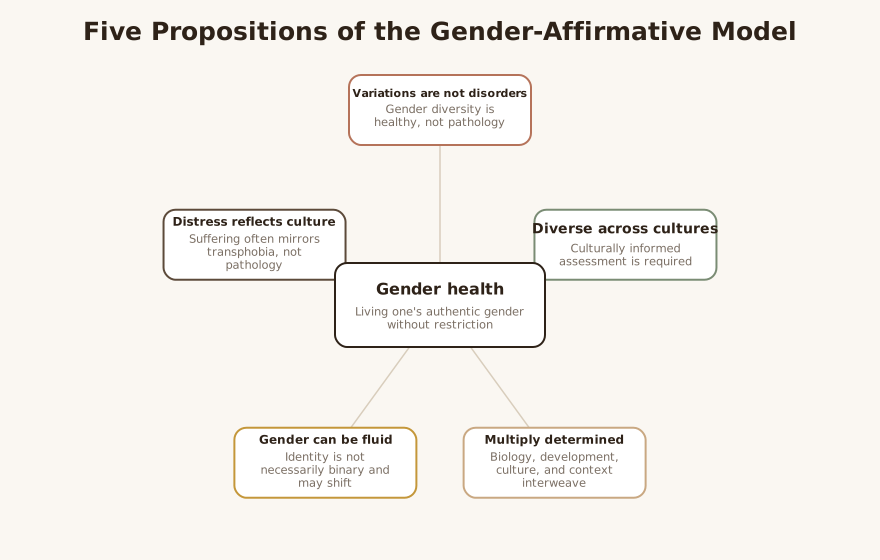
Hidalgo, Ehrensaft, and colleagues set out five propositions that anchor the model 2. First, gender variations are not disorders 2. Second, gender presentations are diverse and vary across cultures, so culturally informed assessment is required 2. Third, gender involves an interweaving of biology, development, socialization, culture, and context, rather than any single determinant 2. Fourth, gender can be fluid and is not necessarily binary, and a person’s identity may shift over time 2. Fifth, when psychological suffering is present, it more often reflects cultural reactions such as transphobia, homophobia, and sexism than something pathological within the person 2.
A central organizing concept is gender health, defined as a person’s opportunity to live in the gender that feels authentic and to express it without restriction, suppression, or rejection 2. The model distinguishes a child’s gender identity, understood as the gender the person articulates as their own and informed primarily by cognition and emotion rather than by genitalia, from gender expression, the outward presentation of gender through appearance, activities, and social affiliations 2. Ehrensaft’s developmental framing further contrasts an authentic true gender self with a false gender self that emerges when a person suppresses their identity to meet external expectations 4.
The clinical implication is a reorientation of the therapeutic target LLM. Rather than attempting to alter gender identity, the affirmative clinician listens, supports exploration over time, and works to reduce the social and familial sources of distress 2. Attempts to change a person’s gender identity or to suppress authentic gender expression are understood to create psychological symptoms rather than relieve them 2.
Interventions & Techniques
Affirmative practice is built from a set of clinician behaviors and competencies rather than a fixed session protocol 6. The foundational intervention is an affirming stance: accepting and validating the client’s gender identity without pathologizing it 6. Consistent use of the client’s chosen name and pronouns is treated as a basic competency, and mirroring a patient’s preferred name and terminology is described as supporting more affirmative and effective care 56.
Beyond stance, affirmative clinicians are expected to hold clinical knowledge of gender development, identity trajectories, and the medical options that may be relevant, so that they can have informed conversations about transition 6. Cultural competence, meaning recognition of systemic discrimination and the impact of minority stress, is a named component, as are crisis-intervention skills given the elevated suicide risk in this population 6. Family engagement is a core technique: helping families understand and accept the client’s identity, addressing parental grief or adjustment needs separately when indicated, and building family support as a protective factor 6. Interdisciplinary collaboration with medical providers, educators, and social supports is also expected 6.
Common psychosocial techniques include psychoeducation about coming out, disclosure, and safety planning; active assessment and reduction of family rejection; resilience-building and community connection alongside symptom management; and direct assessment of suicidality given elevated risk 6. Social transition, which is psychosocial rather than medical, may occur before, during, or after any medical steps depending on the person’s preference and developmental stage 5.
LLM-generated illustrative example (not a guideline): A 16-year-old client presents with depressive symptoms and uses a chosen name at home but not at school. An affirmative clinician would use the chosen name and pronouns in session, explore the gap between home and school as a source of minority stress, work with the family on consistent affirmation, and address the depression directly with an evidence-based approach rather than treating the gender identity as the problem to be solved LLM.
Evidence Base
The maturity of the evidence base is best described as established as a standard of care but still developing in terms of long-term controlled outcome data LLM. The affirmative orientation is embedded in WPATH’s consensus Standards of Care, Version 8, which functions as the field’s principal clinical guideline 1. WPATH and summarizing guidelines note that psychiatric symptoms, including suicidality, tend to decrease when gender-affirming care is provided, and that withholding such care can be counterproductive 5. Reported surgical regret rates are low, on the order of less than 4 percent, and gender-affirming interventions are associated with improved quality of life and reduced dysphoria 5.
For psychosocial care specifically, research supports the protective effect of parental and family acceptance against depression, substance use, and suicidality, and supports the efficacy of psychosocial interventions that target minority stress 26. At the same time, authors of the model are explicit that gaps remain 2. Hidalgo and colleagues identified an agenda of unanswered questions, including comparative developmental outcomes across approaches, how to distinguish persistent transgender identity from non-persistent gender nonconformity in childhood, the effects of transitions and reversals, and resilience and systemic factors 2. The youth-focused affirmative literature similarly describes the evidence base as growing but limited in long-term outcome studies 6. Clinicians should therefore hold the model as the prevailing standard while remaining honest that some questions, especially in pediatric populations, are still being actively researched LLM.
Populations & Indications
The model was first developed for transgender and gender-diverse youth and their families, and the youth-and-family context remains its most fully articulated application 26. It extends across the lifespan to transgender and gender-diverse adults, nonbinary individuals, and the broader LGBTQ+ individuals population, and WPATH provides recommendations spanning age groups and care settings 15. Parents and families of trans youth are an explicit population of clinical focus, both as a target of psychoeducation and as a lever for protective family support 6. Couples that include a trans partner are a natural extension of the model’s relational and systemic emphasis LLM.
Indications are broad because the model is a stance applicable across presenting concerns rather than a treatment for a single diagnosis LLM. It is indicated whenever a gender-diverse person seeks care, whether the presenting issue is gender-related distress, a co-occurring mood or anxiety disorder, trauma, or a concern unrelated to gender LLM.
Problems-for-Work
The model addresses a cluster of problems that frequently co-occur in gender-diverse clients LLM. Gender dysphoria is approached not by changing identity but by supporting authentic expression and, where appropriate, coordinating affirming social and medical steps 12. Minority stress is the model’s central explanatory construct, and clinical work focuses on reducing the external stigma, rejection, and discrimination that drive distress 6. Depression and anxiety are treated directly with evidence-based methods while the affirming stance removes identity invalidation as an ongoing stressor 6.
Suicidality and self-harm, given elevated rates in this population, warrant direct assessment and crisis-intervention skills, with the encouraging observation that affirming care is associated with reduced suicidality 56. Internalized transphobia and low self-esteem are worked through validation, psychoeducation, and resilience building 6. Social isolation is addressed by building community connection 6. Family conflict and rejection is among the highest-yield targets, since family acceptance is protective and rejection is associated with homelessness, substance use, and suicidality 6.
LLM-generated illustrative example (not a guideline): A nonbinary adult presents with social anxiety and isolation after workplace misgendering. Problem-for-work framing would name minority stress and internalized transphobia as drivers, pair an affirming stance with a recognized anxiety treatment, and add safety planning and community connection as resilience supports LLM.
Contraindications, Cautions & Cultural Humility
There are clear contraindications for what the model excludes LLM. Conversion or reparative approaches and any attempt to change or question gender identity in order to alter it are contraindicated, because they suppress authentic expression and generate symptoms 26. The model also cautions against gatekeeping that withholds care, since psychiatric symptoms tend to improve rather than worsen when affirming care is provided 5.
Several clinical cautions apply 6. Clinicians should monitor for comorbid conditions such as depression, anxiety, and co-occurring autism that may require additional intervention, and should be cautious with complex presentations involving trauma or substance use that call for specialized expertise 6. Recognizing the limits of one’s own training and referring when appropriate is itself an affirmative competency 6. In youth work, the model holds developmental nuance: gender identity in childhood can be fluid, some gender-nonconforming children do not persist into a transgender adult identity while others affirm a consistent cross-gender identity over time, and approaches differ for childhood versus adolescence 26. For adolescents, informed-consent processes include counseling on reversibility, fertility, and cognitive maturity, with parental involvement unless it would harm the youth 5.
Cultural humility is built into the model’s third and second propositions: gender presentations vary across cultures, and gender is shaped by socialization and context, so assessment must be culturally informed rather than applying a single normative template 2. Mirroring the client’s own language and terminology is part of delivering affirming, individualized care 5.
Treatment-Plan Suggestions & SMART Objectives
| Goal | SMART objective (example) | Mechanism |
|---|---|---|
| Reduce minority-stress-driven distress | Client will identify 3 recurring minority-stress triggers and one coping response for each within 4 sessions | Reframing distress as externally driven; coping skill acquisition 6 |
| Increase consistent affirmation of identity | Client will report use of chosen name/pronouns in at least 2 daily settings within 8 weeks | Reducing the gap between authentic and suppressed expression 25 |
| Strengthen family acceptance | Family will attend 4 psychoeducation sessions and demonstrate one new affirming behavior by session 6 | Family support as a protective factor against depression and suicidality 6 |
| Lower suicide risk | Client will complete a collaborative safety plan and report it accessible during 100% of risk check-ins over 6 weeks | Direct risk management plus affirmation-related symptom reduction 56 |
| Reduce internalized transphobia | Client will record and reframe 2 self-stigmatizing thoughts weekly for 6 weeks | Validation and cognitive reframing of internalized stigma 6 |
| Decrease social isolation | Client will engage with one affirming peer or community resource within 8 weeks | Community connection and resilience building 6 |
| Support informed decision-making about transition | Client will articulate goals and informed-consent considerations for any next step within 5 sessions | Knowledge of identity trajectories and medical options; shared decision-making 56 |
Common Misconceptions
A frequent misconception is that affirming care means rushing every client toward medical transition LLM. The model centers self-determined gender and supported exploration over time, and social transition may precede, accompany, or follow any medical step depending on the person’s preference and stage 25. A second misconception is that affirming clinicians ignore mental illness; in fact the model treats co-occurring conditions directly while removing identity invalidation as a stressor 6. A third is that affirmation equals lack of assessment, whereas WPATH-aligned care still involves careful assessment and, for adolescents, structured informed-consent and capacity evaluation 5. A fourth is that the model assumes gender is fixed and immediately knowable; the framework explicitly allows for fluidity and change over time, particularly in childhood 2.
Training & Certification
There is no single certifying credential that confers “gender-affirmative therapist” status; the model is a competency set layered onto existing clinical licensure LLM. The most authoritative training reference is the WPATH Standards of Care, Version 8, and WPATH recommends training across age groups and care settings, with structured continuing education through WPATH and its global education program being the recognized pathway 15. The interdisciplinary APA text edited by Keo-Meier and Ehrensaft serves as a foundational clinical reference for the model’s principles and application 34. Named competencies for clinicians include an affirming stance, knowledge of gender development and medical options, cultural competence regarding minority stress, family engagement, crisis intervention, and recognizing the limits of one’s expertise 6.
Key Terms
- Gender identity — the gender a person articulates as their own, informed primarily by cognition and emotion rather than genitalia 2.
- Gender expression — outward presentation of gender through appearance, activities, and social affiliations 2.
- Gender health — the opportunity to live in one’s authentic gender and express it without restriction or rejection 2.
- True gender self / false gender self — Ehrensaft’s developmental contrast between authentic identity and an identity suppressed to meet external expectations 4.
- Minority stress — the externally driven stigma, rejection, and discrimination understood as the primary source of distress in gender-diverse people 6.
- Social transition — psychosocial steps such as name, pronouns, and presentation that can occur before, during, or after any medical steps 5.
- Informed consent / shared decision-making — the WPATH-aligned process of counseling on reversibility, fertility, and capacity rather than gatekeeping care 5.
Resources & Further Reading
▶ Watch — a video introduction to this concept:
- WPATH Standards of Care for the Health of Transgender and Gender Diverse People, Version 8 1
- Hidalgo et al. (2013), The Gender Affirmative Model: What We Know and What We Aim to Learn (Human Development) 2
- Keo-Meier & Ehrensaft (eds.), The Gender Affirmative Model: An Interdisciplinary Approach (APA, 2018) 3
- Introduction to the Gender Affirmative Model (APA, Chapter 1 sample PDF) 4
- Caring for Transgender and Gender-Diverse People: Guidelines From WPATH (AAFP summary) 5
- Affirmative Practice With Transgender and Gender Nonconforming Youth (APA) 6
Reflective / Supervision Questions
- Where in my current caseload am I implicitly treating gender identity as the problem to be solved rather than as the context for the presenting concern? LLM
- How consistently do I mirror clients’ chosen names, pronouns, and terminology across my notes, scheduling, and team communication, not just in session? LLM
- When a client’s distress is driven by minority stress, how do I balance symptom-focused treatment with work on the external and familial sources of that stress? 6
- Am I distinguishing affirmation from gatekeeping, and can I articulate where careful assessment and informed consent still belong in affirming care? 5
- With youth and families, how do I hold developmental fluidity and uncertainty honestly while still affirming the client in front of me? 2
- Where are the limits of my own training, and what is my referral pathway for complex trauma, substance use, or pediatric medical questions? 6