
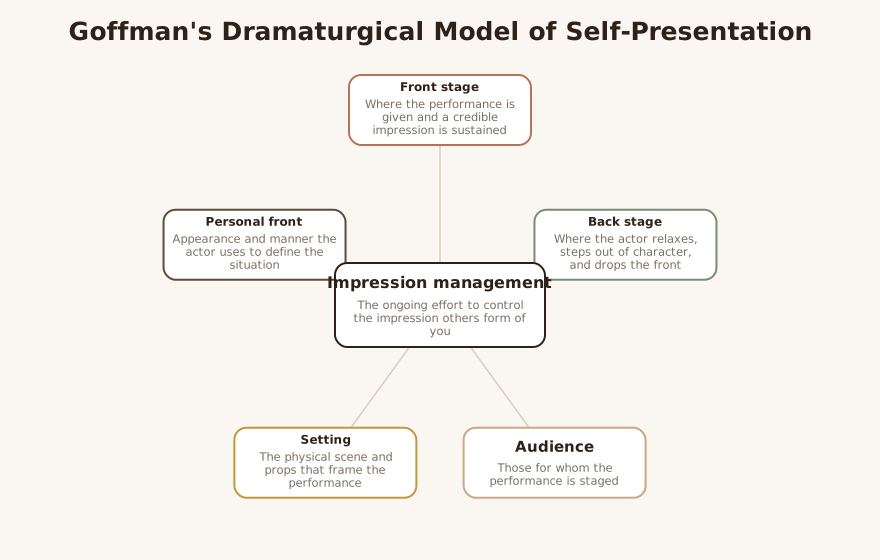
Dramaturgy is one of the most quotable ideas in sociology, and that quotability is exactly why clinicians should handle it with care. The metaphor “all the world’s a stage” is intuitive and immediately useful at the formulation level, but it is a descriptive theory of social interaction, not a treatment protocol LLM. This article lays out the theory faithfully, then translates it into a clinical lens you can use inside recognized modalities for social anxiety, shame, people-pleasing, and emotional-labor burnout.
Type & Discipline
Dramaturgy is a sociological theory of social interaction, sitting within the broader tradition of symbolic interactionism 3. Symbolic interactionism holds that people act toward things and one another on the basis of the meanings those things carry, and that meaning is produced and revised through interaction itself 3. Within that tradition, dramaturgy is the specific approach that analyzes everyday social life using the metaphors of the theater 3. It is descriptive and interpretive social science rather than a clinical discipline; it explains how interaction works, not how to treat distress LLM. For the practicing therapist this matters because dramaturgy supplies vocabulary and formulation, while the actual change work happens inside an established psychotherapy LLM.
Creators & Lineage
The theory is overwhelmingly associated with the Canadian-American sociologist Erving Goffman, who laid it out in his 1959 book The Presentation of Self in Everyday Life 1. Goffman developed the dramaturgical perspective to analyze how individuals present themselves to others and how they shape the impressions other people form of them 2. The book opens from a sociological standpoint and treats face-to-face interaction as the unit of analysis, examining the techniques people use to sustain a coherent self in front of an audience 2. Dramaturgical analysis as a method extends the same theatrical framework into a broader interpretive tool used across sociology and the dramatic arts 7.
The lineage relevant to clinicians runs from Goffman’s symbolic interactionism into adjacent ideas: role theory, which examines how social positions carry expected behaviors; self-presentation theory in social psychology, which studies impression management empirically; and, on the therapeutic side, narrative therapy, which similarly treats identity as authored and performed rather than fixed LLM. These are the concepts most worth holding alongside dramaturgy when you formulate a case LLM.
Core Principles
The organizing claim is that social life can be understood as a series of dramatic performances akin to those on a stage 4. People are “actors” who perform for “audiences,” and the goal of a performance is to convey an impression consistent with the desired goals of the actor in that situation 4.
The central distinction is between the front stage and the back stage 4. Front stage is where the performance is given for an audience; here the actor maintains a particular standard of conduct and works to sustain a credible impression 4. Back stage is where the performer can relax, step out of character, and drop the front, knowing the audience cannot see in 4. The same person behaves very differently across these regions, and this variability is treated as normal and universal rather than as deception or pathology 3.
Several supporting concepts complete the model. Performances rely on a setting (the physical scene and props) and a personal front (appearance and manner) that the actor uses to define the situation for the audience 2. Impression management is the ongoing effort to control the impressions others form, and it is something everyone does continuously, not a trait of the manipulative few 6. Because the meaning of a situation is co-constructed, audiences also do interactional work to keep a performance going, often tactfully overlooking slips so the encounter does not collapse 6.
A further strand, often associated with Goffman’s later work, concerns stigma and the management of a “spoiled identity”: when some attribute marks a person as discredited or discreditable, they must do additional interactional labor to control information and sustain a workable social self LLM. This is the dramaturgical concept that maps most directly onto clinical shame LLM.
Interventions & Techniques
Dramaturgy supplies no intervention manual; the “techniques” below are clinical applications of the metaphor, delivered inside whatever modality you already practice LLM. The unifying move is to externalize self-presentation: to treat performance as something the client does in context rather than as who they fundamentally are LLM.
A first technique is front-stage / back-stage mapping. The client and clinician chart which relationships and settings demand a maintained front and which permit dropping it, using Goffman’s own region distinction as the scaffold 4. This often reveals that a client has many front stages and almost no back stage, which is itself a clinically meaningful finding LLM.
A second is audience analysis. Because impressions are tailored to specific audiences 4, the client examines for whom each performance is staged, what impression they are trying to protect, and what they fear the audience would conclude if the front slipped LLM.
A third is naming the labor. Reframing exhausting social effort as impression-management work makes it visible and, crucially, optional in places where the client assumed it was mandatory 6LLM. A fourth is script and prop inventory: identifying the rehearsed lines, roles, and setting cues a client leans on, then experimenting with smaller or different fronts as graded behavioral exposures LLM.
LLM-generated illustrative example (not a guideline): A client describes feeling “fake at work and exhausted at home.” Mapping reveals that the workplace, the commute, and even calls with their parents are all front-stage regions requiring an upbeat, competent performance, while the only back stage is the twenty minutes alone in the car. Naming this distribution — total front, almost no back — reframes their fatigue as the cost of continuous impression management rather than evidence of personal deficiency LLM.
Evidence Base
Honesty here is essential. As a sociological theory, dramaturgy is well-established and canonical: it is a foundational text within symbolic interactionism and is taught as a core perspective on social interaction 3. Its concepts — front and back stage, impression management, the presentation of self — have been durable and widely adopted across sociology and into related fields 2.
That established status does not transfer to the clinic. There is no body of randomized trials or outcome research evaluating “dramaturgy therapy,” because no such standalone treatment exists LLM. Adjacent constructs have empirical support in social psychology (self-presentation and impression management are studied experimentally), but the dramaturgical frame itself functions clinically as a formulation heuristic, not an evidence-based intervention 6LLM. The defensible clinical claim is therefore modest: dramaturgy can usefully organize a case conceptualization and is best paired with a modality that does carry outcome evidence, such as cognitive behavioral therapy for social anxiety or narrative therapy for identity work LLM. Maturity is high as theory and essentially untested as treatment LLM.
Populations & Indications
The lens is most natural with adults who can engage in reflective, somewhat abstract discussion of their social worlds LLM. It is well-suited to people with social anxiety, for whom the front-stage/back-stage and audience concepts capture the felt experience of being watched and judged LLM. It fits clients with identity concerns or self-concept problems, because dramaturgy treats the self as something performed and revisable 2LLM. It speaks directly to clients exploring authenticity, since the front/back distinction gives language to the gap between performed and felt self LLM.
Because performances are tailored to audiences and co-produced by them 46, the frame also works well in groups, where members can observe one another’s fronts and the collective work of sustaining them LLM. Finally, the stigma strand makes it apt for people navigating stigma — managing a discreditable identity in unsafe or judging settings LLM.
Problems-for-Work
Social anxiety disorder. The client’s dread of negative evaluation is reframed as a hyper-monitored front-stage performance for an imagined critical audience 4LLM. Work targets the assumption that the front must be flawless and that any slip will be catastrophically judged, which dovetails with cognitive restructuring and behavioral exposure LLM.
Shame and spoiled identity. Shame is formulated as the experience of a discrediting attribute leaking into a front stage where it feels unsafe LLM. Externalizing it as information-management labor, rather than as a verdict on the self, can loosen its grip LLM.
Impression management and people-pleasing. Chronic accommodation is named as relentless front-stage performance with no permitted back stage; the work is to legitimize a back stage and tolerate the anxiety of a less-managed impression 6LLM.
Burnout from emotional labor. When a job requires sustaining a prescribed emotional performance, the front/back framework explains the depletion and points toward recovering genuine back-stage regions 4LLM.
Low self-esteem and self-concept problems. Treating self as authored across audiences opens room to ask which performances the client actually endorses 2LLM.
Interpersonal difficulties. Recurrent conflict is examined through clashing performances, mismatched audience expectations, and breakdowns in the mutual tact that normally keeps interactions running 6LLM.
Contraindications, Cautions & Cultural Humility
The theory describes universal interactional processes, so it is rarely “contraindicated” outright, but it is easily misapplied LLM. With clients in acute crisis, dissociation, or psychosis, abstract metaphors about performing selves can be confusing or destabilizing and should be deferred LLM. For trauma survivors, framing protective self-presentation as mere “performance” risks invalidating adaptations that kept them safe; the front is honored as a survival strategy, not labeled as inauthenticity LLM.
Cultural humility is central. Goffman’s account treats impression management as universal 6, but what must be performed, how much front is expected, and where a back stage is even permitted are deeply shaped by culture, race, gender, class, and disability LLM. Code-switching and the heightened impression management many minoritized clients sustain are responses to real external threat, not personal pathology, and must never be pathologized as “fakeness” LLM. The clinician’s job is to validate the labor and its costs while locating its source in the social environment, not in the client LLM.
Treatment-Plan Suggestions & SMART Objectives
| Goal | SMART objective (example) | Mechanism |
|---|---|---|
| Reduce front-stage hypervigilance in social anxiety | Within 8 weeks, client attends 3 social situations rating self-monitoring at or below 4/10 on a self-report scale | Reduces audience-directed self-focus by reframing slips as tolerable, not catastrophic 4LLM |
| Establish a genuine back stage | Within 6 weeks, client identifies and protects 2 weekly back-stage periods with no performance demand | Restores recovery regions to offset continuous front-stage load 4LLM |
| Reduce people-pleasing impression management | Over 10 weeks, client declines 1 low-stakes request per week without managing the other’s reaction afterward | Interrupts compulsive impression management and builds distress tolerance 6LLM |
| Decouple shame from identity | Within 8 sessions, client reframes 1 shame episode as information-management labor in 2 of 3 logged instances | Externalizes “spoiled identity” so it is managed, not equated with the self LLM |
| Reduce emotional-labor burnout | Within 6 weeks, client reports a 2-point drop in end-of-shift depletion on a 0-10 scale after introducing back-stage recovery | Names emotional labor as performance cost and rebuilds off-stage time 4LLM |
| Clarify endorsed self-presentation | Within 5 sessions, client lists 3 performances they endorse and 2 they wish to revise | Treats self as authored, supporting self-concept work 2LLM |
| Improve interpersonal repair | Within 8 weeks, client names the mismatched audience expectation in 2 conflicts and attempts 1 repair | Uses mutual-tact lens to restore co-produced interactions 6LLM |
Common Misconceptions
A frequent error is reading dramaturgy as a claim that people are fake or that social life is mere manipulation. Goffman’s point is the opposite: performance is the ordinary, unavoidable structure of all interaction, not a flaw of dishonest people 36. Relatedly, the back stage is not the “real self” hidden behind a false front; both regions are genuine, just governed by different expectations LLM.
A second misconception is that managing impressions is individually controlled. In fact audiences co-produce performances and often work tactfully to sustain them, so the self on display is a joint accomplishment 6. A third is treating dramaturgy as an evidence-based therapy. It is an established sociological theory and a useful clinical metaphor, but it carries no treatment-outcome evidence of its own 3LLM.
Training & Certification
There is no certification in dramaturgy as a clinical method, and none should be implied, because it is a sociological framework rather than a credentialed therapy LLM. Clinicians acquire it through reading rather than licensure: the primary text is Goffman’s The Presentation of Self in Everyday Life 1, supported by encyclopedic and explainer overviews of the dramaturgical perspective and dramaturgical analysis 37. Competent clinical use comes from pairing this conceptual reading with formal training and supervision in the evidence-based modality through which you will actually deliver the work LLM.
Key Terms
- Front stage — the region where a performance is given for an audience and a standard of conduct is maintained 4.
- Back stage — the region where the performer relaxes, steps out of character, and drops the front 4.
- Impression management — the continuous effort to control the impressions others form of oneself 6.
- Performance / actor / audience — the activity of presenting a self, the person presenting, and those for whom it is presented 4.
- Setting and personal front — the physical scene/props and the appearance/manner used to define the situation 2.
- Spoiled identity (stigma) — a discrediting attribute requiring extra interactional labor to manage information about the self LLM.
- Dramaturgical analysis — the interpretive method of analyzing interaction through theatrical metaphor 7.
Resources & Further Reading
▶ Watch — a video introduction to this concept:
- Erving Goffman, The Presentation of Self in Everyday Life (Anchor/Doubleday, 1959)
- The Presentation of Self in Everyday Life — Wikipedia
- Dramaturgy (sociology) — Wikipedia
- Dramaturgy — Social Sci LibreTexts (Boundless Sociology)
- The Presentation of Self in Everyday Life (1959) — Explore Sociology
- Presentation of Self and Interacting With Others — JackWestin (MCAT content)
- Dramaturgical Analysis — EBSCO Research Starters
Reflective / Supervision Questions
- For this client, which relationships are front stage and where, if anywhere, is a genuine back stage — and what does the distribution tell me about their fatigue or distress? LLM
- Am I treating the client’s self-presentation as a survival adaptation to a real environment, or am I subtly pathologizing it as “fakeness”? LLM
- How might culture, race, gender, class, or disability be shaping what this client must perform, and am I locating the cost in the environment rather than the person? LLM
- Which evidence-based modality am I actually delivering, and is dramaturgy serving as a clarifying metaphor within it rather than substituting for it? LLM
- Where might the theatrical metaphor confuse or destabilize this particular client, and should I defer it? LLM
- What is my own front stage in the room, and how is my impression management shaping what the client feels able to show me? LLM