
Type & Discipline
“Thinking too much” is a cultural concept of distress — specifically an idiom of distress rather than a discrete disorder, technique, or treatment modality 1. It belongs to the conceptual vocabulary of medical anthropology and global mental health, which study how suffering is named, communicated, and made socially intelligible across cultures 1. The construct is best known by its Shona-language form, kufungisisa, literally “thinking too much,” documented in Zimbabwean primary care 2. Parallel forms recur worldwide, including among Cambodian refugees, Haitian populations, and the Khwe of South Africa, where “thinking a lot” similarly organizes personal and interpersonal distress 3. For clinicians, the key reframe is that the phrase is not a metaphor patients reach for casually — in many communities it names a recognized illness with expected causes, symptoms, course, and remedies 1.
This article treats “thinking too much” as a construct that informs assessment and treatment planning, not as a stand-alone therapy LLM. Its clinical value lies in helping practitioners hear a complaint on the patient’s own terms before translating it, cautiously, into biomedical categories 1.
Creators & Lineage
There is no single creator; the construct emerged from cumulative ethnographic and psychiatric fieldwork rather than from a founding theorist LLM. The most cited early empirical anchor is Vikram Patel and colleagues’ 1995 study of kufungisisa among Shona speakers in Zimbabwe, which established the idiom as a locally salient marker of non-psychotic mental illness 2. The construct’s modern consolidation came with Bonnie Kaiser and colleagues’ 2015 systematic review, which gathered 138 publications spanning 1979 to 2014 and demonstrated that “thinking too much” idioms recur across many distinct cultures and languages 1.
The broader lineage runs through medical anthropology’s idioms-of-distress tradition — the recognition that symptom presentation is a culturally shaped mode of communication, not merely raw pathology 1. Within psychiatry, the construct is woven into the DSM-5’s framework of cultural concepts of distress, where “thinking too much” appears as an example idiom in the Glossary of Cultural Concepts of Distress, signaling its formal entry into mainstream nosological awareness LLM. A separate Western strand — the cognitive theory of rumination — supplies the nearest internal analogue and is discussed below 7.
Core Principles
Several principles organize how clinicians use the construct LLM.
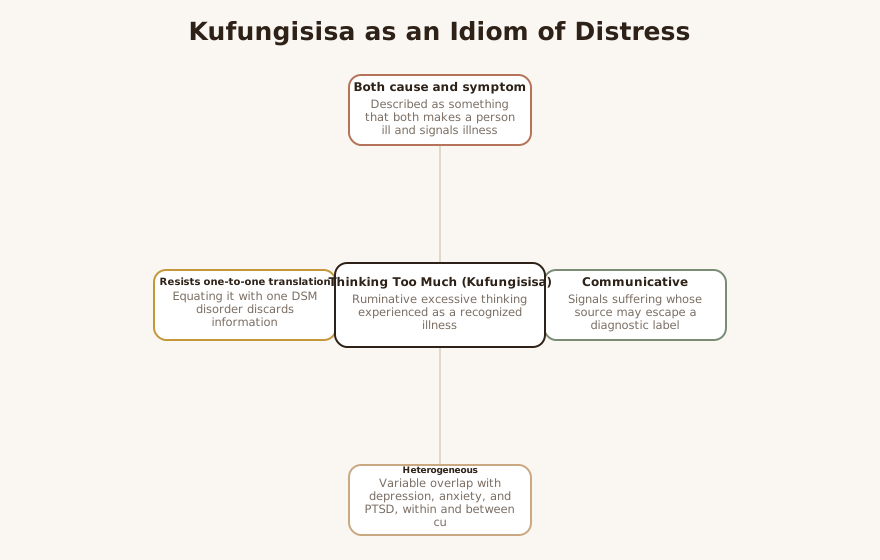
First, the idiom is both cause and symptom. In the Shona framing, kufungisisa is described simultaneously as something that makes a person ill and as a sign that they are ill, spanning mental, social, and spiritual distress 2. Second, it is communicative. The complaint signals suffering whose source — bereavement, poverty, displacement, family conflict — may not be captured by a diagnostic label 1. Third, it is heterogeneous. Kaiser and colleagues stress that “thinking too much” shows variable overlap with depression, anxiety, and PTSD and that it varies meaningfully within cultures, not only between them 1. Fourth, it resists one-to-one translation. Equating the idiom with any single DSM disorder discards information about how the person and their community understand the problem 1.
A fifth principle follows for treatment planning: because the idiom often points to locally relevant targets — sleep, somatic pain, isolation, worry — it can guide intervention even where a formal diagnosis is uncertain 1.
Interventions & Techniques
The construct does not prescribe a manualized protocol; it shapes how established interventions are delivered LLM. The first technique is explanatory-model inquiry: asking what the patient calls the problem, what they believe caused it, how it affects them, and what they think will help 1. This surfaces the idiom in the patient’s own words and prevents premature biomedical reframing 1.
A second technique is reflective use of the idiom in psychoeducation — naming “thinking too much” back to the patient and bridging gently to concepts like rumination or worry without overwriting their meaning 7. A third is targeting the locally salient complications the idiom carries, such as insomnia, headache, and other somatic symptoms, which patients may prioritize over mood language 4. Where the idiom indexes ruminative cognition, transdiagnostic rumination-focused strategies drawn from cognitive-behavioral work offer a plausible, evidence-informed bridge, though the idiom is broader and more culturally embedded than rumination alone 7.
Community-based approaches are also relevant. Task-shifted, locally delivered talking interventions developed in Zimbabwe explicitly engage the language of kufungisisa to make help-seeking acceptable, illustrating how the idiom can be a point of entry rather than an obstacle LLM.
LLM-generated illustrative example (not a guideline): A Zimbabwean-born client reports “my head is too full, I am thinking too much” and complains chiefly of headaches and broken sleep, not sadness. Rather than correcting the framing, the clinician asks what the client believes the thinking comes from, learns it followed a relative’s death, and builds a plan around sleep, grief, and the somatic load the client actually names. LLM
Evidence Base
The honest summary: the idiom as a documented cross-cultural construct is well established, but it is not an established disorder and there is no established “treatment for kufungisisa” LLM. Kaiser and colleagues’ review of 138 publications demonstrates robust, recurring documentation of “thinking too much” idioms across cultures and decades — strong evidence that the construct is real and clinically meaningful 1.
Two findings keep the claim honest. Patel’s foundational Zimbabwe study found that kufungisisa related broadly to non-psychotic mental illness but showed no specific association with depression or anxiety individually, with its closest equivalent being a non-specific “feeling stressed” or neurotic distress 2. Kaiser likewise concluded that “thinking too much” should not be read as a simple equivalent of any one psychiatric diagnosis, given its variable overlap with depression, anxiety, and PTSD 1. So the construct is established as an idiom, not as a validated diagnostic entity LLM. The nearest Western analogue, rumination, is itself well supported as a transdiagnostic process linked to psychopathology, which lends indirect plausibility to rumination-informed approaches without making them proven treatments for the idiom 7.
Populations & Indications
The construct is most directly indicated when working with populations among whom it is documented: Shona-speaking and broader Zimbabwean communities, where kufungisisa originated 2; Cambodian refugees and Haitian populations, where cognate “thinking too much” forms appear 1; and the Khwe of South Africa, where “thinking a lot” is a key idiom of distress 3. More broadly, it is indicated whenever clinicians serve immigrants, refugees, and non-Western cultural groups who may present distress through this frame 1.
Trauma-exposed populations are a particular indication, since the idiom overlaps variably with PTSD and frequently follows loss, violence, or displacement 1. The construct is also useful with any patient — regardless of background — whose chief complaint is excessive, looping thought experienced as harmful, because attending to their explanatory model improves engagement LLM.
Problems-for-Work
The idiom commonly fronts the following clinical problems, each a legitimate focus of work LLM.
- Rumination and worry. “Thinking too much” maps most directly onto perseverative, ruminative cognition, which can be engaged with transdiagnostic strategies 7.
- Depression and anxiety. Overlap is real but partial; clinicians screen for these without assuming the idiom equals them 1.
- PTSD. The idiom often co-occurs with trauma sequelae in refugee and conflict-affected groups 1.
- Somatic symptoms — headache, insomnia. Patients frequently lead with bodily complaints attributed to over-thinking 4.
- Complicated grief. The idiom commonly emerges after bereavement and can organize unresolved mourning LLM.
- Cultural idioms of distress as the presenting frame. Sometimes the work is precisely to honor and decode the idiom itself 1.
For application: a refugee client whose “thinking too much” centers on intrusive memories of violence may be best served by trauma-focused work, while a client whose idiom centers on financial worry and sleeplessness may need a worry- and sleep-targeted plan LLM.
Contraindications, Cautions & Cultural Humility
There is no contraindication to listening for the idiom; the cautions concern interpretation LLM. The primary error is translational over-reach — collapsing “thinking too much” into “depression” and treating the label rather than the person, which Kaiser explicitly warns against 1. The opposite error is exoticizing the idiom as merely cultural color and missing a treatable disorder such as major depression or PTSD beneath it LLM.
Clinicians should not assume uniformity: the idiom varies within cultures, so two Shona-speaking clients may mean different things by kufungisisa 1. Cultural humility means holding the patient as the expert on meaning while retaining clinical responsibility for safety screening — suicide risk, psychosis, and medical causes of somatic complaints must still be assessed regardless of idiom LLM. Finally, kufungisisa is not a standalone DSM diagnosis; documenting it as if it were a billable disorder would misrepresent both the construct and the patient LLM.
Treatment-Plan Suggestions & SMART Objectives
| Goal | SMART objective (example) | Mechanism |
|---|---|---|
| Elicit the patient’s explanatory model | Within 2 sessions, client articulates their own account of “thinking too much” — cause, effect, and desired help — recorded in their words | Explanatory-model inquiry reduces premature reframing 1 |
| Reduce ruminative cognition | Over 8 weeks, client reports a measurable drop in daily time spent looping on worries, tracked via a brief self-monitor | Rumination is a modifiable transdiagnostic process 7 |
| Improve sleep | Within 4 weeks, client increases nights of adequate sleep from baseline by a defined margin | Targets a salient somatic complication of the idiom 4 |
| Address somatic load | Within 6 weeks, client reports reduced headache frequency and links episodes to identified stressors | Symptom reattribution connects body and context 4 |
| Screen and treat co-occurring disorder | By session 3, clinician completes culturally informed screening for depression, anxiety, and PTSD and adjusts the plan accordingly | Variable overlap requires active screening, not assumption 1 |
| Process underlying loss or trauma | Over 12 weeks, client engages grief- or trauma-focused work tied to the event the idiom indexes | Idiom frequently follows bereavement or violence 1 |
| Strengthen social connection | Within 8 weeks, client re-engages at least one supportive relationship or community resource | Counters isolation that sustains over-thinking LLM |
Common Misconceptions
“It’s just an informal way of saying stressed.” In many communities kufungisisa names a recognized illness with expected causes and remedies, functioning as both cause and symptom — not loose slang 2.
“Thinking too much equals depression.” Patel found no specific association with depression or anxiety individually, and Kaiser warns against equating the idiom with any single diagnosis 21.
“It’s identical to rumination.” Rumination is the nearest Western analogue but is narrower and culturally disembedded; the idiom carries social, somatic, and at times spiritual meaning that rumination does not 7.
“It’s not in any diagnostic manual, so it can be ignored.” The construct appears among the DSM-5’s cultural concepts of distress, signaling that clinicians are expected to attend to it LLM.
“It’s a uniform cross-cultural syndrome.” It varies within and between cultures and should not be treated as one fixed entity 1.
Training & Certification
There is no certification in “thinking too much,” because it is a construct rather than a credentialed modality LLM. Competence is built through training in cultural formulation and the use of explanatory-model interviewing, which clinicians can study through the DSM-5 cultural concepts framework and the idioms-of-distress literature 1. Foundational reading for clinicians includes Kaiser and colleagues’ systematic review and Patel’s original Shona study, both of which model how to hold idiom and diagnosis together 12. Broader competency in global mental health and culturally responsive cognitive-behavioral work provides the practical skill set for translating the construct into treatment 7.
Key Terms
- Kufungisisa — Shona for “thinking too much”; the prototypical form of the idiom 2.
- Idiom of distress — a culturally shared way of expressing and communicating suffering 1.
- Cultural concept of distress — the DSM-5 umbrella covering idioms, syndromes, and causal explanations of suffering LLM.
- Explanatory model — a patient’s account of what their problem is, what caused it, and what will help 1.
- Rumination — repetitive, perseverative thinking; a transdiagnostic process and the nearest Western analogue 7.
- Non-psychotic mental illness — the broad category to which kufungisisa was originally linked 2.
Resources & Further Reading
▶ Watch — a video introduction to this concept:
- Kaiser et al. (2015), “Thinking too much”: A systematic review of a common idiom of distress (Social Science & Medicine)
- Patel, Simunyu & Gwanzura (1995), Kufungisisa (thinking too much): a Shona idiom for non-psychotic mental illness
- “Thinking a Lot” Among the Khwe of South Africa (Culture, Medicine, and Psychiatry)
- Thinking too much: rumination and psychopathology (World Psychiatry)
- Thinking Too Much (Routledge chapter)
- Kufungisisa (Wikipedia)
- Kufungisisa — Symptoms and Treatment (iCliniq)
Reflective / Supervision Questions
- When a client says they are “thinking too much,” do I reflexively translate it into a diagnosis, or do I first ask what they mean 1?
- How do I screen for depression, anxiety, and PTSD without assuming the idiom equals any of them 1?
- What in my assessment honors the social, somatic, and spiritual dimensions the idiom may carry, beyond cognition alone 2?
- Where am I at risk of exoticizing the idiom and missing a treatable disorder, or of erasing it by over-medicalizing LLM?
- For my immigrant and refugee clients, do I know which “thinking too much” forms are documented in their communities 1?