
Type & Discipline
Expectancy-value theory (EVT) is a theory of achievement motivation rather than a clinical treatment, and it lives within educational and motivational psychology 2. Its central claim is that the effort a person invests, how long they persist, and which tasks they choose to approach or avoid are jointly determined by how strongly they expect to succeed and how much they value the task 2. Within the achievement-motivation family it sits alongside expected-utility models and self-efficacy theory, but it is distinctive in unpacking “value” into several measurable components 4. For clinicians the key point is that EVT is a conceptual lens, not a billable modality: it sharpens case formulation and goal-setting that are then delivered inside recognized therapies LLM. It is best understood as a vocabulary for the motivational arithmetic that sits underneath avoidance, procrastination, and amotivation LLM.
Creators & Lineage
The lineage begins with John William Atkinson, whose mid-twentieth-century achievement-motivation work modeled behavior as a product of the motive to succeed, the probability of success, and the incentive value of success 5. Atkinson’s formulation was multiplicative, treating expectancy and value as factors that, if either were near zero, would collapse motivation 4. Jacquelynne Eccles, Allan Wigfield, and colleagues then reframed and substantially extended this tradition, studying real achievement contexts such as gender differences in mathematics and the developmental trajectory of competence beliefs 5. Their model retained expectancy and value as the two pillars but treated them as separable, independently measurable predictors rather than strict multiplicative factors 2. In their developmental account, expectancies and values are themselves shaped by self-schemas, prior experiences, and the social and cultural environment 3. In 2020 Eccles and Wigfield renamed the framework “situated expectancy-value theory” to foreground that expectancies and values are formed in, and specific to, particular contexts and moments rather than being stable global traits 1. This situated turn is the lineage capstone clinicians should keep in mind, because it warns against treating “low motivation” as a fixed personality feature LLM. A separate intellectual tradition (Vroom’s organizational expectancy theory and Fishbein-style attitude models) shares the “expectancy-value” label but is a parallel, distinct family and not the ancestry of Eccles-Wigfield achievement EVT LLM. Related frameworks worth knowing include Bandura’s self-efficacy theory, expected-utility theory, and self-determination theory, each of which overlaps with one face of EVT LLM.
Core Principles
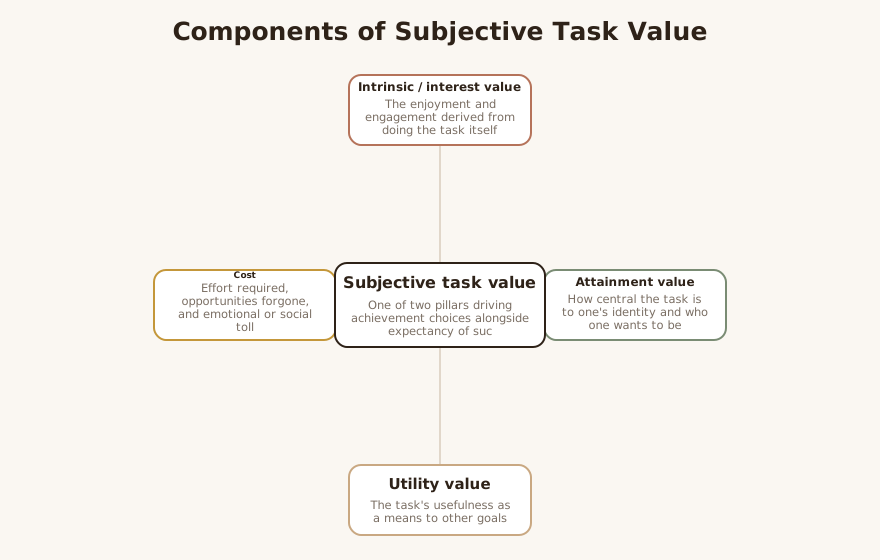
The first pillar is expectancy: a person’s belief about how likely they are to succeed on a specific upcoming task 4. This is closely related to, and often empirically hard to separate from, ability beliefs and perceived competence 2. The second pillar is subjective task value, which EVT decomposes into four components 5. Intrinsic or interest value is the enjoyment and engagement a person derives from doing the task itself 4. Attainment value is how central the task is to the person’s identity and sense of who they want to be 5. Utility value is the task’s usefulness as a means to other goals, such as a career, a relationship, or a future self 5. Cost is the perceived downside of engagement: the effort required, the opportunities forgone, and the emotional or social toll of trying and possibly failing 4. A clinically important nuance is that the modern Eccles-Wigfield model treats expectancy and value as separable predictors with distinct jobs rather than as one fused multiplicative quantity 2. Broadly, expectancy is the stronger predictor of how well a person performs, while value is the stronger predictor of which activities they choose and how long they persist 2. The situated version adds that all of these beliefs are read off the immediate context and can shift task to task and moment to moment 1.
Interventions & Techniques
EVT does not prescribe a technique manual, but it maps cleanly onto interventions clinicians already use LLM. To raise expectancy, the move is to make success feel realistically attainable by calibrating task difficulty, breaking goals into graded steps, and adding scaffolding and support 4. This is structurally identical to graded task assignment and success experiences used in behavioral activation and cognitive-behavioral work LLM. To raise value, clinicians can connect the task to the client’s interests, make its future utility explicit, and link it to identity and respect from valued others 4. Eliciting and amplifying personal utility and intrinsic interest is precisely the change talk that motivational interviewing is built to evoke LLM. The cost component, which is the newest and arguably the most clinically actionable target, is addressed by reducing perceived effort, surfacing hidden opportunity costs, and treating the anticipatory anxiety and shame that inflate the felt price of trying 1. A practical sequence is to assess all four value components plus expectancy for an avoided task, then intervene at whichever term is the binding constraint LLM.
LLM-generated illustrative example (not a guideline): A graduate student avoids starting her thesis. On assessment, her interest value is high and utility value is clear, but expectancy is low (“I won’t be able to write anything good”) and cost is enormous (anticipated weeks of self-criticism). Targeting the high-value/low-expectancy mismatch, the clinician sets a five-minute “write one bad paragraph” task to rebuild expectancy and deflate cost, rather than lecturing about why the thesis matters. LLM.
Evidence Base
The maturity of EVT is best labeled established, but with an important boundary LLM. Within educational and motivational psychology it has robust and replicated support: across many studies, expectancies for success and subjective task values positively predict achievement behaviors and outcomes, perceived competence predicts performance, and perceived utility predicts later course enrollment and persistence 4. The framework has been productive for decades, generating a developmental research program and the 2020 situated refinement 1. Its constructs are operationalized through validated self-report measures and have held up across age groups and domains 2. The honest boundary is that EVT is not a psychotherapy and has no randomized controlled trial base for treating mental disorders LLM. Its predictive evidence concerns motivation and achievement choices, not symptom reduction, so any clinical use rests on borrowing its constructs into therapies that do have an efficacy base LLM. Clinicians should therefore present EVT to clients and in documentation as a formulation tool, not as an evidence-based treatment in its own right LLM.
Populations & Indications
EVT was developed with students and adolescents and remains best validated there, where competence beliefs and task values strongly shape academic choices 3. It extends naturally to adults in academic or career settings, where utility and attainment value drive decisions about training, enrollment, and persistence 5. Athletes and others in performance and achievement contexts fit the model well, since expectancy and value govern training effort and competitive choices LLM. In a clinical practice, the most relevant indication is clients with motivational deficits, where the four-part value breakdown plus expectancy gives a structured way to locate where motivation is failing LLM. The framework has also been applied beyond education to health behaviors such as exercise adoption and smoking cessation, which signals its portability to behavior-change work 5. It is indicated whenever the clinical question is “why isn’t this person doing the thing they say they want to do,” and contraindicated as a primary frame when the presenting problem is symptom-driven rather than choice- or effort-driven LLM.
Problems-for-Work
EVT is especially useful for problems that look like motivational failures LLM. For academic underachievement, the model distinguishes a student who lacks expectancy (“I can’t do math”) from one who lacks value (“math is pointless”), and the two require opposite interventions 4. For procrastination, EVT reframes delay as a value-cost imbalance in the present moment, often driven by inflated emotional cost, which the situated view explains as context-dependent 1. For amotivation and low motivation, the framework prompts a component-by-component audit rather than a global judgment that the person is “unmotivated” LLM. For avoidance behavior, EVT locates avoidance where expectancy is low and cost is high, pointing intervention at those two terms LLM. For low self-efficacy, the expectancy pillar maps directly onto Bandura’s construct and indicates graded mastery experiences 4. For career indecision, attainment and utility value clarification helps a client weigh paths against identity and future goals 5. For behavioral activation deficits, EVT supplies the rationale for choosing activities high in interest and attainment value to maximize follow-through LLM. For treatment nonadherence, the same audit asks whether the client doubts the treatment will work (expectancy) or sees it as not worth the cost (value) LLM.
LLM-generated illustrative example (not a guideline): A client with depression “can’t get motivated” to resume jogging. The clinician walks the four value terms: interest is moderate, utility is clear (mood, sleep), but attainment value is low (“I’m not a runner anymore”) and cost is high (fatigue, comparison to a fitter past self). The plan rebuilds attainment value by reframing the identity (“someone rebuilding”) and cuts cost with a two-block walk, not a run. LLM.
Contraindications, Cautions & Cultural Humility
The first caution is scope: EVT is not a treatment, and using it as if it were can lead clinicians to under-treat depression, anxiety, or trauma that are masquerading as “low motivation” LLM. Apparent value or expectancy deficits can be symptoms (anhedonia, hopelessness, executive dysfunction) requiring direct clinical treatment, not motivational reframing LLM. A second caution is the multiplicative-versus-separable nuance: clinicians should not assume that boosting value alone repairs motivation if expectancy is the binding constraint, because the two terms do different work 2. Cultural humility is essential because expectancies and values are formed within social and cultural systems, and what counts as a valued or attainable goal is culturally situated 1. Eccles and colleagues’ own foundational work on gender and mathematics demonstrated that competence beliefs and values are shaped by social context, not merely individual psychology 5. Clinicians should therefore avoid pathologizing a client’s low value for a goal that conflicts with their cultural, family, or identity priorities, and instead treat that as meaningful information LLM. The situated framing is a built-in corrective: it insists that motivation be read in context rather than as a stable deficit in the person 1.
Treatment-Plan Suggestions & SMART Objectives
| Goal | SMART objective (example) | Mechanism |
|---|---|---|
| Increase expectancy for an avoided task | Client completes one pre-defined “graded” version of the avoided task on 4 of 7 days over 2 weeks, rated for confidence before and after LLM | Mastery/success experiences raise expectancy of success 4 |
| Reduce perceived cost driving procrastination | Client uses a 5-minute “minimum viable start” on the target task at least 3x/week for 3 weeks, logging anticipated vs. actual distress LLM | Lowers emotional and effort cost; tests inflated cost predictions 1 |
| Build utility value for treatment adherence | Client articulates, in writing, two personal future benefits of the treatment task by session 3 and reviews them weekly LLM | Utility value increases choice and persistence 5 |
| Strengthen attainment value tied to identity | Client names one valued identity the activity expresses and selects 2 activities/week consistent with it for 4 weeks LLM | Attainment value links task to self-concept, supporting persistence 5 |
| Leverage intrinsic interest for activation | Client schedules 3 weekly activities chosen specifically for enjoyment and rates engagement 0-10 LLM | Intrinsic value increases sustained engagement 4 |
| Resolve career indecision via value clarification | Client ranks 3 career paths on utility and attainment value and identifies a next step by session 5 LLM | Clarified subjective task values guide achievement choices 5 |
| Re-read motivation in context (situated frame) | Client and clinician map expectancy and value for the target task across 3 different settings over 2 weeks LLM | Situated EVT: beliefs are context-specific, not fixed traits 1 |
Common Misconceptions
A frequent error is treating motivation as a single quantity, when EVT’s value is to separate expectancy from four distinct value components 5. A second is assuming the strict multiplicative formula (“expectancy times value, zero in either kills motivation”) is the current consensus; that is the Atkinson/expected-utility origin, whereas the modern Eccles-Wigfield model treats the two as separable predictors with different roles 2. A third is conflating Eccles-Wigfield achievement EVT with Vroom’s organizational expectancy theory or Fishbein-style attitude models, which share the label but are a different tradition LLM. A fourth is collapsing expectancy into self-efficacy: they overlap heavily but EVT situates expectancy specifically as a forward-looking success belief for a particular task 4. A fifth is treating “low value” as irrational or as resistance, when it may reflect a coherent, culturally grounded priority 1. Finally, clinicians sometimes overclaim EVT as an evidence-based therapy; its evidence is for predicting achievement and motivation, not for treating disorders LLM.
Training & Certification
There is no certification in expectancy-value theory, and none is needed, because it is an academic framework rather than a proprietary treatment LLM. Familiarity is built by reading the primary literature, beginning with the foundational developmental and theoretical papers and ending with the 2020 situated reformulation 2. The accessible entry points are the open educational-psychology textbook treatment and reference summaries, which lay out the components and applications 4. Clinical fluency comes from integrating the constructs into modalities a clinician is already trained and credentialed in, such as CBT, behavioral activation, and motivational interviewing LLM. Because the framework informs case formulation rather than constituting a treatment, the relevant competency is the host modality, supplemented by EVT as a conceptual tool LLM.
Key Terms
Expectancy is the belief that one can succeed at a specific upcoming task 4. Subjective task value is the overall worth a person assigns to a task, decomposed into four components 5. Intrinsic (interest) value is the enjoyment derived from the task itself 4. Attainment value is the task’s importance to one’s identity and self-concept 5. Utility value is the task’s usefulness for reaching other goals 5. Cost is the perceived effort, forgone opportunities, and emotional or social price of engaging 4. Situated expectancy-value theory is the 2020 reformulation emphasizing that expectancies and values are formed in and specific to particular contexts 1.
Resources & Further Reading
▶ Watch — a video introduction to this concept:
- Eccles & Wigfield (2020), From expectancy-value theory to situated expectancy-value theory — Contemporary Educational Psychology
- Wigfield & Eccles (2000), Expectancy-value theory of achievement motivation — Contemporary Educational Psychology
- Eccles & Wigfield (1994), Expectancy-value theory of achievement motivation: A developmental perspective — Educational Psychology Review
- Expectancy-Value Theory — Educational Psychology (open textbook, SUNY/Pressbooks)
- Expectancy-value theory — Psychology Research Starters (EBSCO)
- The Expectancy-Value Theory of Motivation — Study.com (video lesson)
Reflective / Supervision Questions
- When a client presents as “unmotivated,” do I audit expectancy and all four value components separately, or do I treat motivation as one undifferentiated quantity LLM?
- For an avoided task, can I identify which single term (expectancy, interest, attainment, utility, or cost) is the binding constraint, and is my intervention aimed there LLM?
- Am I distinguishing a genuine motivational deficit from a symptom such as anhedonia, hopelessness, or executive dysfunction that requires direct clinical treatment LLM?
- When a client assigns low value to a goal, am I reading that as resistance, or as potentially coherent culturally and identity-grounded information LLM?
- Am I documenting EVT-informed work inside a recognized billable modality and using the EVT terms as rationale rather than as a treatment claim LLM?
- Where am I implicitly assuming that boosting value will fix motivation, when expectancy may be the limiting factor LLM?