
Type & Discipline
Vroom’s expectancy theory is a cognitive theory of motivation that originated in organizational and industrial psychology rather than in clinical or counseling practice 4. It belongs to the family of process theories of work motivation, which attempt to explain how motivation arises rather than simply cataloguing what people want 6. The theory’s central claim is that a person’s motivational force to act is a function of how they perceive the relationship between their effort, their performance, and the outcomes that performance produces 3. Because it was developed and tested in workplace settings, its primary evidence base concerns job satisfaction, work effort, and performance, not symptom reduction or psychological wellbeing 1. For the practicing therapist, it is best understood as a transferable conceptual map of motivation, not as a treatment protocol LLM. Its disciplinary home in industrial-organizational psychology matters clinically because it explains why the theory is most directly relevant to occupational concerns such as disengagement, burnout, and work-related goal-setting LLM.
Creators & Lineage
The theory was formulated by Victor H. Vroom, a Canadian-born psychologist, in his 1964 book Work and Motivation, developed during his work on decision-making and motivation at the Yale School of Management 3. Vroom built on earlier valence-instrumentality-expectancy reasoning and the broader tradition of cognitive and decision-theoretic approaches to behavior, framing the worker as a rational agent who anticipates the consequences of effort 4. The model was subsequently extended and elaborated by later organizational theorists, and it sits alongside a cluster of work-motivation frameworks including goal-setting theory and equity theory 6. Within contemporary clinical thought, expectancy theory shares conceptual territory with self-determination theory and with motivational interviewing, both of which also foreground the person’s appraisal of value and capability LLM. Several critics within organizational psychology—including Lawler, Porter, and Graen—argued early on that the model was too simplistic and that it overestimated the degree to which people calculate expected outcomes deliberately 4.
Core Principles
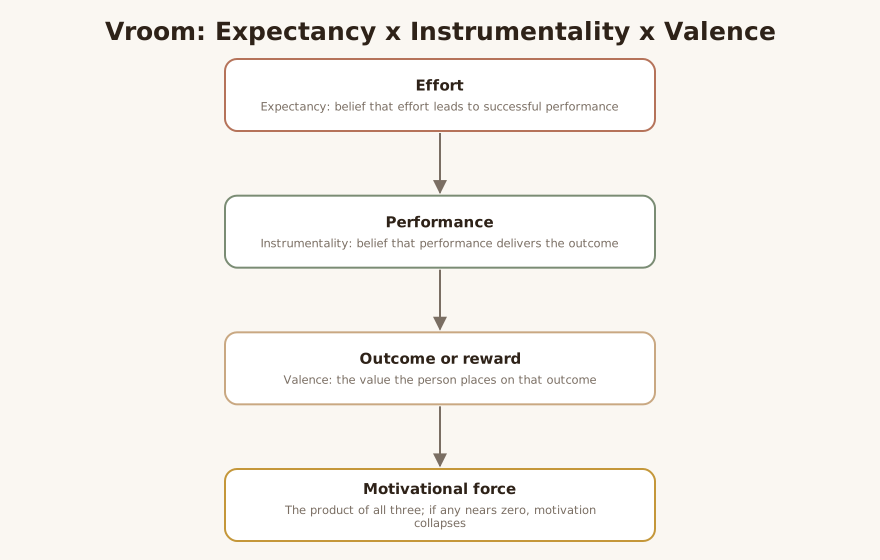
The theory rests on three perceptual constructs. Expectancy is the person’s subjective probability that increased effort will lead to successful performance—an effort-to-performance link 3. Instrumentality is the perceived probability that successful performance will actually deliver a particular outcome or reward—a performance-to-outcome link 3. Valence is the value, positive or negative, that the person places on that outcome 3. Vroom proposed that these combine multiplicatively, classically rendered as Motivational Force = Expectancy x Instrumentality x Valence, meaning that if any single component approaches zero, overall motivation collapses regardless of the strength of the others 4. A crucial and clinically useful nuance is that all three terms are perceptions, not objective facts; two people facing identical circumstances can be differently motivated because they appraise the links differently 5. The theory therefore locates motivation in subjective cognition, which is precisely why it translates into a framework a therapist can work with LLM.
Interventions & Techniques
Expectancy theory does not prescribe clinical techniques, but its structure suggests a diagnostic logic: when motivation is low, ask which of the three links is weak LLM. If expectancy is the problem—the person does not believe effort will produce performance—interventions target perceived competence, such as skill-building, graded task assignment, mastery experiences, and addressing capability-related beliefs 2. If instrumentality is weak—the person doubts performance will yield the desired outcome—the work involves clarifying contingencies, examining whether the link is genuinely broken or distorted by hopelessness, and identifying outcomes that performance can reliably produce 2. If valence is the issue—the available outcomes simply are not wanted—the work shifts to values clarification and connecting effort to outcomes the person authentically cares about 3. Lunenburg frames the managerial corollary as deliberately altering each of these expectations, a stance that maps onto motivation-focused clinical conversations 2. In practice these map naturally onto established techniques within motivational interviewing, cognitive restructuring, and behavioral activation rather than constituting a standalone method LLM.
LLM-generated illustrative example (not a guideline): A client describes intense procrastination on a graduate thesis. Using the three links as a map, the clinician discovers expectancy is intact (the client knows how to write) but instrumentality has collapsed (“even if I finish, I won’t get a job”) and valence has shifted (the degree no longer reflects what they value). Treatment then targets the broken performance-to-outcome belief and a values reappraisal rather than time-management skills LLM.
Evidence Base
Honesty about evidence requires a sharp distinction here. As an organizational-psychology theory, expectancy theory is established: it is widely taught, has generated decades of research, and remains a standard reference in work-motivation curricula 6. However, the empirical record is more mixed than the tidy formula implies. The major meta-analysis, Van Eerde and Thierry (1996), found only modest correlations between expectancy components and work-related criteria, and—critically—the multiplicative model (E x I x V) did not outperform, and arguably underperformed, treating the components separately and additively 1. The same meta-analysis found that within-subjects designs, which compare a person’s choices across options, yielded stronger results than between-subjects designs 1. There is essentially no evidence base for expectancy theory as a psychotherapy; it has not been validated as a clinical treatment, and any therapeutic use is analogical synthesis rather than an empirically supported intervention LLM. The “established” label therefore refers to the theory’s standing in industrial-organizational psychology, not to its status as a tested clinical modality LLM. Clinicians should treat the multiplicative formula as a useful heuristic, not a literal equation LLM.
Populations & Indications
Within its native domain, the theory was developed for and tested on workforce populations: employees, managers and leaders, teams, and whole organizations 6. It has been applied to students in academic-motivation contexts, where effort-performance-outcome reasoning maps onto study behavior and grades 3. For the clinician, the most apt indications are presentations with a strong occupational or achievement component—clients navigating disengagement at work, burnout, performance concerns, or career-related goal-setting difficulties LLM. It is also a serviceable lens for any presentation where a client’s stated goal and their behavior are misaligned, because it forces a precise question about where the motivational chain is broken LLM. It is not indicated as a primary framework for trauma, mood, or anxiety disorders, though its motivational logic can supplement evidence-based treatments for those conditions when activation or goal-pursuit is a target LLM.
Problems-for-Work
The theory maps cleanly onto several common problems-for-work. Low motivation and disengagement at work are the paradigm cases: the framework asks whether the client has stopped believing effort pays off, stopped believing performance is rewarded, or stopped valuing the rewards on offer 6. Procrastination often reflects a quietly collapsed instrumentality or valence rather than a skills deficit, which reframes the intervention LLM. Poor performance invites examination of expectancy—does the client believe they can succeed if they try 2? Burnout frequently presents as a valence problem layered on exhaustion, where previously valued outcomes have lost their pull LLM. Low job satisfaction and goal-setting difficulties both map onto mismatches between effort, outcome, and value 3.
LLM-generated illustrative example (not a guideline): A mid-career nurse reports burnout and is considering leaving the field. Mapped onto the three links, expectancy and instrumentality are intact—she is competent and well-regarded—but valence has eroded: recognition and pay no longer offset moral distress. The clinical work centers on values rather than coping skills, clarifying which outcomes could restore meaning LLM.
Contraindications, Cautions & Cultural Humility
The chief caution is theoretical overreach: expectancy theory was never validated as a psychotherapy, so it should frame, not replace, evidence-based treatment LLM. The model assumes a fairly rational, calculating agent, and its own critics noted this is an oversimplification—much human motivation is automatic, affective, or shaped by factors the model omits 4. Applying a workplace-derived, individualistic, outcome-maximizing logic uncritically can misread clients whose motivation is embedded in collective, relational, or culturally situated value systems rather than individual reward calculus LLM. The construct of valence in particular demands cultural humility: what counts as a desired outcome is culturally and personally specific, and the clinician should elicit rather than assume it LLM. The theory can also pathologize a “broken” instrumentality link that is in fact an accurate appraisal of an unjust or unrewarding system, where the clinically and ethically appropriate response may be validation and systemic problem-solving, not cognitive change LLM. It should not be used to imply that a demoralized client simply needs to recalculate LLM.
Treatment-Plan Suggestions & SMART Objectives
| Goal | SMART objective (example) | Mechanism |
|---|---|---|
| Strengthen effort-performance belief (expectancy) | Within 6 weeks, client completes 3 graded work tasks of increasing difficulty and rates confidence before/after each | Mastery experiences raise perceived expectancy 2 |
| Repair performance-outcome belief (instrumentality) | Over 4 sessions, client identifies and tests 2 concrete outcomes that completed tasks reliably produce | Clarifying contingencies restores instrumentality 2 |
| Clarify valued outcomes (valence) | Within 4 weeks, client articulates a ranked list of 5 personally valued work outcomes and links current effort to the top 2 | Values clarification increases valence 3 |
| Reduce procrastination | Over 8 weeks, client reduces self-reported avoidance of a priority task from daily to twice-weekly | Identifying the weak motivational link targets the true barrier LLM |
| Address burnout-related disengagement | Within 8 weeks, client reports a 2-point increase (0-10 scale) in perceived meaning of one core work activity | Restoring valence re-engages effort LLM |
| Improve goal-setting capacity | By session 6, client sets one weekly goal with explicit effort, performance, and outcome links specified | Making the three links explicit structures goals 5 |
| Increase job satisfaction | Over 10 weeks, client identifies and acts on 2 modifiable instrumentality gaps at work | Closing effort-reward gaps raises satisfaction 1 |
Common Misconceptions
A frequent misconception is that the multiplicative formula is empirically superior—that motivation literally equals the product of three numbers; the meta-analytic evidence does not support the multiplicative model over a simpler additive treatment of the components 1. A second is that expectancy theory is a validated therapy; it is an organizational theory borrowed analogically, and its “established” status belongs to work psychology, not clinical practice LLM. A third is that it describes objective reality, when in fact all three constructs are subjective perceptions that can be distorted, accurate, or revisable 5. A fourth is that low motivation always reflects low valence (“they just don’t want it”), when the bottleneck is often expectancy or instrumentality instead 2. Finally, the model is sometimes read as endorsing the idea that a sufficiently large reward will always increase effort—a stance critics explicitly rejected because it ignores whether the reward aligns with the person’s actual needs 4.
Training & Certification
There is no certification in expectancy theory, and none is needed; it is a conceptual framework taught within organizational-behavior, management, and industrial-organizational psychology curricula rather than a credentialed clinical method 6. Clinicians typically encounter it through coursework or applied readings such as Vroom’s original work and accessible secondary treatments 2. Because there is no validated clinical protocol, no formal clinical training pathway exists; competent use depends on the clinician’s existing grounding in evidence-based motivational and behavioral methods into which the framework is integrated LLM. Therapists wishing to apply the logic responsibly are better served by training in motivational interviewing or behavioral activation, where expectancy reasoning can be embedded with an actual evidence base LLM.
Key Terms
- Expectancy (E→P): The subjective probability that effort will lead to successful performance 3.
- Instrumentality (P→O): The perceived probability that performance will lead to a given outcome or reward 3.
- Valence: The value, positive or negative, that a person assigns to an outcome 3.
- Motivational force: The resultant drive to act, classically modeled as the product of expectancy, instrumentality, and valence 4.
- Multiplicative model: The proposition that the three components combine by multiplication, so any near-zero term nullifies motivation—a pedagogically clean but empirically contested claim 1.
- Outcome: A consequence of performance that may be valued or aversive and is appraised by the individual 5.
Resources & Further Reading
▶ Watch — a video introduction to this concept:
- Vroom’s expectancy models and work-related criteria: A meta-analysis (Van Eerde & Thierry, 1996)
- Expectancy theory of motivation: Motivating by altering expectations (Lunenburg, 2011)
- Victor Vroom’s expectancy theory of motivation (Positive Psychology)
- Expectancy theory (Wikipedia)
- Vroom’s expectancy theory (Institute for Manufacturing, University of Cambridge)
- Expectancy theory (EBSCO Research Starters)
Reflective / Supervision Questions
- When a client presents as “unmotivated,” do I reflexively assume low valence, or do I systematically check expectancy and instrumentality first LLM?
- Am I borrowing a workplace, individualistic motivation model in a way that fits this client’s cultural and relational context, or am I imposing it LLM?
- When a client’s instrumentality belief is “broken,” how do I distinguish a cognitive distortion from an accurate appraisal of an unrewarding or unjust system LLM?
- Have I been transparent—with myself and in documentation—that this is a conceptual map and not an evidence-based standalone treatment LLM?
- Which of my client’s valued outcomes have I actually elicited, versus assumed LLM?
- How do I integrate this framework into a modality with its own evidence base, rather than treating it as a freestanding intervention LLM?