
Type & Discipline
Self-efficacy is a psychological construct rather than a freestanding therapy: it names a specific belief — a person’s conviction in their capability to organize and execute the courses of action required to achieve a given result 4. It sits within social-cognitive psychology and is most precisely defined as the belief in one’s capacity to execute the behaviors necessary to produce specific performance outcomes 3. Because it is a construct, you do not “do” self-efficacy with a client the way you do exposure or behavioral activation; instead you treat it as a mechanism — a lever that established modalities turn LLM. Bandura originally advanced it as a unifying explanatory account, arguing that diverse therapeutic methods share a common pathway: behavioral change is mediated by changes in perceived self-efficacy 1. For the practicing clinician, that framing is the practical payoff — it gives you a shared language for why an intervention works, not merely whether it works LLM.
Creators & Lineage
The theory originates with Albert Bandura, who introduced self-efficacy in a 1977 Psychological Review paper subtitled “Toward a unifying theory of behavioral change” 1. Bandura conceived self-efficacy as central to human agency, reflecting his conviction that people have a hand in determining the course their lives take 2. The construct grew directly out of his earlier social learning theory and matured into the broader social-cognitive theory, where it functions as the engine of personal agency 5. Its conceptual neighbors include self-regulation theory, since efficacy beliefs interact with the self-regulatory capacities of planning, reflection, and self-monitoring to determine outcomes 5. In clinical practice it is most often encountered as a working mechanism inside cognitive behavioral therapy, where mastery-oriented techniques are understood, in part, as efficacy-building procedures 1. From the outset the theory invited scrutiny: contemporaneous analyses in Cognitive Therapy and Research probed whether efficacy expectations were a genuine cause of change or a correlate of it, an argument that sharpened the construct’s definitions 6.
Core Principles
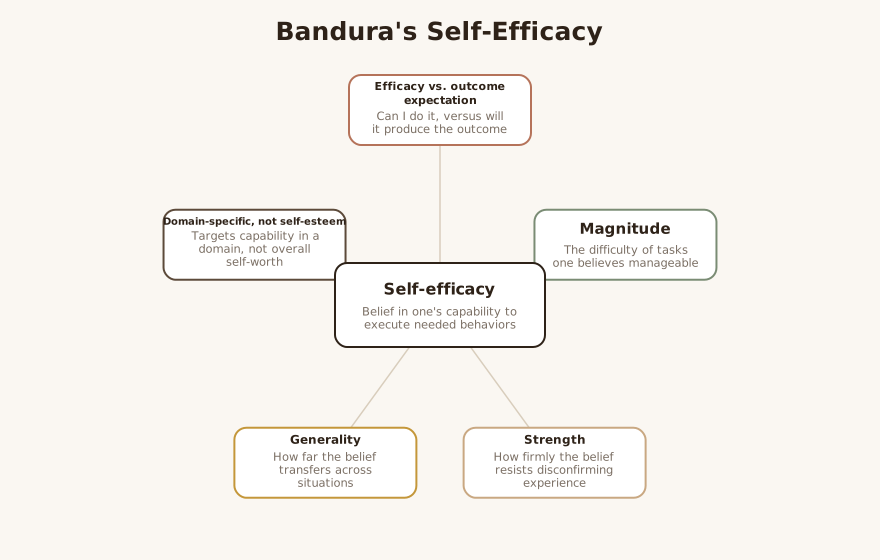
The cornerstone distinction is between efficacy expectations — the belief that one can perform the required actions — and outcome expectations — the belief that those actions will produce a particular outcome 1. A client can believe an action would work yet doubt they can carry it out; Bandura argued it is the efficacy belief, not the outcome belief, that most powerfully governs whether the person tries 1. Efficacy expectations are not a single global trait but vary along three dimensions: magnitude (the difficulty level of tasks a person believes they can manage), strength (how firmly the belief resists disconfirming experience), and generality (how far the belief transfers across situations and domains) 1. The youth-development literature describes self-efficacy in parallel terms as a multilevel, multifaceted set of beliefs differing in level, strength, and generativity 4.
Crucially, self-efficacy is domain-specific rather than diffuse, which separates it sharply from self-esteem: self-efficacy targets capability in particular domains, whereas self-esteem reflects broader overall self-worth, so a person can be highly competent yet hold low self-worth, or the reverse 3. High efficacy beliefs lead people to embrace difficult tasks as opportunities to learn, set more ambitious goals, persist through obstacles, and recover quickly from setbacks; low efficacy beliefs lead people to avoid challenging tasks, lose motivation, and give up easily 2. Efficacy beliefs exert their effects through several mediating processes — cognitive (goal-setting and problem-solving), motivational (self-regulation and attribution), affective (managing emotional arousal), and selective (choosing which environments to enter) 4.
Interventions & Techniques
Bandura specified four modes for inducing efficacy beliefs, and they remain the practical menu for clinicians 1. Performance accomplishments — direct mastery experiences — are the most potent source because they furnish authentic evidence of capability 1. Vicarious experience, observing similar others succeed, raises efficacy on the implicit logic of “if they can do it, I can do it as well,” and is strengthened when the model is perceived as similar to the observer 3. Verbal (social) persuasion — credible encouragement from a trusted source — is the weakest standalone source and is most useful when realistic, genuine, and paired with practical support 3. Emotional/physiological arousal matters through interpretation: a person who reframes pre-performance “butterflies” as normal sustains efficacy, while one who reads the same sensations as evidence of inability erodes it 5.
The clinical implication is a hierarchy of leverage: because performance-based mastery treatments produce stronger and more generalized efficacy gains than vicarious or persuasive methods alone, the practitioner should prioritize graded, real-world success experiences and use modeling, persuasion, and arousal regulation as adjuncts 1. A more recent source adds imaginal experiences — mental rehearsal — as a fifth pathway, useful when in-vivo mastery is not yet feasible 4.
LLM-generated illustrative example (not a guideline): A client with a driving phobia rehearses merging onto a highway in imagery, watches a recording of a peer narrating the same drive calmly, receives specific encouragement tied to a prior small success, and is coached to relabel a racing heart as ordinary activation — then completes a brief on-ramp drive. The completed drive (mastery) is the load-bearing ingredient; the other three sources prime and consolidate it. LLM
Evidence Base
The maturity of self-efficacy as a construct is best described as established: it has decades of cross-domain research and is woven into mainstream theories of motivation and behavior change 2. Self-efficacy has been linked to academic performance, health-behavior adoption, athletic performance, leadership, stress resilience, and psychological well-being, and a 2016 meta-analysis found that self-efficacy had a medium-size effect on health-related behaviors 2. In the developmental literature it predicts academic outcomes, help-seeking, reduced procrastination, better stress management, lower depression and anxiety, and reductions in risk behaviors such as smoking and aggression 4.
Honesty about the evidence requires noting its long-standing critiques. Early analyses questioned whether efficacy expectations cause behavioral change or merely co-vary with it, cautioning against treating a self-report correlate as a proven causal mediator 6. Contemporary researchers continue to debate whether efficacy assessments measure perceived capability or instead conflate it with motivation in voluntary contexts 2. Measurement is a recognized weak point: scales for some sources (notably vicarious experience) can show low reliability, and because efficacy is highly situation-specific, assessments must account for factors such as gender, ethnicity, and the specific academic or behavioral domain 4. The construct is also catalogued in the clinical reference literature as a discrete theory with its own indexed evidence base 7.
Populations & Indications
Self-efficacy is broadly applicable across the lifespan and has been studied in adults and adolescents alike, with the developmental review focusing specifically on its role in adolescent functioning 4. It is especially salient for people managing chronic illness and recovery, where providers can strengthen patient efficacy by modeling health behaviors and offering encouragement during vulnerable periods such as post-hospitalization 5. It is a workhorse construct for athletes and performers, where mastery, modeling, and arousal interpretation map directly onto preparation routines 3. In addiction recovery it functions as a mediator that helps prevent relapse by supporting maintenance of changed behavior patterns 5.
LLM-generated illustrative example (not a guideline): With an older adult recovering cardiac function, a clinician sequences walking goals so each week’s distance is reliably achievable, pairs the client with a same-age peer who completed rehab, and reframes breathlessness as expected exertion rather than danger — building efficacy for sustained activity. LLM
Problems-for-Work
Because efficacy beliefs govern approach versus avoidance, the construct is clinically apt wherever avoidance, low persistence, or nonadherence drive the presenting problem LLM. In phobias and panic disorder, low efficacy for tolerating feared situations sustains avoidance; mastery-based exposure raises efficacy and, by Bandura’s account, that rise mediates symptom reduction 1. In generalized anxiety, a strong negative relationship between anxiety and self-efficacy means that small, repeated successes can interrupt the threat-appraisal cycle 5. In major depressive disorder, clients who view challenges as threats rather than masterable tasks tend to avoid them and recover slowly from setbacks, elevating depression risk — so graded mastery is both behavioral activation and efficacy repair 5.
For substance use disorders and relapse, efficacy for resisting use in high-risk situations is a maintenance lever rather than a one-time gain 5. For chronic pain and treatment nonadherence, efficacy for self-management behaviors predicts whether plans like exercise or medication routines are sustained 5. For low self-esteem, the domain-specific nature of self-efficacy offers a more tractable target than global self-worth: build capability beliefs in concrete arenas rather than arguing about worth in the abstract 3.
Contraindications, Cautions & Cultural Humility
Self-efficacy is a mechanism, not a panacea, and it should not be inflated past the client’s actual circumstances LLM. The literature flags “over-efficaciousness”: illusory confidence can undermine learning, because believing oneself already competent reduces motivation to improve 5. Efficacy beliefs also do not guarantee success when real environmental constraints, task complexity, or genuine skill gaps stand in the way, so efficacy work must be paired with honest appraisal of resources and skill 5. Verbal persuasion in particular is fragile — it is easily negated by disconfirming experience — so pep talks unbacked by real success can backfire 1.
Cultural humility is essential because the construct is not culturally invariant. The review notes that in Chinese contexts high academic achievers often paradoxically report low academic self-efficacy despite clear competence, which means self-report cannot be read at face value across cultures 4. Assessment should therefore be context-sensitive to gender, ethnicity, and domain rather than assuming a universal scale captures the same thing everywhere 4.
Treatment-Plan Suggestions & SMART Objectives
| Goal | SMART objective (example) | Mechanism |
|---|---|---|
| Reduce phobic avoidance | Within 6 weeks, client completes 4 graded exposure tasks logged as “completed without escape” | Performance accomplishments build mastery-based efficacy 1 |
| Increase activity in depression | Over 4 weeks, client completes 3 pre-planned mastery activities per week and rates competence after each | Graded success counters threat-appraisal and avoidance 5 |
| Strengthen relapse resistance | Within 8 weeks, client rehearses and reports use of a refusal plan in 2 real high-risk situations | Coping self-efficacy supports maintenance and prevents relapse 5 |
| Improve treatment adherence | For 30 days, client logs adherence to one self-management behavior at 80%+ | Self-management efficacy predicts sustained health behavior 5 |
| Reframe physiological arousal | Within 4 weeks, client demonstrates relabeling of 3 arousal cues as non-dangerous in session | Reinterpreting arousal preserves efficacy under stress 5 |
| Leverage peer modeling | Within 3 weeks, client identifies and observes 1 similar peer succeeding at the target behavior | Vicarious experience raises capability beliefs 3 |
| Build domain-specific confidence | Over 6 weeks, client sets and meets 1 modestly stretched goal per week in a chosen arena | High efficacy promotes goal-setting and persistence 2 |
Common Misconceptions
A frequent error is treating self-efficacy as a synonym for self-esteem or general confidence; in fact it is domain-specific belief in capability for particular tasks, not a global feeling of worth 3. A second misconception is that more confidence is always better, when the evidence shows that over-efficaciousness can suppress the motivation to learn 5. A third is conflating efficacy expectations with outcome expectations — believing an action would work is not the same as believing one can perform it, and the two can diverge 1. Clinicians also sometimes assume verbal encouragement is sufficient; persuasion is the weakest source and is readily overturned by contradicting experience 1. Finally, it is a mistake to assume a high self-report always signals true capability, since the belief–performance link is moderated by skill, context, and culture 4.
Training & Certification
There is no certification in “self-efficacy theory”; it is a foundational construct taught within social-cognitive psychology and applied within evidence-based modalities, so competence comes through training in those modalities rather than a standalone credential LLM. The primary intellectual training resource is Bandura’s original 1977 formulation, which lays out the efficacy/outcome distinction and the four sources directly 1. Applied fluency is developed by learning to operationalize the four sources inside structured interventions, the way cognitive behavioral techniques already embed mastery and arousal-regulation procedures 1. Accessible secondary summaries from professional and educational organizations are useful for orienting trainees and clients to the core ideas 2.
Key Terms
Self-efficacy — belief in one’s capacity to execute the behaviors necessary to produce specific performance outcomes 3. Efficacy expectation — the conviction that one can successfully perform the required behavior 1. Outcome expectation — the belief that a given behavior will lead to a particular outcome, distinct from believing one can perform it 1. Magnitude, strength, generality — the three dimensions along which efficacy expectations vary: task difficulty, firmness against disconfirmation, and transfer across situations 1. Performance accomplishments — direct mastery experiences, the most potent source of efficacy 1. Vicarious experience — efficacy gained by observing similar others succeed 3. Verbal persuasion — efficacy influenced by credible encouragement, the weakest source 3. Coping self-efficacy — perceived ability to manage difficulties encountered during performance 4. Human agency — the broader capacity to influence one’s own life course, of which self-efficacy is the core 2.
Resources & Further Reading
▶ Watch — a video introduction to this concept:
- Bandura, A. (1977). Self-efficacy: Toward a unifying theory of behavioral change. Psychological Review.
- Self-efficacy: The theory at the heart of human agency (American Psychological Association)
- Self-Efficacy: Bandura’s Theory of Motivation in Psychology (Simply Psychology)
- Self-Efficacy as a Positive Youth Development Construct: A Conceptual Review (PMC)
- Self-efficacy (Wikipedia)
- Analysis of self-efficacy theory of behavioral change (Cognitive Therapy and Research)
- Self-efficacy theory (PubMed)
Reflective / Supervision Questions
- For a given client, am I targeting an efficacy expectation (can I do it?) or an outcome expectation (will it work?), and have I confirmed which one is actually blocking action? 1
- Am I relying on verbal persuasion when a graded mastery experience would be more durable, given that performance accomplishments are the strongest source? 1
- Where might over-efficaciousness be reducing a client’s motivation to keep building skill rather than helping them? 5
- How am I accounting for culture in reading a client’s self-efficacy reports, given that competence and reported efficacy can diverge across cultural contexts? 4
- When I attribute a client’s progress to rising self-efficacy, is that a demonstrated mechanism in this case or an assumed one, and how would I know the difference? 6