
Type & Discipline
Expected Utility Theory (EUT) is not a psychotherapy but a normative theory of rational choice drawn from economics and decision theory.1 It specifies what an idealized rational agent should do when choosing among uncertain options, rather than describing what people actually do.1 Its central prescription is mathematically compact: when outcomes are uncertain, a rational agent should choose the option whose expected utility — the probability-weighted sum of the utilities of its possible outcomes — is greatest.3 In this wiki it sits as a cross-disciplinary conceptual scaffold: a formal model of judgment under uncertainty whose structure maps usefully onto the decision-making and worry processes clinicians encounter.4 LLM The clinically relevant move is that EUT separates two distinct quantities a distressed client routinely fuses — how likely an outcome is, and how much it matters — and insists that a sound choice weighs both, not either alone.6 LLM
Creators & Lineage
The earliest insight comes from Daniel Bernoulli (1738), who proposed that people value money not in linear cash terms but in terms of its subjective worth, or utility, with each additional unit worth less than the last — diminishing marginal utility.3 Bernoulli introduced this to resolve the St. Petersburg paradox, in which a gamble with infinite expected monetary value commands only a modest price from real bettors.3 The modern axiomatic form was supplied by John von Neumann and Oskar Morgenstern in Theory of Games and Economic Behavior (1944), who proved that an agent whose preferences satisfy a short list of consistency axioms behaves as if maximizing the expectation of a utility function.2 This von Neumann–Morgenstern (vNM) theorem is the formal backbone of the theory.2 Its lineage continues forward into decision theory, behavioral economics, and most importantly into Prospect Theory (Kahneman and Tversky), which was built explicitly as a descriptive correction to EUT’s failures as a model of real human choice.7 LLM
Core Principles
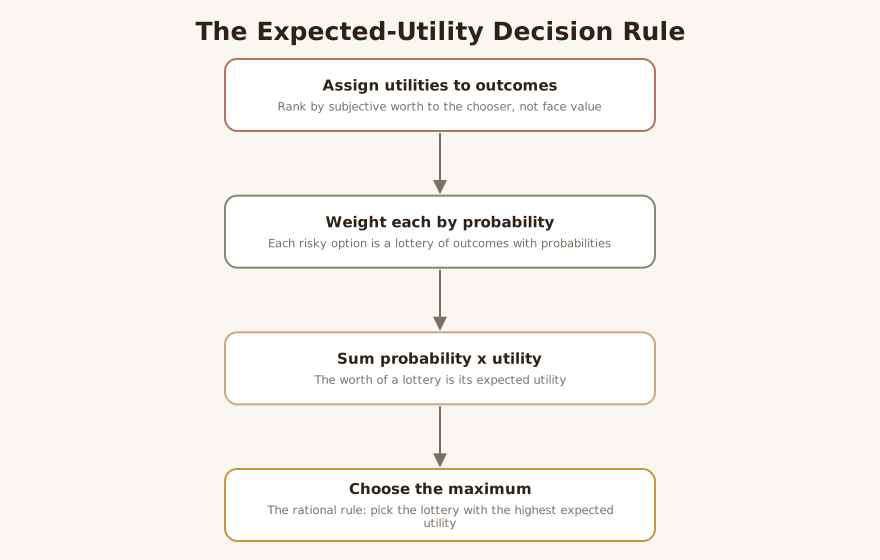
- Utility, not raw outcome. Choices should be ranked by the subjective utility of outcomes, not their face value (dollars, minutes, units), because utility captures what an outcome is actually worth to the chooser.3
- Expected value over a lottery. Any risky option is a “lottery” — a set of outcomes each with a probability — and its worth is the sum of (probability × utility) across those outcomes.3
- Maximize the expectation. The rational rule is to pick the lottery with the highest expected utility.1
- The vNM axioms. The theory holds only for agents whose preferences are complete, transitive, continuous, and independent; satisfy these and an expected-utility representation exists.2
- Diminishing marginal utility and risk attitude. A concave utility function implies risk aversion (a sure thing is preferred to a fair gamble of equal expected value); the shape of the curve encodes how a person trades off risk and reward.3 LLM
The independence axiom — that a preference between two options should not flip when both are mixed with a common third option — is the assumption most often violated by real people, and the seam along which descriptive theories later diverged.2 LLM
Interventions & Techniques
EUT is not delivered as a manualized therapy; it supplies a structure that a clinician can lay over decision-focused work inside an evidence-based modality.4 LLM The most natural translation is the decision matrix or decision tree: laying out the live options, the possible outcomes of each, an honest estimate of each outcome’s probability, and a rating of how much each outcome matters, then computing or eyeballing the weighted balance.5 LLM This externalizes a choice the client has been running, poorly, in their head.5 LLM A second technique is probability re-estimation — surfacing the client’s implicit forecast (“I’m certain I’ll be fired”) and testing it against base rates and evidence, which is functionally cognitive restructuring of likelihood.6 LLM A third is utility clarification: separating “how bad would this really be, and for how long?” from “how likely is it?”, which targets the affective magnitude that worry inflates.6 LLM Because EUT formally distinguishes probability from value, it gives the clinician a clean vocabulary for decatastrophizing: catastrophic thinking is, in EUT terms, the simultaneous overweighting of a low-probability outcome’s likelihood and its disutility.6 LLM
LLM-generated illustrative example (not a guideline): A client paralyzed over whether to leave a stable job for a startup builds a two-column grid: outcomes (thrive, fail and rejob-hunt, fail and burn savings), each with a rough probability and a 0–10 “how much this matters” rating. Seeing the feared “burn savings” outcome assigned both a low probability and a recoverable-rather-than-catastrophic utility loosens the all-or-nothing grip and converts an anxious loop into a workable comparison. LLM
Evidence Base
Honesty here requires holding two facts at once.4 As a normative, mathematical theory, EUT is established: the vNM representation theorem is proven, and the framework remains the standard benchmark of rationality across economics, statistics, and decision analysis.2 As a descriptive account of how humans actually decide, it is decisively falsified — the Allais and Ellsberg paradoxes, framing effects, loss aversion, and probability weighting all show systematic, replicable departures from its predictions, which is precisely why Prospect Theory was developed.7 For the clinician, the implication is specific: there is no body of randomized trials showing that “Expected Utility Therapy” reduces symptoms, because no such standalone therapy exists.4 LLM Its clinical value is indirect — it is a conceptual tool that sharpens techniques already validated within CBT and decision-coaching frameworks.4 LLM Use it as a scaffold for reasoning, and let the evidence-based modality carry the therapeutic claim. LLM
Populations & Indications
EUT-informed work fits clients whose distress is organized around choice and uncertainty.1 LLM It is most apt for adults facing high-stakes decisions (career, relationship, relocation), patients weighing medical decisions where probabilities and trade-offs are explicit, and clients embedded in financial or risk contexts where the math is real and consequential.6 LLM It is also indicated for people with anxiety disorders whose symptoms cluster around outcome forecasting, and for individuals with decision-making difficulties who stall not from lack of information but from an inability to integrate likelihood and value into a single comparison.5 LLM The common thread is a client who is trying to reason about an uncertain future and doing it in a way the framework can make visible and correct. LLM
Problems-for-Work
- Decisional conflict / indecision — an explicit options-by-outcomes matrix converts an unresolvable internal debate into a side-by-side comparison the client can actually adjudicate.5 LLM
- Worry and rumination about outcomes — separating probability from disutility interrupts the fusion that drives catastrophic loops, since worry typically inflates both at once.6 LLM
- Risk-related anxiety — calibrating subjective probabilities against base rates shrinks the gap between feared and actual likelihood.6 LLM
- Avoidance behavior — naming the (often modest, recoverable) utility of a feared outcome reduces the perceived cost of approach, supporting exposure planning.1 LLM
- Pathological gambling — the same expected-value arithmetic that the gambler intuitively distorts (overweighting the jackpot’s tiny probability) can be made explicit to disconfirm the “due to win” narrative.3 LLM
- Maladaptive risk-taking — mapping the full outcome distribution surfaces low-probability, high-disutility tails the client has been discounting.5 LLM
- Impaired judgment in decision-making — a shared decision-tree gives a structured external scaffold when integration of probability and value is the specific deficit.5 LLM
LLM-generated illustrative example (not a guideline): A client with health anxiety insists a benign symptom “must” be serious. Rather than reassure, the clinician helps them write down the realistic probability the physician quoted, then rate the disutility of each branch — and notices the client had silently assigned the catastrophic branch a probability of near-1. The work becomes recalibrating that single number, not arguing about the feeling. LLM
Contraindications, Cautions & Cultural Humility
The chief misuse is treating EUT as a descriptive truth about how clients ought to feel — telling an anxious or grieving person their distress is “irrational” because it violates the axioms is both clinically inert and invalidating, since the theory is normative, not a standard for emotional experience.4 LLM EUT can also impose a false precision: assigning crisp probabilities and utilities to deeply uncertain, value-laden life choices (whether to have a child, whether to end a marriage) can manufacture a spurious sense of objectivity over what is genuinely a values question.1 LLM For clients with significant cognitive load, trauma, or low numeracy, the matrix can become another source of overwhelm rather than relief, and should be simplified or set aside.5 LLM Culturally, the model embeds individualist, self-interested maximization assumptions; for clients whose decisions are properly made in relation to family, community, or faith, “maximize your own utility” can be alienating or ethically off-key, and the utility being weighed must be defined in the client’s own terms.6 LLM Finally, in acute risk — active suicidality, mania, intoxication — formal decision analysis is not the intervention; stabilization and safety are. LLM
Treatment-Plan Suggestions & SMART Objectives
| Goal | SMART objective (example) | Mechanism |
|---|---|---|
| Reduce decisional paralysis | Within 4 sessions, client completes one written options-by-outcomes decision matrix for the target decision and identifies a leading option | Externalizing the expected-utility comparison so likelihood and value can be integrated5 |
| Recalibrate inflated threat probabilities | For 6 weeks, client logs ≥3 worry predictions/week with a 0–100% likelihood estimate and later records the actual outcome | Probability re-estimation against observed base rates6 |
| Separate likelihood from magnitude | Within 5 weeks, on 3 feared events/week client rates “how likely (0–100%)” and “how bad and for how long (0–10)” as distinct columns | Decoupling probability and disutility to interrupt catastrophizing6 |
| Support approach toward an avoided situation | Over 6 weeks, before each planned exposure client names the realistic utility cost of the feared outcome, ≥2×/week, logged | Reframing the expected cost of approach to lower avoidance1 |
| Reduce gambling urges via expected-value reality-testing | Across 4 sessions, client computes the true expected value of a typical bet and reviews it before each high-urge episode for 4 weeks | Disconfirming distorted probability weighting of large, rare payoffs3 |
| Improve quality of a high-stakes life decision | By session 8, client defines and weights their own outcome values, then maps each option’s outcome distribution with the clinician | Structured integration of subjective utility and probability5 |
| Build tolerance for irreducible uncertainty | For 6 weeks, after each matrix the client practices committing to the better-expected-value option despite residual unknowns, weekly | Acting on expected value rather than waiting for certainty1 |
Common Misconceptions
- “EUT describes how people actually decide.” It does not — it is normative, and human choice systematically violates it, which is the founding observation of Prospect Theory and behavioral economics.7 LLM
- “Higher expected utility means higher expected money.” No — Bernoulli’s whole point is that utility is subjective and nonlinear, so a risk-averse person can rationally prefer a smaller sure sum to a larger gamble of equal expected cash value.3
- “The theory says risk-taking is irrational.” EUT is neutral on risk attitude; risk aversion, neutrality, and seeking are all permitted and are encoded in the curvature of the utility function.3 LLM
- “It applies to any choice.” The vNM representation holds only when preferences satisfy the axioms; where they don’t (as they often don’t for real people), the “maximize expected utility” guarantee simply doesn’t apply.2 LLM
- “It’s a way to tell clients their feelings are wrong.” Using a normative model to label emotional experience as irrational is a category error and a clinical liability.4 LLM
Training & Certification
There is no clinical credential in Expected Utility Theory, and none is needed.4 LLM Competent use rests on two things: basic decision-theoretic literacy (understanding expected value, utility, the vNM axioms, and EUT’s empirical limits) from reputable secondary sources, and clinical training in the evidence-based modalities that operationalize the techniques — chiefly CBT, problem-solving therapy, and exposure-based work.14 LLM A clinician should be able to explain why the model is normative-but-not-descriptive, so as not to misapply it to clients’ emotions.7 LLM
Key Terms
- Utility — the subjective worth of an outcome to the chooser, distinct from its objective magnitude.3
- Expected utility — the probability-weighted sum of the utilities of an option’s possible outcomes.3
- Lottery — a decision-theory term for any risky option: a set of outcomes each with an attached probability.3
- vNM axioms — completeness, transitivity, continuity, and independence; the conditions under which a preference can be represented as expected-utility maximization.2
- Diminishing marginal utility — the principle that each additional unit of a good adds less utility than the last, producing a concave (risk-averse) utility curve.3
- Independence axiom — the requirement that a preference between two lotteries be unaffected by mixing both with a common third lottery; the axiom most often empirically violated.2
- Normative vs. descriptive — whether a theory says how one should choose (EUT) or how people do choose (Prospect Theory).7
Resources & Further Reading
▶ Watch — a video introduction to this concept:
- Normative Theories of Rational Choice: Expected Utility — Stanford Encyclopedia of Philosophy
- Expected utility hypothesis — Wikipedia
- Von Neumann–Morgenstern utility theorem — Wikipedia
- Expected Utility Theory and Psychology — Springer chapter
- Expected Utility Theory: an overview — ScienceDirect Topics
- Expected Utility Theory — Economics Help (glossary)
- Expected Utility vs. Prospect Theory — lecture (YouTube)
Reflective / Supervision Questions
- When I lay out a decision matrix with a client, am I clarifying their own values and probabilities — or quietly importing my own utilities into their choice?
- How do I use the likelihood-versus-magnitude distinction to reduce catastrophizing without implying the client’s fear is “irrational”?
- Where does formalizing a choice genuinely help, and where am I manufacturing false precision over what is really a values or meaning question that no arithmetic can resolve?
- For clients whose decisions are properly relational or faith-grounded, how do I redefine “utility” in their terms rather than defaulting to individual self-interest?