
Type & Discipline
Autopoiesis is a theory of what it means to be living, not a method of treatment. LLM The term, from the Greek auto (self) and poiesis (production or making), names a system that continuously produces the very components that produce it, and in doing so produces itself. 6 It originates in theoretical biology and was developed to answer a deceptively basic question: what is the organization that all living things share, such that we recognize them as alive at all. 1 A system is autopoietic when it is a network of processes of production that regenerate the components and boundary that realize that same network within the space those components define. 6
For practicing therapists the useful framing is that autopoiesis is a systems-theory and enactivist lens, not a billable intervention, and it carries no protocol of its own. LLM Its clinical value is conceptual: it supplies a rigorous account of why a living, self-maintaining system behaves the way it does, which in turn reframes resistance, change, and the limits of a therapist’s influence. LLM The biological theory was elaborated by Humberto Maturana and Francisco Varela, who went on to argue that cognition itself is a biological process inseparable from the activity of a living system. 1
Creators & Lineage
The concept was articulated by the Chilean biologists Humberto Maturana and Francisco Varela, most fully in their 1980 volume Autopoiesis and Cognition: The Realization of the Living. 1 Maturana’s work on the biology of perception and Varela’s on the mathematics of self-referential systems converged on a single claim: that the living is defined not by a list of properties but by a particular organization, namely autopoietic organization. 1 Their later book for general readers, The Tree of Knowledge, traced this biology of cognition from the cell upward to human language and social life, and became the most widely read statement of their thinking. 2
Conceptually, autopoiesis sits at the intersection of systems theory, cybernetics, and what later became enactivist cognitive science. 6 It extended general systems thinking by specifying a precise kind of organizational closure rather than treating “system” loosely. 6 It is foundational to second-order cybernetics, in which the observer is no longer outside the system but is part of what is observed, captured in Maturana’s dictum that everything said is said by an observer. 6 Through Varela it became a cornerstone of the enactive approach to mind, which holds that cognition is the activity of an embodied agent enacting a world rather than representing a pre-given one, a position now central to debates in embodied cognition. 4 In the helping professions these ideas were carried into constructivist, systemic, and narrative therapies, and the social theorist Niklas Luhmann controversially extended autopoiesis to social systems, a graft Maturana himself viewed with caution. 6
Core Principles
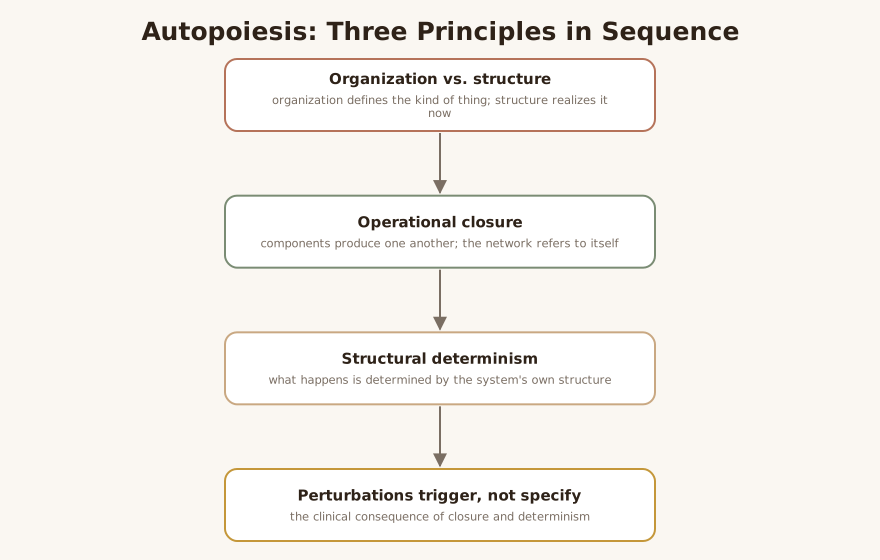
The first principle is the distinction between organization and structure. 6 A system’s organization is the set of relations among components that make it a member of a class — the relations that must hold for the thing to be, say, a living cell. 6 Its structure is the actual physical components and relations that realize that organization in a particular instance at a particular moment. 6 A system can change its structure considerably while conserving its organization, and it stays the same kind of thing only as long as its organization is conserved; lose the organization and the system disintegrates. 6
The second principle is operational (organizational) closure. 6 An autopoietic system is closed with respect to its own dynamics: its components are produced by, and produce, other components of the same network, so the network refers only to itself. 6 Closure does not mean isolation; the system is thermodynamically open and exchanges matter and energy with its surroundings, but its organization is determined from within, not imposed from without. 6
From closure follows the third and most clinically consequential principle: structural determinism, and with it the claim that instructive interaction is impossible. 1 An external agent cannot specify what happens inside a structurally determined system; the agent can only perturb it, and the system’s own structure determines whether a perturbation registers at all and what change, if any, it triggers. 1 You do not instruct a living system; you trigger it, and what it does with the trigger is its business, not yours. LLM
The fourth principle is structural coupling: a system and its medium, or two systems, undergo recurrent mutual perturbation over time, and through this history each comes to fit the other without either instructing the other. 6 Coupling is how an organism comes to embody a world, and for Maturana and Varela cognition is precisely this history of effective structural coupling, not the internal mirroring of an outside reality. 1
Interventions & Techniques
Because autopoiesis is a theory rather than a therapy, it yields orienting stances and heuristics, not scripted techniques. LLM The hinge for clinical use is structural determinism: if you cannot instruct a client’s system but can only perturb it, then the therapist’s job shifts from delivering correct content to designing perturbations the system can actually metabolize. LLM
The first move is perturbation rather than instruction. LLM Advice, confrontation, and psychoeducation are not inputs the system executes; they are perturbations whose effect is decided by the client’s existing structure, which is why the same intervention lands very differently across clients. LLM The clinically humble corollary is to expect that much of what you say will be filtered, reinterpreted, or absorbed without visible change, and to read that not as failure but as the system conserving its organization. LLM
The second move is to work within and respect operational closure. LLM Interventions that fit the client’s existing distinctions and language are more likely to register than those imported wholesale from the clinician’s frame, which dovetails with the Milan systemic practice of generating new connections from inside the family’s own descriptions rather than prescribing them from outside. LLM
The third move is to cultivate structural coupling — to treat the therapeutic relationship as a history of recurrent mutual perturbation in which therapist and client co-adapt over time, so that change is a slow drift of structure rather than a delivered correction. LLM This reframes the alliance itself as the medium of change, not merely its precondition. LLM
LLM-generated illustrative example (not a guideline): A family arrives locked in a pursue-withdraw loop: the more one parent presses for closeness, the more the other retreats, and each new tactic only deepens the same pattern. A clinician working from this lens stops trying to instruct the system out of the loop (which it has already shown it will not execute) and instead introduces perturbations the system can take up from within — circular questions that surface how each member’s response is, for the others, an environment they are coupled to. The aim is not to install a correct behavior but to introduce enough novel perturbation that the family’s structure drifts toward a new, self-maintained pattern. LLM
Evidence Base
Honesty about maturity is essential here, and the honest label is theoretical. LLM As a theory of biological living systems, autopoiesis is a coherent, influential, and well-specified account; as a clinical tool it has no trial program, because there is no standalone “autopoiesis therapy” to test. LLM Its foundational works are conceptual and biological, not outcome studies, and the strongest claims it licenses are about understanding, not efficacy. 1
The more important caveat is the legitimacy of extension. LLM Autopoiesis was defined for the realization of the living — paradigmatically the cell — and its application to families, psyches, organizations, and societies is by analogy rather than by demonstration. 1 Whether a family or a social system is “really” autopoietic, or only usefully described as if it were, is genuinely contested; Luhmann’s transposition of the idea to social systems is a separate and debated theoretical move, and Maturana himself was wary of extending his biological concept to the social domain. 6 A fair clinician’s summary is that autopoiesis is a rigorous biological theory imported into therapy as a generative metaphor and systemic heuristic, valuable for formulation and stance but not a source of empirical warrant for any technique. LLM Where it has earned firmer scientific standing beyond biology is in cognitive science, through the enactive approach to mind that grew out of Varela’s work and now figures in embodied-cognition debates. 4
Populations & Indications
The “indication” for autopoiesis is not a diagnosis but a way of thinking, and it is most useful wherever a clinician is already reasoning in terms of systems, feedback, and self-maintenance. LLM With families, the organization-versus-structure distinction clarifies why a family can change many surface behaviors while conserving the deeper pattern that keeps generating its symptoms, and why interventions aimed only at structure leave the organization intact. 6 For systems-oriented clinicians working with couples and family subsystems, structural coupling reframes chronic interactional patterns as histories of mutual perturbation that each member is adapted to, rather than as one person’s pathology. 6
For therapists and researchers, the theory is also a lens on the clinical encounter itself: second-order cybernetics places the therapist inside the system being observed, so the clinician’s descriptions and interventions are themselves perturbations within a coupled field rather than neutral observations from outside it. 6 With clinical populations more broadly, the structural-determinism principle counsels against assuming that good information reliably produces good change, and supports tailoring perturbations to the person’s existing structure. LLM The framework is frequently applied to organizations as self-producing systems of communication and practice, a domain where the autopoietic metaphor is widely used in management and coaching. 5
Problems-for-Work
- Rigid systemic patterns. A family or couple conserves its organization across superficial change, so the same pattern regenerates. 6 Application: identify the organization being conserved beneath the shifting structure, and target perturbations at that level rather than at surface behaviors. LLM
- Resistance to change. Structural determinism reframes “resistance” as a system doing exactly what self-maintaining systems do — filtering perturbations that do not fit its structure. 1 Application: stop treating non-response as defiance and instead design inputs the system can register. LLM
- Self-perpetuating maladaptive cycles. Operationally closed loops sustain themselves because each component reproduces the conditions for the others. 6 Application: locate where a novel perturbation could be introduced inside the loop rather than imposed from outside it. LLM
- Therapeutic impasse. An impasse often means the therapist is trying to instruct a system that can only be perturbed. 1 Application: shift from delivering content to varying the form, timing, and language of perturbations until one registers. LLM
- Relational rigidity. Partners coupled over a long history have co-adapted to a narrow joint repertoire. 6 Application: use the coupling frame to make each partner an explicit part of the other’s changing environment. LLM
- Communication problems. In second-order terms, breakdowns reflect divergent distinctions made by different observers, not simply lost messages. 6 Application: surface and reconcile the distinctions each party is operating with before adding new behaviors. LLM
- Identity processes. The conservation of organization through structural change is a useful model for a stable sense of self that persists across life’s changes. 6 Application: frame identity work as conserving what is organizationally essential while allowing structure to drift. LLM
Contraindications, Cautions & Cultural Humility
Autopoiesis is descriptive, so it has no contraindications in the clinical sense, but its use carries real hazards. LLM The gravest is misusing structural determinism to imply that the client cannot change or to excuse therapist passivity. LLM The theory says change is not instructively imposed; it does not say change is impossible — structures do drift through coupling and perturbation, and treating “you can only be perturbed” as “nothing I do matters” is a clinical and ethical error. LLM
A second caution is reification: forgetting that the application to families, psyches, and social systems is a metaphor and treating a family or a self as literally an autopoietic cell. 1 This is a model, not the territory, and presenting cybernetic-biological formalism as the literal truth about a person or family is reductive and should be avoided. LLM The contested status of the social extension — and Maturana’s own caution about it — should keep clinicians appropriately tentative. 6
On cultural humility, what an observer calls a system’s “organization,” a “maladaptive” pattern, or an “essential variable” is a distinction made by that observer, and second-order cybernetics insists the clinician is inside the observed system, not above it. 6 A pattern that looks rigid from the outside may be a finely tuned, self-maintaining adaptation to a hostile, racist, or unpredictable environment the clinician has not seen, and pathologizing it as mere dysfunction would relocate structural harm into the individual or family. LLM The theory’s own emphasis on the observer is a built-in invitation to ask whose distinctions are governing the formulation. 6
Treatment-Plan Suggestions & SMART Objectives
| Goal | SMART objective (example) | Mechanism |
|---|---|---|
| Interrupt a self-perpetuating relational cycle | Within 8 sessions, the couple identifies their recurring loop and rehearses 1 alternative response at a named choice point, using it in 2 consecutive sessions | Introduces a novel perturbation inside an operationally closed loop so the structure can drift 6 |
| Reframe resistance as system maintenance | Over 4 sessions, client and clinician reframe 1 stuck pattern as the system conserving its organization, documented in session notes | Applies structural determinism so non-response is read as filtering, not defiance 1 |
| Distinguish surface change from organizational change | By session 6, family lists 2 behaviors they have changed and names the deeper pattern that has persisted | Uses the organization-versus-structure distinction to target the conserved level 6 |
| Strengthen therapeutic structural coupling | Across the first 6 sessions, clinician adapts the language and form of interventions to the client’s own distinctions in at least 3 sessions, tracked in notes | Treats the alliance as a history of mutual perturbation through which both co-adapt 6 |
| Surface observer-dependent distinctions in conflict | Within 5 sessions, each partner articulates the distinction underlying 1 recurring disagreement before responding, in 3 sessions | Second-order cybernetics: breakdowns reflect divergent distinctions, not lost messages 6 |
| Design fitting perturbations for an impasse | Over 4 weeks, clinician varies the timing or framing of a key intervention across 3 attempts and records which registers | Shifts from instruction to perturbation until one is metabolized by the client’s structure 1 |
| Conserve identity through life transition | Within 8 sessions, client names what is organizationally essential to their sense of self and 2 structural changes they can tolerate | Frames identity as conservation of organization across structural drift 6 |
Common Misconceptions
The most consequential misconception is taking autopoiesis as literally true of a family or a psyche rather than as a biological theory imported by analogy; the concept was defined for the realization of the living, and its social and clinical use is metaphorical and contested. 1 A related error is treating closure as isolation — autopoietic systems are operationally closed but thermodynamically open, exchanging matter and energy with their surroundings while determining their own organization. 6 A third is conflating organization with structure, and so missing the central insight that a system can change its structure while conserving its organization. 6
A fourth misconception reads structural determinism as fatalism, as though “you can only perturb, not instruct” meant clients cannot change; the theory locates the source of change in the system’s own dynamics, not its impossibility. LLM A fifth treats autopoiesis as a therapy with outcome data, when it is a theoretical framework that informs stance and formulation and licenses no efficacy claim by itself. LLM Finally, the enactive reading is sometimes flattened into “the brain represents the world,” whereas the whole point is that cognition enacts a world through structural coupling rather than mirroring a pre-given one. 4
Training & Certification
There is no certification in autopoiesis, because it is a scientific theory rather than a credentialed practice. LLM Clinicians typically encounter it through training in systemic and family therapies, second-order cybernetics, constructivist and narrative approaches, and enactivist cognitive science. LLM The primary route to fluency is the source literature: Maturana and Varela’s Autopoiesis and Cognition for the rigorous statement, and The Tree of Knowledge for the accessible, illustrated synthesis aimed at general readers. 1 2 The Stanford Encyclopedia of Philosophy entry on embodied cognition situates the enactive lineage within current cognitive-science debate. 4 Secondary overviews — such as the ScienceDirect topic summary and applied explainers from the coaching and organizational literature — offer accessible orientations and worked analogies, though they should be read as introductions rather than primary sources. 3 5 Certification, where relevant, belongs to the parent clinical modality, not to the theory. LLM
Key Terms
- Autopoiesis: A network of processes of production that continuously regenerates the components and boundary realizing that same network, so the system produces itself. 6
- Organization: The relations among components that define a system as a member of a class; conserved as long as the system remains that kind of thing. 6
- Structure: The actual components and relations realizing the organization in a specific instance at a specific time; it can change while organization is conserved. 6
- Operational (organizational) closure: The property whereby a system’s components are produced by the very network they constitute, so its organization is determined from within. 6
- Structural determinism: The principle that an external agent can perturb but not instruct a system; the system’s own structure determines its response. 1
- Structural coupling: A history of recurrent mutual perturbation through which a system and its medium, or two systems, come to fit each other without instructing each other. 6
- Observer: In second-order terms, the one who draws distinctions; everything said is said by an observer who is part of what is observed. 6
- Enaction: The view that cognition is the activity of an embodied agent bringing forth a world through structural coupling, not representing a pre-given one. 4
Resources & Further Reading
▶ Watch — a video introduction to this concept:
- Maturana & Varela, Autopoiesis and Cognition: The Realization of the Living (1980, Springer) 1
- Maturana & Varela, The Tree of Knowledge (1987, Shambhala) 2
- Autopoiesis — an overview (ScienceDirect Topics) 3
- Embodied Cognition (Stanford Encyclopedia of Philosophy) 4
- Understanding Autopoiesis: Life, Systems, and Self-Organisation (Mannaz) 5
- Autopoiesis — Wikipedia 6
Reflective / Supervision Questions
- For a client or family I am treating, what is the organization being conserved beneath the structural changes I can already see? 6
- Where am I trying to instruct a system that can only be perturbed, and how might I redesign the input so it actually registers? 1
- When I call a client “resistant,” am I describing them, or am I describing a perturbation that did not fit their structure? LLM
- As an observer inside this therapeutic system, whose distinctions are governing my formulation, and what would change if I foregrounded the client’s? 6
- What looks like rigidity in this system that might be a finely tuned adaptation to an environment I have not yet seen? LLM
- Am I using autopoiesis as a generative metaphor for stance and formulation, or have I slipped into treating a family or psyche as literally an autopoietic cell? 1