
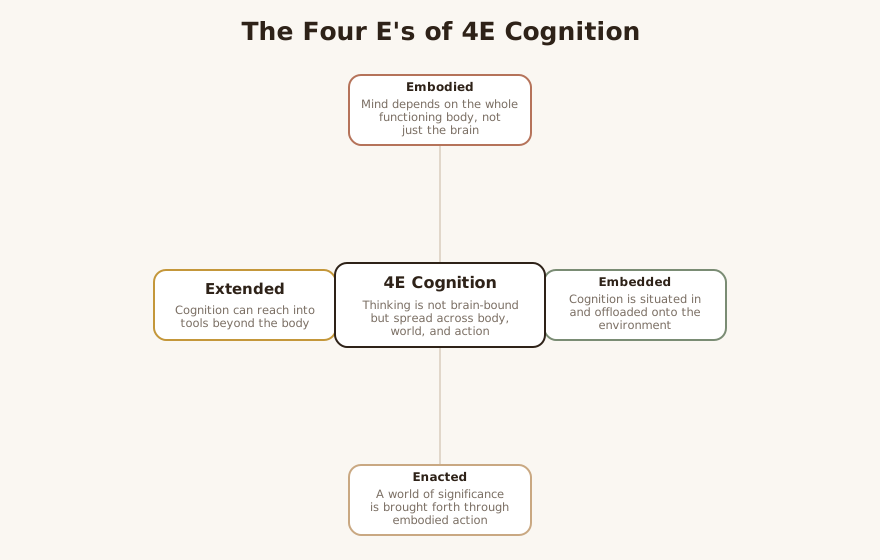
4E cognition is not a therapy and was never meant to be one. It is a position in the philosophy of mind and cognitive science: the claim that cognition does not happen solely inside the skull but is embodied in the whole body, embedded in its environment, enacted through action, and in some accounts extended into the tools and structures of the world 2. For clinicians, its value is conceptual and orienting. A great deal of clinical work already treats the body and the environment as central rather than peripheral to the mind, and 4E cognition supplies a rigorous philosophical rationale for doing so LLM. The honest framing to keep in front of you throughout is that 4E is a theoretical movement, not a tested treatment package, and its clinical relevance is downstream and inferential 3LLM.
Type & Discipline
4E cognition is a theoretical framework, or more precisely a family of frameworks, drawn from the philosophy of mind and cognitive science 2. It defines itself against the traditional cognitivist or computational picture, on which the mind is essentially a brain-bound symbol-processor that builds internal representations of an external world 1. The embodied tradition rejects that picture, arguing instead that “the body or the body’s interactions with the environment constitute or contribute to cognition” in fundamental ways 1. The label “4E” gathers four overlapping commitments: embodied, embedded, enacted (enactive), and extended cognition 2.
The discipline matters for how a clinician should hold the idea. It originated as basic philosophy and science about the nature of mind, not as a model of psychopathology or a manual for treatment 3. Its natural homes are debates about perception, concepts, representation, and consciousness, and a recent analysis stresses that it is best understood not as a single unified theory but as “a set of family resemblances of overlapping ideas, hypotheses, theories and conceptual frameworks about the mind” 3. That disunity is important and is returned to below; for now it is enough to say that 4E gives clinicians a vocabulary for the mind-body relationship, not a procedure LLM.
Creators & Lineage
The 4E family draws on several lineages that predate the acronym. Its phenomenological root runs through Maurice Merleau-Ponty, whose work tied consciousness inseparably to the body, the view that the life of the mind is “bound up with that of the body” 1. Its ecological root runs through J.J. Gibson, whose ecological psychology rejected the information-processing model of perception and emphasized what the environment affords an active organism 1. These threads supplied the soil in which the contemporary movement grew LLM.
Two foundational texts anchor the modern formulation. The enactive strand was introduced by Francisco Varela, Evan Thompson, and Eleanor Rosch in their 1991 book The Embodied Mind: Cognitive Science and Human Experience, which set out to bridge cognitive science with lived experience and contemplative thought 45. The extended strand was launched by Andy Clark and David Chalmers, whose argument for extended cognition the Stanford Encyclopedia of Philosophy treats as the canonical case 1. A 2025 survey of the field underlines that even its leading practitioners diverge sharply in their commitments, so that “no work of 4E Cognitive Science must include all dimensions to count as 4E,” and the movement is better described as “a family resemblance concept constrained by historical ties of positive and negative influence” than as a doctrine with a single founder 3.
Core Principles
The first principle is embodiment: the mind depends on the body as a functioning whole, not merely on the brain it contains 2. On the enactive reading, “self-generated motor activity doesn’t simply cause perception; it’s part of perceiving,” so that the moving, sensing body is a constituent of cognition rather than a mere input device 5. A strong version of this claim holds that “the body (and, perhaps, parts of the world) does more than merely contribute causally to cognitive processes” but is partly constitutive of them 1.
The second principle is embeddedness: cognition is situated within, and offloaded onto, physical and social environments that scaffold it, so the mind is best understood as emerging from a “coupled brain-body-environment system” 5. The third is enaction: “cognition is not the representation of an independent outside world by an independent inside mind, but instead is the enactment or bringing forth of a world of significance through embodied action” 5. Perceiving, on this view, is itself “a particular way of exploring the environment” rather than the passive receipt of data 6.
The fourth principle, extension, is the most contested. Here “the mind is supplemented and even enhanced by the exterior world (e.g., writing, a calculator, etc.),” and external resources can become genuine constituents of a cognitive system 2. Clark and Chalmers defend this with a parity principle: “If, as we confront some task, a part of the world functions as a process which, were it done in the head, we would have no hesitation in recognizing as part of the cognitive process, then that part of the world is…part of the cognitive process” 1. Their famous illustration is Otto, who keeps in a notebook the addresses a normally functioning person would hold in biological memory; because the notebook plays the identical functional role, the parity principle implies it is part of Otto’s memory and cognition 1. A useful distinction cuts across all four: extracranial processes may be either causally relevant (a weak claim) or constitutive of cognition (a strong claim), and they may occur inside the body or outside it 2.
Interventions & Techniques
4E cognition does not supply a protocol, and the most common way to misuse it clinically is to treat it as if it prescribes one 3LLM. What it does is furnish a rationale for techniques that already live inside established modalities LLM. The first is taking the body as a site of cognition and meaning rather than a mere reporter of symptoms. If self-generated motor activity is “part of perceiving” and the mind depends on the body as a whole, then interoceptive awareness work, grounding, breath and posture work, and movement become ways of engaging cognition directly rather than peripheral add-ons, and this rationale informs somatic and sensorimotor approaches 5LLM.
A second application follows from enaction: if a person brings forth their lived world through embodied action, then changing patterns of action and bodily engagement is a route to changing how the world shows up for them, which converges with experiential and behavioral-activation logic 5LLM. A third follows from embeddedness and extension: treating external scaffolds, written reminders, structured environments, supportive relationships, as legitimate parts of the client’s cognitive system rather than as crutches, which reframes “offloading” to the world as adaptive cognitive design rather than dependence 12LLM. None of this is unique to 4E; the contribution is a coherent philosophical justification for the body- and environment-oriented stance many clinicians already take LLM.
LLM-generated illustrative example (not a guideline): A trauma client describes feeling “all in my head” and disconnected from their body. Drawing on the enactive premise that perception is part of bodily action, the clinician, within a somatic-oriented frame, slows the session to track sensation and small movements, treating the returning sense of the body not as a relaxation technique but as restoring a constituent of the client’s cognition and sense of a meaningful world LLM.
Evidence Base
The honest position is unambiguous: 4E cognition is theoretical, a movement in philosophy of mind and cognitive science, not an established therapy 3. As a framework its constructs, embodiment, embeddedness, enaction, extension, are well developed and actively debated, and the embodied-cognition literature marshals empirical arguments from neuroscience, for instance that reading action words such as “kick” activates motor regions and that sensorimotor areas engage during concept use 1. But an established theory is not an established treatment LLM. There is no standalone outcome literature for “4E therapy,” and no randomized trials of it, because no such modality exists; its clinical utility is entirely downstream, embedded as a rationale within somatic, experiential, and other approaches that must earn their own evidence 3LLM.
The framework also carries genuine internal disagreements a clinician should not paper over. A 2025 analysis argues that the four Es cannot be unified by a single essential feature, that attempts to unify them through one concept such as embodiment fail because the concept is “itself contested and multifarious,” and that paradigmatic practitioners diverge, with some emphasizing non-representationalism, others modal concepts, others extension 3. The field’s own commentators note that “the claims of embodied cognition…appear to conflict with the tenets of extended cognition,” a real tension rather than a settled synthesis 2. Specific theses face pointed criticism: it is contested how abstract concepts like justice could be grounded in sensorimotor experience, and Adams and Aizawa argue that extended cognition violates the “marks” of the cognitive, since a notebook lacks the “intrinsic, non-derived content” that thoughts are held to possess, its meaning depending entirely on the user’s interpretation 1. The defensible clinical stance is to use 4E as an orienting philosophy while keeping disorder-specific care anchored in approaches with their own trial support LLM.
Populations & Indications
The framework is, first and most literally, a tool for cognitive scientists and researchers, for whom it is a live theoretical program 3. Within clinical settings its natural users are clinicians who already work in embodied or somatic registers, for whom it supplies the conceptual backing that ties body-oriented method to a serious theory of mind 5LLM. It speaks with particular force to work with people who have experienced trauma, where somatic frameworks already treat the body as central and where the enactive emphasis on the body as constitutive of perception and meaning fits the clinical picture of dissociation and felt disconnection 5LLM. And it is apt for people with chronic pain, whose experience is shaped by the coupled brain-body-environment system rather than by tissue signals alone, a framing the embedded and enactive views render intelligible 5LLM.
The clearest indications for invoking 4E are conceptual: when a formulation needs to integrate mind and body, when a clinician wants a principled rationale for somatic technique, and when treating the environment and tools as part of a client’s cognitive resources clarifies the case LLM. It is not indicated as a primary, freestanding intervention for any disorder, and presenting it to a client as a treatment in its own right would misrepresent its maturity 3LLM.
Problems-for-Work
4E concepts give clinicians a vocabulary for a cluster of presentations where mind and body meet LLM.
- Mind-body integration in therapy. The framework’s core move, dissolving the brain-bound picture in favor of a coupled brain-body-environment system, gives a principled basis for treating thought and bodily experience as one process rather than two domains to be bridged 5.
- Embodiment deficits. Where a client is cut off from bodily experience, the enactive claim that “self-generated motor activity…is part of perceiving” reframes reconnecting with the body as restoring a constituent of cognition, not as a peripheral relaxation aim 5.
- Somatic dysregulation. Because the mind is held to depend on the body as a functioning whole, regulation work at the bodily level is reframed as cognitive and affective regulation rather than mere symptom management 5LLM.
- Theoretical framing of cognition. For clinicians and trainees, 4E offers an explicit, defensible alternative to the implicit “brain in a vat” model that otherwise smuggles itself into formulation, while being honest that it is a contested family of views rather than a settled one 3.
LLM-generated illustrative example (not a guideline): A client with persistent chronic pain has come to see their body as a faulty machine sending false alarms. The clinician, within an established pain-focused approach, uses the embedded framing, that pain emerges from the whole coupled system of body, attention, history, and context, to shift the client from a search for the broken part toward changing the conditions under which pain is enacted LLM.
Contraindications, Cautions & Cultural Humility
The first caution is against overclaiming. Because 4E is a philosophy of mind rather than a treatment, presenting it to clients or in documentation as an evidence-based therapy would misstate its status; it informs technique but does not validate it, and the empirical work belongs to the modalities that borrow it 3LLM. A related caution is against treating the four Es as a single settled doctrine: the field itself reports that embodied and extended claims can “appear to conflict,” and that no unifying core has been established, so a clinician should resist the temptation to invoke “4E” as if it spoke with one authoritative voice 23.
A second caution concerns body-centered work itself. The philosophical warrant for emphasizing the body does not by itself make intensive interoceptive or somatic technique appropriate for every client; for some, heightened attention to internal sensation can intensify distress, and indications must be judged within the somatic modality being used, not assumed from the theory LLM. Finally, cultural humility is essential because much of the 4E literature is written in a Western academic idiom, while many cultural and contemplative traditions have long held the mind to be embodied and relational rather than brain-bound. The enactive strand itself draws explicitly on contemplative thought, noting an alignment with the Buddhist insight that mind is ultimately “ungraspable” rather than reducible to neural mechanism 5. The clinician should hold 4E as one articulation of an embodied view of mind among many, and should not present it as a novel Western discovery to a client whose tradition already takes embodiment for granted LLM.
Treatment-Plan Suggestions & SMART Objectives
| Goal | SMART objective (example) | Mechanism |
|---|---|---|
| Increase interoceptive awareness as a route to cognition, not just relaxation | Within 8 weeks, client will complete a brief body-scan practice 4 days per week and log one noticed sensation each time | Body as constituent of perception and cognition 5 |
| Reduce felt mind-body disconnection | Over 10 sessions, client will name and locate in the body 2 emotions per session rather than reporting them as purely “in my head” | Coupled brain-body-environment processing 5 |
| Restore agency through embodied action | Over 6 weeks, client will initiate one value-aligned physical activity per week and note any shift in mood or outlook | Enaction: bringing forth a meaningful world through action 5 |
| Use environmental scaffolds deliberately | Within 4 weeks, client will set up 2 external reminders or structured cues and rate their helpfulness weekly | Embedded and extended cognition; offloading to the world 12 |
| Reframe chronic pain within the whole system | Over 8 sessions, client will identify 3 contextual or attentional factors that modulate pain and track one each day | Pain as enacted by the coupled system, not tissue signal alone 5LLM |
| Build a defensible mind-body formulation (clinician aim) | Within 2 sessions, clinician will draft a formulation that names bodily and environmental contributors alongside cognitive ones | Embodied/embedded account of mind 23 |
| Stabilize before intensive somatic work | Within 3 weeks, client will establish 1 reliable grounding skill they can use before deeper interoceptive work | Indication-matching within the somatic modality LLM |
Common Misconceptions
The most consequential misconception is that 4E cognition is a therapy or a set of techniques; it is a family of theories in philosophy of mind, and the techniques associated with it are borrowed from, and validated by, other modalities 3LLM. A second is that the four Es form a single unified doctrine: the field itself describes them as overlapping family resemblances with no agreed core, and notes that embodied and extended claims can pull against each other 23. A third is that “the mind is in the body, not the brain” means the brain does not matter; the enactive view is rather that “you need a brain to have a human mind, but your mind isn’t inside your brain; it’s a relation between you and the world, including society and culture” 5. A fourth is that extended cognition is obviously true or obviously absurd, when it is a serious and contested claim met by serious objections, such as the charge that external tools lack the “intrinsic, non-derived content” that marks genuine cognition 1. A final misconception is that 4E is a recent novelty; its phenomenological and ecological roots in Merleau-Ponty and Gibson long predate the acronym 1.
Training & Certification
There is no certification in 4E cognition, and none would be appropriate, because it is a theoretical framework rather than a credentialed treatment 3LLM. Clinicians typically encounter it within graduate or post-graduate coursework in cognitive science, philosophy of mind, or the theory underpinning somatic and experiential therapies, where its constructs are absorbed into how a practitioner thinks about the body and the environment in the life of the mind 5LLM. Clinical competence in the body-oriented methods that 4E rationalizes is earned separately, through supervised training in the specific modalities, somatic, sensorimotor, experiential, and pain-focused approaches, that actually carry the techniques and their evidence LLM.
Key Terms
- Embodied cognition: the view that the body and its interactions with the environment constitute or contribute to cognition, against the brain-bound computational picture 1.
- Embedded cognition: the view that cognition is situated within and offloaded onto physical and social environments that scaffold it 25.
- Enaction (enactive cognition): cognition as the bringing forth of a world of significance through embodied action, rather than the inner representation of an outer world 5.
- Extended cognition: the view that external resources such as notebooks or tools can become genuine constituents of a cognitive system 2.
- Parity principle: Clark and Chalmers’s test that a worldly process counts as cognitive if, were it done in the head, we would unhesitatingly call it cognition 1.
- Otto’s notebook: the thought experiment in which a notebook plays the functional role of biological memory and so, by parity, counts as part of memory 1.
- Coupled brain-body-environment system: the integrated system from which, on the embedded/enactive view, the mind emerges 5.
- Affordances: Gibson’s ecological notion of what an environment offers an active organism for action 6.
- Family resemblance (of 4E): the claim that 4E is not one theory but overlapping ideas linked by historical influence rather than a shared essence 3.
- Weak vs. strong / causal vs. constitutive claims: the distinction between extracranial factors merely influencing cognition and their being part of it 2.
Resources & Further Reading
▶ Watch — a video introduction to this concept:
- Embodied Cognition — Stanford Encyclopedia of Philosophy
- 4E cognition — Wikipedia
- What is 4E cognitive science? (Alexander, 2025) — Phenomenology and the Cognitive Sciences, Springer
- The Embodied Mind: Cognitive Science and Human Experience (Varela, Thompson & Rosch, 1991) — MIT Press
- What is Mind? An ‘enactive approach’ to understanding cognition — Mind & Life Institute
- ‘4E’ (embodied, embedded, enactive, extended) cognition — Cognitive Classics, School of Advanced Study
Reflective / Supervision Questions
- When I work with the body in session, am I treating it as a peripheral relaxation aid or, in the enactive sense, as a constituent of the client’s cognition and meaning-making, and does that distinction change what I do? 5LLM
- Am I representing 4E honestly to clients and in my own thinking as a contested theoretical lens rather than as an evidence-based therapy? 3LLM
- For this client, which external scaffolds, reminders, structures, relationships, function as legitimate extensions of their cognition rather than as dependencies to be eliminated? 12LLM
- Where might intensive interoceptive or somatic work, however well justified philosophically, actually intensify this particular client’s distress, and how would I know? LLM
- Does my formulation quietly assume a brain-bound model of mind, and what would change if I took the coupled brain-body-environment system seriously? 5
- Am I presenting an embodied view of mind as a Western discovery to a client whose own tradition has long held mind to be embodied and relational? 5LLM