
Type & Discipline
Hedonic adaptation, popularly called the “hedonic treadmill,” is a descriptive theory of subjective well-being rather than a therapeutic modality.1 It sits at the intersection of positive psychology and behavioral economics, and it is closely tied to set-point theory of happiness.2 The core observation is empirical: across a wide range of positive and negative life events, people tend to drift back toward a relatively stable baseline level of happiness over time.3 For clinicians this matters because it reframes a common patient complaint — “nothing makes me happy for long” — not as personal failure but as a predictable feature of human affective regulation.LLM
Because it is a theory and not an intervention, hedonic adaptation does not have its own evidence base for “efficacy” in the way a treatment protocol does; instead, the relevant question is how well the descriptive claim holds and where it breaks down.1 That distinction is important for honest clinical use: the framework informs case conceptualization and psychoeducation, but the change strategies it implies are delivered through established behavioral and cognitive methods.LLM
Creators & Lineage
The metaphor of the hedonic treadmill was introduced by Philip Brickman and Donald Campbell in their 1971 chapter “Hedonic Relativism and Planning the Good Society.”6 Their argument grew out of adaptation-level theory: just as the eye adjusts to ambient light, people adjust their internal standard for “good enough” as their circumstances improve, so that running harder (acquiring more) leaves subjective satisfaction roughly where it started.6 The treadmill image captures this neatly — effort produces motion without net forward progress in felt happiness.2
The most cited empirical anchor for the idea is the 1978 study by Brickman, Coates, and Janoff-Bulman comparing lottery winners and people who had become paraplegic, which suggested both groups drifted back toward baseline happiness rather than remaining permanently elevated or devastated.2 The theory was later folded into the broader set-point tradition associated with subjective well-being researchers, and behavioral genetics work (Lykken & Tellegen) estimated that roughly half of the variance in happiness is heritable, lending support to a stable baseline.2
Sonja Lyubomirsky is a central figure in the applied turn: her work popularized the idea that a meaningful share of happiness is governed by intentional activity rather than genetics or circumstances, and she helped develop frameworks for deliberately slowing adaptation.5 Ed Diener and Richard Lucas led the major theoretical revision of the strict treadmill, which is discussed in the Evidence Base below.1
Core Principles
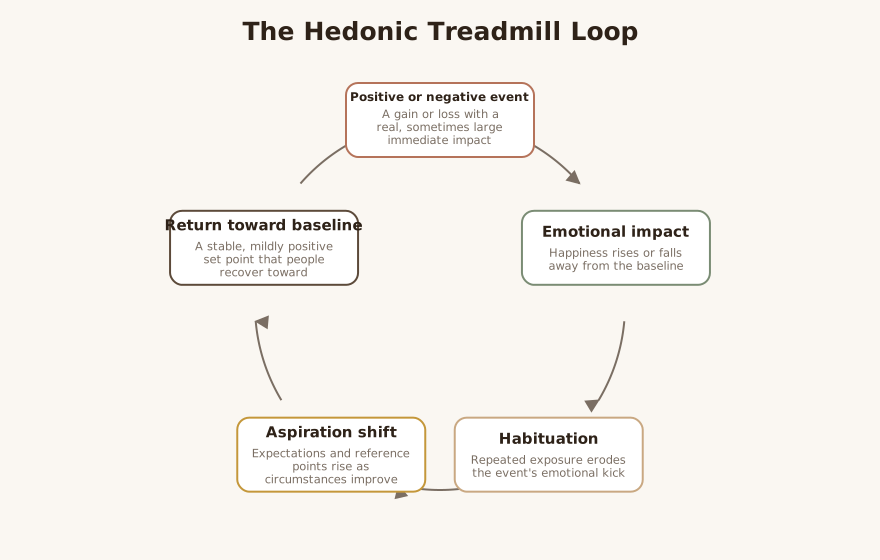
Several principles follow from the basic model. First, habituation: repeated exposure to a once-novel positive (a new home, a raise, a relationship) erodes its emotional kick as it becomes the new normal.3 Second, social comparison and aspiration shift: as circumstances improve, expectations and reference points rise in step, so the gap between “what I have” and “what I want” tends to reopen.6 Third, asymmetry over time: the immediate emotional impact of events is real and sometimes large, but its durability is limited as adaptation proceeds.3
A fourth principle, often misunderstood, is that the baseline is not emotionally neutral. For most people the set point sits in the mildly positive range rather than at zero, which is part of why people generally recover toward contentment rather than toward misery.3 A fifth principle, central to the modern view, is that the set point is stable but not immutable — it can shift, and people may hold different baselines for different components of well-being.1
Interventions & Techniques
Although hedonic adaptation is not itself a treatment, it generates a coherent set of techniques aimed at slowing or counteracting adaptation — sometimes organized under a Hedonic Adaptation Prevention (HAP) framing.5 Variety and dynamic activity is the first: rotating and changing positive experiences, rather than repeating the same one, reduces habituation to a single stimulus.5 Savoring asks the patient to deliberately attend to and prolong positive moments rather than letting them pass unmarked.5
Gratitude practices are used to counter adaptation to what one already has, and grateful thinking is described as promoting adaptive coping by reducing the impact of negative aspects of experience.5 Acts of kindness and the pursuit of altruistic, meaningful goals are linked to more durable satisfaction than the acquisition of material goods.5 Prioritizing experiences over material possessions follows directly from the observation that new belongings reliably lose their appeal through repetition.3 Mindfulness supports present-moment awareness that makes savoring possible.5
LLM-generated illustrative example (not a guideline): A clinician working with a client who feels flat after a long-awaited promotion might pair psychoeducation about adaptation with a savoring log and a weekly “novelty rotation” of small valued activities, framing the goal as enriching daily experience rather than chasing the next milestone. LLM
Evidence Base
The maturity of this concept is best described as established — the descriptive phenomenon of partial return-to-baseline is among the more robust findings in well-being research — but the strong version of the theory has been substantially revised.1 In their influential 2006 paper, Diener, Lucas, and Scollon argued for five revisions to set-point/adaptation theory while preserving its core.1 First, set points are not neutral; baselines are typically positive.3 Second, individuals differ in their set points, partly for heritable reasons, so there is no single universal baseline.1
Third, people may have multiple set points — different baseline levels for distinct components of well-being such as life satisfaction versus pleasant affect.1 Fourth, and most important clinically, set points can change under sustained conditions; long-term longitudinal data show that some life circumstances produce lasting shifts rather than complete recovery.1 Fifth, people differ in their rate and completeness of adaptation, so the same event can leave durable marks on one person and fade quickly for another.1
This nuance is reinforced by longitudinal findings: Fujita and Diener described life-satisfaction baselines as a “soft baseline” — stable for most people but meaningfully variable for roughly a quarter of the population.2 Critics also note clear limits to adaptation: substance dependence can produce neurochemical changes that prevent return to baseline, and some disability data show lasting reductions in well-being without full recovery.2 The honest clinical takeaway is that adaptation is real and powerful but incomplete and unevenly distributed — not a guarantee that “everything evens out.”LLM
Populations & Indications
The framework is broadly applicable to adults and to people pursuing well-being who feel stuck despite objective gains.3 It is especially useful with high-achievers caught in goal-attainment letdown, where each accomplishment briefly satisfies before the reference point resets upward.6 It speaks directly to materialism, given the reliable fading of satisfaction from purchases.3
For people recovering from adversity and those navigating major life changes, the model offers a hopeful but honest message: emotional impact tends to soften over time for most, though not all, individuals.1 With people experiencing depression or anhedonia, the concept must be applied carefully — it can normalize the experience of pleasures wearing off, but it should never be used to minimize a clinical mood disorder, which is not simply “adaptation” and requires its own assessment and treatment.LLM
Problems-for-Work
Persistent dissatisfaction is the prototypical target: the model reframes the felt sense that “nothing is ever enough” as an aspiration treadmill rather than a defect of the person or their circumstances.6 In practice this opens work on adjusting reference points and building gratitude rather than acquiring more.5
Goal-attainment letdown and burnout in high-achievers can be addressed by anticipating the post-achievement dip and pre-planning savoring and meaning-based activities so that worth is not contingent on the next win.5 Materialism and low well-being are approached by shifting investment from possessions toward experiences, relationships, and altruistic goals that adapt more slowly.5 For adjustment after positive or negative life events, psychoeducation about the soft baseline can reduce alarm about a slow recovery while validating that some shifts are real.1
LLM-generated illustrative example (not a guideline): For a client describing burnout after years of promotions that “stopped feeling like anything,” a clinician might map the aspiration treadmill explicitly, then negotiate behavioral experiments that decouple self-worth from achievement and introduce varied, intrinsically valued activities. LLM
Contraindications, Cautions & Cultural Humility
The chief caution is misuse as invalidation. Telling a grieving, traumatized, or clinically depressed patient that “people adapt and return to baseline” can minimize genuine suffering and ignores that adaptation is incomplete for a substantial minority and may not occur at all in conditions like substance dependence or some disabilities.2 Hedonic adaptation is descriptive, not prescriptive — it should never become a reason to withhold support, accommodation, or active treatment.LLM
A second caution: the set-point concept can be misread as fatalism (“my happiness is fixed by genes”), when the revised evidence shows baselines are partly heritable but genuinely changeable.1 Clinicians should hold both truths.1
On cultural humility, the bulk of subjective well-being and treadmill research draws heavily on Western, individualistic samples, and constructs like the “good society,” aspiration, and what counts as a positive event are culturally shaped.6 Reference points, social comparison norms, and the value placed on material versus relational goods vary across communities, and what reads as adaptation in one context may reflect structural constraint or collective meaning-making in another.LLM
Treatment-Plan Suggestions & SMART Objectives
| Goal | SMART objective (example) | Mechanism |
|---|---|---|
| Reduce persistent dissatisfaction | Client completes a 3-entry gratitude log 4 evenings/week for 6 weeks, rated for specificity | Counters adaptation to existing positives; resets reference point5 |
| Counter goal-attainment letdown | Client identifies and pre-plans 3 savoring activities to follow the next major milestone, reviewed in session | Prolongs positive affect; decouples worth from the next goal5 |
| Address materialism / low well-being | Client substitutes 1 planned experiential activity for a discretionary purchase weekly for 8 weeks | Experiences adapt more slowly than possessions3 |
| Increase intentional positive activity | Client rotates among 5 distinct valued activities across the week (no repeats within 48h) for 1 month | Variety reduces habituation to a single stimulus5 |
| Build durable meaning | Client performs 1 deliberate act of kindness weekly and logs its effect for 6 weeks | Altruistic/meaningful goals yield more lasting satisfaction5 |
| Normalize adjustment after life change | Client articulates the “soft baseline” model in their own words and tracks mood weekly for 8 weeks | Psychoeducation reduces alarm; supports realistic expectations1 |
| Improve present-moment engagement | Client completes a 5-minute daily mindful-attention practice 5 days/week for 4 weeks | Enables savoring; increases awareness of fading positives5 |
Common Misconceptions
“Happiness is fixed, so therapy can’t change it.” The revised evidence is explicit that set points are stable but not immutable and that intentional activity matters.1 “Everyone returns to baseline, so adversity has no lasting effect.” Adaptation is incomplete and uneven; some events and conditions produce durable shifts, and roughly a quarter of people show meaningfully variable baselines.2
“The baseline is neutral / zero.” For most people the set point is mildly positive, not neutral.3 “Money can’t buy any happiness.” The relationship is one of diminishing returns and adaptation, not zero effect, and well-being improvements tend to plateau rather than reverse.3 “Just acquire more and the gap will close.” Aspiration rises with acquisition, which is the treadmill’s central trap.6
Training & Certification
There is no certification in hedonic adaptation itself, because it is a research concept rather than a credentialed treatment.LLM Clinicians typically encounter it within positive psychology coursework and within continuing education on subjective well-being.5 The applied techniques it motivates — gratitude, savoring, behavioral activation, mindfulness — are taught within established CBT and positive-psychology-informed training and supervision.5 For depth, clinicians should read the primary revision paper and ground their use of the model in that nuanced source rather than the popular metaphor alone.1
Key Terms
Hedonic adaptation: the process by which emotional reactions to events fade as people adjust to new circumstances.3 Hedonic treadmill: the metaphor that rising aspirations keep subjective happiness near baseline despite improving circumstances.6 Set point / baseline: a relatively stable, partly heritable, typically positive level of happiness an individual tends to return toward.3 Soft baseline: the finding that the set point is stable for most but meaningfully variable for a substantial minority.2 Aspiration shift / social comparison: the upward movement of expectations and reference standards as conditions improve.6 Intentional activity: deliberate, controllable behaviors (gratitude, kindness, savoring) that influence well-being beyond genetics and circumstances.5
Resources & Further Reading
▶ Watch — a video introduction to this concept:
- Diener, Lucas & Scollon (2006), Beyond the Hedonic Treadmill — American Psychologist
- Hedonic treadmill — Wikipedia
- Hedonic Treadmill — Psychology Today (Basics)
- How to Escape the Hedonic Treadmill and Be Happier — PositivePsychology.com
- Brickman & Campbell (1971), Hedonic Relativism and Planning the Good Society — via ScienceDirect Topics
Reflective / Supervision Questions
- When a client reports that achievements “stop feeling like anything,” how do I distinguish normal hedonic adaptation from anhedonia warranting mood-disorder assessment?LLM
- Am I using the treadmill model to validate and orient the client, or am I at risk of using it to minimize real, possibly durable, suffering?2
- How do my client’s cultural reference points shape what counts as a “positive event” and what adaptation versus constraint looks like for them?6
- Which billable modality am I actually delivering, and is the adaptation framework serving as psychoeducation rather than substituting for treatment?LLM
- For this high-achieving client, what would it look like to decouple self-worth from the next goal rather than feed the aspiration treadmill?6