
Theatre of the Oppressed (TO) is a body of participatory, interactive theatre techniques developed to let ordinary people rehearse, rather than merely watch, the changes they want to make in their lives and communities 2. For therapists, TO is best understood not as a packaged psychotherapy but as a set of action methods that can be braided into recognized therapeutic work — and increasingly has been, particularly alongside drama therapy and psychodrama 5. This article orients practicing clinicians to what TO is, what it can do, where the evidence stands, and how to use it responsibly within a billable frame.
Type & Discipline
TO originates in the discipline of applied theatre — theatre practiced for explicit social, educational, or developmental purposes rather than primarily for entertainment 4. Its defining mechanism is the dissolution of the boundary between performer and audience: spectators become “spect-actors” who stop a scene, step onstage, and try out interventions 2. As a modality it is participatory and embodied rather than verbal-insight-driven, which places it in the same broad family as psychodrama and drama therapy 5. It is closely tied to critical pedagogy, having grown directly out of Paulo Freire’s ideas about consciousness and liberation 3. Clinically, it is most accurately classified as an action-based, group-oriented method that a credentialed therapist can adapt within their own discipline rather than a standalone licensed therapy LLM.
Creators & Lineage
TO was created by the Brazilian theatre director, writer, and politician Augusto Boal (1931–2009) 3. Boal developed the work while directing the Arena Theatre in São Paulo, where he grew dissatisfied with theatre that left audiences passive 4. Persecution under Brazil’s military dictatorship led to his arrest, torture, and exile in 1971, and he continued developing and disseminating the techniques across Latin America and Europe during that exile 3. His major texts include Theatre of the Oppressed and the practical handbook Games for Actors and Non-Actors, which catalogues the exercises and games on which the method rests 1. The explicit intellectual debt is to Paulo Freire, whose Pedagogy of the Oppressed gave Boal both his title and his core conviction that the oppressed must be active subjects, not objects, of their own liberation 3. Within the helping professions, TO sits adjacent to psychodrama (J.L. Moreno’s action method) and drama therapy, and these neighboring traditions are where most clinical adaptations have emerged 5.
Core Principles
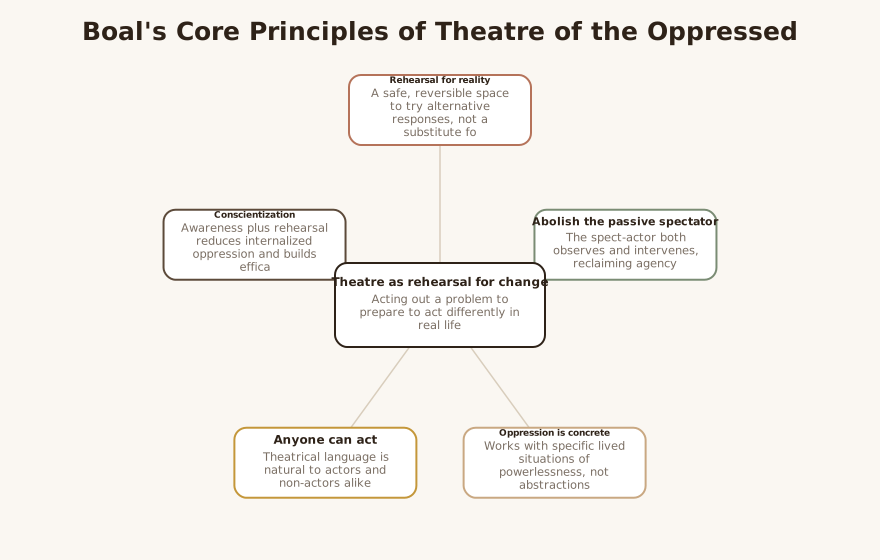
The foundational principle is that theatre is a rehearsal for reality, not a substitute for it 2. By acting out a problem and trying alternative responses in a safe, reversible space, participants prepare to act differently in life 2. A second principle is the abolition of the passive spectator: the “spect-actor” both observes and intervenes, reclaiming agency that oppression tends to strip away 2. A third is that oppression is concrete and enactable — TO works with specific lived situations of powerlessness rather than abstract grievances 4. Boal insisted that anyone can act and that theatrical language is the natural human language, accessible to “actors and non-actors” alike 1. Underlying all of this is the Freirean conviction that becoming aware of one’s situation (a form of conscientization) and physically rehearsing change can reduce internalized oppression and build collective and individual efficacy 3. For clinicians, the throughline is embodied behavioral rehearsal coupled with a critical examination of power LLM.
Interventions & Techniques
TO is an umbrella for several distinct forms. Forum Theatre is the best-known: a short scene depicting an unresolved oppression is performed, then replayed while spect-actors stop the action and substitute themselves for the protagonist to try solutions, facilitated by a “Joker” who mediates between stage and audience 2. Image Theatre uses participants’ bodies to sculpt frozen tableaux representing a feeling, relationship, or social situation, then dynamizes those images toward an ideal 4. Invisible Theatre stages a scene in a real public setting among people who do not know it is theatre, provoking spontaneous engagement 2. Later in his life Boal developed Rainbow of Desire techniques, turning the lens toward internalized oppression — the “cop in the head” — for work that is more explicitly psychotherapeutic in flavor 2. The method is built on a large repertoire of warm-up games and exercises designed to “de-mechanize” the body and senses and to build group trust, documented in detail in Games for Actors and Non-Actors 1. An accessible overview of how these forms function in practice is available in introductory media on the method 6.
LLM-generated illustrative example (not a guideline): In a Forum-style group, a member enacts a scene where a supervisor repeatedly dismisses her concerns. After watching once, another member calls “stop,” steps in, and tries assertively restating the concern; the group then discusses what shifted and what felt realistic, treating the stage as a low-stakes lab for assertiveness LLM.
Evidence Base
Honesty about maturity matters here. As an applied-theatre and community practice, TO is well-established: it has a decades-long international track record, a coherent body of method, and wide adoption in education, activism, and community development 24. As a clinical intervention with controlled outcome data, the evidence base is far younger and thinner LLM. The most relevant peer-reviewed clinical work is a study of a therapeutic program combining drama therapy, Theatre of the Oppressed, and psychodrama with women who had survived intimate partner violence, which reported therapeutic achievements for participants 5. That study is encouraging but is a single program-evaluation context, with TO delivered in combination rather than isolation, so it cannot establish TO alone as an empirically supported treatment 5LLM. Clinicians should therefore present TO as a promising, theory-rich method with limited controlled evidence — not as a first-line treatment for any diagnosis LLM. Where rigorous trials are absent, the responsible stance is to use TO as an adjunct within an evidence-based therapeutic frame and to track outcomes locally LLM.
Populations & Indications
TO was built for and with marginalized and oppressed communities, and that remains its natural indication: groups whose distress is bound up with real conditions of powerlessness 34. Documented and theoretically apt populations include survivors of violence and abuse — the strongest clinical signal comes from work with women survivors of intimate partner violence 5. It has been widely used with adolescents and youth, with refugees and immigrants, and with activists and community groups confronting shared social problems 4. For trauma survivors, the embodied, agency-restoring quality of spect-actor intervention has clear conceptual appeal, though it must be handled with trauma-informed care LLM. The method is generally best suited to people who can tolerate group exposure and physical participation and who share, or can recognize, a common axis of oppression LLM.
Problems-for-Work
TO maps onto several presenting problems clinicians encounter, especially in group settings.
- Internalized oppression and powerlessness: the Rainbow of Desire and Forum forms directly externalize and rework the “oppressor within,” targeting beliefs that change is impossible 2.
- Low self-efficacy and behavioral rehearsal for change: stepping in as a spect-actor is, functionally, rehearsal of new behavior with immediate group feedback — a natural fit where a client knows what to do but cannot yet do it 2LLM.
- Trauma and interpersonal violence: combined drama therapy/TO/psychodrama programming has shown therapeutic benefit for IPV survivors, suggesting value in restoring voice and choice 5.
- Social anxiety and low self-esteem: graded, playful group games build tolerance for being seen and acting in front of others, with esteem gains as participants succeed onstage 1LLM.
- Relationship conflict: Image and Forum work let group members externalize a conflict and physically test alternative responses before risking them in life 2LLM.
- Community and social problems: TO’s original wheelhouse — using staged scenes to surface and collectively problem-solve shared injustices 4.
LLM-generated illustrative example (not a guideline): A youth group names “being ignored by adults” as a shared problem. Using Image Theatre, members sculpt a frozen picture of that experience, then re-sculpt it into how they wish it looked; the facilitator helps them articulate the concrete steps between the two images LLM.
Contraindications, Cautions & Cultural Humility
TO surfaces real, often charged material about power, and it does so in public, embodied form — so the central caution is exposure and safety LLM. Enacting oppression can be activating for trauma survivors, and the method has no built-in clinical safeguards; the clinician supplies the trauma-informed scaffolding, pacing, and grounding 5LLM. Invisible Theatre, which involves unaware members of the public, raises clear ethical and consent concerns and is generally inappropriate inside a clinical treatment context LLM. Group cohesion, confidentiality norms, and the right to pass must be established before any enactment LLM. On cultural humility: TO is explicitly a method of and with the oppressed, not a technique applied to them — Boal’s Freirean lineage warns against the facilitator becoming yet another authority who defines other people’s reality 3. Clinicians should let participants name their own oppressions, avoid casting themselves as rescuers, and remain alert to power differences (clinician/client, dominant/minoritized) inside the room LLM. Facilitators without grounding in both the method and the relevant community should seek training and partnership rather than improvising LLM.
Treatment-Plan Suggestions & SMART Objectives
| Goal | SMART objective (example) | Mechanism |
|---|---|---|
| Increase assertiveness | Client will step in as spect-actor to rehearse one assertive response in 3 of 4 group sessions over 6 weeks | Embodied behavioral rehearsal with immediate feedback 2 |
| Reduce internalized oppression | Client will identify and re-stage one “cop in the head” belief using Rainbow-of-Desire-style technique within 8 sessions | Externalization and rework of internalized oppressor 2 |
| Restore sense of agency (IPV survivor) | Client will report a 1-point increase on a self-efficacy scale after a combined drama therapy/TO program of 10 sessions | Reclaiming voice and choice through enactment 5 |
| Build group connection / reduce isolation | Client will participate in warm-up games in 4 consecutive sessions without leaving early | Trust-building and de-mechanization games 1 |
| Tolerate social exposure | Client will hold a sculpted Image in front of the group for 5 sessions, rating anxiety before/after | Graded exposure to being seen 1LLM |
| Problem-solve relationship conflict | Client will enact and test two alternative responses to a named conflict in Forum format within 6 weeks | Reversible rehearsal of alternatives 2 |
| Increase self-esteem | Client will name one personal strength demonstrated onstage in each of 5 sessions | Mastery and positive feedback through successful action 1LLM |
Common Misconceptions
A frequent misconception is that TO is psychodrama under another name. They share an action-method DNA and are often combined, but TO grows from a sociopolitical, Freirean root focused on collective oppression and public rehearsal, whereas psychodrama is a more individually focused psychotherapy method 35. A second misconception is that TO is “just” role-play or an icebreaker; the games are deliberately structured to de-mechanize habitual perception and build the capacity to act, and they form a coherent system rather than warm-up filler 1. A third is that watching a TO performance is the point — in fact the defining move is intervention by spect-actors, so a TO event with a passive audience has, by Boal’s own logic, failed 2. Finally, some assume TO is an evidence-based treatment; it is an established practice with promising but limited clinical outcome data 5LLM.
Training & Certification
There is no single licensing body that confers a clinical “TO therapist” credential; competence in the method is built through workshop-based, apprenticeship-style training in the tradition Boal and his collaborators established LLM. Organizations dedicated to the work, such as Pedagogy and Theatre of the Oppressed, maintain the lineage, biography, and community of practice around the method 3. Boal’s own handbook Games for Actors and Non-Actors functions as a foundational practical text for facilitators learning the games and exercises 1. For clinical use, the responsible path is to combine TO facilitation training with a recognized mental-health credential (for example, in group therapy, drama therapy, or psychodrama), so that the action methods are delivered inside an accountable clinical scope 5LLM. Introductory videos and explainer resources can orient a newcomer but do not substitute for experiential training and supervision 46.
Key Terms
- Spect-actor: a participant who is simultaneously spectator and actor, intervening in the scene rather than only watching 2.
- Forum Theatre: a scene of unresolved oppression replayed so spect-actors can substitute for the protagonist and try solutions 2.
- Joker: the facilitator who mediates between stage and audience and structures the intervention 2.
- Image Theatre: building and transforming frozen body tableaux to represent and rework situations 4.
- Invisible Theatre: staged scenes performed in public among unaware bystanders 2.
- Rainbow of Desire: Boal’s later, more introspective techniques addressing internalized oppression, the “cop in the head” 2.
- Conscientization: Freirean critical awareness of one’s situation as a precondition for change 3.
- De-mechanization: loosening habitual, automatic patterns of body and perception through games 1.
Resources & Further Reading
▶ Watch — a video introduction to this concept:
- Games for Actors and Non-Actors (Boal, 1992/2002) — Routledge
- Theatre of the Oppressed — Wikipedia
- A Brief Biography of Augusto Boal — Pedagogy and Theatre of the Oppressed (PTO)
- Theatre of the Oppressed (TO) — EBSCO Research Starters
- Therapeutic Achievements of a Program Based on Drama Therapy, Theatre of the Oppressed, and Psychodrama with Women Victims of Intimate Partner Violence — Violence Against Women (Sage)
- What is Theatre of the Oppressed — YouTube
Reflective / Supervision Questions
- When I use TO techniques, am I letting participants name their own oppressions, or am I, as facilitator, defining their reality for them 3LLM?
- Do I have the trauma-informed scaffolding in place before I ask a survivor to enact a scene of their oppression 5LLM?
- Within which billable modality and credential am I delivering this, and does my documentation reflect the clinical target rather than the theatrical form LLM?
- How am I tracking outcomes locally, given that the controlled evidence base for TO as a clinical intervention is still limited 5LLM?
- Am I attending to the power differences in the room — clinician/client, dominant/minoritized — or assuming the method neutralizes them on its own LLM?
- Where does my own competence end, and at what point should I seek further TO training, supervision, or community partnership 1LLM?