
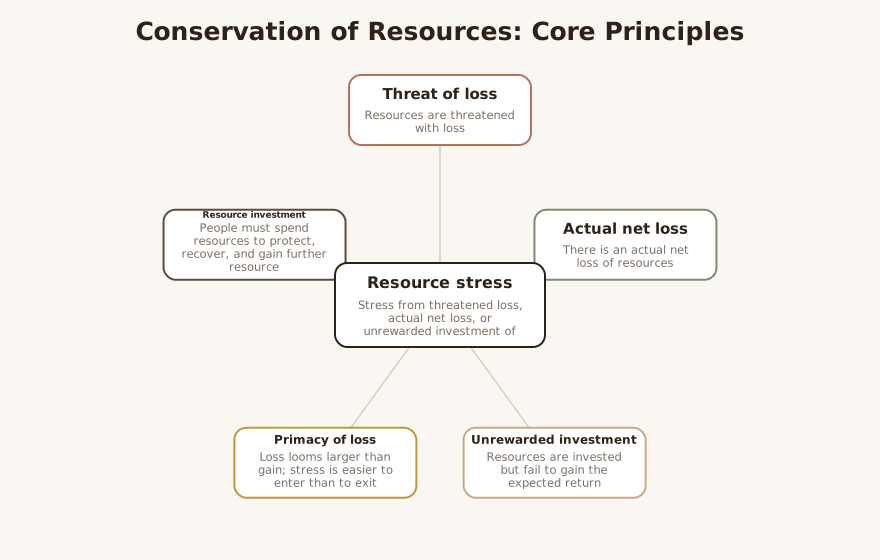
Conservation of Resources theory is one of the most cited stress frameworks in psychology, and for the practicing clinician its appeal is that it makes stress concrete: not a vague subjective state but a measurable accounting of what a person values, what they are losing, and what they are spending to hold on 1. Where appraisal models locate stress inside the head, COR locates it partly in the world — in the objects, relationships, roles, and energies a person actually has or stands to lose — which gives the clinician a more tangible target than “thoughts about stress” alone 1. Its single most useful idea for the consulting room is the primacy of loss: that the pain of losing what we have outweighs the pleasure of gaining what we don’t, and that loss, once started, tends to feed on itself 7.
Type & Discipline
Conservation of Resources is a theory of psychological stress, not a treatment modality or a clinical technique 4. It originated in social and organizational psychology and has become a foundational framework in occupational health psychology, burnout research, and the study of traumatic and community-wide stress 4. It belongs to the family of stress-and-resources models, sitting alongside transactional appraisal theories but defining itself partly in contrast to them: COR proposes that stress is best understood through the gain and loss of objectively valued resources rather than through subjective appraisal alone 1. For the clinician its value is explanatory and integrative — it supplies a vocabulary for why depletion compounds, why people under threat behave defensively, and why those with the fewest reserves are hit hardest — and it is best held as a formulation and psychoeducation lens layered onto established psychotherapy, not as a standalone therapy LLM.
Creators & Lineage
The theory was introduced by Stevan Hobfoll in a 1989 paper in American Psychologist, “Conservation of Resources: A New Attempt at Conceptualizing Stress” 1. Hobfoll’s explicit aim was to address what he saw as the overreliance of stress research on purely subjective, appraisal-based definitions, which he argued risked circularity and were hard to operationalize 1. In their place he proposed a model built on a single motivational premise — that people strive to obtain, retain, protect, and foster the things they value — and defined stress as a reaction to the environment in which those valued resources are threatened, lost, or fail to be replenished after investment 1.
The theory drew on and synthesized earlier traditions: it borrowed the language of resources from stress and coping research, incorporated insights about social support and its protective role, and connected to behavioral and evolutionary reasoning about why organisms guard what sustains them 4. Over subsequent decades Hobfoll and colleagues extended the framework with concepts such as resource caravans and the trajectories of loss and gain spirals, and the theory became a dominant lens in burnout and occupational-stress research and in the study of disaster and mass-trauma populations 6. Empirical extensions by later researchers, including meta-analytic and longitudinal tests, refined and in places challenged its specific predictions while leaving its core architecture intact 23.
Core Principles
The foundational definition is that psychological stress occurs in three circumstances: when resources are threatened with loss, when there is an actual net loss of resources, and when an individual invests resources and fails to gain the expected return 7. This tripartite definition is the engine of the whole theory; everything else elaborates what counts as a resource and what happens once loss begins 1.
The first and most clinically important principle is the primacy of resource loss: loss is disproportionately more salient and more harmful than gain is beneficial 7. A pay cut wounds more than an equivalent raise gratifies; the threat of losing a relationship destabilizes more than the prospect of a new one reassures 7. This asymmetry means stress is “easier to enter than to exit,” because losses register with greater force and pull attention more powerfully than gains of the same magnitude 5.
The second principle is resource investment: because resources are needed to protect against loss, to recover from loss, and to gain further resources, people must continually spend resources to defend and build their store 7. The resources people deploy and protect span health, well-being, family, self-esteem, and a sense of purpose or meaning in life 7. A corollary is that those who already possess ample resources are better positioned to gain still more and to absorb losses, while those who are resource-poor are both more exposed to loss and less able to recover — a self-perpetuating advantage and disadvantage that has obvious implications for inequality 7.
The third principle concerns spirals. Because loss begets further loss — depletion reduces the very reserves needed to stem the next loss — initial resource loss tends to trigger subsequent loss in a self-reinforcing loss spiral, while initial gains can likewise generate further gains in a gain spiral 7. Loss spirals gather momentum and speed because each loss leaves the person with less to defend against the next 7. The fourth principle is defensive conservation under depletion: when resources are stretched thin or exhausted, people shift into a defensive posture to conserve what remains, and may act defensively, aggressively, or even irrationally as a last resort to protect a dwindling store 5.
A further organizing idea is that resources fall into four categories — objects (e.g., a home or a phone), conditions (favorable circumstances such as stable employment, marriage, or tenure), personal characteristics (traits such as hope, self-esteem, or a sense of mastery), and energies (resources whose value lies in helping acquire other resources, such as time, money, or knowledge) 57. This taxonomy lets a clinician inventory what a specific client actually values and is losing, rather than treating “stress” as undifferentiated LLM.
Interventions & Techniques
COR does not arrive with proprietary techniques; it is a stress theory that informs assessment, formulation, and the rationale for established interventions LLM. Its most direct clinical translation is a resource inventory: working with a client to name what they value across the four categories — objects, conditions, personal characteristics, and energies — and to map which resources are threatened, which have been lost, and which investments have failed to pay off, converting “I’m overwhelmed” into a specific ledger that can be acted on 7LLM. Because the theory holds that stress lives in resource dynamics, this inventory is itself a formulation tool LLM.
From there the framework points toward two complementary aims LLM. The first is arresting loss spirals, since the theory predicts that early, even modest, intervention to stop ongoing loss is high-leverage because it prevents the cascade that gathers speed 7LLM. The second is deliberately seeding gain spirals, building small, achievable resource gains — a restored routine, a reactivated relationship, a recovered sense of competence — on the rationale that gains too can compound 7LLM. Because resource investment is required to protect and rebuild, the clinician also helps the client spend scarce reserves wisely, prioritizing investments most likely to yield protective return rather than depleting further on low-yield demands 7LLM. Social support is treated as a resource and a means of replenishing others, which is why mobilizing matched support is a core COR-informed move 2LLM. These techniques are delivered inside recognized modalities — cognitive behavioral therapy, problem-solving therapy, behavioral activation, supportive psychotherapy — not as a freestanding “COR therapy” LLM.
LLM-generated illustrative example (not a guideline): A clinician working with a newly single parent who has lost a partner, a second income, and most of her free time maps these as losses across conditions (marriage, stable finances), objects (the family home now at risk), and energies (time, money). Rather than tackling “stress,” they target the fastest-moving loss first — stabilizing housing and income to arrest the spiral — and protect one small personal-characteristic resource, her sense of competence, by rebuilding a single domain she can reliably succeed in. LLM
Evidence Base
The maturity of Conservation of Resources theory is best described as established — it is a well-validated, heavily cited, and widely applied research framework with a large empirical literature, though it is a theory of stress rather than a manualized, trial-tested therapy 4. The primacy-of-loss principle in particular has accumulated substantial support: meta-analytic work has shown that people respond more strongly to increased demands and resource losses than to comparable resource gains, consistent with the theory’s central asymmetry 7. The framework has been productively applied across burnout, occupational stress, work-family conflict, and disaster and mass-trauma research, giving it broad external validity 6.
Longitudinal evidence supports the loss-spiral concept directly. A four-wave study of 1,196 Palestinian adults exposed to political violence found reciprocal relationships between resource loss and psychological distress over an 18-month period, with psychological distress predicting resource loss across shorter six-month intervals and resource loss predicting distress across longer twelve-month intervals — an empirical demonstration of the self-reinforcing loop the theory predicts 3. This kind of bidirectional, over-time evidence is stronger than cross-sectional correlation and lends the spiral construct real credibility in trauma-exposed populations 3.
Honesty requires several caveats LLM. First, the theory’s specific predictions do not always hold cleanly: a meta-analytic test of the COR model in burnout found that social support, treated as a resource, did not produce the differentiated relationships across the three burnout dimensions that the model predicted, and instead the source of support (work versus non-work) mattered more — work support tied most strongly to emotional exhaustion, non-work support to depersonalization and reduced personal accomplishment 2. This is a meaningful refinement and a caution against assuming the theory’s resource logic maps neatly onto every outcome 2. Second, “established” describes the standing of the theory, not the outcomes of any therapy derived from it; the clinical applications here are reasoned extensions of established interventions rather than direct findings from COR treatment trials LLM. Third, a recurring critique is that defining stress by “valued resources” can reintroduce the very subjectivity Hobfoll sought to escape, since what counts as a resource, and how much it is valued, varies across persons and cultures and can be hard to specify objectively 4. The theory may also underattend to cultural and individual differences in how resources are valued and managed 4.
Populations & Indications
COR is most illuminating wherever loss, depletion, or threat to valued resources organizes a presentation LLM. People with burnout are a paradigm case, since the theory was extensively developed in occupational-stress research and frames burnout as the end state of chronic, unreplenished resource loss at work 2. Trauma survivors, including those with post-traumatic stress disorder, are a second core population: rapid, large-scale resource loss is associated with the development of PTSD, and the loss-spiral model captures how trauma’s effects compound over time 53. Survivors of disaster and political or community violence have been studied directly through a COR lens, where sudden collective loss of objects, conditions, and safety drives distress at the population level 3.
Beyond these, caregivers carrying sustained, unreciprocated demand experience steady drain on time, energy, and personal resources, fitting the depletion model closely LLM. People of low socioeconomic status are especially indicated because the theory predicts that the resource-poor lose resources more readily and recover less easily, making COR a bridge between material disadvantage and psychological distress 7. Healthcare and other frontline workers facing high-demand, resource-stripping environments, and clients in compassion fatigue, occupy the same territory of investment that fails to replenish 2LLM. Across all of these the theory is an adjunct formulation and psychoeducation lens, not a diagnosis-specific protocol LLM.
Problems-for-Work
Burnout. COR frames burnout as chronic resource loss outpacing replenishment, directing the work toward identifying which work and non-work resources are being drained and arresting the spiral; because the source of support matters, the clinician distinguishes work-related from non-work support when targeting emotional exhaustion versus depersonalization 2.
Post-traumatic stress disorder. The loss-spiral model connects trauma’s lasting impact to a self-reinforcing cycle in which distress and resource loss feed each other over time, supporting trauma-focused therapy alongside concrete work to stop ongoing losses of safety, stability, and relationship 3.
Chronic stress. The tripartite definition gives client and clinician a shared, non-pathologizing account of stress as threatened, actual, or unrewarded loss, and points toward protecting reserves and investing them where return is likeliest 1.
Caregiver burden. Framing caregiving as continual investment of time and energy with little replenishment clarifies why depletion mounts, and targets respite and resource recovery rather than willpower 7.
Major depressive disorder and adjustment disorder. Where mood disturbance follows a significant loss or a failed major investment, the resource ledger locates the precipitant and informs behavioral activation aimed at seeding small, compounding gains 7LLM.
LLM-generated illustrative example (not a guideline): A nurse two years into a understaffed unit describes cynicism, exhaustion, and a sense of failure. Mapped through COR, her work resources — time, control, collegial support, and a sense of competence — have been chronically spent without replenishment, and the loss has begun to spiral into her home life. The plan separates work support (to target exhaustion) from non-work support (to target the growing depersonalization), and protects one rebuildable resource, her sense of mastery, through a domain she can still succeed in. LLM
Contraindications, Cautions & Cultural Humility
Because COR is a theory rather than a treatment, it carries no direct contraindications, but its misuse does LLM. The first caution is against framing a client’s resource loss as a personal failure of management when the loss is structural — driven by poverty, discrimination, disaster, or violence that no individual coping strategy will reverse — since the theory itself predicts that the resource-poor lose more and recover less precisely because of conditions beyond their control 7LLM. A second caution is not to let an elegant resource accounting substitute for evidence-based care or for assessment of risk; the loss-spiral concept describes how distress can accelerate, and a clinician should treat escalating loss in a depleted client as a signal to attend to safety rather than to admire the model 3LLM. A third caution concerns the defensive-conservation principle: when clients act defensively, aggressively, or seemingly irrationally under depletion, the theory predicts this as a protective response to dwindling reserves, which should inform compassionate formulation rather than a punitive reading 5LLM.
Cultural humility is essential because what counts as a valued resource is culturally patterned, and the theory’s reliance on “valued resources” can smuggle in the clinician’s own assumptions about what matters 4. Conditions such as marriage, employment, or independence are weighted very differently across collectivist and individualist contexts, and the theory has been criticized for underattending to cultural and individual variation in how resources are valued and managed 4. The clinician should therefore let the client define their own resource hierarchy rather than imposing a standard one, and should hold in mind that resources are not only individual: in many contexts family, community, and collective standing are themselves primary resources whose loss is felt communally 4LLM.
Treatment-Plan Suggestions & SMART Objectives
| Goal | SMART objective (example) | Mechanism |
|---|---|---|
| Build a working resource inventory | Within 2 sessions, client completes a four-category resource map (objects, conditions, personal characteristics, energies) naming what is threatened, lost, or unreplenished | Operationalizes stress as specific resource dynamics rather than a global state 7 |
| Arrest the fastest-moving loss spiral | By week 3, client identifies the single most rapidly escalating loss and takes one concrete step to halt it | Early interruption prevents the self-reinforcing acceleration of loss 7 |
| Seed a gain spiral | Over 6 weeks, client completes one small, achievable resource-building action weekly and logs the result | Initial gains can compound into further gains 7 |
| Invest scarce resources for return | By week 4, client reallocates one recurring low-yield expenditure of time or energy toward a higher-yield protective use | Resource investment is required to protect against and recover from loss 7 |
| Mobilize source-matched social support | Within 8 weeks, client secures one work-linked and one non-work support source matched to their primary depletion | Source of support differentially relates to exhaustion vs depersonalization 2 |
| Protect one personal-characteristic resource | Over 6 weeks, client rebuilds a sense of competence by reliably succeeding in one chosen domain weekly | Defends a core internal resource against erosion under depletion 7 |
| Address structural loss beyond self-management | By week 6, client connects with one concrete external resource (financial, legal, housing, or community) | Recognizes that resource-poor positions reflect conditions, not coping failure 7 |
| Track distress-loss reciprocity over time | Client and clinician review the resource ledger and a brief distress measure every 4 weeks for 12 weeks | Monitors the bidirectional loss-distress loop the theory predicts 3 |
Common Misconceptions
A frequent misreading is that COR is just another way of saying “stress is subjective”; in fact Hobfoll built the theory specifically to move beyond purely appraisal-based definitions, grounding stress in the threatened, actual, or unrewarded loss of objectively valued resources 1. A second misconception is that gains and losses are symmetric — that building a resource simply offsets losing one — when the theory’s central claim is the primacy of loss, that loss is disproportionately more potent than equivalent gain 7. A third error treats resources as a single undifferentiated pool, missing the four distinct categories (objects, conditions, personal characteristics, energies) that let a clinician specify exactly what a client is losing 57.
A fourth misconception is that more resources are always straightforwardly better; the theory notes that resource accumulation has limits and that the framework attends less well to potential downsides of accumulation and to cultural variation in what is valued 4. A fifth, clinically important misconception is that loss spirals reflect individual weakness, when the model holds that those with fewer resources lose more readily by virtue of their depleted position, not their character 7. Finally, clinicians sometimes treat COR as a validated therapy, when its standing is that of a well-supported theory of stress whose treatment applications are reasoned extensions of established interventions LLM.
Training & Certification
There is no certification, credential, or formal training pathway specific to Conservation of Resources theory, because it is a scientific theory of stress rather than a practice modality LLM. Clinicians typically encounter it within graduate coursework in stress and coping, health and occupational psychology, traumatic stress, and organizational behavior, and through the primary literature beginning with Hobfoll’s 1989 paper and the burnout and disaster-research extensions that followed 16. Accessible explainer summaries and reference entries are widely available and are sufficient for most clinical conceptual use 45.
For applied competence, the relevant training is in the established interventions the theory informs — cognitive behavioral therapy, problem-solving therapy, behavioral activation, supportive psychotherapy, and the support-mobilization work of case management LLM. The most useful preparation is therefore to learn the theory well enough to use it as a resource-focused formulation and psychoeducation aid, while building credentialed skill in the treatments it complements LLM.
Key Terms
Resource: anything a person values and strives to obtain, retain, protect, and foster — including objects, conditions, personal characteristics, and energies 17.
Objects: physical resources valued in themselves or for status, such as a home or a vehicle 7.
Conditions: favorable circumstances that are themselves valued and enable other resources, such as stable employment, marriage, or seniority 7.
Personal characteristics: internal traits that aid stress resistance, such as self-esteem, hope, and a sense of mastery 57.
Energies: resources valued chiefly for their power to acquire other resources, such as time, money, and knowledge 7.
Primacy of resource loss: the principle that loss of resources is disproportionately more salient and harmful than an equivalent gain is beneficial 7.
Resource investment: the principle that people must spend resources to protect against loss, recover from loss, and gain further resources 7.
Loss spiral: a self-reinforcing cycle in which initial resource loss depletes the reserves needed to prevent further loss, accelerating over time 7.
Gain spiral: the reciprocal cycle in which initial resource gains generate further gains 7.
Defensive conservation: the shift, under depletion, into a protective posture to guard remaining resources, sometimes expressed as defensive or aggressive behavior 5.
Resources & Further Reading
▶ Watch — a video introduction to this concept:
- Conservation of Resources: A New Attempt at Conceptualizing Stress (Hobfoll, 1989) — author PDF
- Sources of Social Support and Burnout: A Meta-Analytic Test of the Conservation of Resources Model (Halbesleben, 2006) — PubMed
- Reciprocal Relationships between Resource Loss and Psychological Distress Following Political Violence: COR Loss Spirals (Heath et al., 2011) — PMC
- Conservation of Resources Theory — TheoryHub, Newcastle University
- Conservation of Resources Theory — EBSCO Research Starters
- Conservation of Resources — an overview (ScienceDirect Topics)
- Conservation of resources theory — Wikipedia
Reflective / Supervision Questions
- When I name a client’s “stress,” have I actually inventoried which resources — objects, conditions, personal characteristics, or energies — are threatened, lost, or unreplenished, or am I working with an undifferentiated global state? 7
- For this client, where is the fastest-moving loss spiral, and is my plan interrupting it early enough to prevent the acceleration the theory predicts? 7
- Am I treating this client’s resource depletion as a personal management failure when it may reflect structural conditions — poverty, discrimination, disaster — that the theory says hit the resource-poor hardest? 7
- When mobilizing support, am I distinguishing work from non-work sources and matching them to the specific dimension of depletion I am targeting? 2
- How might this client’s culture weight resources like marriage, employment, or independence differently from my own assumptions, and am I letting them define their own resource hierarchy? 4
- When a depleted client behaves defensively or seemingly irrationally, am I reading it as a protective conservation response, or am I pathologizing it? 5