
Type & Discipline
Meaning in life is a psychological construct rather than a treatment modality or a discrete technique LLM. It sits at the intersection of positive psychology and existential psychology, drawing measurement traditions from the former and conceptual depth from the latter LLM. As a construct, it names a subjective appraisal: the felt sense that one’s life is comprehensible, worth living, and pointed toward something 2. Contemporary work distinguishes the presence of meaning — the degree to which a person experiences their life as meaningful — from the active search for meaning, the drive to establish or deepen that sense 1. Because it is a construct and not a stand-alone therapy, clinicians work with meaning inside existing modalities — clarifying it, repairing it, or helping clients tolerate its temporary absence — rather than delivering “meaning therapy” as a procedure LLM.
Creators & Lineage
The modern clinical interest in meaning traces most directly to Viktor Frankl, the Viennese psychiatrist whose concentration-camp memoir argued that the human will to meaning persists even under extreme suffering 5. Frankl’s logotherapy held that people can endure almost any “how” of life if they have a “why,” and that meaning can be found through creative work, through love and relationship, and through the attitude one takes toward unavoidable suffering 6. From this existential root the construct was taken up by empirical positive psychology, where it became something measurable rather than only philosophical LLM. Michael F. Steger has been central to this translation, developing scales and conceptual models that made meaning a tractable research and assessment target 3. Roy Baumeister’s analysis of meaning as a need built from purpose, value, efficacy, and self-worth shaped the construct’s structure LLM. Frank Martela and Steger later consolidated decades of competing definitions into a parsimonious tripartite model 2. Self-determination theory contributes a parallel emphasis on autonomy, competence, and relatedness as nutriments that plausibly feed a sense of meaning LLM.
Core Principles
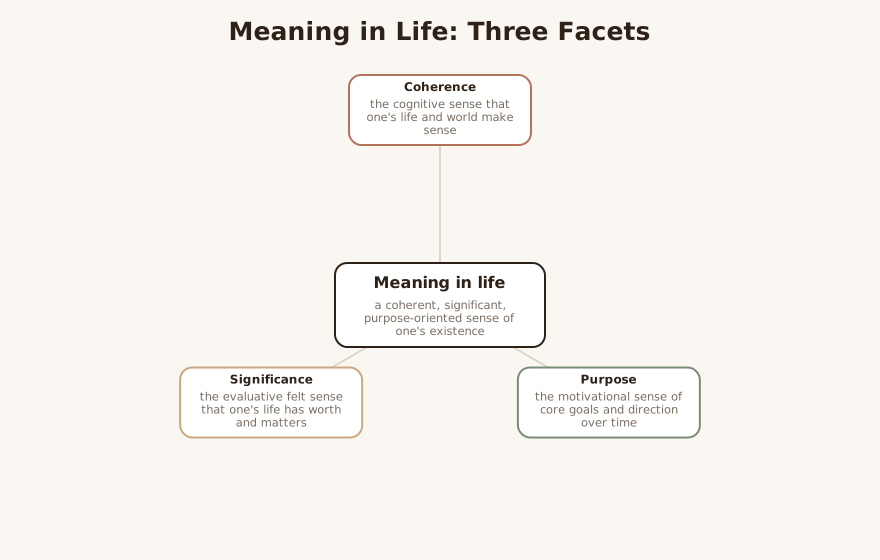
The most useful clinical synthesis parses meaning into three facets 2. Coherence (or comprehension) is the cognitive facet: the sense that one’s life and the world make sense, hang together, and are intelligible 2. Purpose is the motivational facet: having core goals, aims, and a direction that organizes behavior over time 2. Significance (often experienced as mattering) is the evaluative facet: the felt sense that one’s life has worth and is worth living 2. A person can be high on one facet and low on another — a client may have clear purpose yet feel their existence does not matter, or feel their life matters yet find it incoherent after trauma LLM. A second principle is the presence-versus-search distinction: actively searching for meaning is not the same as lacking it, and search can be either a healthy exploratory process or a distressing symptom of deficit depending on context 1. Finally, meaning is understood as constructed and revisable rather than fixed — it is built through interpretation, commitment, and relationship, which is precisely what makes it a workable clinical target LLM.
Interventions & Techniques
Because meaning is a construct, the relevant techniques are borrowed from established modalities and aimed at one of the three facets LLM. To build coherence, clinicians use narrative work — helping clients author a life story in which adversity has a place and events connect rather than fragment LLM. To build purpose, values-clarification exercises from acceptance and commitment work, goal-laddering, and behavioral activation toward valued domains are common levers LLM. To build significance/mattering, therapists strengthen relationships, contribution, and legacy — interventions such as life review, legacy letters, and acts of generativity LLM. Frankl’s own techniques included dereflection (shifting attention away from self-monitoring toward engagement with the world) and Socratic dialogue about sources of meaning even amid suffering 6. A practical entry point is measurement-as-intervention: administering a brief meaning scale and reviewing the profile collaboratively often opens the conversation 7. Across techniques, the clinician’s stance is exploratory rather than prescriptive — meaning that is handed to a client tends not to hold, whereas meaning the client articulates and tests for themselves does LLM.
LLM-generated illustrative example (not a guideline): A recently widowed client says she “goes through the motions but none of it counts anymore.” The therapist hears intact coherence (she understands what happened) but collapsed significance. Sessions focus on small acts of contribution — volunteering, mentoring a niece — chosen by the client, to rebuild the felt sense that her life still matters. LLM
Evidence Base
The construct itself is established: meaning in life is well-defined, reliably measured, and embedded in a large correlational literature 1. The Meaning in Life Questionnaire demonstrates good internal consistency, a stable two-factor structure (Presence and Search), and predictable relationships with well-being and distress, supporting its construct validity 1. The tripartite model has organized otherwise fragmented definitions into a coherent, testable framework 2. Measurement of the search side is comparatively less mature: a 2025 systematic review found that existing tools capture presence and broad search reasonably well but inconsistently differentiate personal, social, and existential significance, and concluded that the field still needs more precise instruments for some facets 4. Catalogues of validated measures give clinicians vetted options beyond the MLQ 7. The important honesty for practice: the construct’s evidence is solid, but rigorous outcome trials of meaning-centered interventions are a developing rather than fully settled literature, and the provided evidence here speaks to measurement and structure more than to treatment efficacy LLM. Clinicians should treat meaning as a robust target and a reasonable mechanism, while remaining modest about claiming a mature intervention evidence base LLM.
Populations & Indications
Meaning work is broadly relevant across the adult lifespan, with particular salience at developmental and existential inflection points LLM. Adolescents and young adults forming identity often present with active search for meaning that is developmentally normal rather than pathological 1. Older adults frequently engage purpose and legacy as horizons shift, making life-review approaches apt LLM. People facing chronic or terminal illness, and those confronting mortality, are a core indication — this is the population from which Frankl’s framework originally drew its force 5. Bereaved individuals often experience a rupture in coherence and significance simultaneously, making the tripartite lens clinically useful for locating where the damage sits 2. Clients in existential crisis — questioning whether anything is worth doing — are squarely indicated 6. The construct is also relevant to high-functioning clients whose presenting concern is a diffuse sense that, despite outward success, their life lacks point LLM.
Problems-for-Work
Meaning maps onto several common clinical problems and, importantly, helps differentiate among them LLM. Lack of meaning or purpose and existential distress are the most direct indications, where the work targets whichever facet has collapsed 2. Demoralization — a state of subjective incompetence and loss of purpose distinct from anhedonic depression — is a meaning-relevant target, and naming it can reframe a stuck case LLM. In depression, low presence of meaning frequently co-occurs and can be addressed alongside mood-focused work rather than instead of it 1. With hopelessness and suicidal ideation, restoring even a fragile sense that one’s life matters can function as a protective focus within a broader safety-oriented plan, never as a substitute for risk assessment LLM. Life transitions, burnout, grief, and low life satisfaction all involve disrupted coherence, purpose, or mattering and respond to facet-specific exploration LLM.
LLM-generated illustrative example (not a guideline): A mid-career clinician reports burnout — “I’m good at this but I don’t know why I’m doing it.” Assessment reveals high coherence and significance but eroded purpose. Work centers on reconnecting daily tasks to chosen values rather than reducing workload alone. LLM
Contraindications, Cautions & Cultural Humility
Meaning is rarely contraindicated as a construct, but the timing and framing of meaning-focused work can be LLM. Pressing a client to “find the meaning” in acute trauma or fresh loss can feel invalidating and may foreclose necessary grief, so stabilization and validation generally precede meaning-making LLM. With active suicidality, meaning exploration supplements but never replaces structured risk assessment and safety planning LLM. Clinicians should also resist conflating a client’s active search for meaning with deficit — for some, searching is a vital, ongoing, and healthy process rather than a problem to be solved 1. Cultural humility is essential: dominant scales and frameworks were largely developed in Western, individualistic contexts, and reviews note limited cross-cultural adaptability and an under-attention to social and collective significance 4. Sources of meaning are culturally and spiritually patterned — family, faith, community, ancestry, and duty may carry meaning that individual-purpose framings miss entirely LLM. The clinician’s task is to elicit the client’s own meaning vocabulary rather than impose a normative one LLM.
Treatment-Plan Suggestions & SMART Objectives
| Goal | SMART objective (example) | Mechanism |
|---|---|---|
| Increase felt purpose | Within 6 weeks, client will identify 3 personally chosen values and take ≥1 weekly action aligned to each, logged in session | Purpose facet via values-directed behavior LLM |
| Restore narrative coherence | Over 8 sessions, client will construct a written life-timeline integrating a major loss, rated for “makes sense” 0-10 pre/post | Coherence facet via narrative integration 2 |
| Strengthen mattering | Within 4 weeks, client will complete 2 acts of contribution and report mattering on a 0-10 scale weekly | Significance facet via generativity LLM |
| Establish a baseline | By session 2, client will complete the Meaning in Life Questionnaire and review the Presence/Search profile collaboratively | Assessment-informed targeting 1 |
| Reduce demoralization | Over 6 weeks, client will reduce self-reported “pointlessness” rating by ≥3 points via valued-activity scheduling | Purpose + mattering via behavioral re-engagement LLM |
| Reframe healthy search | Within 4 weeks, client will reframe ≥2 “something’s missing” statements as active exploration rather than failure | Normalizing search vs. deficit 1 |
| Connect meaning to mood | Across 8 sessions, client will pair one meaning-based action with each depression-focused behavioral task, tracked weekly | Co-targeting meaning and mood 1 |
Common Misconceptions
A frequent error is treating “meaning” as a single thing rather than three separable facets — clients can possess purpose while feeling their life does not matter, and lumping these together obscures where intervention should aim 2. A second misconception is that searching for meaning is inherently a symptom; in fact search and presence are distinct, and active searching can be a healthy developmental or reflective process 1. A third is the assumption that meaning must be grand or singular — Frankl emphasized that meaning is concrete, situation-specific, and found in particular tasks, relationships, and stances, not only in a master life-purpose 6. Clinicians sometimes also conflate meaning with happiness; the constructs diverge, and a meaningful life can include considerable difficulty and negative affect LLM. Finally, there is a tendency to assume meaning can be supplied by the therapist — in practice, meaning that the client constructs and endorses is what holds LLM.
Training & Certification
There is no single licensure or required certification to “do meaning work,” because it is a construct deployed within modalities the clinician is already trained in LLM. Therapists typically integrate it through existing competencies in narrative therapy, acceptance and commitment therapy, existential therapy, or interpersonal approaches LLM. Formal training in logotherapy is available through institutes in the Franklian tradition for clinicians who want depth in that lineage 6. For assessment competence, familiarity with validated instruments — the Meaning in Life Questionnaire and the broader catalogue of vetted measures — is the practical entry point 7. Researcher resources curated by Steger provide measures, scoring, and conceptual background suitable for clinicians building competence without a formal program 3. Ongoing supervision and reading in existential and positive-psychology literatures are generally sufficient to use the construct responsibly within scope LLM.
Key Terms
Presence of meaning — the degree to which a person experiences their life as meaningful 1. Search for meaning — the active drive to establish, augment, or deepen one’s sense of meaning 1. Coherence/comprehension — the cognitive facet; life and world feel intelligible and connected 2. Purpose — the motivational facet; core aims and direction 2. Significance/mattering — the evaluative facet; the felt worth of one’s life 2. Logotherapy — Frankl’s meaning-centered approach holding that the will to meaning is a primary human motivation 6. Dereflection — a Franklian technique redirecting attention from self-monitoring toward engagement with the world 6. Demoralization — a syndrome of subjective incompetence, hopelessness, and loss of purpose, distinct from anhedonic depression LLM.
Resources & Further Reading
▶ Watch — a video introduction to this concept:
- Steger, Frazier, Oishi & Kaler (2006). The Meaning in Life Questionnaire — the foundational presence/search scale and validation.
- Martela & Steger (2016). The Three Meanings of Meaning in Life — the coherence/purpose/significance framework.
- Michael F. Steger — Meaning & Purpose (researcher site) — measures, scoring, and background.
- Systematic review of search-for-meaning assessment tools (Frontiers in Psychology, 2025) — current state and gaps in measurement.
- Frankl, Man’s Search for Meaning (Beacon Press) — the originating clinical-existential text.
- Man’s Search for Meaning — Psychology Today essay — accessible overview of Frankl’s ideas.
- Meaning in Life: Scientific Measures (IPPA Network) — catalogue of validated instruments.
Reflective / Supervision Questions
- When a client reports feeling their life is meaningless, can you locate which facet — coherence, purpose, or significance — has actually collapsed, and does your plan target that facet specifically? LLM
- How do you distinguish, in a given client, a healthy active search for meaning from a distressing deficit, and does your response differ accordingly? 1
- Whose meaning vocabulary is operating in the room — the client’s, or a normative individualistic one you may be importing? 4
- Are you respecting timing, ensuring stabilization and grief have room before pressing toward meaning-making after acute loss or trauma? LLM
- When meaning work intersects with risk, have you kept it as a supplement to, rather than a substitute for, structured safety assessment? LLM