
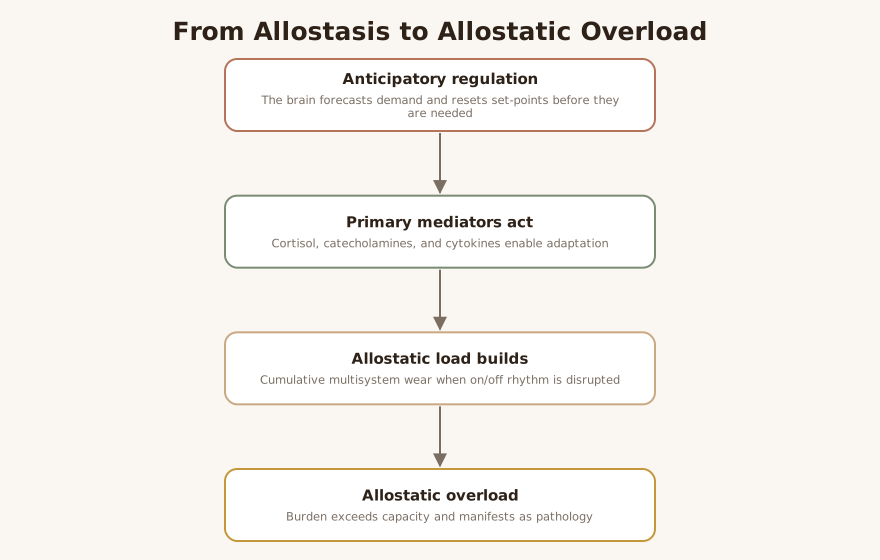
Allostasis reframes how we understand stress: rather than a system that merely defends a fixed internal baseline, the body is an anticipatory regulator that resets its own set-points to meet predicted demand 1. This article unpacks the construct, its evidence, and — most importantly for clinicians — how it can sharpen case formulation, psychoeducation, and treatment planning without overclaiming what it can do. LLM
Type & Discipline
Allostasis and allostatic load are explanatory constructs drawn from neuroendocrinology and psychophysiology, not therapeutic modalities in themselves 2. They sit within the “post-homeostasis” family of stress physiology, offering a model of how adaptive regulation, sustained too long or too often, becomes a driver of disease 1. For the therapist, the value is conceptual: a shared biological vocabulary that links lived stress to measurable physiology and to downstream mental and physical health outcomes 4. The construct is descriptive and mechanistic, so any clinical use occurs inside an established psychotherapy rather than as a freestanding intervention. LLM
Creators & Lineage
The term allostasis — literally “stability through change” — was introduced by Peter Sterling and Joseph Eyer in 1988 to describe how the body achieves stability by varying, not defending, its internal parameters 2. Bruce McEwen and Eliot Stellar extended the idea in the early 1990s with the concept of allostatic load, the cumulative cost of chronic over-activation of the mediators that produce allostasis, a framework McEwen consolidated in his influential 1998 synthesis 1. The lineage runs through homeostasis (Cannon’s defended set-point) and stress-and-coping theory (Lazarus and Folkman’s appraisal-based model), and it converses closely with psychoneuroimmunology and, in clinical practice, with polyvagal theory as a complementary language for autonomic regulation 4. Allostasis was offered as a correction to homeostasis: set-points are not fixed but predictively adjusted by the brain 1.
Core Principles
The model rests on a few interlocking ideas. First, regulation is anticipatory: the brain forecasts demand and mobilizes resources before they are needed, which is efficient but costly when forecasts are chronically threat-biased 1. Second, the same primary mediators that enable adaptation — cortisol and other glucocorticoids, catecholamines (adrenaline, noradrenaline), and inflammatory cytokines — become damaging when their normal on/off rhythm is disrupted 1. McEwen described four problematic patterns: too-frequent activation; failure to habituate to repeated stressors; failure to shut off the response after the stressor ends; and an inadequate response in one system that drives compensatory overactivity in another 1.
Third, the model is cumulative and multisystem. Allostatic load is not a single hormone level but the integrated burden across neuroendocrine, autonomic, immune, metabolic, and cardiovascular systems over time 3. When this burden exceeds the body’s capacity to adapt, the construct shades into allostatic overload, the tipping point at which wear-and-tear manifests as pathology 4.
Interventions & Techniques
Because allostasis is a construct rather than a protocol, it does not prescribe specific techniques; it informs how existing ones are framed and sequenced. LLM In practice, clinicians borrow the model to do three things. The first is psychoeducation: explaining symptoms as the predictable physiology of a system stuck “on,” which normalizes the client’s experience and reduces self-blame. LLM The second is load-reduction targeting — using the four-pattern framework to ask whether the problem is too-frequent activation, poor recovery, or failure to shut off, and matching the intervention accordingly (e.g., recovery and sleep work for a failure-to-shut-off pattern; graded exposure for a failure-to-habituate pattern). LLM The third is regulation skills drawn from established therapies — paced breathing, progressive relaxation, behavioral activation, and routine restoration — chosen to lower chronic mediator output and restore circadian and recovery rhythms. LLM
LLM-generated illustrative example (not a guideline): A frontline nurse describes “always being on edge even on days off.” Reframing this as a stress-response system that has learned not to switch off — rather than a personal failing — gives a rationale for protecting recovery windows, anchoring sleep, and practicing downregulation skills between shifts. LLM
Evidence Base
Here honesty matters. As a construct in stress physiology, allostatic load is well established: decades of research link a composite biomarker index to morbidity, mortality, and cognitive and physical decline, and the framework has strong explanatory traction 3. The MacArthur operationalization — a cumulative index typically combining markers across neuroendocrine (cortisol, DHEA-S, catecholamines), cardiovascular/metabolic (blood pressure, waist-hip ratio, lipids, glucose/HbA1c), and inflammatory domains — gave the field a measurable proxy that predicts outcomes better than any single marker 3.
What is not established is an “allostatic-load therapy.” There is no validated, allostasis-targeted treatment modality, and the construct’s clinical translation remains an active, emerging effort — signaled by recent work explicitly moving “from theory to therapy” 5. The index also lacks a single standardized formula; biomarker panels and cut-points vary across studies, complicating direct clinical use 4. The model is best understood as a strong formulation and mechanism framework whose therapeutic applications are promising but still maturing. LLM
Populations & Indications
Allostatic load is most clinically illuminating where stress is chronic, repeated, or poorly recovered. It is well documented in low-socioeconomic-status populations, where cumulative social and material adversity produces measurably higher load and helps explain health disparities 3. It applies to trauma survivors, people with chronic illness, caregivers under sustained burden, older adults (where load tracks with biological aging), and healthcare and frontline workers facing repeated acute demand without adequate recovery 3. More broadly, anyone with prolonged exposure to chronic stress is a candidate for this lens 1. The construct does not diagnose; it frames why these groups carry elevated physiological risk and where intervention might reduce it. LLM
Problems-for-Work
The model maps onto many presenting problems clinicians treat. For chronic stress and burnout, allostatic load names the cost of a never-resetting system and justifies recovery-focused goals. LLM For PTSD, the failure-to-shut-off and failure-to-habituate patterns describe a stress axis that stays mobilized long after threat. LLM In major depressive disorder and anxiety disorders, dysregulated cortisol rhythms and inflammatory tone fit the load framework and support attention to sleep, activation, and rumination 1. Insomnia is both a contributor to and a consequence of load, making sleep a high-yield target. LLM Chronic pain, cardiovascular and metabolic dysregulation, adjustment disorder, caregiver burden, and HPA axis dysregulation all sit naturally within a multisystem wear-and-tear account, helping clinicians connect psychological work to physical health. LLM
LLM-generated illustrative example (not a guideline): A caregiver with insomnia and rising blood pressure can be helped to see these not as separate complaints but as overlapping signs of sustained load, supporting a plan that treats sleep, respite, and downregulation together rather than in isolation. LLM
Contraindications, Cautions & Cultural Humility
The construct itself has no contraindications, but its use does carry cautions. It is a physiological explanation, not a measurement available in session; clinicians should not imply a client’s “allostatic load score” without actual biomarker data, and even then panels are non-standardized 4. Avoid biological determinism — framing load as fixed damage can induce hopelessness; the more accurate and useful message is that recovery and regulation can lower ongoing burden. LLM
Cultural humility is essential. Elevated load in marginalized and low-SES groups reflects structural conditions — discrimination, economic precarity, unequal access — not individual deficiency, and a load framework that ignores this risks pathologizing people for their environments 3. Use the model to validate the bodily toll of chronic adversity, not to locate the problem solely inside the client. LLM
Treatment-Plan Suggestions & SMART Objectives
| Goal | SMART objective (example) | Mechanism |
|---|---|---|
| Restore recovery rhythm | Client will maintain a consistent sleep-wake schedule (within 60 min) at least 5 nights/week for 6 weeks | Lowers chronic mediator output; supports HPA-axis shut-off 1 |
| Reduce activation frequency | Client will identify and reduce two recurring daily stress triggers, logging them weekly for 8 weeks | Addresses too-frequent activation pattern 1 |
| Build downregulation skills | Client will practice paced breathing or relaxation 5 min twice daily, 5 days/week, for 4 weeks | Shifts autonomic tone toward recovery LLM |
| Improve recovery between demands | Client will schedule one protected respite period weekly for 8 weeks | Counters failure-to-shut-off; restores reserve LLM |
| Increase adaptive coping | Client will apply one cognitive-reappraisal skill to a stressor 3x/week for 6 weeks | Alters threat appraisal driving anticipatory load 4 |
| Support physical-health behaviors | Client will engage in 20 min moderate activity 3x/week for 8 weeks | Reduces metabolic/cardiovascular components of load 3 |
| Strengthen social support | Client will initiate two supportive contacts weekly for 6 weeks | Buffers stress reactivity; lowers cumulative load 3 |
Common Misconceptions
The most common error is treating allostatic load as interchangeable with homeostasis or with “stress” generally — it is specifically the cumulative cost of repeated allostatic adjustment, not stress itself 1. A second is assuming there is a single, validated allostatic-load test or therapy; in reality the index varies across studies and no allostasis-specific treatment is established 45. A third is reading load as permanent damage; while some effects are durable, the framework explicitly concerns ongoing burden that current and future regulation can influence. LLM Finally, clinicians sometimes overstate precision — speaking as though they can quantify a client’s load from interview alone, when the construct’s measurement is biomarker-based and research-grade 3.
Training & Certification
There is no certification in allostasis or allostatic load, because it is a scientific construct rather than a credentialed modality 2. Clinicians integrate it through familiarity with the foundational literature — McEwen’s synthesis and the MacArthur Network resources are accessible entry points — and through existing competencies in the evidence-based therapies (cognitive-behavioral, behavioral, and somatic/regulation-focused approaches) within which the model is applied 13. Continuing education in psychoneuroimmunology, health psychology, and stress physiology deepens fluency 4.
Key Terms
- Allostasis: Stability through change; anticipatory resetting of regulatory set-points to meet demand 2.
- Allostatic load: Cumulative physiological wear-and-tear from chronic or dysregulated allostatic activation 1.
- Allostatic overload: The point at which load exceeds adaptive capacity and produces pathology 4.
- Primary mediators: Glucocorticoids (cortisol), catecholamines, and inflammatory cytokines that drive adaptation but cause damage when dysregulated 1.
- Four activation patterns: Frequent activation, failure to habituate, failure to shut off, and inadequate response with compensatory overactivity 1.
- Allostatic load index: A composite multisystem biomarker measure used to estimate cumulative burden 3.
Resources & Further Reading
▶ Watch — a video introduction to this concept:
- Stress, Adaptation, and Disease: Allostasis and Allostatic Load (McEwen, 1998, Annals NYAS)
- Allostasis, Allostatic Load — Springer Encyclopedia entry
- Allostatic Load — MacArthur SES & Health Network (UCSF)
- Allostatic Load — an overview (ScienceDirect Topics)
- Advancing the Allostatic Load Model: From Theory to Therapy (ScienceDirect, 2023)
- Allostatic load — introductory video
Reflective / Supervision Questions
- For a given client, which of McEwen’s four activation patterns best fits the presentation, and how would that change my intervention emphasis? LLM
- Am I using the load framework to validate the bodily cost of chronic adversity, or am I inadvertently locating a structural problem inside the individual? 3
- Where am I overstating precision — implying I can quantify load I cannot actually measure in session? 4
- How do I balance honest psychoeducation about cumulative wear-and-tear with a message of recoverability that sustains hope? LLM
- For populations facing structural stressors, how do I integrate advocacy or referral alongside in-session regulation work? LLM