
Type & Discipline
Supportive psychotherapy is a modality within the broader psychodynamic and common-factors tradition whose explicit aim is to maintain or restore the patient’s best level of functioning, rather than to produce structural personality change through insight 5. It is sometimes described as the default or “generic” psychotherapy of routine clinical care — the treatment most clinicians actually deliver much of the time, even when they label their work otherwise 7. Where insight-oriented or expressive treatments work by uncovering unconscious conflict and increasing self-understanding, supportive psychotherapy works primarily by strengthening adaptive defenses, bolstering self-esteem, reducing anxiety, and using the relationship itself as the active ingredient 1. LLM
A useful orienting frame is the expressive–supportive continuum: most psychodynamic work mixes interpretive (expressive) and supportive interventions, and the balance is titrated to the patient rather than fixed by the brand of therapy 7. Supportive psychotherapy occupies the supportive pole of that continuum, and a single course of treatment — or even a single session — can move along it as the patient’s state changes 5. Because it is defined more by its goals and stance than by a single rigid protocol, it is practiced across psychiatry, psychology, social work, and counseling 5. LLM
Creators & Lineage
Supportive psychotherapy grew out of psychoanalysis and ego psychology, where it was long treated as the lesser sibling of “real,” interpretive analytic work — something offered to patients deemed unsuitable for insight-oriented treatment 7. The modern articulation that reframed it as a coherent, teachable treatment in its own right is associated above all with Henry Pinsker and Arnold Winston, working with Richard N. Rosenthal, whose Introduction to Supportive Psychotherapy and Learning Supportive Psychotherapy: An Illustrated Guide became the standard clinical texts 12. David S. Werman was another influential early systematizer of the approach 7. LLM
The conceptual roots run back to ego psychology’s emphasis on defenses, adaptation, and the strength of the ego to cope with internal and external demands — supportive psychotherapy is, in effect, an applied ego psychology that works to shore up these capacities rather than to dismantle them 1. It also draws heavily on the common factors literature: the therapeutic alliance, empathy, expectancy, and the relationship itself are not merely the soil in which technique grows but are themselves the primary mechanism of change in this modality 7. LLM In this sense supportive psychotherapy sits at the intersection of the psychodynamic lineage it descends from and the transtheoretical common-factors tradition that helps explain why it works 5. LLM
Core Principles
The organizing goal is functional: to help the patient maintain, recover, or improve self-esteem, adaptive skills, and psychological function, and to relieve symptoms and subjective distress 5. Insight is welcome when it arises but is not the target; the clinician does not deliberately frustrate the patient to surface unconscious material, and regression is discouraged rather than cultivated 1. LLM
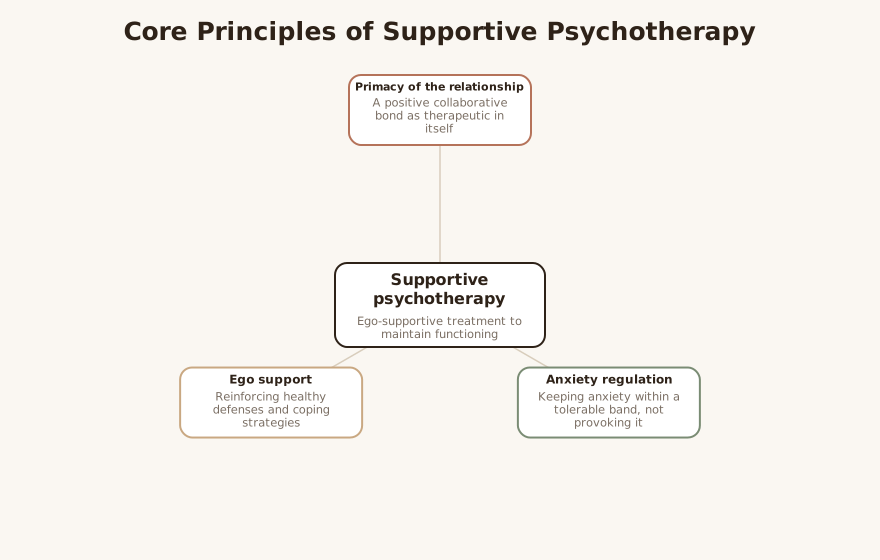
A first principle is the primacy of the relationship. The alliance is actively built and protected, and a positive, collaborative bond is treated as therapeutic in itself, not just as a precondition for technique 5. The clinician adopts a warm, engaged, conversational stance — more like an ordinary supportive conversation in tone than the neutral, abstinent posture of classical analysis 6. LLM
A second principle is anxiety regulation rather than anxiety provocation: the clinician works to keep anxiety within a tolerable band, lowering it when it is disorganizing and, less often, raising it slightly when a patient is too avoidant to engage 1. A third is ego support — actively reinforcing healthy defenses and coping strategies rather than interpreting them away, and helping the patient lean on what already works 5. A fourth is esteem-building: praise, encouragement, normalization, and reassurance are deliberate, legitimate interventions here, not lapses in technique 1. Finally, the work is here-and-now and reality-oriented, focused on current problems, relationships, and functioning rather than on systematic reconstruction of the past 6. LLM
Interventions & Techniques
Supportive psychotherapy has a recognizable toolkit, most of it conversational and relational rather than manualized 1. Core techniques include 15:
- Praise, encouragement, and reassurance — affirming the patient’s strengths, efforts, and gains, and offering realistic reassurance to counter demoralization 1.
- Clarification and confrontation (gentle) — restating and organizing what the patient has said so it becomes clearer, and tactfully drawing attention to inconsistencies, without the destabilizing edge of interpretation 1.
- Advice, guidance, and psychoeducation — offering concrete suggestions, anticipatory guidance, and information when the patient lacks knowledge or is overwhelmed 5.
- Naming and normalizing affect — helping the patient identify, tolerate, and contextualize feelings so they feel less alien or dangerous 6.
- Esteem- and defense-support — reinforcing adaptive coping and reframing setbacks in ways that protect self-worth 1.
- Modeling and rehearsal — using the relationship to model calmer problem-solving and, where useful, rehearsing how the patient might handle a situation 5. LLM
A defining feature is what supportive psychotherapy deliberately withholds: it generally avoids transference interpretation, deep exploration of unconscious conflict, and techniques that intentionally heighten anxiety or foster regression 1. The clinician keeps the patient oriented toward present functioning and uses self-disclosure and a real, person-to-person manner more freely than expressive therapists typically would 7. LLM
LLM-generated illustrative example (not a guideline): A patient with a long history of psychosis arrives agitated after a conflict with a roommate. Rather than exploring the meaning of the conflict, the clinician slows the pace, names the distress (“that sounds frightening and unfair”), reinforces the patient’s good judgment in coming in, reviews the medication and sleep routine that usually steadies them, and rehearses one concrete sentence to say to the roommate — lowering arousal and shoring up coping rather than seeking insight. LLM
Evidence Base
The evidence picture here is genuinely two-sided, and clinical honesty requires holding both halves. On one hand, supportive psychotherapy is among the most commonly delivered treatments in real-world care 7. On the other, it has been studied less than its ubiquity would suggest as a named, structured brand — in large part because a deliberately stripped-down version of it is the standard control or comparison arm in psychotherapy trials, which has shaped, and arguably distorted, how its efficacy reads in the literature 3. LLM
In a network meta-analysis of seven psychotherapies for adult depression (198 trials, 15,118 patients), Barth and colleagues found that the treatments were broadly comparable, with “moderate to large” effects against waitlist across the board, but that interpersonal therapy was significantly more effective than supportive therapy, and that in the larger, higher-quality studies supportive counseling was no longer significantly better than waitlist 3. The authors themselves cautioned that conceptual limitations in how supportive counseling was operationalized in research may have underestimated its true effectiveness — a crucial caveat for interpreting these results 3. In a larger network meta-analysis covering all main treatment types for depression, Cuijpers and colleagues likewise found that the individual psychotherapies did not differ significantly from one another, with the single exception of non-directive supportive counseling, which ranked lowest and was less efficacious than the others — yet that difference was no longer significant once analyses were restricted to studies at low risk of bias 4. LLM
The throughline is a distinction clinicians must keep sharp: the thin, deliberately minimal “non-directive supportive counseling” used as a control condition is not the same thing as the structured, technique-rich supportive psychotherapy described by Pinsker, Winston, and Rosenthal 1. LLM Conflating the construct-as-control with the construct-as-practiced is the single most common error in reading this evidence base, and it produces the misleading headline that “supportive therapy is weak” 3. The honest summary is: supportive psychotherapy is an established, mainstream modality whose relationship-driven mechanisms are well supported by the common-factors literature, but whose efficacy as a manualized brand is less robustly and less favorably documented than its real-world prevalence — and the research that exists may understate it 34. LLM
Populations & Indications
Supportive psychotherapy is especially indicated where insight-oriented work is unsuitable, unsafe, or simply unnecessary 1. Classic indications include patients with lower ego strength or limited capacity for reflection and frustration tolerance, in whom anxiety-provoking, uncovering work could be destabilizing 7. It is a mainstay for people with severe and persistent mental illness — chronic schizophrenia and other psychotic-spectrum conditions — where the goals are stabilization, function, and engagement rather than personality change 7. LLM
It is also well-suited to medically ill and hospitalized patients, including those coping with chronic or life-threatening illness, where a supportive, here-and-now stance helps the person manage real external stressors 5. It is the natural mode for people in acute crisis needing rapid stabilization, and for those navigating grief and bereavement or adjustment to major life change, where what is needed is steadying, validation, and mobilization of existing coping rather than depth work 6. Across these groups it spans the lifespan, with particular relevance for older adults and for higher-functioning patients during periods of acute stress when a temporarily supportive stance is appropriate 5. LLM
Problems-for-Work
Supportive psychotherapy’s techniques map onto problems where the clinical task is to bolster functioning and contain distress 1. Representative targets and how the methods apply:
- Acute crisis and demoralization — reassurance, esteem-building, and concrete guidance to interrupt a downward spiral and restore a sense of agency 1. LLM
- Chronic schizophrenia and psychotic-spectrum disorders — relationship-anchored stabilization, psychoeducation, reality-orientation, and reinforcement of adaptive routines and treatment adherence 7. LLM
- Grief and bereavement — naming and normalizing affect, accompanying the patient, and supporting gradual re-engagement with life rather than interpreting the loss 6. LLM
- Depression in the medically ill — anxiety regulation, encouragement, and practical problem-solving around real illness-related stressors 5. LLM
- Adjustment disorders — clarification of the stressor, validation, and rehearsal of coping responses 5. LLM
- Severe personality disorders requiring stabilization — defense support and a steady, predictable relationship that contains rather than provokes 1. LLM
- Low ego strength and impaired affect regulation — graded, tolerable engagement that strengthens the patient’s capacity to bear and organize feeling 1. LLM
LLM-generated illustrative example (not a guideline): A recently widowed older adult presents withdrawn and self-critical, saying she “should be over it.” The clinician normalizes the timeline of grief, praises her for keeping a weekly call with her sister, gently clarifies the link between her isolation and her low mood, and collaboratively sets one small re-engagement step — attending a single community lunch — reinforcing coping rather than excavating the loss. LLM
Contraindications, Cautions & Cultural Humility
There are few absolute contraindications to a supportive stance, but several cautions matter 1. The principal risk is under-treatment: for a patient who has the ego strength, motivation, and goals for change-oriented work, a reflexively supportive approach can foster dependency, collude with avoidance, or leave treatable problems unaddressed 7. Reassurance offered too quickly or without accuracy can feel dismissive and can undermine credibility, and praise that is not genuine or earned rings hollow 1. LLM Supportive psychotherapy is also not a substitute for medication, higher levels of care, or crisis services when severity or risk demands them 5. LLM
On cultural humility, the warmth, advice-giving, and self-disclosure that define this modality are culturally shaped: what counts as appropriate encouragement, acceptable directiveness, or respectful boundary-setting varies considerably across communities, and the clinician should calibrate rather than assume 6. LLM Because the modality leans on the clinician’s judgment about what to reinforce as “adaptive,” there is a real risk of reinforcing conformity to the clinician’s own norms; humility means treating the patient’s own cultural and contextual definition of adaptive functioning as the reference point 5. LLM
Treatment-Plan Suggestions & SMART Objectives
Goals center on stabilizing function, regulating anxiety, strengthening coping and self-esteem, and using the alliance as the engine of change 5. LLM
| Goal | SMART objective (example) | Mechanism |
|---|---|---|
| Reduce acute distress and demoralization | Within 3 weeks, client reports a ≥2-point drop on a 0–10 distress rating in 3 of 4 sessions | Reassurance / anxiety regulation |
| Strengthen and rely on adaptive coping | Over 4 weeks, client identifies and uses ≥2 existing coping strategies per week, logged | Ego / defense support |
| Improve self-esteem and self-efficacy | Over 6 weeks, client names one personal strength and one weekly accomplishment in each session | Esteem-building / encouragement |
| Stabilize daily functioning and routine | Within 4 weeks, client maintains a consistent sleep, medication, and activity routine ≥5 days/week | Structure / reality-orientation |
| Increase social re-engagement | Over 6 weeks, client completes one valued social or community contact per week | Encouragement / behavioral support |
| Build a steady working alliance | By session 3, client and clinician co-name 2 concrete, functional goals for the work | Therapeutic alliance |
| Improve affect tolerance and naming | Over 5 weeks, client names the predominant feeling in a distressing situation in ≥3 sessions | Clarification / affect labeling |
| Support adherence and stabilization (SPMI) | Over 8 weeks, client attends ≥80% of scheduled sessions and reports medication adherence | Engagement / continuity of care |
These objectives are illustrative; tailor each to the individual client and track with a validated outcome measure. LLM
Common Misconceptions
- “Supportive therapy is just being nice / hand-holding.” It is a defined modality with a specific stance, goals, and techniques — esteem-building, clarification, anxiety regulation, defense support — chosen deliberately, not an absence of technique 1. LLM
- “It’s a watered-down, second-rate version of real therapy.” It is the appropriate primary treatment for many patients, and for those with low ego strength or in crisis it can be safer and more effective than uncovering work 7. LLM
- “The research shows it doesn’t work.” The trials that rank supportive therapy lowest mostly used a thin, control-arm version of it, and even those findings often vanish in low-risk-of-bias analyses; the structured modality is not the same thing 34. LLM
- “It avoids feelings.” It actively names, normalizes, and helps the patient tolerate affect — it simply does not provoke or excavate it the way expressive therapy does 6. LLM
- “Reassurance is always supportive.” Premature or inaccurate reassurance can be invalidating and erode trust; supportive technique requires it to be realistic and well-timed 1. LLM
- “It’s only for sick or low-functioning patients.” Higher-functioning people in acute stress are well served by a temporarily supportive stance, and the balance can shift back toward expressive work as they stabilize 7. LLM
Training & Certification
Supportive psychotherapy is a core competency in psychiatry residency and is taught across graduate clinical and counseling training, in part because it is what trainees and practitioners deliver most often in routine settings 5. There is no single mandatory certification unique to it; it is practiced by licensed psychiatrists, psychologists, social workers, and counselors, and competence is built through supervised practice, observation, and structured curricula 5. LLM The Pinsker–Winston–Rosenthal texts — Introduction to Supportive Psychotherapy and Learning Supportive Psychotherapy: An Illustrated Guide — function as the standard teaching references, and resources such as the EFPT Psychotherapy Guidebook provide trainee-oriented overviews of its principles and techniques 125. LLM
Key Terms
- Expressive–supportive continuum — the spectrum from interpretive, insight-oriented technique to relationship- and esteem-focused technique, along which dynamic treatment is titrated to the patient 7.
- Ego support — reinforcing the patient’s adaptive defenses and coping capacities rather than interpreting or dismantling them 1.
- Anxiety regulation — actively keeping the patient’s anxiety within a tolerable, workable range rather than provoking it 1.
- Therapeutic alliance — the collaborative, affective bond between patient and clinician, treated here as the primary mechanism of change, not just its precondition 5.
- Common factors — the shared, cross-modality ingredients (alliance, empathy, expectancy, relationship) that account for much of psychotherapy’s benefit 7.
- Clarification — restating and organizing the patient’s material so its meaning becomes clearer, without the destabilizing edge of interpretation 1.
- Non-directive supportive counseling — the minimal, often control-arm version of supportive contact used in trials, distinct from structured supportive psychotherapy 4.
Resources & Further Reading
▶ Watch — a video introduction to this concept:
- Winston, Rosenthal & Pinsker — Learning Supportive Psychotherapy: An Illustrated Guide (APA Publishing)
- Winston, Rosenthal & Pinsker — Introduction to Supportive Psychotherapy (Google Books)
- Barth et al. (2013) — Comparative Efficacy of Seven Psychotherapeutic Interventions for Depression: A Network Meta-Analysis (PLOS Medicine)
- Cuijpers et al. (2021) — Psychotherapies for depression: a network meta-analysis (World Psychiatry)
- Supportive Psychotherapy — EFPT Psychotherapy Guidebook
- Supportive Psychotherapy: Definition, Techniques, and More (Healthline)
- Supportive psychotherapy (Wikipedia)
Reflective / Supervision Questions
- For this patient, am I choosing a supportive stance because it is genuinely indicated, or defaulting to it because change-oriented work feels harder or riskier?
- When I offer reassurance or praise, is it realistic and earned — or am I soothing my own discomfort with the patient’s distress?
- Where on the expressive–supportive continuum is this patient today, and what would signal that we can move toward more uncovering work?
- Am I reinforcing the patient’s own definition of adaptive functioning, or quietly rewarding conformity to my cultural assumptions about how they should cope?
- Could my supportive stance be fostering dependency or colluding with avoidance, and how would I know if it were?
- When I read that “supportive therapy ranks lowest” in a trial, am I distinguishing the thin control-arm version from the structured modality I actually practice?