
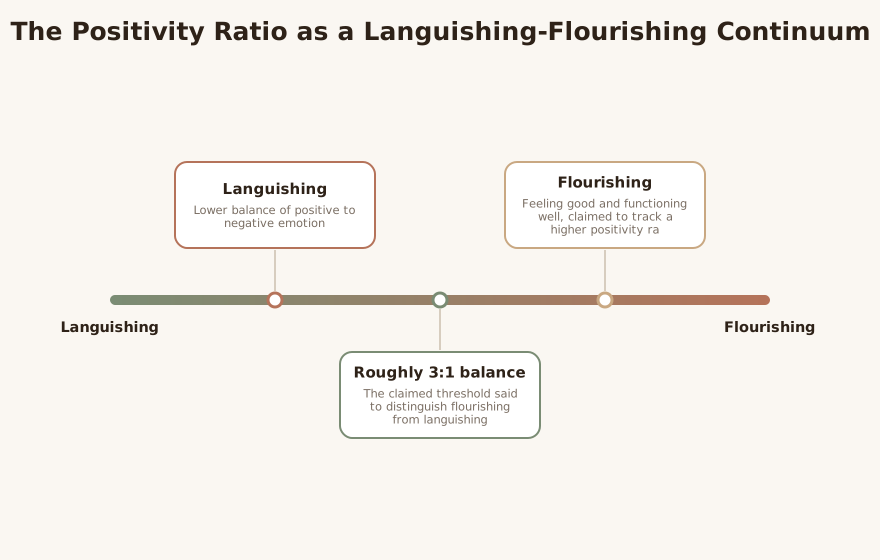
The “positivity ratio” is one of the most cited and most cautionary ideas in modern positive psychology. It is worth knowing not because it gives you a number to chase in session, but because its rise and fall is a master class in how a seductive figure can outrun its evidence. LLM
Type & Discipline
The positivity ratio is a construct within positive psychology, situated in affective science and the broaden-and-build tradition of emotion research. 1 In its original and most famous form it claimed that an individual’s degree of flourishing could be predicted by that person’s ratio of positive to negative emotions over time. 2 Fredrickson and Losada proposed not merely that the ratio mattered but that there existed a precise critical minimum value—2.9013—above which people flourish and below which they languish. 2 That precise, numeric, threshold version is the part that has been formally withdrawn; the underlying intuition that emotional balance matters is older and less controversial. 2
Creators & Lineage
The construct grew directly out of Barbara Fredrickson’s broaden-and-build theory, which holds that positive emotions broaden momentary thought-action repertoires and, over time, build durable personal resources such as resilience. 2 Fredrickson and Marcial Losada extended this in their 2005 American Psychologist paper, “Positive affect and the complex dynamics of human flourishing,” which married Fredrickson’s emotion data to Losada’s nonlinear-dynamics modeling. 2 Fredrickson then popularized “the 3-to-1 ratio” in her 2009 trade book Positivity, whose paperback subtitle promised “the 3-to-1 ratio that will change your life.” 2
The critique lineage is equally important. Nicholas Brown, a part-time graduate student in applied positive psychology, encountered the original paper as a class reading in late 2011 and immediately doubted that fluid-dynamics equations could legitimately describe emotions. 6 He enlisted the physicist Alan Sokal—known for an earlier hoax exposing lax standards in cultural studies—and the psychologist Harris Friedman. 6 Their 2013 rebuttal, published in the same journal, dismantled the mathematical edifice. 2
Core Principles
In its defensible, non-numeric form the construct rests on a few claims. First, positive and negative emotions are not simply opposite ends of one dimension; they can be tracked as a balance, and that balance has a long history of study through ratio and non-ratio indices of affect. 2 Second, drawing on broaden-and-build theory, frequent positive emotion is thought to widen attention and cognition and to accumulate into psychological resources. 2 Third, flourishing—a state combining feeling good and functioning well—was claimed to be statistically associated with higher positivity ratios. 2
The original strong version added far more: that a single critical ratio of 2.9013 (rounded to 3) functions as a universal “tipping point beyond which the full impact of positive emotions becomes unleashed.” 2 Crucially, the authors asserted this constant applied identically to individuals, couples, and groups of arbitrary size, independent of age, gender, ethnicity, education, or socioeconomic status. 2 As the critics noted, a quantity in the social sciences that is universally constant to five significant digits would be unprecedented—a claim extraordinary enough to demand extraordinary scrutiny. 2
Interventions & Techniques
The construct never specified a manualized protocol; in practice it has been operationalized through emotion self-monitoring and broaden-and-build-style positive-emotion cultivation. LLM Clinicians and coaches who adopted it typically asked clients to log positive and negative emotional experiences—often daily—and to compute or estimate a ratio over a defined window. 1 On the cultivation side, the broaden-and-build framework points toward practices that increase the frequency of genuine positive emotion: savoring, gratitude, acts of kindness, and noticing moments of interest, contentment, or connection. 2 These are reasonable, low-risk experiential exercises in their own right. LLM
The error to avoid is mechanical: setting “reach a 3:1 ratio” as the therapeutic target. LLM Because the specific number has no valid theoretical basis, treating it as a dose-to-be-hit confuses a discredited threshold for an outcome. 2 Self-monitoring of affect balance remains useful as an awareness exercise—helping a client notice patterns and the texture of their emotional life—rather than as a scoreboard. LLM
Evidence Base
This is the section that matters most, and honesty is required: the evidentiary maturity here is best described as historical and partially retracted. 4 In 2013 the modeling element of the 2005 paper was formally withdrawn as invalid, along with the model-based predictions of the specific ratios 2.9 and 11.6. 4 What the retraction notice retained was narrower: the data from two independent samples and the finding that flourishing individuals had significantly higher positivity ratios than non-flourishing ones. 4
The mathematical demolition was thorough. Brown, Sokal, and Friedman found no theoretical or empirical justification for borrowing the Lorenz equations—differential equations from fluid dynamics—to describe human emotion over time, and showed the application contained numerous fundamental conceptual and mathematical errors. 2 Their most damaging point is also the most intuitive: the parameters fed into the model were borrowed arbitrarily from a fluid-dynamics convention, so the resulting “critical ratio” is itself arbitrary. 2 Choose different (equally defensible) parameter values and the equations spit out an entirely different number—for one plausible alternative set, 4.1655 instead of 2.9013. 2 Sokal put it plainly: the equation would generate essentially the same meaningless number regardless of what the actual emotion data showed. 6 The critics concluded the claim to have demonstrated a critical minimum ratio was entirely unfounded, and urged researchers to verify that the elementary conditions for advanced mathematical tools have been met before deploying them. 2
Fredrickson’s response conceded the math. Her 2013 reply proceeded explicitly “scrubbed of Losada’s now-questioned mathematical modeling,” abandoning the precise tipping point. 3 She nonetheless maintained that ample evidence continues to support the conclusion that, within bounds, higher positivity ratios predict flourishing mental health and other beneficial outcomes. 3 Co-author Losada declined to sign the reply, and Sokal and colleagues argued no evidence whatsoever supported a critical ratio. 1
Later correlational work is consistent with the soft version but cannot rescue the threshold. A cross-sectional study of roughly 1,335 Romanian teachers found that those with higher wellbeing showed a mean positivity ratio near 2.84, with work engagement (vigor, dedication, absorption) mediating the link between affect balance and wellbeing. 7 That association is interesting, but a mean value in a flourishing subgroup is not evidence of a critical tipping point—the very claim that was retracted—so it should be read as supporting “higher positive-to-negative affect relates to better functioning,” not the number itself. LLM The broader lesson, as Friedman and Brown later argued, is that the episode carries warnings for humanistic and positive psychology about the seductiveness of precise mathematics and the costs of insufficient scrutiny. 5
Populations & Indications
The construct was developed and discussed largely in nonclinical contexts: adults, students, couples, work teams, and—through the coaching and self-help market—coaching clients. 1 The original strong claim even extended to couples and groups of arbitrary size. 2 For practicing therapists, the appropriate framing is that affect-balance self-monitoring and positive-emotion cultivation may be supportive adjuncts for relatively high-functioning clients presenting with languishing, low wellbeing, low life satisfaction, or pessimism, rather than primary treatments for acute disorder. LLM None of the source material supports the ratio as a diagnostic indicator or a standalone intervention for clinical populations. LLM
Problems-for-Work
Within those limits, several presenting problems map onto the defensible kernel of the idea. LLM
- Languishing and low wellbeing. A client who is not symptomatic enough for a diagnosis but reports feeling “flat” or “empty” may benefit from structured attention to positive-emotion frequency, consistent with the flourishing-versus-languishing distinction the retained data spoke to. 4
- Negative affect and emotional imbalance. Self-monitoring can surface a habitual skew toward threat-focused appraisal, opening a conversation about where positive experiences are being missed or discounted. LLM
- Pessimism and low resilience. The broaden-and-build rationale suggests that building positive-emotion repertoires may, over time, contribute to resource-building such as resilience—offered as a hypothesis to test with the client, not a guarantee. 2
- Relationship dissatisfaction. Couples were among the populations the original claim addressed; tracking the balance of warm versus critical exchanges can be a useful awareness exercise, decoupled from any magic ratio. 2
LLM-generated illustrative example (not a guideline): A 34-year-old client describes months of going through the motions—competent at work, but joyless. Rather than chasing “3 positives for every negative,” the clinician frames a two-week experiment: each evening the client notes one moment of genuine interest, contentment, or connection, and one moment of distress, simply observing the texture and frequency of each. The conversation centers on what the noticing reveals, not on a score. LLM
Contraindications, Cautions & Cultural Humility
The first caution is intellectual: do not present the 3:1 (or 2.9013) figure to clients as an established scientific constant—it was formally withdrawn as invalid. 4 Doing so risks importing a discredited claim into the therapeutic relationship under a veneer of false precision, which is exactly the “wishful thinking” the critique named. 2
The second caution is clinical. Pressuring clients to manufacture positive emotion or to “outweigh” the negative can shade into invalidation and toxic positivity, particularly for those processing grief, trauma, or oppression-related distress; negative emotions carry information and are not contaminants to be diluted to a ratio. LLM Friedman and Brown’s reflection underscores the field’s vulnerability to scientism—dressing value-laden claims about the good life in borrowed mathematical authority—which warrants humility about whose definition of “flourishing” is being applied. 5
The third caution concerns generalizability and culture. The original claim asserted invariance across demographic and cultural lines, a sweeping assumption the critics flagged as implausible. 2 Supporting correlational work is geographically narrow—the mediation study was a single Romanian teacher sample—so any application should attend to whether a client’s cultural context, life circumstances, and emotional norms make an “affect-balance” framing fitting or alienating. 7
Treatment-Plan Suggestions & SMART Objectives
The objectives below operationalize the defensible kernel—awareness of affect balance and cultivation of positive emotion—explicitly without setting any numeric ratio as the target. LLM
| Goal | SMART objective (example) | Mechanism |
|---|---|---|
| Build affect-balance awareness | For 2 weeks, client logs one positive and one distressing moment daily and reviews patterns in session, completing at least 10 of 14 entries | Self-monitoring increases metacognitive awareness of emotional patterning 4 |
| Increase frequency of positive emotion | Client practices one savoring or gratitude exercise on 4 days per week for 4 weeks and rates engagement (0-10) | Broaden-and-build: positive emotion broadens cognition and helps build resources 2 |
| Reduce languishing | Within 6 weeks, client identifies and re-engages two previously meaningful activities and reports on functioning, not on a ratio | Behavioral re-engagement targets the “functioning well” facet of flourishing 4 |
| Reframe negative affect as informative | In 3 sessions, client articulates the signal or need behind a recurring negative emotion rather than trying to suppress it | Counters toxic-positivity risk; treats affect as data LLM |
| Strengthen resilience repertoire | Over 8 weeks, client builds a written menu of 5 reliable positive-emotion sources and uses it during stressors, reviewing weekly | Hypothesized resource-building pathway from broaden-and-build 2 |
| Improve relational warmth (couples) | For 3 weeks, partners each initiate one appreciative exchange daily and discuss the felt effect, independent of any tally | Shifts attention to warm exchanges without a prescribed ratio 2 |
| Calibrate expectations | Client can state, in their own words, that “3-to-1” is not a validated rule, by end of psychoeducation session | Prevents false-precision beliefs and pseudoscience uptake 2 |
Common Misconceptions
“There is a scientifically proven 3:1 ratio for happiness.” No. The precise critical ratio (2.9013, popularized as 3:1) was derived from a misapplied fluid-dynamics model and formally withdrawn as invalid. 4 The number changes entirely if you pick different model parameters, which means it never described anything real. 2
“The whole positivity-ratio idea was debunked, so emotion balance is meaningless.” Also no. What was retracted was the mathematical model and its specific thresholds; the retained finding—that flourishing individuals tended to report higher positive-to-negative affect ratios—survived, in correlational form. 4
“Fredrickson recanted everything.” She conceded Losada’s mathematics were questionable and dropped the tipping point, but she continued to defend, on separate empirical grounds, that within bounds higher positivity ratios relate to flourishing. 3
“This was an obscure technical dispute.” The original paper had been cited hundreds of times and reached a mass audience before anyone publicly challenged it for roughly eight years—a striking gap that the critique itself highlighted. 6
Training & Certification
There is no certification in the positivity ratio, and none is warranted, given that its signature claim has been withdrawn. 4 The relevant competencies are upstream: training in positive-psychology interventions, in the broaden-and-build framework, and—just as importantly—in critically appraising the evidence behind any “evidence-based” number before bringing it into clinical work. 5 Clinicians using affect-monitoring or positive-emotion exercises should ground that work in their existing modality training (for example, behavioral activation or CBT) rather than in this construct as a standalone method. LLM
Key Terms
Positivity ratio. The proposed ratio of positive to negative emotions over time, claimed to predict flourishing. 2
Critical positivity ratio. The specific withdrawn claim of a universal threshold (2.9013) separating flourishing from languishing. 2
Broaden-and-build theory. Fredrickson’s theory that positive emotions broaden thought-action repertoires and build lasting personal resources. 2
Flourishing vs. languishing. A contrast between feeling good and functioning well versus a state of emptiness and stagnation; the original paper linked these states to higher and lower ratios respectively. 2
Lorenz equations. Differential equations from fluid dynamics whose unjustified borrowing supplied the discredited mathematical “derivation” of the critical ratio. 2
Work engagement. Vigor, dedication, and absorption at work; in a teacher sample it mediated the affect-balance-to-wellbeing link. 7
Resources & Further Reading
▶ Watch — a video introduction to this concept:
- Critical positivity ratio — Wikipedia
- Brown, Sokal & Friedman (2013), The complex dynamics of wishful thinking (arXiv)
- Fredrickson (2013), Updated thinking on positivity ratios (PubMed)
- Fredrickson-Losada ‘positivity ratio’ paper partially withdrawn — Retraction Watch
- Friedman & Brown (2018), Implications of debunking the critical positivity ratio for humanistic psychology
- Ratio for a good life exposed as ‘nonsense’ — Science News
- Positivity ratio and well-being among teachers: the mediating role of work engagement (PubMed)
Reflective / Supervision Questions
- When have I cited a precise figure to a client or in a note because it sounded authoritative, without checking whether the underlying evidence supports that precision? LLM
- How do I distinguish, in my own practice, between cultivating positive emotion and invalidating a client’s legitimate distress? LLM
- If a client arrives believing in the “3-to-1 rule,” how do I correct the misconception without undermining their motivation to pursue wellbeing? LLM
- What is my threshold of evidence for adopting a new construct or technique, and does it differ for ideas that confirm what I already hope is true? LLM
- Whose definition of “flourishing” am I importing when I use an affect-balance frame, and does it fit this client’s cultural and life context? 5