
Type & Discipline
The British Independent or “Middle Group” tradition is a theory and clinical sensibility within psychoanalysis, not a manualized treatment protocol. LLM It sits inside the broader family of object relations theory, which reoriented psychoanalysis away from Freud’s drive economics toward the internalized relationships a person forms with primary caregivers. 5 Discipline-wise it belongs to clinical psychology and psychiatry as practiced in psychodynamic and psychoanalytic psychotherapy. LLM For the practicing therapist, its value is less a set of techniques than a lens: a way of hearing how early relational experience is reproduced in the consulting room and in the patient’s present-day relationships. LLM
The label “Middle Group” is historically literal. LLM Following the wartime “Controversial Discussions” that split the British Psychoanalytical Society, the Independents positioned themselves as a buffer zone between the followers of Melanie Klein and those of Anna Freud, declining to swear allegiance to either camp. 7 That non-partisan stance produced a deliberately pragmatic, even “anti-theoretical” attitude: ideas were to be judged “for their use and truth value—no matter from whence they come.” 7 Clinicians should therefore expect a tradition that is eclectic by design rather than doctrinally tight. LLM
Creators & Lineage
The original Independents included Sylvia Payne, Marjorie Brierley, Ronald Fairbairn, and Ella Freeman Sharpe; Donald Winnicott and Paula Heimann later joined after moving away from Kleinian circles, and refugees such as Michael Balint and Michael Foulkes became influential members. 7 Winnicott emerged as the most prominent figure, though he consistently denied being the group’s formal leader. 7
Three figures anchor the contemporary clinical relevance of the tradition. Ronald Fairbairn (1889–1964) is often called the “father” of object relations theory, developing a relational/structural model in which the human drive for relationship is central to psychic development. 5 Donald Winnicott (1896–1971) contributed the concepts of the true and false self, holding, transitional objects, and the “good enough mother,” all emphasizing the maternal environment’s role in healthy development. 5 Michael Balint extended the work toward primary love and the regressed patient, and his name is grouped with Winnicott, Fairbairn, and Harry Guntrip in John Sutherland’s canonical survey of the British object relations theorists. 1 Sutherland himself, as both a clinician and the tradition’s historian, is a useful bridge for clinicians wanting an organized overview. 1
The tradition descends from Freudian psychoanalysis but breaks decisively from it, and it runs alongside Klein’s developmental framework while rejecting her emphasis on innate destructiveness. 5 Its developmental, environment-centered emphasis later fed into attachment theory and self psychology, both of which foreground relational needs and caregiver responsiveness over innate drives. 5
Core Principles
The foundational claim is motivational. LLM The Independents argued that “the primary motivation of the child is object-seeking rather than drive gratification”—the infant seeks a relationship, not merely the discharge of tension. 7 Fairbairn radicalized this: libido is not pleasure-seeking but object-seeking, so even pleasure is a signposting toward the object rather than the aim itself. 4 This reframes symptoms as ways of maintaining or repairing ties to internalized objects, not as failures to discharge instinct. LLM
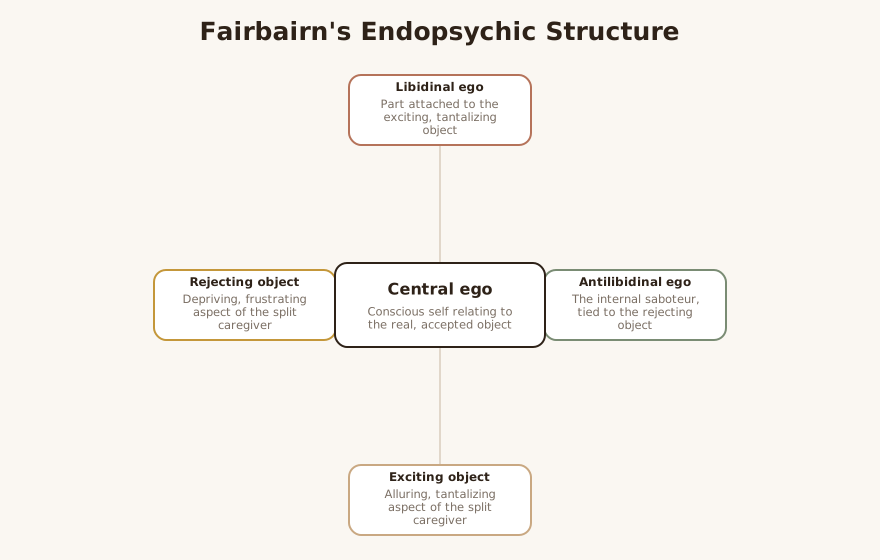
Fairbairn’s endopsychic structure models the inner world as a set of split-off ego-and-object relationships. 2 When the real caregiver is both needed and frustrating, the child internalizes and splits the object into an exciting (alluring, tantalizing) object and a rejecting (depriving) object, with corresponding parts of the ego—the libidinal ego attached to the exciting object and the antilibidinal ego (the “internal saboteur”) attached to the rejecting object—remaining repressed beneath a central ego. 2 The “moral defense” describes how a child will experience the self as bad in order to preserve the caregiver as good, since a bad self in a good world is more bearable than a good self in a bad one. LLM
Winnicott’s principles concern the holding environment. LLM The true self is rooted in “spontaneous authentic experience and a feeling of being alive,” emerging from the infant’s instinctual gestures—what he called “simply being.” 6 The false self develops as a defensive facade when spontaneity is suppressed because the caregiver cannot meet the infant’s spontaneous gesture; “other people’s expectations can become of overriding importance, overlaying or contradicting the original sense of self.” 6 Crucially, the false self is protective, not merely pathological—it shields “the hidden true self” from annihilating exploitation. 6 The transitional object and transitional phenomena name the infant’s “first not-me possession,” an intermediate area of experience between inner and outer reality. 3
Interventions & Techniques
This tradition is theory-rich and technique-light; its “interventions” are stances more than procedures. LLM The central technical commitment is to provide a reliable, non-impinging therapeutic environment—an analytic analogue of Winnicott’s holding—within which the patient’s true self can risk emerging. 6 The therapist’s countertransference is treated as data rather than contamination; the Independents were “strongly associated with the concept of countertransference,” using the analyst’s emotional reactions to understand the patient’s internal object world. 7
In practice this means attending closely to enactments of split-off object relations: the patient who recruits the therapist into the role of the exciting object (promising closeness, then withholding) or the rejecting object (frustrating, depriving) is showing the endopsychic structure in vivo. 2 Naming and metabolizing these role-pulls, rather than gratifying or retaliating, is the working method. LLM The therapist also tolerates and protects the patient’s use of transitional space—play, metaphor, the “as-if” quality of the therapy relationship—as the medium in which authentic experience is recovered. 3
LLM-generated illustrative example (not a guideline): A patient repeatedly arrives effusive and idealizing, then cancels the following session. Rather than interpreting resistance, an Independent-informed therapist might track the oscillation between an exciting and a rejecting object, hold steady through both, and eventually wonder aloud whether closeness feels dangerous because it has historically been followed by withdrawal. LLM
Evidence Base
Honesty about maturity is essential here. LLM The tradition is established in the sense that it is historically central, widely taught, and has shaped attachment theory and self psychology, but it is established as a body of clinical theory rather than as an empirically validated treatment package. 5 Its foundational literature is conceptual and case-based—Fairbairn’s 1944 paper on endopsychic structure and Winnicott’s 1953 paper on transitional phenomena are theoretical works, not trials. 23 Sutherland’s survey consolidates the theorists but is itself a scholarly review rather than an outcome study. 1
There is no randomized controlled trial literature for “British Independent object relations” as a discrete modality, and clinicians should not represent it as an evidence-based treatment in the same sense as, for example, manualized CBT. LLM Its empirical credibility today rests largely on the downstream traditions it informed—attachment research and self psychology—which carry their own evidence bases for relational and developmental claims. 5 When documenting or describing this work to payers or patients, frame it as the theoretical scaffolding underneath an evidence-supported psychodynamic psychotherapy rather than as a standalone validated therapy. LLM
Populations & Indications
The framework is most often applied with adults in open-ended or longer-term psychotherapy. LLM It is especially resonant for patients whose difficulties are characterological and relational rather than narrowly symptomatic—people with personality disorders, identity disturbance, and attachment difficulties, whose presentations map naturally onto split internal object relations. 2 Because the maternal-environment model centers early relational deficit, it offers a coherent way of understanding people with early relational trauma and complex trauma, for whom the false-self adaptation and the schizoid retreat are common. 6
Patients reporting chronic emptiness, depersonalization, or a sense of going through the motions are well described by Winnicott’s account of the false self leaving a person “feeling dead and empty behind an inconsistent and incompetent appearance.” 6 Those with narcissistic vulnerability and low self-esteem can be understood through the moral defense and through compliance-based self-organization. LLM The model also speaks to people in repetitive interpersonal conflict, where the same exciting/rejecting object pattern is re-enacted across relationships. 2
Problems-for-Work
- Identity disturbance and chronic emptiness. The true/false self distinction gives a developmental account of the patient who does not know “who they really are.” Work targets recovering spontaneous, authentic experience rather than reinforcing the compliant facade. 6
- Attachment difficulties and complex trauma. The maternal-environment focus frames insecure or disorganized relating as an adaptation to a caregiving environment that was not “good enough,” linking directly to the attachment tradition the Independents helped seed. 5
- Personality disorders and interpersonal conflict. Fairbairn’s split exciting/rejecting objects explain the push-pull, idealize-devalue patterns clinicians see, and the therapy relationship becomes the site where these are observed and revised. 2
- Depersonalization and the schizoid retreat. Detachment and feeling unreal are read as withdrawal of the libidinal ego from an object world experienced as unsafe, guiding the therapist to titrate closeness rather than force engagement. LLM
LLM-generated illustrative example (not a guideline): A client with longstanding low self-esteem describes being “the good one” in the family who never made demands. An Independent-informed formulation might frame this as a moral defense—taking on badness to keep caregivers good—and a false-self adaptation, with treatment slowly licensing the client’s own needs and protest. LLM
Contraindications, Cautions & Cultural Humility
The chief caution is dose and stability. LLM An uncovering, regression-tolerant approach that invites the true self to emerge can destabilize patients who lack containment, are in acute crisis, or have limited external support; for such patients, structure and stabilization should precede depth work. LLM The tradition’s comfort with regression—particularly in Balint’s and Winnicott’s work with deeply regressed patients—requires a frame, supervision, and clinician experience that not every setting can provide. 1
Cultural humility is non-trivial here. LLM The “good enough mother” and “maternal environment” language encodes mid-twentieth-century, Western, mother-centric assumptions about caregiving that do not map onto kinship structures, communal child-rearing, or paternal and extended-family caregiving in many cultures. 5 Clinicians should translate “maternal environment” into the patient’s actual caregiving ecology rather than imposing a normative maternal ideal, and should be alert that a behavior read as “false self compliance” in one cultural frame may be adaptive, valued interdependence in another. LLM The model’s developmental determinism can also slide into mother-blame; responsible use holds environmental influence without reducing a person’s whole psychology to a single caregiver’s failures. 6
Treatment-Plan Suggestions & SMART Objectives
| Goal | SMART objective (example) | Mechanism |
|---|---|---|
| Reduce false-self compliance | Within 12 sessions, client will identify and name three situations per week where they suppressed a genuine preference, in session log | Surfacing true-self experience by noticing compliance 6 |
| Increase relational security | Over 16 weeks, client will tolerate two interpersonal disagreements without withdrawing, reported and reviewed in session | Revising internalized rejecting-object expectations 2 |
| Decrease depersonalization/emptiness | Within 8 weeks, client will report at least one daily moment of feeling “real” or present, tracked on a simple scale | Recovering spontaneous, authentic experience 6 |
| Interrupt idealize–devalue cycles | Over 12 sessions, client will recognize the exciting/rejecting pattern in one current relationship and articulate it aloud | Making split object relations conscious 2 |
| Build reflective capacity about needs | Within 10 sessions, client will distinguish their own needs from others’ expectations in three logged examples | Loosening the moral defense LLM |
| Strengthen use of transitional/symbolic space | Across treatment, client will engage in one creative or playful activity weekly and reflect on it in session | Using transitional space to bridge inner and outer reality 3 |
| Reduce schizoid withdrawal | Over 16 weeks, client will initiate one socially connecting action per week and review the felt experience | Titrating contact with the object world LLM |
Common Misconceptions
- “It is the same as Kleinian analysis.” The Independents explicitly positioned themselves between Klein and Anna Freud and rejected strict allegiance to either, prizing usefulness over doctrine. 7
- “Object relations means relationships in the ordinary sense.” “Objects” are internalized representations of others and the self’s relations to them, not literal social relationships—Fairbairn’s endopsychic structure is about internal object relations. 2
- “Libido seeks pleasure.” In this tradition libido is object-seeking; pleasure is a route to the object, not the aim. 4
- “The false self is purely pathological.” Winnicott regarded the false self as protectively vital, shielding the true self from exploitation; the goal is not to demolish it but to reduce reliance on it. 6
- “The transitional object is just a security blanket.” It names a whole intermediate area of experience—the first not-me possession—foundational to play, symbolization, and culture. 3
- “The ‘good enough mother’ means perfect parenting.” It explicitly means adequate, not perfect, responsiveness. 6
Training & Certification
There is no certification in “British Independent object relations” as such; competence is acquired through formal psychodynamic or psychoanalytic training and supervised clinical experience. LLM In the United Kingdom the Independent tradition lives within the British Psychoanalytical Society and its institute, which maintains the lineage of figures such as Fairbairn. 4 In the United States and elsewhere, object relations is taught through psychoanalytic institutes and dedicated centers, such as the Center for Object Relations, which curate this history for clinicians. 5
For most practicing therapists, the realistic path is to read the primary literature, integrate the concepts into existing psychodynamic practice, and—given the tradition’s emphasis on countertransference and regression—work under experienced supervision when applying it to more disturbed or regressed patients. 1 Sutherland’s survey is a reasonable orienting text before deeper reading in Fairbairn and Winnicott. 1
Key Terms
- Object-seeking libido — The principle that the person primarily seeks relationship, not drive discharge. 7
- Endopsychic structure — Fairbairn’s model of the inner world as split ego-and-object units: central ego, libidinal ego/exciting object, antilibidinal ego (internal saboteur)/rejecting object. 2
- Moral defense — Experiencing the self as bad to keep the caregiver good. LLM
- True self — The locus of spontaneous, authentic, alive experience. 6
- False self — A compliant defensive facade built around others’ expectations. 6
- Good enough mother — A caregiver who is adequately, not perfectly, responsive. 6
- Holding (environment) — Reliable, non-impinging care; in therapy, a steady relational frame. LLM
- Transitional object / transitional phenomena — The first not-me possession and the intermediate area of experience between inner and outer reality. 3
- Schizoid retreat — Withdrawal from an object world experienced as unsafe. LLM
- Countertransference (as instrument) — The therapist’s reactions used as data about the patient’s internal objects. 7
Resources & Further Reading
▶ Watch — a video introduction to this concept:
- Sutherland JD. The British object relations theorists: Balint, Winnicott, Fairbairn, Guntrip (J. Am. Psychoanal. Assoc., 1980)
- Fairbairn WRD (1944). Endopsychic Structure Considered in Terms of Object-Relationships
- Winnicott DW (1953). Transitional Objects and Transitional Phenomena
- Ronald Fairbairn — British Psychoanalytical Society
- A Brief History on British Object Relations — Center for Object Relations
- True self and false self — Wikipedia
- British Independent Group (psychoanalysis) — Wikipedia
Reflective / Supervision Questions
- When this patient pulls me toward being an exciting or a rejecting object, how am I responding, and what does my countertransference reveal about their internal world? 7
- Where in this person’s presentation is a false self protecting something, and would dismantling it prematurely leave the true self exposed? 6
- Have I translated “maternal environment” into this patient’s actual caregiving ecology, or am I importing a normative maternal ideal? LLM
- Is this patient stable and supported enough for uncovering, regression-tolerant work, or does the frame need more structure first? LLM
- Am I using object-relations theory as a flexible formulation, in the Independents’ pragmatic spirit, or am I forcing the patient into the model? 7
- What is my own relationship to this patient’s needs and protest, and how might it be shaping the holding I can offer? LLM