
Type & Discipline
Self psychology is a theory of personality development, psychopathology, and treatment that sits within the broader tradition of post-Freudian psychoanalysis 7. It is best understood as a clinical psychology and psychoanalytic framework rather than a single manualized protocol, and its concepts are most often delivered through psychodynamic and psychoanalytic psychotherapy 5. Its defining move is to relocate the center of mental life from instinctual drives and intrapsychic conflict to the development and cohesion of “the self” as a supraordinate psychological structure 7. In that sense self psychology belongs to the same family of relationally oriented psychoanalytic theories as object relations theory, while remaining historically and conceptually distinct from each of them 5.
For practicing therapists, the most useful framing is that self psychology offers a lens: a way of listening to how a patient uses relationships—including the relationship with you—to maintain a coherent, vital, and worthwhile sense of self LLM. That lens reorganizes case formulation around self-cohesion and unmet developmental needs rather than around symptoms or defended-against wishes LLM.
Creators & Lineage
Self psychology was originated by Heinz Kohut, an Austrian-born American psychoanalyst working in Chicago, beginning with his 1971 book The Analysis of the Self and culminating in his posthumously published How Does Analysis Cure? in 1984 21. Kohut trained as a classical Freudian analyst and was a leading figure in American psychoanalysis before his clinical work with narcissistic patients led him to revise core analytic assumptions 7. The Analysis of the Self introduced his systematic approach to the treatment of narcissistic personality disorders, and the later work consolidated his mature views on empathy as the cure-carrying element of analysis 21.
Lineage-wise, self psychology grew out of and departed from classical Freudian psychoanalysis, sharing intellectual territory with object relations theory and later feeding directly into intersubjective and relational psychoanalysis 57. Contemporary empirical work has also positioned Kohut’s “selfobject” needs in dialogue with attachment theory, treating selfobject functioning and attachment security as overlapping but separable constructs 4. The tradition is institutionally carried today by the International Association for Psychoanalytic Self Psychology (IAPSP), which maintains a teaching canon for clinicians entering the field 3.
Core Principles
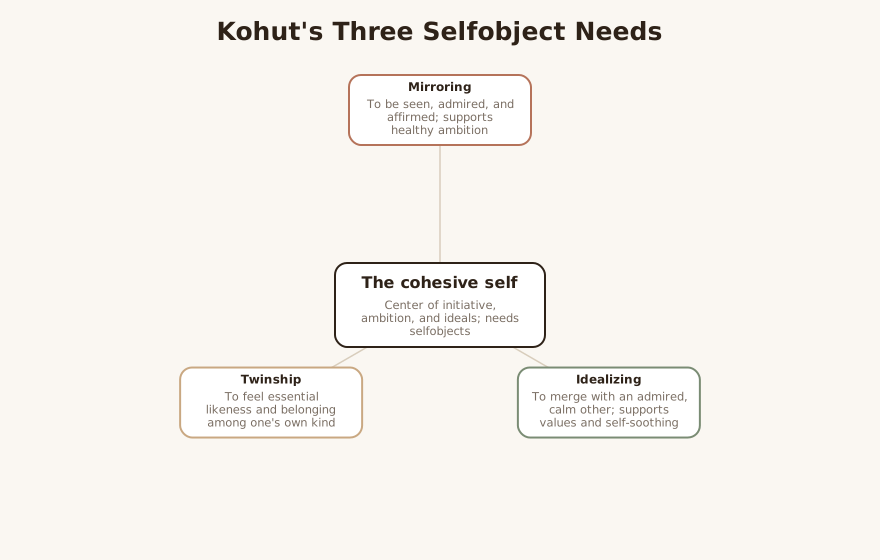
The organizing construct is the self: the center of initiative, ambition, and ideals that, when healthy, is experienced as cohesive, continuous in time, and vital 7. Kohut proposed that the self does not develop in isolation but requires responses from others who perform psychological functions the immature self cannot yet perform for itself 5. He called these others, in their function-providing role, selfobjects—not whole, separate people experienced as such, but figures experienced as part of, or in the service of, one’s own self 7.
Kohut described three principal selfobject needs 7. The first is the mirroring need: to be seen, admired, and affirmed, which supports healthy ambition and self-esteem 7. The second is the idealizing need: to merge with and draw strength from an admired, calm, competent other, which supports the formation of values and ideals and the capacity for self-soothing 7. The third is twinship (or alter-ego): the need to feel essential likeness and belonging with others, a sense of being among one’s own kind 7. Empirical operationalization of these needs has supported their distinctness and linked them to self-cohesion, affect regulation, and broader adjustment, while also tying them to attachment processes 4.
Development proceeds through inevitable, manageable failures of the selfobject environment—what Kohut called optimal frustration—which, when not traumatic, are internalized through transmuting internalization into durable self-structure and self-regulating capacities 51. Pathology, in this model, arises not primarily from forbidden drives but from chronic, traumatic failures of selfobject responsiveness that leave the self enfeebled, fragmentation-prone, or maintained only through archaic, rigid means 25. Empathy—the analyst’s sustained attempt to understand the patient’s experience from within the patient’s own perspective—is treated both as the primary mode of data-gathering and as a core curative agent 1.
Interventions & Techniques
Self psychology is delivered less through a fixed toolkit than through a consistent stance, but several recognizable techniques follow from the theory LLM. The foundational technique is sustained empathic immersion: the therapist works to grasp and articulate the patient’s inner experience from within, rather than from an external, “objective” frame 1. Kohut distinguished a first step of empathic understanding from a second step of interpretation/explanation, and held that being understood is itself therapeutic, not merely a precondition for insight 1.
A second technique is the careful tracking of selfobject transferences—mirroring, idealizing, and twinship transferences—as they emerge in the treatment relationship 2. Rather than confronting these as resistances or grandiosity to be corrected, the therapist allows them to unfold and uses them as the developmental medium through which thwarted self-needs can be reworked 2. A third technique is the empathic analysis of disruptions: when the therapist inevitably fails to attune (a missed session, a mistimed comment), repairing the rupture through non-defensive understanding becomes a primary vehicle of change via optimal frustration and transmuting internalization 15.
LLM-generated illustrative example (not a guideline): A client describes, with flat affect, that they aced a presentation but “it doesn’t really matter.” A self-psychological response is not to interpret a hidden conflict but to articulate the unmet mirroring need: “It sounds like there was no one whose genuine delight in you made the achievement feel real—so even your own success goes oddly dead.” LLM
GoodTherapy summarizes the practical thrust of these techniques as helping clients build a more cohesive, resilient sense of self through an empathic, attuned therapeutic relationship rather than through confrontation or symptom-focused technique 6. Across these methods, the therapist’s affective attunement and willingness to be used as a selfobject are the working ingredients, with verbal interpretation as a secondary refinement 16.
Evidence Base
Honest appraisal: self psychology is an established and influential theory with a deep clinical and conceptual literature, but it does not have the controlled-trial evidence base of manualized therapies such as CBT or DBT 56. Its primary “evidence” historically has been clinical—detailed case material and the cumulative judgment of analysts—rather than randomized comparison 5. This is a meaningful limitation to disclose to patients and to weigh in treatment planning LLM.
The most rigorous empirical support comes from construct-validation work rather than outcome trials. Banai, Mikulincer, and Shaver developed and validated a self-report measure of selfobject needs and found that these needs cohere as distinct dimensions and relate predictably to self-cohesion, affect regulation, attachment, and psychological adjustment 4. That line of research lends scientific credibility to Kohut’s constructs—it suggests selfobject needs are measurable and meaningfully linked to functioning—without yet establishing the efficacy of self-psychological treatment in controlled designs 4. Reference and explainer sources likewise characterize self psychology as a respected, widely taught psychoanalytic approach whose influence on relational therapy is broad, while noting the empirical literature is concentrated in theory and case study 57. Clinicians should therefore present it as a coherent, theoretically grounded approach with strong face validity and emerging construct support, not as an empirically supported treatment in the strict sense LLM.
Populations & Indications
Self psychology was developed specifically out of work with adults presenting with narcissistic personality disorder and related disturbances of self-esteem regulation, and that remains its paradigmatic indication 27. Kohut’s clinical innovation was precisely that such patients, often considered unanalyzable by classical technique, became workable when their grandiosity and idealization were understood as revivable developmental needs rather than as defenses 2.
Beyond NPD, the framework is applied to a broader range of personality disorders and to disorders of self-cohesion more generally 57. It is frequently indicated for adults with chronic low self-esteem, pervasive shame, chronic emptiness, and identity disturbance, where the central problem is a fragile or depleted self rather than a focal symptom 67. Because selfobject failures are conceptualized as relational-developmental injuries, the approach is also drawn upon with adult survivors of childhood emotional neglect and people with developmental or relational trauma, where early caregiving failed to provide adequate mirroring, idealizable strength, or belonging 54. The construct-validation work additionally supports relevance to clients struggling with affect dysregulation and interpersonal difficulties, given the demonstrated links between selfobject needs and these domains 4.
Problems-for-Work
The clearest target is the regulation of self-esteem and grandiosity in narcissistic presentations—both the overt, grandiose form and the more covert, vulnerable form—reframed as archaic mirroring and idealizing needs seeking a usable response 27. In practice, this means helping a vulnerable-narcissistic client tolerate ordinary admiration and ordinary disappointment without collapse or rage LLM.
A second problem-for-work is chronic emptiness and depletion depression: the deadened, joyless state Kohut linked to a self starved of vitalizing selfobject responsiveness 7. Here the work centers on reviving the capacity to feel enlivened by others’ genuine engagement LLM. A third is shame and self-cohesion under threat—fragmentation experiences, where criticism or rejection produces a sense of falling apart rather than a discrete bad feeling 57.
LLM-generated illustrative example (not a guideline): A client who, after a partner’s mild criticism, spirals into hours of self-loathing and somatic disorganization is formulated not as “overreacting” but as experiencing a fragmentation of the self when mirroring is withdrawn; sessions focus on naming the disintegration anxiety and using the steady therapeutic bond as a re-cohering selfobject. LLM
Affect dysregulation and interpersonal difficulties round out the typical targets, with the therapeutic relationship serving as a live laboratory for building self-regulating structure 46.
Contraindications, Cautions & Cultural Humility
The chief caution is evidence maturity: because self psychology lacks controlled outcome data, it should not be presented as a first-line, empirically supported treatment where one exists—for example, for acute conditions with strong evidence-based protocols 56. For risk-bearing presentations (active suicidality, severe affect dysregulation, psychosis), an empathic self-psychological stance can be valuable but is generally insufficient on its own and should be integrated with safety planning and evidence-based interventions LLM.
A second caution is dosage and pacing of the selfobject transference: allowing idealizing or mirroring transferences to unfold is therapeutic, but the therapist must remain attentive to boundaries, dependency, and the patient’s vulnerability to retraumatizing disruptions if attunement fails repeatedly 1LLM. The approach is also relatively unstructured and open-ended, which may not fit clients seeking brief, symptom-targeted work 6LLM.
On cultural humility: the very notion of a “healthy self,” and the kinds of mirroring or belonging a person needs, is culturally shaped, so a clinician must hold the theory’s developmental norms lightly and let the patient define what cohesion and vitality mean within their own context LLM. Twinship and belonging needs, for instance, may be organized around collective and communal identities in ways the original individualistic framing underemphasizes, and empathic attunement here requires genuine curiosity about cultural meaning rather than imposing a default model of the self LLM. The empirical observation that selfobject needs intertwine with attachment and adjustment should be read as a general human pattern whose specific content is culturally variable, not as a fixed normative template 4LLM.
Treatment-Plan Suggestions & SMART Objectives
| Goal | SMART objective (example) | Mechanism |
|---|---|---|
| Improve self-esteem regulation | Within 12 sessions, client will identify and name 3 situations where self-worth collapsed after criticism, in session, without spiraling into self-loathing | Mirroring selfobject experience; articulating unmet affirmation needs 27 |
| Reduce fragmentation/disintegration anxiety | Over 8 weeks, client will use one self-soothing strategy and rate distress before/after during 4 documented “falling-apart” episodes | Building self-regulating structure via transmuting internalization 15 |
| Decrease chronic emptiness / increase vitality | Within 90 days, client will report 2 specific experiences of feeling genuinely enlivened in a relationship, logged between sessions | Revival of vitalizing selfobject responsiveness 7 |
| Tolerate idealization and disappointment | Across treatment, client will process 3 therapeutic disruptions (e.g., missed attunement) and articulate the feeling without rupture-driven dropout | Empathic repair; optimal frustration 1 |
| Reduce shame intensity | Within 10 sessions, client will verbalize a shame experience to the therapist at the moment it arises, in 3 distinct sessions | Empathic understanding as the curative first step 17 |
| Strengthen sense of belonging (twinship) | Over 12 weeks, client will identify and engage 2 settings where they feel “among their own kind,” tracking affect | Twinship/alter-ego selfobject function 74 |
| Improve affect regulation | Within 8 weeks, client will name the precipitant and bodily signal of 4 dysregulation episodes before acting on them | Linking selfobject needs to affect-regulation capacity 4 |
Common Misconceptions
A frequent misconception is that self psychology “indulges” or flatters narcissistic patients by going along with their grandiosity LLM. In fact Kohut’s claim is more precise: grandiosity and idealization are treated as revivable developmental needs to be understood and worked through, not gratified for their own sake, with growth occurring through manageable, non-traumatic frustration of those needs 21. A second misconception is that “selfobject” means another person; the term denotes the function an other serves for the self, so the same person can be a selfobject in one moment and experienced as separate in another 7.
A third is that empathy in this model is simply warmth or being nice 1. For Kohut, empathy is a rigorous mode of observation—vicarious introspection into the patient’s experience—and a structural agent of cure, not a bedside manner 1. Finally, some assume self psychology rejects all of psychoanalysis; rather, it is a revision from within the tradition that retains depth, transference, and developmental thinking while shifting the explanatory center from drive conflict to self-cohesion 75.
Training & Certification
There is no single licensure or certificate required to use self-psychological thinking; it is incorporated into psychodynamic training and graduate clinical education as a body of theory 5LLM. Foundational study typically begins with Kohut’s own works—The Analysis of the Self and How Does Analysis Cure?—which remain the primary texts 21.
For structured, advanced training, the International Association for Psychoanalytic Self Psychology (IAPSP) is the field’s principal professional home and maintains an early-career canon and educational resources for clinicians entering the approach 3. Deeper formation generally occurs through psychoanalytic institutes and supervised clinical work where selfobject transferences can be tracked over time 3LLM. Clinicians should pursue self-psychological supervision specifically, because the approach’s core skill—sustained empathic immersion and the handling of selfobject transferences and disruptions—is learned experientially rather than from reading alone 1LLM.
Key Terms
- Self — the supraordinate psychological structure experienced, when healthy, as cohesive, continuous, and vital; the center of ambitions and ideals 7.
- Selfobject — an other (or function of an other) experienced as part of or in service to one’s own self, providing functions the self cannot yet supply alone 7.
- Mirroring — the selfobject need to be seen and affirmed, supporting healthy ambition and self-esteem 7.
- Idealizing — the need to merge with and draw calm and strength from an admired other, supporting ideals and self-soothing 7.
- Twinship / alter-ego — the need for essential likeness and belonging, a sense of being among one’s own kind 7.
- Empathy (vicarious introspection) — understanding the patient from within their own experience; both the method of observation and a curative agent 1.
- Optimal frustration — non-traumatic, manageable failures of the selfobject environment that drive growth 51.
- Transmuting internalization — the process by which selfobject functions, repeatedly and tolerably “failed,” are converted into the patient’s own self-structure 51.
- Selfobject transference — the revival in treatment of mirroring, idealizing, or twinship needs toward the therapist 2.
- Fragmentation — the breakdown of self-cohesion under threat, experienced as falling apart rather than as a discrete emotion 7.
Resources & Further Reading
▶ Watch — a video introduction to this concept:
- Kohut, H. (1984). How Does Analysis Cure? University of Chicago Press
- Kohut, H. (1971). The Analysis of the Self
- International Association for Psychoanalytic Self Psychology (IAPSP) — Self Psychology Canon for Early-Career Professionals
- Banai, Mikulincer & Shaver (2005) — selfobject needs, attachment, and self-cohesion (PubMed)
- Self psychology — EBSCO Research Starters
- Self Psychology: Benefits, Techniques & How It Works — GoodTherapy
- Self psychology — Wikipedia
Reflective / Supervision Questions
- When this patient describes a relationship, can I hear which selfobject function (mirroring, idealizing, twinship) is being sought or has gone missing—and how does that reshape my formulation? LLM
- Where in the treatment am I being used as a selfobject, and am I able to let that transference unfold without prematurely interpreting or correcting it? 2LLM
- When I inevitably mis-attune, how do I metabolize my own defensiveness so the disruption can become repair rather than rupture? 1LLM
- Am I distinguishing genuine empathic understanding from simply being agreeable—and can I name the difference in my last session? 1LLM
- How do this client’s cultural and communal contexts define a “cohesive, vital self,” and where might Kohut’s individualistic norms be quietly imposing a different ideal? LLM
- Given the limited controlled-trial evidence, how am I integrating this lens with evidence-based interventions for any acute or risk-bearing elements of the case? 56LLM