
Habitus is one of the most clinically useful imports sociology offers a therapist, and one of the most easily misread. It is Pierre Bourdieu’s name for the durable, largely unconscious set of dispositions — tastes, bodily postures, expectations, ways of perceiving and judging — that a person internalizes from their position in social space and that then generates their practice, often beneath the level of deliberate thought 5. For a clinician, the payoff is a reframe: much of what a client experiences as a private flaw — feeling like a fraud, feeling fundamentally out of place, never quite belonging — is better understood as a mismatch between an embodied history and a present social field 3. This article orients practicing therapists to the construct, its evidence status, and how to put it to work inside the modalities you already practice LLM.
Type & Discipline
Habitus is a theoretical construct, not a treatment, a manualized protocol, or a school of therapy LLM. Its home discipline is sociology, specifically the critical and structural tradition that reads individual action as shaped by — and reproducing — broader social structures 5. Bourdieu developed habitus as the central pivot of his “theory of practice,” an attempt to dissolve the old opposition between objectivism (structures determine everything) and subjectivism (free individual choice explains everything) by locating the generative principle of action in the body and dispositions of socialized agents 1. The construct therefore sits at the junction of social structure and individual psychology, which is exactly why it travels usefully into clinical formulation 3. Because it is a lens rather than a modality, habitus does not tell you which technique to deploy; it shapes how you understand the origin and meaning of a client’s distress before any technique is chosen LLM.
Creators & Lineage
The construct is overwhelmingly associated with Pierre Bourdieu, the French sociologist and anthropologist who elaborated it most fully in Outline of a Theory of Practice (1977) and across his later work 1. Bourdieu did not coin the word — “habitus” has a long history in philosophy reaching back through Aristotle’s hexis and its later Latin rendering, and the term was used by earlier thinkers including Marcel Mauss on “techniques of the body” — but he gave it the systematic, generative meaning now standard in the social sciences 5. His early fieldwork among the Kabyle of Algeria grounded the concept empirically, showing how the rhythms of agricultural life, kinship, and ritual were inscribed in bodily dispositions rather than consciously calculated 1.
Within Bourdieu’s own system, habitus is inseparable from two companion concepts that clinicians will encounter alongside it: field (the structured social arena, with its own stakes and rules, in which dispositions play out) and capital (economic, cultural, social, and symbolic resources whose distribution defines positions in a field) 5. Practice, in Bourdieu’s famous shorthand, is the product of the relationship between habitus, capital, and field 5. The lineage also runs forward into the notions of cleft habitus and hysteresis — what happens when dispositions formed in one world meet a different one — and the related idea of symbolic violence, the soft, internalized imposition of dominant categories that makes hierarchy feel natural to the dominated 5. More recent scholarship has pushed the concept in a dialogical direction, arguing that habitus is not a sealed monologue but is formed and revised through internal dialogue and relationship with others 4.
Core Principles
Several interlocking principles define habitus, and each has a clinical edge LLM.
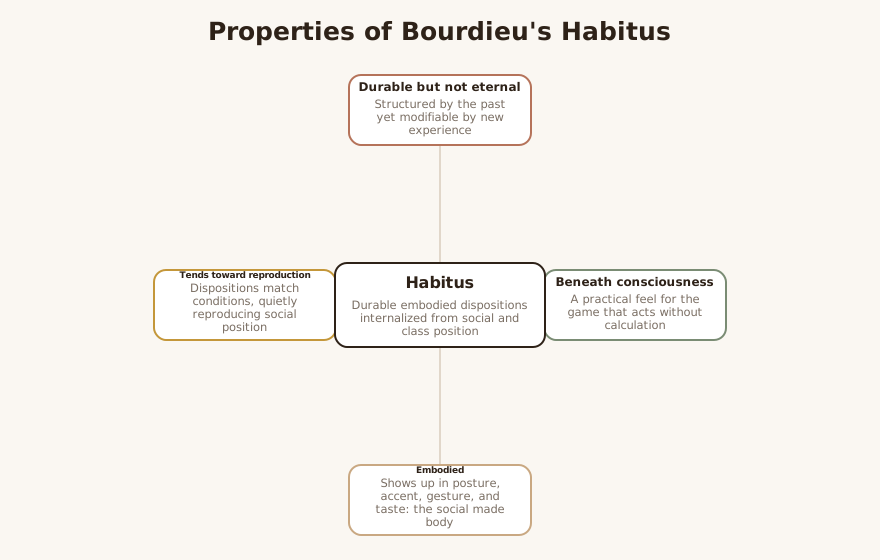
First, dispositions are durable but not eternal. Habitus is laid down primarily through early socialization in the family and reinforced through schooling, and it tends to persist; but it is “structured” by past conditions and “structuring” of present and future ones, meaning it can be modified by new experience even as it resists wholesale change 5. Second, habitus operates beneath consciousness. It is a “feel for the game” — a practical sense that lets people act appropriately in familiar settings without calculating, which is why Bourdieu describes practice as generated by dispositions rather than by rational deliberation 1. Third, habitus is embodied. It shows up in posture, accent, gesture, taste, and comfort or discomfort in a room — what Bourdieu treats as history turned into nature, or the “social made body” 1. Fourth, habitus tends toward reproduction. Because dispositions are matched to the conditions that produced them, people typically gravitate toward situations in which their habitus fits, quietly reproducing their social position and making inequality feel like personal preference or natural order 3. Fifth, and crucially for therapists, the construct refuses both “it’s all structure” and “it’s all individual choice.” Habitus is the mechanism by which objective social conditions become subjective dispositions, so distress can be simultaneously socially produced and genuinely, personally felt 1.
Interventions & Techniques
Habitus is a construct, so it has no techniques of its own; what it offers is a set of formulation moves that can be layered onto established modalities LLM. The first move is socio-genetic reframing — helping a client trace a felt deficit back to the conditions that formed it, so that “I don’t belong here” becomes “my dispositions were formed in a different field than the one I’m now in” 3. This externalizes without dismissing, because the dispositions are real and embodied even though their origin is social LLM.
A second move is naming the field mismatch (hysteresis): making explicit that the discomfort is produced by a gap between an embodied history and a new social arena — the working-class student in an elite university, the immigrant in a new national culture — rather than by personal inadequacy 5. A third is rendering symbolic violence visible: helping a client notice when they have internalized the dominant group’s standards as neutral “good taste” or “the right way,” and are judging themselves by criteria that quietly disadvantage them 5. A fourth, drawing on the dialogical reading of habitus, is using the therapeutic relationship itself as a site of revision — since habitus is partly formed and reformed through dialogue, the relationship offers a setting in which dispositions can be examined and slowly reworked 4.
LLM-generated illustrative example (not a guideline): A first-generation professional describes freezing in leadership meetings and “knowing” she will be exposed as not belonging. Rather than treating this only as a cognitive distortion, the clinician maps it as a habitus formed in a household where deferring to authority was adaptive, now meeting a corporate field that rewards assertive self-promotion; the work then targets both the embodied anxiety response and the meaning the client has assigned to the mismatch LLM.
Evidence Base
Honesty about evidence requires a clear distinction here LLM. As a sociological construct, habitus is firmly established: it is one of the most cited concepts in contemporary social science, central to Bourdieu’s influential body of work, and embedded across sociology, education, anthropology, and cultural studies 3. Its standing rests on theoretical elaboration and a large tradition of qualitative and ethnographic application rather than on experimental trials, which is the appropriate evidentiary mode for a social theory 1. The construct has also drawn substantive critique within its own field — most persistently the charge that it tilts toward determinism and struggles to explain how change and agency arise — and contemporary scholars have responded by reworking it, for instance toward a more dialogical, reflexive, and changeable account of how dispositions are formed and revised 4.
What habitus is not is a validated clinical intervention with outcome data LLM. There is no body of randomized controlled trials showing that “habitus-informed therapy” reduces symptoms, because habitus is a way of understanding a client’s situation, not a treatment to be tested LLM. The honest clinical claim is therefore modest and structural: habitus is an established, well-developed conceptual tool that improves the accuracy and cultural fit of formulation for class- and culture-rooted distress, to be used within evidence-based modalities rather than in place of them 3.
Populations & Indications
Habitus is most illuminating wherever a client’s embodied social history sits at odds with the field they now inhabit LLM. Immigrants and first-generation individuals and acculturating individuals are a paradigm case: dispositions formed in one national or cultural field meet another, producing the friction Bourdieu’s framework predicts 5. Bicultural individuals live this mismatch as a standing condition, holding two sets of dispositions that may be valued differently across fields 3. Low-income individuals and the upwardly mobile encounter habitus most sharply when class trajectory carries them into fields where their formative dispositions no longer fit 3.
College and university students — especially first-in-family students entering institutions saturated with the dispositions of more privileged groups — are a classic site for the concept, which originated partly in Bourdieu’s analysis of how schooling reproduces class advantage 1. Racial and ethnic minority individuals navigating majority-coded institutions, and high-achieving professionals whose success has outpaced the dispositions they were raised with, round out the populations for whom the lens is especially apt 3. Across all of these, the indication is the same: the client’s suffering is bound up with belonging, fit, and the sense of being legible (or not) in a given social world LLM.
Problems-for-Work
Habitus is particularly serviceable for distress organized around belonging, fit, and self-worth LLM.
For imposter syndrome and chronic self-doubt at work, the construct reframes the feeling of fraudulence as a habitus-field mismatch: the client’s dispositions signal “I don’t belong” because they were formed elsewhere, not because they are actually unqualified 3. For feeling fundamentally different / not belonging and belonging deficits, habitus names the experience precisely — the body registers the field as foreign before the mind can articulate why 1. For bicultural identity negotiation and cultural / acculturative identity conflict, the framework supplies a non-pathologizing account of holding two dispositional repertoires across fields that value them unequally 5.
For chronic shame, internalized shame about sexuality or gender, and low self-esteem, the concept of symbolic violence is directly relevant: clients may have internalized dominant standards that quietly devalue who they are, then turned that devaluation against themselves 5. For social anxiety in specific settings, the habitus lens distinguishes a generalized disorder from field-specific discomfort that intensifies precisely where the client’s dispositions are most exposed LLM. For identity confusion and chronic uncertainty about the self, tracing the social genesis of one’s dispositions can restore a coherent narrative of how one came to be as one is 3.
LLM-generated illustrative example (not a guideline): A bicultural client reports feeling “fake in both directions” — too foreign at home, too foreign at work. Using habitus, the clinician helps him see that he has two competent dispositional repertoires, each well-fitted to a different field, and that the distress comes not from being deficient in either but from rapid code-switching across fields with mismatched rules; the goal becomes flexibility and self-acceptance rather than choosing one “real” self LLM.
Contraindications, Cautions & Cultural Humility
There are no contraindications to a lens in the way there are for a drug, but several cautions matter LLM. First, habitus is frequently criticized as deterministic, and a clinician who over-applies it can inadvertently communicate that the client is trapped by their origins; the corrective is to foreground the construct’s “structuring” and revisable side and the dialogical view that dispositions can be reworked in relationship 4. Second, the framework can slide into the clinician imposing a sociological narrative the client did not request, which is itself a subtle reenactment of symbolic violence — naming someone’s experience in your categories rather than theirs 5. The reframe must follow the client’s lived account, not override it LLM.
Third, habitus widens the formulation but must not collapse it: belonging-related distress can co-occur with treatable mood, anxiety, or trauma pathology, and a sociological reading should sit alongside, not replace, appropriate diagnosis and evidence-based care LLM. Cultural humility is intrinsic to using the construct well, because the clinician has a habitus too — formed by their own class, culture, and professional training — that shapes what they find normal, articulate, or “well-adjusted” 1. Bourdieu’s own answer was reflexivity: turning the analytic tools back on oneself, which for a therapist means continually asking how one’s own dispositions are shaping the encounter 3.
Treatment-Plan Suggestions & SMART Objectives
| Goal | SMART objective (example) | Mechanism |
|---|---|---|
| Reframe imposter feelings as habitus-field mismatch | Client will identify 3 specific situations where dispositions clash with the current field and reframe each in writing across 4 of 6 sessions | Socio-genetic reframing; externalizing felt deficit 3 |
| Reduce field-specific social anxiety | Client will enter 2 anxiety-provoking professional settings per week for 6 weeks while logging the felt “mismatch” signal, with a 30% drop in peak distress | Naming hysteresis; separating field-discomfort from global self 5 |
| Surface and challenge internalized shame | Client will name 3 dominant standards they have internalized and generate counter-evaluations in 4 of 6 sessions | Making symbolic violence visible 5 |
| Integrate bicultural dispositions | Client will articulate the strengths of each cultural repertoire and 2 contexts where each fits best by session 5 | Validating dual habitus; reducing “one true self” pressure 3 |
| Build a coherent self-narrative | Client will complete a social-genesis timeline linking formative conditions to present dispositions by session 4 | Tracing the social formation of the self 1 |
| Increase reflexive agency | Client will identify 2 dispositions they wish to revise and practice an alternative response weekly for 8 weeks | Dialogical revision of habitus in and out of session 4 |
| Strengthen belonging | Client will engage 1 setting per week where their habitus fits and 1 where it is stretched, reflecting on both, for 6 weeks | Reducing reproduction pull; widening tolerable fields 3 |
Common Misconceptions
The most common misconception is that habitus is the same as habit — a simple routine — when Bourdieu meant something broader and generative: a whole system of dispositions that produces an open-ended range of practices, perceptions, and judgments, not a fixed behavioral repetition 5. A second is that habitus is purely deterministic, leaving no room for agency; Bourdieu insisted it was “structured and structuring,” and later theorists have emphasized its capacity for change, especially through reflexivity and dialogue 4. A third is that habitus is a conscious strategy — in fact its defining feature is that it operates as a pre-reflective “feel for the game,” below deliberate calculation 1. A fourth is that habitus is individual psychology dressed up; it is explicitly the point of contact between social structure and the person, which is why it cannot be reduced to either pole 1. Finally, some assume habitus is a clinical method; it is a sociological construct that informs formulation and must be paired with an actual modality to become treatment LLM.
Training & Certification
There is no certification in “habitus,” consistent with its status as a construct rather than a modality LLM. Clinicians acquire it through reading and integration rather than a credential LLM. A reasonable pathway is to start with an accessible secondary overview to fix the core ideas — field, capital, dispositions, reproduction — and then read Bourdieu’s primary statement of the theory of practice for the full argument 21. Engaging with the critical literature, including the dialogical reworking of the concept, helps a clinician avoid the deterministic misreading that limits its clinical usefulness 4. For ongoing development, the most relevant “training” is reflexive: applying Bourdieu’s own demand that the analyst examine their own habitus, ideally within supervision focused on how the clinician’s social position shapes the work 3.
Key Terms
- Habitus: the durable, largely unconscious system of embodied dispositions — tastes, postures, perceptions, expectations — internalized from one’s social position, which generates practice 5.
- Field: a structured social arena with its own stakes, rules, and forms of capital, in which habitus operates 5.
- Capital: resources (economic, cultural, social, symbolic) whose distribution defines positions within a field 5.
- Symbolic violence: the soft, internalized imposition of dominant categories and standards that makes hierarchy feel natural to those it disadvantages 5.
- Hysteresis / cleft habitus: the lag and friction that arise when dispositions formed in one set of conditions meet a different field, producing a “split” or out-of-place feeling 5.
- Reproduction: the tendency of habitus to lead agents back into conditions that fit their dispositions, thereby perpetuating existing social positions 3.
- Reflexivity: Bourdieu’s discipline of turning the analytic tools back on oneself to examine one’s own habitus and position 3.
- Dialogical habitus: the view that dispositions are formed and revised through internal dialogue and relationship, not as a sealed monologue 4.
Resources & Further Reading
▶ Watch — a video introduction to this concept:
- Bourdieu, Outline of a Theory of Practice (1977) — Cambridge University Press — the primary statement of the theory of practice and habitus 1
- Pierre Bourdieu & Habitus — Simply Psychology — accessible explainer of habitus, field, and capital 2
- Bourdieu’s Habitus — EBSCO Research Starters — concise academic overview with applications and critiques 3
- A dialogical conception of Habitus — PMC — peer-reviewed reworking toward a changeable, relational habitus 4
- Habitus (sociology) — Wikipedia — overview of definitions, lineage, and related concepts 5
- Introduction to Bourdieu: Habitus — YouTube — short video introduction for orientation 6
Reflective / Supervision Questions
- Where in my current caseload am I treating a client’s “not belonging” as a cognitive distortion when it may be a genuine habitus-field mismatch 3LLM?
- How is my own habitus — my class, culture, and professional training — shaping what I find articulate, well-adjusted, or “normal” in this client 1?
- Am I at risk of communicating determinism, implying the client is trapped by their origins, rather than holding open the revisable side of habitus 4?
- Where might I be naming a client’s experience in my sociological categories rather than following their own account, and is that itself a form of symbolic violence 5?
- For this client’s distress, how do I keep the habitus lens alongside rather than instead of appropriate diagnosis and evidence-based treatment LLM?
- What dominant standards has this client internalized as neutral “good taste” or “the right way,” and how are they judging themselves by criteria that disadvantage them 5?