
Type & Discipline
Symbolic violence is a theoretical construct from sociology, not a treatment model or clinical technique 5. It originates in the critical and structural tradition of social theory, where it names a distinctive, non-physical form of domination 2. Bourdieu defined it as a “gentle,” invisible violence that operates through symbols, meanings, and taken-for-granted categories rather than through force 3. Because it is a construct and not an intervention, clinicians should treat it as a conceptual lens for understanding a client’s experience rather than as something a therapist “does” in session LLM.
The clinical relevance is interpretive: symbolic violence helps explain why some clients reflexively judge themselves by standards that disadvantage them and experience that judgment as simply true rather than as imposed LLM. It belongs alongside other critical frameworks that ask how social structure becomes psychological experience LLM. In this article the construct is translated from its sociological home into a clinical lens, and that act of translation — not any outcome research — is what the article offers LLM.
Creators & Lineage
The concept is the work of French sociologist Pierre Bourdieu, who developed it across his studies of education, taste, and social reproduction 5. It is articulated in his foundational Outline of a Theory of Practice, alongside his better-known concepts of habitus, field, and capital 4. Symbolic violence is tightly bound to those companion ideas: the dispositions a person acquires through their upbringing (habitus) come to feel natural, and the resources a person possesses (cultural, social, and economic capital) are valued unequally by the dominant order 4.
Bourdieu’s central move was to show how power relations get naturalised — made to appear as the inevitable order of things rather than as arbitrary social arrangements 2. Subsequent theorists have extended symbolic violence into studies of consumer culture, where market hierarchies of taste and status reproduce inequality through everyday acts of distinction 6. The construct has migrated into the clinical world informally, by way of critical theory, liberation psychology, feminist therapy, and narrative therapy — traditions that already attend to power, ideology, and the social construction of self-worth LLM. None of these traditions treats symbolic violence as a protocol; each borrows it as an explanatory frame LLM.
Core Principles
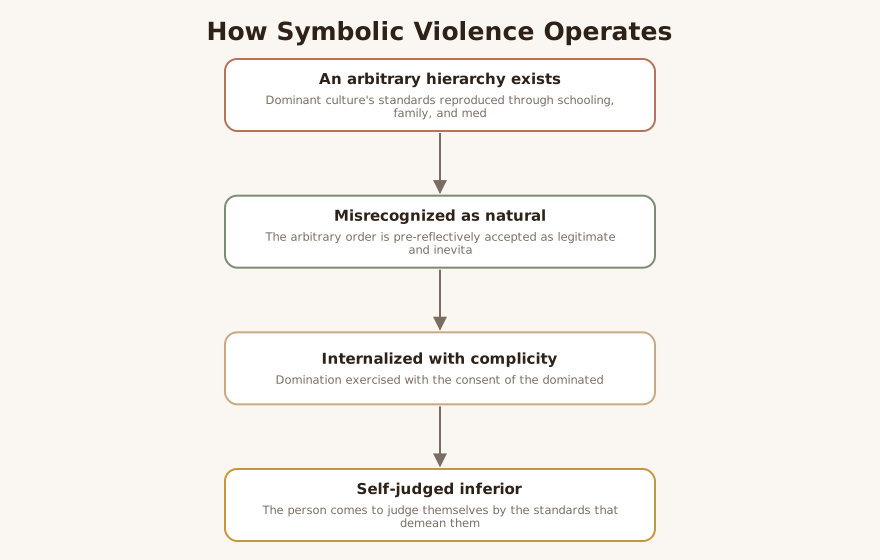
The defining principle is complicity: symbolic violence is domination exercised with the consent of the dominated, who accept the legitimacy of the very standards by which they are judged inferior 2. This consent is not deliberate agreement but a pre-reflective acceptance built into perception itself 3. The dominated misrecognise an arbitrary social hierarchy as a natural and legitimate order, a process Bourdieu called misrecognition 5.
A second principle is invisibility. Symbolic violence works precisely because it is not experienced as violence; it is “soft” and woven into ordinary interactions, language, and institutions 3. A third is that it is reproduced through everyday life — schooling, family, media, and consumption — rather than imposed by a single agent 6. Empirical work has shown how this plays out in mundane settings, including the way some people come to accept their own degradation as deserved or unremarkable 1.
For the clinician, three translations follow LLM. First, a client’s harsh self-appraisal may encode an internalized social hierarchy rather than an objective fact about their worth LLM. Second, the client may defend that hierarchy because it feels like reality, not ideology, which is why simple reassurance often fails LLM. Third, the standards themselves — about accent, body, family, sexuality, or “professionalism” — are legitimate targets of curiosity rather than givens to be met LLM.
Interventions & Techniques
Symbolic violence supplies no techniques of its own; it informs how a clinician listens and where they direct curiosity LLM. The first move is making the invisible visible: naming the social standard a client is measuring themselves against and asking where it came from, who benefits from it, and whether the client ever agreed to it LLM. This denaturalising stance mirrors Bourdieu’s analytic aim of exposing power relations that present themselves as natural 2.
Borrowed from narrative therapy, externalising conversations help separate the person from the internalized standard, treating “the voice that says I don’t belong here” as a social import rather than a core truth LLM. Borrowed from liberation psychology and feminist therapy, consciousness-raising and sociopolitical contextualising reframe private shame as a shared, structural experience LLM. Techniques that surface misrecognition — examining whose taste, language, or comportment a client has unconsciously adopted as the measure of worth — operationalise the construct without claiming to treat it 3.
LLM-generated illustrative example (not a guideline): A first-generation graduate student says, “Everyone here is just smarter than me.” The clinician gently maps the standard: “Smarter how — by which way of speaking, writing, name-dropping? Who taught you those count as intelligence?” Over sessions the client begins to see “fitting in” as a learnable game rather than proof of inferiority LLM.
Evidence Base
Honesty about evidence requires a clear distinction LLM. As a sociological construct, symbolic violence is well-established and widely cited; it is a mature, theoretically developed idea with decades of scholarly use across education, gender, and consumer studies 6. Qualitative and ethnographic research has documented its operation in everyday life, including detailed accounts of how the dominated internalize their position 1.
As a clinical intervention, however, there is no direct outcome evidence LLM. No randomised trials, manualised treatments, or effect-size estimates exist for “symbolic-violence-informed therapy,” because it is not a freestanding treatment LLM. Its clinical value is conceptual: it enriches case formulation within established, evidence-supported traditions such as narrative and feminist approaches rather than standing alone LLM. Clinicians should therefore present it to clients and supervisors as an explanatory lens, and should not overclaim it as an evidence-based method LLM. The “established” label here means established in social theory, not validated as a psychotherapy LLM.
Populations & Indications
The lens is most useful when a client’s distress is entangled with social marginalisation LLM. First-generation college students are a paradigm case, since the construct was developed in part through Bourdieu’s analysis of how educational systems reward inherited cultural capital and quietly penalise those without it 4. Working-class clients similarly may carry a felt unworthiness that tracks class hierarchy rather than personal failing 6.
Immigrants and refugees often confront standards of language, accent, and comportment that mark them as deficient, a classic site of symbolic domination 3. Racial and ethnic minorities and LGBTQ+ individuals individuals may internalize dominant norms about bodies, relationships, and legitimacy, experiencing them as personal defects LLM. Survivors of abuse can come to accept degrading treatment as deserved or normal, which research on everyday symbolic violence has illuminated 1. Across these groups the indication is the same: when self-criticism mirrors a social pecking order, the construct earns its place in the formulation LLM.
Problems-for-Work
Internalized oppression is the central problem-for-work the construct illuminates — the process by which a person adopts the dominant order’s devaluation of their own group as self-evident truth 2. Shame and chronic feelings of inadequacy are framed not as isolated symptoms but as the affective residue of misrecognised hierarchy 3. Imposter syndrome, especially in first-generation and minority clients, reads as a felt mismatch between one’s habitus and a field that rewards a different upbringing 4.
Low self-esteem and relentless self-criticism become legible as the dominated’s complicity in their own judgment, which is why they resist simple positive reframing LLM. Perfectionism can express a client’s attempt to finally meet an arbitrary standard they have accepted as legitimate LLM. Internalized racism and homophobia name the same mechanism applied to race and sexuality LLM. Identity disturbance and depressive symptoms related to social marginalisation can both be partly understood as the cost of living inside a hierarchy that one has been taught to see as natural LLM.
LLM-generated illustrative example (not a guideline): A queer client says, “I just want a normal relationship,” and feels broken for not having one. Naming “normal” as a dominant script — rather than a health standard — lets the client grieve the pressure and choose their own measures of a good partnership LLM.
Contraindications, Cautions & Cultural Humility
The first caution is that symbolic violence is a lens, not a diagnosis, and must never displace assessment of risk, trauma, or biological contributors to a client’s distress LLM. Foregrounding structural analysis before a client feels safe or understood can feel intellectualising or invalidating, especially in acute distress LLM. The clinician should follow the client’s readiness rather than impose a critique LLM.
A second caution is the risk of the therapist enacting symbolic violence themselves — imposing the clinician’s preferred political framing as the new “natural” standard the client must accept LLM. This reproduces the very domination the construct critiques, since misrecognition can be installed by helpers as easily as by oppressors 2. Cultural humility requires holding the analysis tentatively, treating the client as the authority on their own experience, and recognising that “liberation” defined by the therapist can become another imposed norm LLM. Finally, naming structural injustice does not, by itself, change a client’s material conditions, and the lens should be paired with concrete support rather than offered as a substitute for it LLM.
Treatment-Plan Suggestions & SMART Objectives
| Goal | SMART objective (example) | Mechanism |
|---|---|---|
| Externalize internalized oppression | Within 6 sessions, client will identify and name three social standards they have been measuring themselves against, in session and in a between-session log | Denaturalising / making misrecognition visible 3 |
| Reduce shame’s grip | Over 8 weeks, client will reframe two recurring self-critical thoughts as inherited social scripts rather than personal truths, rated on a shame scale | Separating person from imposed standard LLM |
| Address imposter feelings | Within 4 sessions, client will articulate one way their background is an asset rather than a deficit in their current setting | Revaluing devalued cultural capital 4 |
| Counter perfectionism | Over 6 weeks, client will set one “good enough” criterion of their own choosing for a feared task and act on it twice | Replacing arbitrary external standard with self-authored measure LLM |
| Contextualize depressive symptoms | Within 5 sessions, client will distinguish self-blame from structural contributors in two recent low-mood episodes | Sociopolitical contextualising of distress LLM |
| Strengthen identity coherence | Over 8 weeks, client will describe two personal values that do not depend on dominant-group approval | Consciousness-raising / re-authoring identity LLM |
| Reduce internalized racism/homophobia | Within 6 sessions, client will name one dominant norm they have internalized and one counter-narrative they choose to hold | Misrecognition surfaced and contested 2 |
Common Misconceptions
A common misconception is that symbolic violence is a metaphor for verbal abuse or harsh speech; it is broader and subtler, referring to the structural imposition of meaning that the dominated accept as legitimate 3. Another is that it requires a conscious oppressor acting with intent, whereas it operates through impersonal institutions and pre-reflective dispositions 5. A third is that the dominated are simply duped or weak; complicity here is a feature of how perception itself is socially structured, not a personal failing 2.
Clinicians sometimes assume the construct names something the therapist can “remove” from a client, but it describes a social process, not an internal lesion to be excised LLM. It is also mistakenly read as identical to ordinary low self-esteem; the distinguishing feature is that the client’s self-judgment tracks a social hierarchy and feels natural rather than arbitrary LLM. Finally, treating it as an evidence-based therapy, rather than a conceptual lens, overstates its status LLM.
Training & Certification
There is no certification, credential, or formal training pathway in symbolic violence, because it is a sociological concept rather than a clinical modality LLM. Clinicians typically encounter it through graduate coursework in sociology or critical theory, or through the literatures of liberation psychology, feminist therapy, and narrative therapy that draw on it LLM. The most direct primary source for self-study is Bourdieu’s own Outline of a Theory of Practice, which situates the concept within habitus, field, and capital 4.
For applied understanding, accessible explanatory overviews and the empirical literature on symbolic violence in everyday life are useful complements to the dense primary texts 13. Competence is best built by supervised practice in a critical or narrative tradition rather than by any standalone course in the construct itself LLM.
Key Terms
Symbolic violence — domination exercised through symbols and meanings, accepted as legitimate by those it disadvantages 2. Misrecognition — perceiving an arbitrary social order as natural and legitimate, the mechanism that makes symbolic violence work 5. Habitus — durable dispositions acquired through upbringing that shape perception and action, often below awareness 4.
Cultural capital — the knowledge, tastes, and credentials that confer advantage, unequally distributed and unequally valued 4. Field — the structured social arena in which actors compete for valued resources and recognition 4. Naturalisation — the process by which power relations are made to appear as the inevitable order of things 2. Complicity — the dominated’s pre-reflective acceptance of the standards by which they are judged inferior 3.
Resources & Further Reading
▶ Watch — a video introduction to this concept:
- Outline of a Theory of Practice (Pierre Bourdieu) — Cambridge University Press
- Pierre Bourdieu – Challenging Symbolic Violence and the Naturalisation of Power Relations — E-International Relations
- Pierre Bourdieu’s Symbolic Violence: An Outline and Explanation — Easy Sociology
- ‘I’d rather you’d lay me on the floor and start kicking me’: Understanding symbolic violence in everyday life — ScienceDirect
- Symbolic Violence — Encyclopedia of Consumer Culture (SAGE Reference)
- Symbolic violence — Wikipedia
Reflective / Supervision Questions
- When a client expresses self-criticism, do I reflexively reassure, or do I get curious about the standard they are using and where it came from? LLM
- Whose definitions of “normal,” “professional,” or “successful” am I, as the clinician, treating as neutral facts in this case? LLM
- Am I at risk of imposing my own political framing as a new standard the client must accept, and how would I notice if I were? LLM
How do I distinguish distress that is meaningfully tied to social marginalisation from distress with other primary drivers, so the lens enriches rather than overrides assessment? LLM When does naming structural injustice help this particular client, and when does it intellectualise away an affect they need to feel first? LLM What concrete, material supports am I pairing with this analysis so that insight is not offered as a substitute for change? LLM