
Type & Discipline
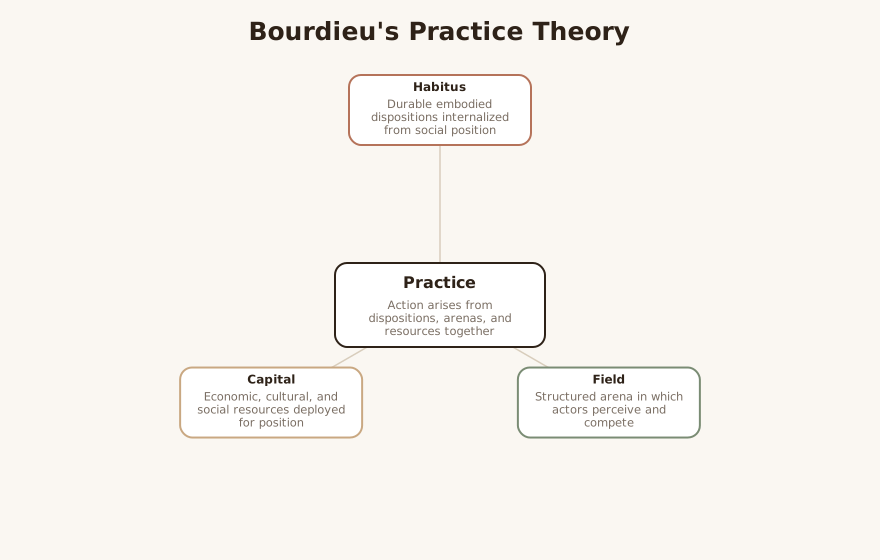
Habitus, field, and capital are the three interlocking concepts of Pierre Bourdieu’s theory of practice, a framework within the sociology of practice rather than a model of psychotherapy 3. Bourdieu’s project was to explain social order as emerging neither from objective structures alone nor from purely conscious individual choice, but from the interplay of embodied dispositions (habitus), available resources (capital), and the structured arenas in which actors compete for position (fields) 3. The framework is sometimes condensed into the heuristic that practice arises at the intersection of habitus, capital, and field, a relationship that is multiplicative rather than additive in the sense that action only becomes intelligible when a given disposition meets a given distribution of resources inside a particular field’s rules 3.
For clinicians, the relevant point is that this is a lens, not a treatment LLM. It supplies a vocabulary for understanding why some presentations that look intrapsychic—low confidence, a sense of not belonging, self-limiting expectations—are partly produced by a person’s social position and history LLM. Used well, it sharpens case formulation and cultural humility; it does not replace the modality through which care is actually delivered LLM.
Creators & Lineage
Pierre Bourdieu (1930–2002) was a French sociologist born into a working-class family in Denguin, who studied philosophy at the École Normale Supérieure before military service in Algeria turned his attention toward anthropology and empirical sociology 7. He founded the Center for European Sociology and the journal Actes de la Recherche en Sciences Sociales, and his major works include Distinction: A Social Critique of the Judgment of Taste (1984), Reproduction in Education, Society, and Culture (1977), and the essay “The Forms of Capital” (1986) 7. His thought draws on and extends Marxist class analysis, pushing it beyond economics into the cultural domain 7.
The intellectual lineage clinicians will recognize includes critical theory and social constructionism, alongside Bourdieu’s own cultural capital theory LLM. His analysis of how education reproduces class advantage directly challenged functionalist assumptions about meritocracy, and his influence spread across education studies, cultural analysis, anthropology, and media studies 7.
Core Principles
Habitus is a system of durable, embodied dispositions—habits, skills, tastes, and ways of perceiving and acting—acquired through prolonged exposure to a particular social environment, much as one acquires a native language 1. It is largely unconscious, absorbed from childhood through accumulated cues and repeated experience rather than formal instruction, until it becomes “second nature” integrated into speech, bearing, and identity 1. Bourdieu described habitus as a “structured and structuring structure”—shaped by one’s social position, and in turn shaping how one reads and responds to the world 4. It produces a practical “feel for the game,” letting people navigate familiar contexts smoothly without explicit deliberation 1.
Capital is the set of resources actors deploy to maintain or improve their position, and Bourdieu identified several convertible forms: economic capital (money, property), cultural capital (knowledge, credentials, refined tastes), and social capital (networks and useful relationships) 3. He added symbolic capital—the resources that accrue from being recognized as honorable or prestigious 2. Cultural capital exists in three states: embodied (internalized knowledge, accent, and mannerisms acquired especially in the family), objectified (cultural goods such as books and art), and institutionalized (formal qualifications and credentials that convert readily into economic capital) 2. Capital only functions as capital when it is recognized and legitimized within a specific field 3.
Field is a relatively autonomous social arena—education, law, art, the labor market—with its own rules, hierarchies, and stakes 3. Each field determines what counts as valuable, who is judged competent, and which forms of capital are rewarded, and is structured by ongoing relationships of inequality between those who dominate and those who are dominated 34. Two further field concepts matter clinically. Doxa names the taken-for-granted assumptions that go unquestioned within a field—the rules that feel simply natural 3. Symbolic violence is domination that operates through legitimacy rather than force: social differences come to be misrecognized as natural differences, and the dominated comply because the order appears plausible 3.
Interventions & Techniques
Bourdieu’s framework is not a manualized therapy and carries no prescribed techniques LLM. What it offers the clinician is a set of formulation moves that can be folded into an existing treatment LLM.
- Map the three concepts onto the case. Ask, in effect: what dispositions has this person internalized (habitus), which fields are they trying to move through (workplace, university, a new country), and what capital do they actually hold versus what each field rewards? LLM
- Externalize the socially produced. Where a client treats a limitation as a fixed personal trait, the lens reframes it as a learned disposition shaped by position, which opens room for change LLM.
- Name doxa and symbolic violence. Helping a client see that a “natural” rule of a field is in fact a contingent norm—one that may quietly devalue their background—can reduce shame and self-blame LLM.
- Use therapist reflexivity. Bourdieu’s reflexive sociology asks the analyst to examine how their own social position and habitus shape their interpretations; in the room, this becomes disciplined attention to the clinician’s own class, culture, and assumptions 5.
LLM-generated illustrative example (not a guideline): A first-generation graduate student says she “just isn’t cut out for academia.” Rather than accepting this as trait-level, the clinician reframes: the student arrived without the embodied cultural capital her peers absorbed at home, and the field rewards a fluency she was never taught—not a deficit of ability. The work shifts from “fixing” her to building specific skills and reducing the shame attached to the gap LLM.
Evidence Base
A precise statement of maturity matters here. Bourdieu’s theory is established as social theory—influential and empirically productive across sociology and education—but there is no clinical-trial evidence for habitus, field, and capital as a therapeutic intervention, because it was never designed as one LLM. The “established” label refers to the sociology, not to outcomes for any treatment delivered through this lens LLM.
The empirical literature does illuminate the mechanisms clinicians might invoke. A study of 2,929 college students across twelve Chinese higher-education institutions tested whether family cultural capital predicts academic achievement, with habitus and the school field as mediators 6. The headline finding is counterintuitive and worth representing honestly: family cultural capital had a significantly negative direct association with academic performance (β = –0.226, p < 0.001), which the authors attributed in part to excessive parental expectations 6. Yet the indirect pathways were positive—through habitus (β = 0.368), through the school field (β = 0.084), and through the sequential habitus-then-field chain (β = 0.087) 6. Underlying paths were strong: family cultural capital predicted habitus (β = 0.624), habitus predicted both the school field (β = 0.566) and achievement (β = 0.590), and the field predicted achievement (β = 0.247) 6. The authors concluded that family advantage is not transmitted directly but must be “transformed and adapted”—internalized through habitus and aligned with the field—before it yields benefit 6. For the clinician, the takeaway is mechanistic rather than prescriptive: dispositions mediate between social origin and outcome, which is exactly where reflective therapeutic work can intervene LLM.
Populations & Indications
The lens is most useful with people whose distress is entangled with social position LLM. It speaks naturally to marginalized populations, cultural and ethnic minorities, and people experiencing socioeconomic disadvantage, for whom a “deficit” framing often compounds the problem LLM. Immigrants are a particularly apt group: the difficulty of changing an established habitus—Bourdieu likened it to learning a second language as an adult—maps onto the lag a newcomer feels when long-internalized dispositions no longer fit a new field 1. Students, especially first-generation or working-class students entering institutions built on middle-class norms, are another core group, since schools reward cultural capital absorbed at home and can inflict symbolic violence on those whose backgrounds are devalued 24. At the community level, the framework helps clinicians and programs understand collective patterns of disadvantage rather than locating every problem in the individual LLM.
Indications are formulation-driven: the lens earns its place when a client’s presenting concern is bound up with belonging, class, culture, mobility, or the experience of not fitting an institution’s unspoken rules LLM.
Problems-for-Work
- Low self-efficacy related to social position. A client’s “I can’t” may reflect a habitus calibrated to a different field rather than a stable belief about ability; naming this can loosen it 1LLM.
- Internalized oppression. Symbolic violence describes how the dominated come to accept a devaluing order as natural; therapy can surface that misrecognition and separate the person from the imposed verdict 3LLM.
- Acculturative stress. The mismatch between an immigrant’s prior habitus and the rules of a new field gives a concrete, non-pathologizing account of disorientation and fatigue 1LLM.
- Class-based identity conflict. Upward mobility can leave a person between fields, fluent in neither old nor new doxa; the framework normalizes that liminality 3LLM.
- Barriers to social mobility and systemic disadvantage. Distinguishing what the client controls (skills, choices) from what the field structures (which capital is rewarded) protects against both fatalism and self-blame 4LLM.
- Cultural marginalization. Recognizing that an institution’s “neutral” standards encode a particular cultural capital can reframe exclusion as structural rather than personal 2LLM.
LLM-generated illustrative example (not a guideline): A recently arrived professional, highly respected in his home country, feels humiliated taking entry-level work. Framing this as habitus-lag and a field that does not recognize his institutionalized capital across borders helps separate his worth from the field’s verdict, reducing the depressive self-attack while the practical work of credential conversion proceeds LLM.
Contraindications, Cautions & Cultural Humility
Because this is a lens and not a therapy, the cautions are conceptual rather than procedural LLM. The most common critique of Bourdieu is determinism—that the framework can present social structure as nearly total, leaving little room for agency 7. Commentators temper this by noting that the “structuring structure is not, and cannot be, total,” but a clinician who over-applies the lens risks telling clients their futures are fixed by origin, which is anti-therapeutic 4LLM. A second caution: the concept of cultural capital has been misused as something that can be “taught” to the poor, which misreads Bourdieu, since key elements are entwined with privileged lifestyles rather than discrete, transferable skills 4. Avoid converting the lens into a subtle deficit model LLM.
Cultural humility is where the framework is strongest. Bourdieu’s reflexive sociology insists the analyst examine how their own habitus shapes interpretation, and in clinical terms this means the therapist continually checking how their class, culture, and accumulated capital structure what they notice, value, and recommend 5. The consulting room is itself a field with doxa; the clinician’s “common sense” about a good outcome may quietly impose dominant norms 3LLM. Holding that awareness, rather than concealing it, is the discipline the theory asks for 5.
Treatment-Plan Suggestions & SMART Objectives
The objectives below are illustrative syntheses showing how the lens can inform goals delivered within a recognized modality; they are not validated protocols LLM.
| Goal | SMART objective (example) | Mechanism |
|---|---|---|
| Reduce self-blame tied to social position | Over 8 sessions, client will identify and reframe 3 self-statements that attribute structural barriers to personal deficit, rated weekly | Distinguishes habitus/field from fixed trait, loosening internalized verdict |
| Ease acculturative distress | Within 6 weeks, client will name 2 specific habitus-field mismatches contributing to disorientation and rehearse one coping response for each | Externalizes habitus-lag as adjustment, not pathology |
| Build field-relevant capital | Over 12 weeks, client will complete 3 concrete steps toward a credential or network identified as rewarded in their target field | Targets institutionalized/social capital the field actually rewards |
| Address class-based identity conflict | By session 10, client will articulate a coherent narrative integrating origin and current field in their own words | Reduces liminality between competing doxa |
| Counter internalized oppression | Within 8 sessions, client will identify 2 instances of symbolic violence and separate the imposed evaluation from self-worth, tracked in a log | Surfaces and corrects misrecognition |
| Increase position-specific self-efficacy | Over 6 weeks, client will attempt 2 graded tasks in the difficult field and review evidence against the “I can’t” belief | Recalibrates habitus through corrective experience |
| Strengthen support network (social capital) | Within 90 days, client will initiate or deepen 3 relationships that provide access or belonging in the target field | Builds social capital that mediates outcomes |
Common Misconceptions
- “Habitus means habit.” Habitus is a generative system of dispositions shaping perception and action across situations, not a list of repeated behaviors 14.
- “Cultural capital is just being cultured, and you can teach it.” It is socially recognized, often invisible advantage entangled with lived privilege; treating it as a transferable lesson misreads Bourdieu 24.
- “Capital means money.” Bourdieu deliberately extended the term to cultural, social, and symbolic forms that convert into—but are not reducible to—economic capital 37.
- “The theory says origin is destiny.” The structuring structure is not total, and the empirical pathway from origin to outcome runs through changeable mediators like habitus and field 46.
- “It’s a therapy.” It is a sociological lens applied within a treatment, with no efficacy evidence of its own as an intervention LLM.
Training & Certification
There is no certification in Bourdieusian theory as a clinical method, because it is not a therapy LLM. Clinicians develop fluency through primary and secondary reading—Distinction, Reproduction in Education, Society, and Culture, and “The Forms of Capital” are the canonical starting points—supplemented by the explainer and educational sources listed below 7. The most transferable clinical skill the tradition trains is reflexivity: the habit of interrogating one’s own social position and assumptions, which can be cultivated in supervision and consultation rather than through a credentialing pathway 5.
Key Terms
- Habitus — durable, largely unconscious dispositions internalized from one’s social position; a “structured and structuring structure” producing a practical feel for the game 14.
- Field — a relatively autonomous social arena with its own rules and hierarchies that determine which capital is rewarded 3.
- Capital — convertible resources: economic, cultural, social, and symbolic 32.
- Embodied / objectified / institutionalized capital — the three states of cultural capital: internalized dispositions, cultural goods, and formal credentials 2.
- Doxa — taken-for-granted assumptions within a field that go unquestioned 3.
- Symbolic violence — domination through legitimacy, in which social differences are misrecognized as natural 3.
- Reflexive sociology — the requirement that the analyst examine how their own position shapes interpretation 5.
Resources & Further Reading
▶ Watch — a video introduction to this concept:
- Pierre Bourdieu & Habitus (Sociology) — Simply Psychology
- Cultural Capital Theory of Pierre Bourdieu — Simply Psychology
- Bourdieu’s Theory of Practice: Habitus, Capital & Field — SozTheo
- Pierre Bourdieu on education: Habitus, capital, and field — infed.org
- Pierre Bourdieu: Habitus, Capital, Fields, Doxa, and Reflexive Sociology — PHILO-notes
- Family cultural capital and academic achievement: the mediating roles of habitus and field — PMC
- Pierre Bourdieu: Theory, Definitions, & Impact — StudySmarter
Reflective / Supervision Questions
- For this client, what dispositions look like fixed personal traits but may be a habitus calibrated to a field they have left? LLM
- Which field is the client trying to move through, and does the capital they hold match what that field rewards? LLM
- Where might I be mistaking my own doxa—my “common sense” about a good outcome—for a neutral clinical standard? LLM
- How is my own habitus and accumulated capital shaping what I notice, value, and recommend with this client? LLM
- Am I using this lens to reduce shame and open possibility, or am I drifting into a deterministic, deficit framing? LLM