
Type & Discipline
African-Centered (or Black, or Africana) Psychology is a culturally-centered paradigm within the discipline of psychology rather than a single manualized treatment protocol 7. It emerged in the late 1960s as a corrective to Eurocentric frameworks that were built from a predominantly White worldview and that produced norms its proponents argue are inapplicable to Black people 7. As a paradigm, it supplies a worldview, a set of values, and a research and practice orientation that can inform how a clinician conceptualizes, assesses, and treats — but most of its clinical delivery still occurs through recognized therapeutic modalities LLM. Scholars describe three methodological postures within the field: a deconstructionist stance that challenges biases in Eurocentric testing and research, a reconstructionist stance that redefines Black self-concept and racial identity outside Western frameworks, and a constructionist stance that builds autonomous African-centered paradigms grounded in African worldviews 7. For the practicing therapist, the most useful framing is that this is a lens layered onto evidence-based practice, not a replacement for it LLM.
Creators & Lineage
The institutional birth of the field is dated to 1968, when the Association of Black Psychologists (ABPsi) was founded as a protest against the American Psychological Association’s neglect of Black psychologists and Black communities 7. Joseph White, often called the “Godfather of Black Psychology,” is credited with helping launch the modern field and shaping a strengths-based view of Black life, and his scholarly legacy continues to be examined as foundational to a more diverse psychology 2. Other founders included Wade Nobles, Robert V. Guthrie (author of Even the Rat Was White), Robert Lee Williams II, and Charles W. Thomas, the first ABPsi president 7. The Journal of Black Psychology was established in 1974 and has now passed fifty years of publication 73.
Several theorists deepened the constructionist branch. Na’im Akbar described African psychology as a perspective lodged in the historical primacy of the human view from Africa 7. Wade Nobles emphasized communalism and African worldviews, and later advanced the concept of Sakhu Djaer — reframing psychology itself as the illumination of the spirit or soul within a Pan-African frame 71. Linda James Myers developed Optimal Theory from African thought traditions 7. Kobi Kambon (Joseph Baldwin) defined African psychology through African cosmology and reality structures and sought to build entirely new African-centered theory rather than merely critique White psychology 67. Thomas Parham, with White and Adisa Ajamu, centered these perspectives for clinical application in Psychology of Blacks 4. The paradigm draws lineage from and remains intertwined with multicultural counseling, liberation psychology, Afrocentric philosophy, and community psychology LLM. More recent voices such as Thema Bryant frame the broader project as decolonizing psychology, insisting that cultural, political, and economic contexts and experiences of oppression are central influencing factors in mental health 5.
Core Principles
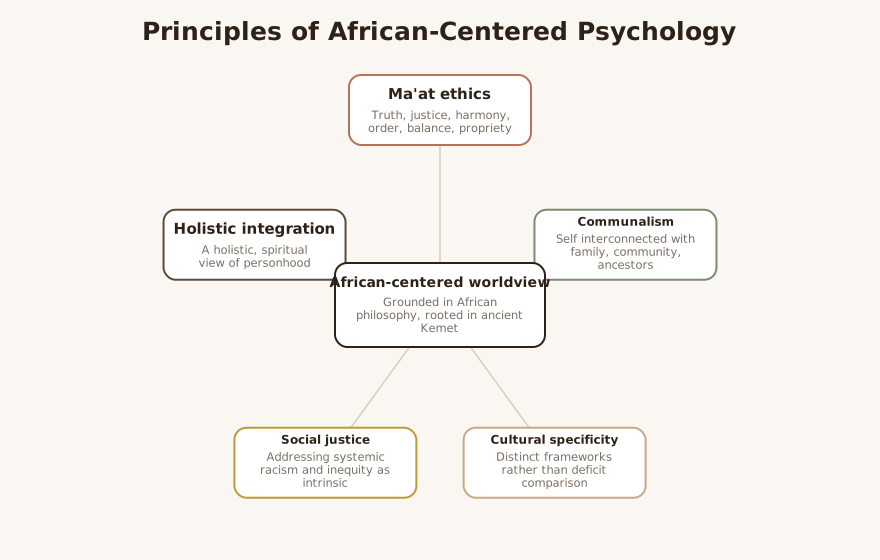
The paradigm rests on an African-centered worldview in which psychology is grounded in African philosophy rather than Western individualism 7. Its intellectual roots are traced to ancient Kemet (Egypt), which emphasized consciousness development and positive relationships 7. From Kemet comes the ethical code of Ma’at, encompassing virtues such as truth, justice, righteousness, harmony, order, balance, and propriety, which function as a moral and relational compass 7. The classical model of the psyche described it as seven interrelated elements integrating human and divine dimensions, signaling a fundamentally holistic and spiritual view of personhood 7.
Communalism is a defining principle: the well-being of the collective is weighted alongside or above individual well-being, and the self is understood as interconnected with family, community, and ancestors 7. Cultural specificity holds that Black psychological experience requires distinct analytical frameworks rather than deficit comparisons to a White norm 7. Social justice is treated as intrinsic, with a commitment to addressing systemic racism and inequity 7. Finally, holistic integration links the psychological, spiritual, social, and material dimensions of human experience into a single field of concern 7. Nobles’ Sakhu Djaer extends this by positioning the discipline as the study and illumination of spirit, not merely behavior or cognition 1. For clinicians trained in symptom-focused models, the practical implication is that spirituality, kinship, and collective identity are not peripheral to the case but often central to it LLM.
Interventions & Techniques
Because this is a paradigm rather than a protocol, its “techniques” are best understood as orientations that reshape how standard interventions are delivered LLM. A foundational move is strengths-based reframing — anchoring assessment and treatment in the resilience and assets of Black life rather than in deficit 2. Identity affirmation and racial-cultural identity work help clients articulate and consolidate a positive sense of self, consistent with reconstructionist redefinitions of Black self-concept 7. Cultural reconnection interventions address cultural disconnection by reattaching clients to heritage, language, and community practice LLM.
Kambon’s work points toward strengthening African Self-Consciousness — conscious acknowledgment of African identity paired with commitment to community — and toward naming cultural misorientation, the internal conflict that arises when a Black client has internalized Eurocentric norms that do not fit their cultural background 6. ABPsi has operationalized communal healing through practices such as the Sawubona Healing Circle, illustrating a community-based, collective format for restoration 3. Decolonizing techniques, in Bryant’s framing, mean explicitly attending to oppression, context, and collective identity inside the therapy room and incorporating culturally grounded sources of healing such as spirituality and community 5. In practice, clinicians integrate these moves into established formats: a CBT cognitive restructuring exercise can target internalized racist messages; a narrative therapy externalizing conversation can separate the person from imposed deficit narratives; and family or group work can mobilize communal and kinship resources LLM.
LLM-generated illustrative example (not a guideline): A clinician using a CBT frame notices a Black client repeatedly describing himself as “not really professional material.” Rather than treating this only as a cognitive distortion, the clinician explores whose standard “professional” reflects, names the internalized racism at work, and re-anchors the client in family and community definitions of competence and dignity LLM.
Evidence Base
The honest assessment is that the framework is established while its outcome evidence is uneven LLM. The paradigm has decades of theoretical development, a dedicated peer-reviewed journal since 1974, and a national professional association since 1968, which together mark it as an established and institutionalized body of scholarship 73. Several of its constructs have been operationalized into validated scales; Kambon, for example, developed and empirically validated measures of African Self-Consciousness rather than relying on theory alone, and research generally supports a correlation between higher African Self-Consciousness and better well-being 6. That said, this is largely correlational and construct-validation evidence, not a deep base of randomized controlled trials demonstrating that African-centered treatment packages outperform standard care LLM. Clinicians should therefore treat the paradigm as a well-developed, theoretically rich, and culturally responsive lens with strong face validity and growing empirical support for its core constructs, while remaining candid that head-to-head efficacy data are still emerging LLM. This maturity profile argues for integrating its principles into evidence-based modalities rather than abandoning those modalities LLM.
Populations & Indications
The primary populations are African Americans, Black and African-descended individuals, people of the African diaspora, communities affected by racism, and Black families and communities 73. The paradigm is indicated whenever the cultural, racial, spiritual, or communal dimensions of a client’s life are clinically relevant — which, given its premises, includes most presentations among these populations rather than only “race-related” complaints 5. It is especially apt where a Eurocentric formulation would pathologize culturally normative behavior, such as labeling appropriate cultural mistrust as paranoia; the field explicitly replaced the older “cultural paranoia” language with cultural mistrust to correct that bias 7. Indications also include presentations where spirituality, extended kinship, and collective identity are protective factors a clinician would otherwise overlook 45.
Problems-for-Work
Racial trauma and race-based traumatic stress. Bryant’s decolonizing frame supports treating experiences of oppression as legitimate clinical material rather than as background, validating the injury and locating it in context 5. Application: a clinician processes a client’s distress after a discriminatory encounter as trauma, not oversensitivity LLM.
Internalized racism and devaluation. Kambon’s cultural misorientation names the conflict of having absorbed Eurocentric norms misaligned with one’s heritage, giving the clinician a non-shaming label to work with 6. Application: externalizing internalized “deficit” beliefs and contrasting them with community-derived self-worth LLM.
Identity development and low self-esteem. Reconstructionist redefinition of Black self-concept and White’s strengths-based legacy support affirming identity work 72. Application: building a coherent, positive racial-cultural identity narrative across adolescence and emerging adulthood LLM.
Cultural disconnection and intergenerational trauma. The communal, ancestral, and holistic worldview offers a route to reconnection and meaning-making across generations 71. Application: incorporating family history, ritual, and ancestral connection into restorative work LLM.
Minority stress and discrimination-related distress. Locating distress in systemic context rather than individual defect reframes the problem accurately and reduces self-blame 57. Application: validating chronic vigilance as an adaptive response to a hostile environment while building coping and collective support LLM.
Contraindications, Cautions & Cultural Humility
There are no medical “contraindications” to a worldview, but there are clear cautions LLM. The paradigm should not be applied prescriptively or monolithically: Black clients vary enormously in identity, religiosity, and relationship to African heritage, and assuming any single client wants or shares an African-centered orientation is itself a cultural imposition LLM. Clinical humility means inviting rather than assigning cultural framing, and the field’s own emphasis on context and collective identity should be offered, not imposed 5. The paradigm is most safely used as an enriching lens on top of evidence-based, ethically delivered care, particularly given that outcome evidence is still maturing LLM. Clinicians who are not African-descended can practice from this informed stance, but should pursue genuine cultural competence, supervision, and consultation, and should be prepared to refer or collaborate with culturally matched providers or community healing resources such as ABPsi-affiliated practitioners when appropriate 3. Finally, spiritual content should be engaged respectfully and on the client’s terms, never substituted for indicated treatment of acute risk or major psychiatric illness LLM.
Treatment-Plan Suggestions & SMART Objectives
| Goal | SMART objective (example) | Mechanism |
|---|---|---|
| Reduce internalized racism | Within 10 sessions, client will identify and reframe 3 specific internalized deficit beliefs, rating belief conviction below 30% on a self-report scale | Cognitive restructuring of cultural misorientation messages 6 |
| Strengthen racial-cultural identity | Over 12 weeks, client will articulate a written personal identity narrative integrating at least 3 valued aspects of heritage and report increased identity clarity | Reconstructionist redefinition of Black self-concept 7 |
| Process racial trauma | Within 8 sessions, client will narrate the index discriminatory event with subjective distress reduced by 50% on a standardized measure | Context-validating trauma processing 5 |
| Reconnect to community/kinship | Within 6 weeks, client will re-engage 2 supportive family or community relationships and log weekly contact | Communalism and collective-support activation 7 |
| Reduce minority-stress symptoms | Over 8 weeks, client will use 2 coping strategies during high-vigilance situations and report a measurable decrease in stress symptoms | Reframing distress as adaptive response to systemic stress 57 |
| Increase self-worth via cultural strengths | Within 10 sessions, client will list and verbally affirm 5 culturally grounded personal strengths weekly | Strengths-based, asset-focused work 2 |
| Integrate spirituality as a resource | Over treatment, client will identify and use 1 personally meaningful spiritual or communal practice as a coping resource, by choice | Holistic, spirit-inclusive view of personhood 14 |
Common Misconceptions
A frequent error is treating the paradigm as anti-scientific or purely ideological; in fact it includes a deconstructionist program that critiques methodological bias and a tradition of empirical scale validation 76. Another is assuming it applies only to “race issues,” when its premises make culture, spirit, and community relevant across most presentations for these populations 5. Some clinicians conflate it with a deficit model of Black mental health, the opposite of its strengths-based, asset-focused legacy 2. It is also wrongly assumed to be uniform; in reality it spans deconstructionist, reconstructionist, and constructionist branches with real internal debate 7. Finally, ABPsi did not “split off” out of separatism but was founded in 1968 as a protest against neglect by the mainstream profession, with an affirmative mission of liberation and well-being for people of African descent 73.
Training & Certification
The Association of Black Psychologists offers structured professional development, including a Certification in African/Black Psychology (CABP) specializing in the science of African/Black psychology 3. ABPsi also runs a Jegnaship mentoring program, the Sawubona Healing Circle, school and organizational consultation services, and an ABPsi Global Institute building international solidarity, along with member access to the Journal of Black Psychology and related resources 3. Clinicians seeking grounding can engage these offerings, the foundational scholarship of White, Nobles, Akbar, Myers, Kambon, and Parham, and consultation or supervision from experienced African-centered practitioners 2467.
Key Terms
- Ma’at: Kemetic ethical code of virtues including truth, justice, harmony, order, balance, and propriety, used as a moral-relational compass 7.
- Sakhu / Sakhu Djaer: A reframing of psychology as the study and illumination of spirit or soul within a Pan-African frame 1.
- Communalism: Emphasis on collective well-being and an interconnected, kin- and community-embedded self 7.
- African Self-Consciousness (ASC): Conscious acknowledgment of African identity coupled with commitment to the well-being and liberation of the African community 6.
- Cultural misorientation: Internal conflict produced when a Black individual internalizes Eurocentric norms misaligned with their cultural background 6.
- Cultural mistrust: The bias-corrected term replacing “cultural paranoia,” recognizing wariness as an adaptive response rather than pathology 7.
- Nigrescence: Cross’s model of Black racial identity development that rejects Eurocentric framings 7.
- Optimal Theory: Linda James Myers’ framework derived from African thought traditions 7.
Resources & Further Reading
▶ Watch — a video introduction to this concept:
- Association of Black Psychologists (ABPsi) 3
- Nobles, W. W. — From Black Psychology to Sakhu Djaer (Journal of Black Psychology) 1
- Cokley, Palmer & Stone — The Scholarly Legacy of Joseph White (Journal of Black Psychology) 2
- Parham, White & Ajamu — Psychology of Blacks: Centering Our Perspectives in the African Consciousness (Routledge) 4
- Thema Bryant — Why we need to decolonize psychology (TED) 5
- The Radical Black Psychology of Dr. Kobi K. K. Kambon (Center for Advanced Hindsight) 6
- Black psychology (Wikipedia) 7
Reflective / Supervision Questions
- Whose worldview is implicit in the standard formulation I default to, and does it pathologize anything that is culturally normative for this client? 7
- Am I offering an African-centered lens as an invitation, or imposing it on a client who may not share that orientation? LLM
- How am I weighting spirituality, kinship, and community as protective resources rather than treating them as peripheral to the “real” clinical work? 45
- When a Black client expresses wariness or mistrust, am I reading it as adaptive cultural mistrust or mislabeling it as pathology? 7
- Where might internalized racism or cultural misorientation be shaping my client’s self-concept, and how can I address it without shame? 6
- If I am not African-descended, what supervision, consultation, or referral relationships do I need to practice this lens competently and humbly? 3