
Type & Discipline
Emerging adulthood is a developmental theory within developmental psychology, situated in the broader family of lifespan development 1. It describes a distinct period of life — not a diagnosis, intervention, or therapeutic modality LLM. For clinicians, it functions as a normative-developmental lens: a framework for understanding what is age-expectable versus genuinely pathological in clients between roughly 18 and 29 4. Holding this distinction prevents two opposite errors — pathologizing normal exploratory turbulence, and dismissing real distress as “just a phase” LLM.
Creators & Lineage
The construct was named by Jeffrey Jensen Arnett in 2000, who argued that industrialized societies had produced a new life stage sitting between adolescence and settled young adulthood 4. Arnett built directly on Erik Erikson’s psychosocial framework, in which the central task of late adolescence and young adulthood is resolving identity versus role confusion LLM. He also drew on James Marcia’s identity-status theory, which operationalized Eriksonian identity work as movement through exploration (“moratorium”) toward commitment LLM. Arnett’s contribution was to argue that the heavy lifting of identity exploration had migrated later — out of the teen years and into the twenties 1. In his public articulation of the theory, Arnett frames the question as why it now “takes so long to grow up” in affluent societies 6. The construct overlaps with, but is distinguished from, conventional models of early adulthood, which assume settled adult roles by the early twenties 5.
Core Principles
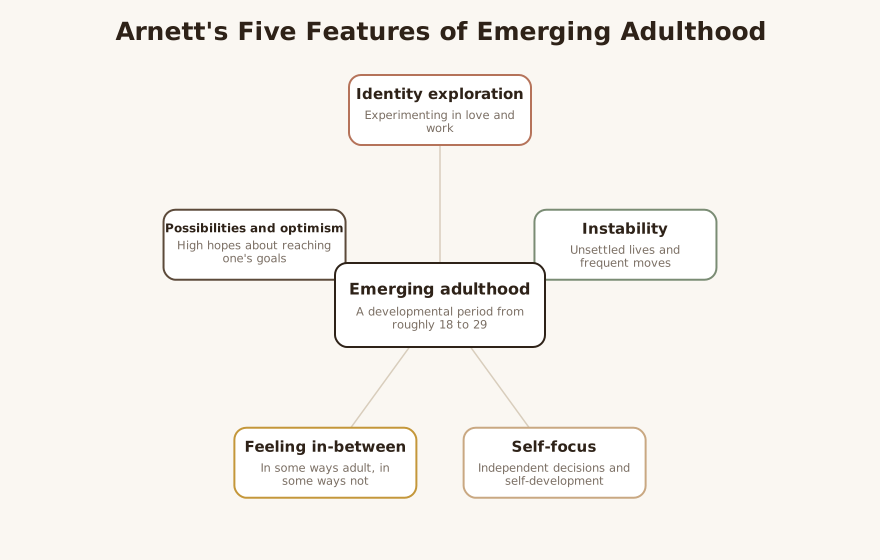
Arnett described five features that characterize this period 1. First, identity exploration: young people experiment with possibilities in love and work to consolidate a sense of self, beliefs, and values 1. Second, instability: as options are explored, lives become unsettled, with Americans aged 18–29 changing residence more than any other age group and nearly half moving back with parents at least once 1. Third, self-focus: between leaving home and committing to partnership or children, attention is directed toward independent decision-making and self-development 1. Fourth, feeling in-between: most report “in some ways yes, in some ways no” when asked whether they feel adult, a pattern documented across Argentina, Austria, Israel, and China 1. Fifth, possibilities and optimism: hopes run high, with roughly 89% of American 18–24-year-olds agreeing they are confident they will reach where they want to be 1.
Underlying these features are two structural conditions. Subjective markers of adulthood — accepting responsibility for oneself, making independent decisions, and becoming financially independent — have displaced traditional role transitions like marriage and homeownership as the felt criteria for being “grown up” 4. And the period coincides with continued neurodevelopment, as prefrontal-cortex maturation extends well into the third decade, meaning independence is often gained before full cognitive and executive maturity 3.
Interventions & Techniques
Emerging adulthood has no proprietary techniques; clinically, it shapes how existing modalities are delivered to this age group LLM. Four applications are most useful in practice.
Developmental psychoeducation and normalizing. Naming instability, residential churn, and the in-between feeling as expectable rather than as personal failure can reduce shame and self-blame, given how strongly these are documented as age-typical 1. This reframing is often the single most relieving intervention for a distressed young-adult client LLM.
Structured identity-exploration work. Because the core developmental task is exploration toward commitment, the clinician can scaffold deliberate experimentation in love, work, and worldview rather than treating indecision as avoidance 1. Values-clarification exercises and behavioral experiments fit naturally here within acceptance-based or cognitive-behavioral frames LLM.
Decision support and executive scaffolding. Given that independence frequently precedes full prefrontal maturation, externalizing decision-making — pros/cons, staged commitments, problem-solving frameworks — supports capacities still coming online 3. The aim is to build self-efficacy and agency, consistent with asset-building developmental models 3.
Family individuation work. Because parental support and family dynamics strongly shape trajectories, brief systemic or family sessions can renegotiate autonomy and financial dependence without rupture 3.
LLM-generated illustrative example (not a guideline): A 23-year-old presents with “I’m so behind everyone.” The clinician validates the feeling, then offers psychoeducation that frequent job and relationship change is statistically modal for this age, reframing the client’s instability from defect to developmental position LLM.
Evidence Base
The maturity here is best described as established for the descriptive phenomenon, contested for the universal-stage claim LLM. The five features are well-documented empirically, including cross-national replication of the in-between feeling 1. The associated public-health pattern is robust: substance-use rates rise sharply across this window (binge drinking from roughly 11% to 42%, illicit-drug use from 11% to 20%), and three-quarters of lifetime mental, emotional, and behavioral disorders begin by age 24 3. Roughly 13.7% of young adults experience serious mental illness 3. These convergent findings make emerging adulthood a defensible clinical population concept regardless of theoretical disputes LLM.
Honesty about the construct’s limits matters. Critics within developmental psychology note that the experience is heavily structured by economics and culture: those who grow up in poverty are far more likely to delay postsecondary enrollment (about 70% versus 40% in higher-SES households) and far less likely to complete degrees (22% versus 48%) 3. Commentators have warned that prolonged exploration may be a privilege of the relatively advantaged, while others languish in low-skilled work without a true “exploratory” stage at all 2. The descriptive features are real; their universality across class and culture is the disputed part LLM.
Populations & Indications
The lens is most applicable to young adults aged 18–29, college students, and late adolescents in transition out of the family home 4. It is also clinically useful when working with parents of young adults, who often need help recalibrating expectations against current developmental norms LLM. Within this band, the framework is especially indicated for clients presenting with identity confusion, those described as “failure to launch,” and any young-adult client whose distress centers on feeling stalled, behind, or directionless LLM. Because this is the peak window for onset of serious mental illness, the period is also a screening priority rather than only a normative one 3.
Problems-for-Work
The lens reframes — but does not replace — formal diagnosis LLM.
- Identity disturbance / quarter-life crisis. Distinguish developmentally normative exploration from clinically significant identity diffusion; the former is expectable given the migration of identity work into the twenties 1.
- Adjustment disorder. Residential moves, job changes, and relational churn are statistically modal here, so adjustment reactions are common and the stressor is often developmental rather than catastrophic 1.
- Anxiety and depression in young adults. Given onset peaks before 24, low mood or anxiety in this group warrants active screening, not normalization-by-default 3.
- Career and vocational indecision. Reframe as legitimate exploration in the domain of work, while watching for avoidance masquerading as exploration 1.
- Family individuation conflict / failure to launch. Address renegotiation of dependence; nearly half of emerging adults return home at least once, so co-residence alone is not pathology 1.
- Relationship instability and low self-esteem. Frame instability as feature, not flaw, while attending to the optimism–reality gap that can produce disappointment 2.
Contraindications, Cautions & Cultural Humility
The chief caution is over-normalization: because so much is age-expectable, a clinician using this lens can rationalize away genuine pathology in the single highest-onset window for serious mental illness 3. Symptoms meeting diagnostic threshold should be treated, not reframed away LLM. The framework is also culturally and economically bounded: it was articulated largely in Western, individualistic, relatively affluent contexts, and the “exploratory” experience is shaped by access to education and family financial support 3. Applying it uncritically to clients constrained by poverty, caregiving obligations, immigration, or collectivist family expectations risks imposing a privileged template 2. Cultural humility means asking whether a given client even has the structural latitude the theory assumes, rather than presuming a universal stage LLM.
Treatment-Plan Suggestions & SMART Objectives
| Goal | SMART objective (example) | Mechanism |
|---|---|---|
| Reduce shame about being “behind” | Client will articulate, in 2 of 3 sessions over 6 weeks, one normalizing reframe of an instability event | Developmental psychoeducation reduces self-blame 1 |
| Advance identity consolidation | Client will complete one values-clarification exercise and name 3 guiding values within 4 weeks | Structured identity exploration toward commitment 1 |
| Improve vocational decision-making | Client will conduct 2 informational interviews and rank 3 options by week 8 | Executive scaffolding supports maturing decision capacity 3 |
| Renegotiate family autonomy | Client and parent will agree on 2 written autonomy/financial expectations in a family session within 6 weeks | Family individuation work 3 |
| Build self-efficacy / agency | Client will set and complete one weekly self-directed goal for 4 consecutive weeks | Asset-building / positive-youth-development approach 3 |
| Screen and treat mood/anxiety | Client will complete a validated measure at intake and weeks 4 and 8 | Active screening given peak disorder onset by 24 3 |
| Stabilize the optimism–reality gap | Client will identify 2 realistic interim milestones toward a long-range hope within 3 weeks | Tempers untested optimism to reduce later disappointment 2 |
Common Misconceptions
A frequent misconception is that emerging adulthood is a universal biological stage like puberty; it is a culturally and historically produced period tied to delayed marriage and expanded education, not a fixed maturational law 2. A second is that “feeling in-between” signals immaturity or arrested development, when it is the statistically modal self-perception for the age 1. A third, and clinically dangerous, error is treating the whole period as a benign phase that excuses inattention to symptoms — yet this is precisely when most lifetime psychiatric disorders first appear 3. Finally, clinicians sometimes assume returning home or job-hopping reflects failure, although both are normative behaviors in this group 1.
Training & Certification
There is no certification in emerging adulthood, because it is a developmental construct rather than a credentialed treatment model LLM. Competence comes from grounding in lifespan-development theory, Eriksonian identity development, and Marcia’s identity-status framework, paired with formal training in whatever evidence-based modality the clinician actually bills (individual psychotherapy, CBT, ACT, or family therapy) LLM. Familiarity with Arnett’s primary descriptions and the public-health epidemiology of this age band rounds out applied competence 13.
Key Terms
- Identity exploration — experimentation in love, work, and worldview to consolidate a sense of self 1.
- Instability — frequent change in residence, relationships, and employment characteristic of the period 1.
- Self-focus — orientation toward independent decision-making with minimal obligations to others 4.
- Feeling in-between — the subjective sense of being neither adolescent nor fully adult 1.
- Possibilities/optimism — heightened hope and sense of open futures, sometimes exceeding realistic prospects 12.
- Subjective markers of adulthood — self-responsibility, independent decisions, and financial independence as the felt criteria for adulthood 4.
Resources & Further Reading
▶ Watch — a video introduction to this concept:
- Emerging Adulthood (Noba module)
- Emerging adults / young adults: The in-between age (APA Monitor)
- Emerging Adulthood as a Critical Stage in the Life Course (NCBI Bookshelf)
- What is Emerging Adulthood (UNH)
- Emerging adulthood and early adulthood (Wikipedia)
- Why does it take so long to grow up today? — Jeffrey Jensen Arnett, TEDxPSU
Reflective / Supervision Questions
- When this client describes feeling “behind,” am I distinguishing normative exploration from clinically significant identity diffusion, or collapsing the two? LLM
- Have I screened actively for mood, anxiety, and substance use, given that this is the peak onset window — or am I over-normalizing under the developmental lens? 3
- Does this client actually have the economic and cultural latitude the theory assumes, or am I imposing a privileged template? 2
- Whose definition of “adulthood” is operating in the room — mine, the parents’, or the client’s? LLM
- Am I scaffolding genuine exploration toward commitment, or inadvertently reinforcing avoidance framed as “keeping options open”? 1