
Type & Discipline
Talking circles, also called healing circles or peacemaking circles, are a structured group process deeply rooted in the traditional practices of Indigenous peoples 1. They are best understood not as a proprietary modality with a manualized protocol but as a technique or container — a way of organizing group communication that can hold story, grief, conflict, and collective problem-solving 1. The disciplinary home is Indigenous group process, and the broader family includes restorative justice and peacemaking practices that draw on the same circle form 3. The English term sits atop a much older lineage: the Lakota word hocokah names “a sacred circle,” and the practice connects to Native American cosmology centered on the Medicine Wheel and the seven sacred directions 1.
For practicing clinicians, it is important to frame circles accurately from the outset LLM. Circles are a living cultural and ceremonial practice belonging to specific Indigenous nations, not a generic facilitation hack to be extracted and rebranded 4. When clinicians borrow the form, they take on responsibility to understand its origins, honor its protocols, and — where possible — work in partnership with Indigenous knowledge-holders rather than appropriating the practice 4. This article describes how the circle works and where it has clinical relevance, while keeping that humility in the foreground LLM.
Creators & Lineage
Talking and healing circles have no single author; they emerged across North American First Nations and Native American tribes over generations as ways of resolving conflict, sharing knowledge, and restoring relationships 1. The lineage threads forward into at least three converging streams that contemporary clinicians will recognize LLM. First, Indigenous healing traditions, in which the circle is a method of promoting healing grounded in Indigenous belief systems and used as group support for people struggling with addictions, violence, grief, and trauma 4. Second, restorative justice and peacemaking, in which circles resolve conflict through traditional values and ceremony rather than adversarial verdicts 3. Third, the broader field of group therapy and narrative work, where the circle’s emphasis on turn-taking and uninterrupted storytelling resonates with established group and narrative practice LLM.
In the clinical and primary-care literature, Lewis Mehl-Madrona and Barbara Mainguy are central figures, having implemented talking circles across ten primary care clinics in Saskatchewan and studied their outcomes 1. In the restorative justice tradition, Kay Pranis, Barry Stuart, and Mark Wedge articulated the circle process for conflict and community repair in Peacemaking Circles: From Crime to Community 2. The Native American Rights Fund’s Indigenous Peacemaking Initiative continues to steward and teach peacemaking circle practice grounded in tribal traditions 3.
Core Principles
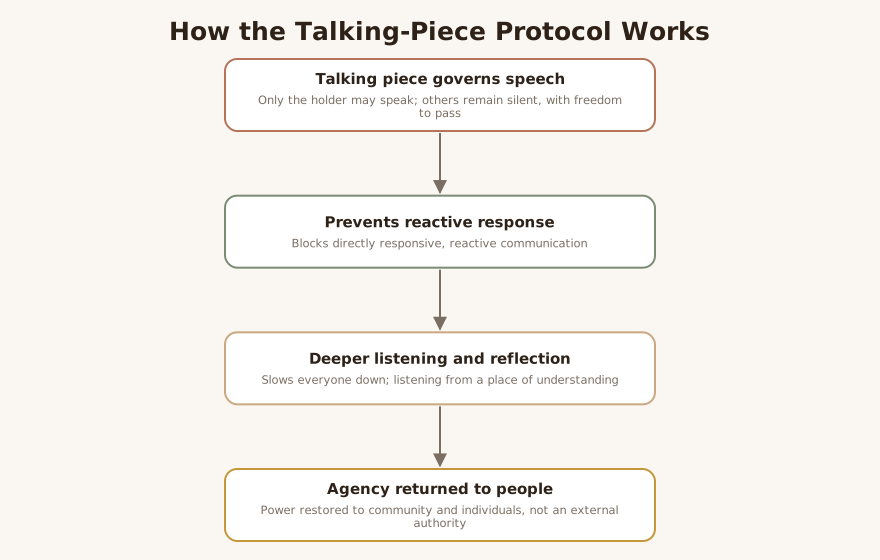
The defining principle is non-hierarchical, equal-standing participation: members sit in a circle and take turns speaking, with each person holding equal standing in the group 3. Speech is governed by a talking piece — often a sacred object such as an eagle feather or talking stick — and only the person holding it may speak while all others remain quiet 1. The talking piece typically circulates clockwise, and the holder receives complete silence, no interruption, and freedom to speak without time limits or to pass and not speak at all 4.
This protocol does specific work. By preventing reactive and directly responsive communication, the circle fosters deeper listening and reflection 1. The structure “slows everyone down and encourages them to listen from a place of understanding,” shifting participants away from defensiveness and toward authentic engagement 6. The form returns agency and power to the community and to individuals in a collective way, rather than externalizing it to an authority 6. Stated goals of the healing circle commonly include beginning the healing process, promoting understanding, preventing or solving problems, building trust, sharing common experiences, and learning from others about life 4.
Ceremony frames the work. Many circles open with smudging — a cleansing ceremony using sacred medicines and smoke — and open and close with communal prayer, sometimes while holding hands 4. Symbolic items such as an eagle feather, talking stick, candle, water, shell, or hand drum may be placed at the center 4. In secular restorative settings, the opening may instead be a breathing exercise, meditation, or poem, with participants placing meaningful objects like photos or written messages at a central focal point 6.
Interventions & Techniques
The core “intervention” is the disciplined practice of the round: the facilitator opens the space, frames a question or theme, and passes the talking piece so each person speaks in turn without cross-talk 6. A single circle may move through several rounds — a check-in round, a story or theme round, and a closing round — each governed by the same speaking protocol LLM.
The facilitator, often called the circle keeper or Elder, holds a distinctive role 4. The circle keeper sets ground rules, models appropriate self-disclosure, manages emotional content, and reminds participants of the protocols when needed 1. In restorative circles, facilitators model vulnerability and accountability by sharing their own experiences, signaling that the space is reciprocal rather than top-down 6. The keeper does not direct outcomes; the circle’s authority rests in the collective and in consensus rather than in the facilitator’s expertise 3.
Specific applications vary by purpose. Talking circles emphasize active and deep listening and serve teaching and healing functions 3. Sentencing and healing circles, in the justice context, build consensus on sentencing plans or facilitate victim and offender healing — separately or together — integrating tribal values and traditions 3. In substance use treatment, the talking circle has been framed as “healing through feeling,” foregrounding emotional expression as the mechanism of change 5.
LLM-generated illustrative example (not a guideline): A bereavement circle for six community members opens with the keeper lighting a candle and naming the purpose — to make room for grief. The talking piece passes once for check-in, then a second time around the theme “something I have not been able to say out loud.” Each person speaks uninterrupted; no one is fixed, advised, or interrupted. The keeper closes by passing the piece a final time for one word each, then extinguishing the candle. LLM
Evidence Base
The evidence base should be characterized honestly: the cultural and practice maturity is high and well-established, while the clinical research base is small, promising, and methodologically limited LLM. Circles have been practiced for generations and are firmly embedded in Indigenous healing, restorative justice, and community life 1. As a manualized intervention studied with controlled designs, however, the form remains under-researched LLM.
The most-cited clinical study comes from Mehl-Madrona and Mainguy’s primary-care implementation 1. Among 415 participants who attended four or more sessions, the circles produced statistically significant improvements (p < 0.001) in symptoms, daily functioning, and well-being on the MYMOP2 measure, with effect sizes ranging from 0.75 to 1.19 1. Those are large effect sizes by conventional standards LLM. The authors are candid about the limitations: the study lacked a control group, and results reflect only participants who completed four or more sessions, which likely biases findings toward more engaged individuals 1.
The practical takeaway is that circles show a strong signal of benefit in real-world settings, but the absence of randomized comparison and the self-selection of completers mean the form cannot yet claim the empirical status of a first-line evidence-based treatment for any specific disorder LLM. Clinicians should present circles to clients as a culturally grounded, promising practice rather than as a proven cure LLM.
Populations & Indications
Circles have been used primarily within Indigenous communities, addressing problems with drugs, alcohol, and mental health alongside common presenting issues such as musculoskeletal pain, family problems, stress, depression, and anxiety 1. As a form of group support, healing circles serve people struggling with addictions, violence, grief, and trauma 4. They are well suited to survivors of collective and historical trauma, where the wound is shared and the repair is relational rather than purely individual LLM.
Beyond Indigenous-specific settings, the circle form has been adapted for community and group members seeking connection and dialogue, for incarcerated and justice-involved populations through sentencing and healing circles, and for bereaved groups processing loss together 3. Restorative circles have also been used with people who have caused and experienced harm, restoring agency to those harmed by allowing them to express themselves directly and receive truthful answers 6. The form’s emphasis on belonging and voice makes it a natural fit for adolescents and at-risk youth, though specific evidence for that population is not detailed in the provided sources LLM.
Indications cluster where the therapeutic targets are isolation, disconnection, unspoken grief, shame, and ruptured relationships — conditions for which being witnessed without interruption is itself the intervention 6.
Problems-for-Work
Circles map onto several concrete problems-for-work that clinicians track in treatment LLM.
- Grief and bereavement. A circle gives mourners structured, uninterrupted space to voice loss and hear that others carry similar weight, normalizing grief through shared experience 4. Application: a standing grief circle where each round invites one memory or one unspoken feeling LLM.
- Substance use disorders. Framed as “healing through feeling,” circles foreground emotional expression that addiction often suppresses, complementing other recovery supports 5.
- Historical and intergenerational trauma. Circles locate healing in collective and cultural context, which individual therapy alone may not reach for community-level wounds 1.
- Social isolation and shame. Being heard in silence, without correction, counters shame and isolation by restoring the experience of belonging 6.
- Interpersonal conflict and reintegration needs. Peacemaking and sentencing circles build consensus and repair relationships rather than assigning blame, supporting reintegration into community 3.
- Posttraumatic stress and community trauma. The slowed, regulated pace of the circle and the safety of non-reactive listening can support trauma processing in a group field, though pacing must be managed carefully 6.
Contraindications, Cautions & Cultural Humility
The first and largest caution is cultural LLM. Healing and talking circles belong to specific Indigenous nations, and protocols vary meaningfully across communities — a point the practice traditions themselves explicitly acknowledge 4. Clinicians who are not Indigenous, or who work outside the originating community, should not present a circle as an authentic ceremonial practice they own; appropriating smudging, sacred objects, and ceremony without relationship, permission, or understanding is a real harm 4. Where possible, partner with Elders, knowledge-holders, or Indigenous-led organizations, and be transparent with clients about what is and is not being offered LLM.
Clinically, the open-ended, uninterrupted speaking protocol means strong emotional content can surface, and the circle keeper must be able to manage it 1. This makes circles less appropriate, without significant adaptation, for participants in acute crisis, those who are floridly psychotic, or those whose trauma may be retriggered by unstructured disclosure from others — situations the provided sources do not address in detail and that require clinical judgment LLM. The voluntary, no-pressure norm — the freedom to pass and not speak — must be genuinely honored, or the safety of the form collapses 4. Confidentiality and group agreements should be established explicitly before sensitive material is invited LLM.
Finally, circles are not a substitute for indicated individual treatment of acute psychiatric conditions; they are best positioned as an adjunct or community support rather than a standalone treatment for severe disorder LLM.
Treatment-Plan Suggestions & SMART Objectives
| Goal | SMART objective (example) | Mechanism |
|---|---|---|
| Reduce social isolation | Client will attend at least 6 of 8 weekly circle sessions over two months and report one new sense of connection by session 8 | Structured, equal-standing participation restores belonging and being heard 6 |
| Process grief | Client will voice one previously unspoken loss in circle within 4 sessions and rate distress before/after on a 0–10 scale | Uninterrupted witnessing and shared experience normalize and metabolize grief 4 |
| Support substance use recovery | Client will name one feeling underlying a craving in circle weekly for 6 weeks | “Healing through feeling” surfaces suppressed affect that drives use 5 |
| Reduce shame | Client will disclose one shame-linked experience in circle and report the group’s non-judgmental response by session 6 | Being heard in silence without correction counters shame 6 |
| Repair an interpersonal rupture | Client will participate in one facilitated peacemaking round and co-create one agreement within 3 sessions | Consensus and relationship focus replace blame 3 |
| Strengthen cultural connection | Client will participate in 4 culturally grounded circles co-led with a knowledge-holder over 8 weeks | Circle situates healing in cultural and collective context 1 |
| Improve emotional regulation in groups | Client will practice waiting for the talking piece and listening without interrupting across all sessions in a month | Non-reactive protocol slows arousal and builds tolerance for others’ affect 1 |
Common Misconceptions
A frequent misconception is that a talking circle is simply a “share circle” or any group sitting in a ring — but the form is a specific, ceremonially grounded practice with protocols around the talking piece, turn-taking, and the absence of cross-talk 1. Another is that the facilitator leads or directs outcomes; in fact the circle keeper holds space and models, while authority rests in the collective and in consensus 3. A third is that circles are primarily for “venting”; the structure is designed to produce deep listening and reflection rather than reactive expression 1.
Some assume circles are interchangeable with Western adversarial process when used in justice settings, but peacemaking explicitly centers community and family relationships, reintegration, restoration, support, and trust rather than legal liability and punishment 3. Finally, clinicians sometimes treat the ceremonial elements — smudging, sacred objects — as decorative; they are integral cultural practices that vary across communities and warrant respect rather than casual replication 4.
Training & Certification
There is no single universal certification for talking or healing circles, consistent with their status as a living cultural tradition rather than a proprietary, manualized modality LLM. In Indigenous contexts, the appropriate path is learning from Elders, circle keepers, and community knowledge-holders, with practice transmitted relationally and protocols varying by nation 4. The Native American Rights Fund’s Indigenous Peacemaking Initiative offers resources and teaching on peacemaking circle practice grounded in tribal traditions 3.
In the restorative justice field, foundational training is informed by texts such as Pranis, Stuart, and Wedge’s Peacemaking Circles: From Crime to Community, and by restorative practice organizations that train facilitators in circle keeping 2. For clinicians, the most defensible stance is to seek direct mentorship and partnership rather than to self-certify from a manual, and to be explicit about the limits of one’s training when offering circles LLM.
Key Terms
- Talking piece: A sacred or meaningful object — often an eagle feather or talking stick — that grants the holder the sole right to speak while others listen 1.
- Circle keeper / facilitator: The person who sets ground rules, models self-disclosure, manages emotional content, and holds the space without directing outcomes 1.
- Smudging: A cleansing ceremony using sacred medicines and smoke that often opens a healing circle 4.
- Hocokah: The Lakota term for “a sacred circle,” reflecting the practice’s spiritual grounding 1.
- Peacemaking circle: A circle process for resolving conflict through traditional values and consensus rather than adversarial verdicts 3.
- Sentencing / healing circle: Specialized justice circles that build consensus on sentencing or facilitate victim and offender healing 3.
- Healing through feeling: A framing of the talking circle in substance use treatment that foregrounds emotional expression as the mechanism of change 5.
Resources & Further Reading
▶ Watch — a video introduction to this concept:
- Introducing Healing Circles and Talking Circles into Primary Care — Mehl-Madrona & Mainguy, The Permanente Journal (2014)
- Peacemaking Circles: From Crime to Community — Pranis, Stuart & Wedge (Living Justice Press)
- Frequently Asked Questions About Peacemaking — Indigenous Peacemaking Initiative (NARF)
- Lesson: Healing Circles — Indigenous Health (eCampusOntario Pressbooks)
- Traditional ‘Talking Circle’ or ‘Healing Through Feeling’ — ATTC Network
- How Restorative Justice Circles Help People Heal — Center for Justice Innovation
Reflective / Supervision Questions
- What is my relationship to the Indigenous traditions this practice comes from, and do I have the standing, permission, or partnership to facilitate a circle authentically? 4
- Am I offering the full ceremonial form, a secular adaptation, or something in between — and have I been transparent with clients about which? 4
- How will I, as circle keeper, manage strong emotional content without taking over the group or violating the non-reactive protocol? 1
- For this client or group, is a circle an adjunct to indicated treatment, or am I treating it as a substitute for care that severe symptoms actually require? LLM
- How do I honor the freedom to pass while still inviting participation, and how do I protect confidentiality and group safety? 4
- When I present the evidence to clients or referrers, am I being honest that the clinical research is promising but methodologically limited? 1