
Type & Discipline
Affect attunement and vitality affects are paired theoretical constructs rather than a treatment modality, drawn from developmental psychology and infant observation research 1. They belong to the tradition of microanalytic infant research that emerged in the late twentieth century, in which slowed videotape of caregiver-infant interaction is examined frame by frame to characterize the moment-to-moment choreography of relating 3. The constructs sit at the intersection of developmental science, attachment theory, and psychoanalytic thinking about intersubjectivity, and they have been imported into adult psychotherapy as a way of describing the non-verbal, affective channel of the therapeutic relationship LLM.
Because they are descriptive constructs and not a manualized intervention, their clinical “use” is interpretive: they give clinicians a vocabulary and an observational lens for what happens in the implicit relational field, rather than a protocol to deliver LLM. This matters for evidence appraisal, because the maturity of the underlying developmental science is quite different from the maturity of any specific therapeutic technique built on top of it 5.
Creators & Lineage
The constructs are principally the work of Daniel Stern, an American psychiatrist, psychoanalyst, and infant researcher, articulated most fully in his 1985 book The Interpersonal World of the Infant 1. In that work Stern proposed a sequence of emerging “senses of self,” and located affect attunement within the development of a subjective self—the period (roughly 7 to 15 months) when the infant discovers that inner states can be shared with another mind 1.
Stern’s thinking grew out of, and fed back into, several lineages LLM. It draws on infant research and the empirical study of caregiver-infant exchange 3. It is in deep conversation with attachment theory, sharing a concern with how early relational experience shapes regulation and internal working models LLM. It is foundational to affect regulation theory, which treats the dyad as the infant’s external regulator before self-regulation comes online LLM. And it has been central to intersubjectivity and relational psychoanalysis, where the idea that two minds can share a feeling state without words reframed how analysts understand the implicit, non-interpretive action of treatment LLM. Later scholars such as Ammaniti and Ferrari extended Stern’s “vitality affects” toward contemporary neuroscience, linking them to mirror-neuron systems and to dynamic, cross-modal integration in the brain 3.
Core Principles
The first core idea is the vitality affect. Stern noticed that much of felt experience is not captured by the discrete, categorical emotions—joy, fear, anger, sadness—but by dynamic, kinetic qualities better described with words like surging, fading, fleeting, explosive, crescendo, bursting 3. These are the temporal contours of activation, the how of a feeling rather than its category 3. A baby reaching for a toy and a mother’s voice rising to greet her can share the same vitality contour even though the surface behaviors are entirely different 3.
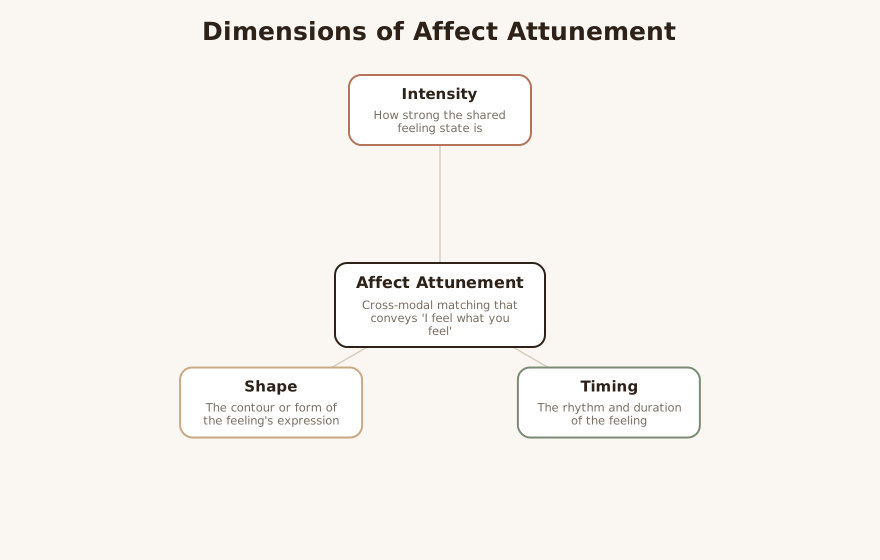
The second core idea is affect attunement itself: the caregiver’s behaviors that express the quality of a shared feeling state without imitating its exact behavioral expression 1. When a baby gives an exuberant arm-flap, a mother might answer not by flapping her own arm but with a rising “yeaaah!” that matches the burst’s intensity, timing, and shape 1. The message conveyed is “I feel what you feel”—a referent that is the inner state, not the outer act 1.
Stern specified that attunement typically matches along three recurrent dimensions: intensity (how strong), timing (rhythm and duration), and shape (the spatial or contour form of the act) 1. Crucially, the matching is cross-modal (amodal): the infant’s vocal burst can be met by a maternal gesture, the infant’s gesture by a maternal sound 3. This presupposes an innate amodal perception—the capacity to receive information in one sensory channel and translate it into another—so that vitality forms can transfer freely across modalities 3.
Interventions & Techniques
Although the constructs are descriptive, several derived practices follow naturally LLM. In dyadic and parent-infant work, the clinician observes and names the caregiver’s attunement behaviors, helps the caregiver notice the infant’s vitality contours, and supports cross-modal matching where it is absent or flattened 5. Slowed video review of interaction—video feedback—operationalizes this by letting caregiver and clinician watch matched and mismatched moments together 3.
In adult psychotherapy, attunement supplies a frame for the therapist’s implicit relational responsiveness: tracking the patient’s vitality—the rise and fall of affect in the room—and answering it in tone, tempo, prosody, and timing rather than only in content LLM. Stern’s concept of selective attunement is itself a quasi-intervention: caregivers (and therapists) inevitably attune to some states and not others, and this selectivity shapes which parts of inner experience feel shareable and which become private or split off 1. A related move is tuning—deliberate, slight over- or under-matching of intensity to up-regulate or down-regulate the other’s state 1.
LLM-generated illustrative example (not a guideline): A patient describes a loss in a flat, clipped voice. Rather than supplying interpretation, the therapist slows her own cadence and lets a quiet “mm” fall exactly on the patient’s exhale, matching the deflating contour. The patient’s eyes fill—an attuned, cross-modal answer to vitality reached the feeling that words had bypassed. LLM
Evidence Base
The maturity of these constructs is best described as established as developmental science but translational, not proven, as adult treatment ingredients 5. The descriptive base is robust: Stern’s microanalytic observations have been widely replicated in infant-research paradigms, and attunement reliably produces more infant gazing, smiling, and positive vocalization than mechanical imitation does 3. Vitality affects have also acquired a plausible neurobiological scaffold—mirror-neuron systems that encode action goals abstractly, and fMRI evidence implicating the dorsocentral insula in the perception of “vitality forms” across modalities 3.
The honest caveat is that this is convergent observational and neuroimaging evidence for the construct, not randomized evidence that attunement-based technique improves outcomes in adult or child psychotherapy 5. Reviews aimed at practitioners explicitly raise the “does it add to practice?” question, noting that translating a developmental observation into a defensible clinical method requires evidence the construct itself does not supply 5. Clinicians should therefore treat attunement as a well-grounded explanatory lens and a hypothesis-generating frame, while remaining candid that its incremental therapeutic value over established modalities is not yet demonstrated LLM.
Populations & Indications
The constructs were derived from infants and their caregivers, and parent-infant and parent-child dyads remain the most direct application 1. They extend naturally to parents learning to read and respond to a child’s states, and to children whose regulation is still scaffolded by adults 3. In adult work, the lens is most useful with individuals in psychotherapy where the implicit relational and affective channel carries much of the work, and with survivors of early relational trauma whose histories of chronic misattunement shaped their capacity to feel felt LLM.
Indications are best understood as states where the non-verbal regulation of affect is central: presentations marked by affect dysregulation, difficulty experiencing states as shareable, or relational disconnection 3. The constructs are also clinically generative with people who communicate largely non-verbally—an emphasis in learning-disability and profound-disability settings, where attunement offers a channel of contact when language is limited 5.
Problems-for-Work
Affect regulation difficulties. Attunement frames dysregulation as a dyadic, not purely intrapsychic, phenomenon—the patient’s capacity to modulate vitality was co-built and can be re-scaffolded through matched, then gently re-tuned, responses 1.
Emotional misattunement and empathic failures in therapy. The construct names the rupture precisely: a mismatch in intensity, timing, or shape, or attunement to content while missing vitality, which the patient registers as not being met 1.
Attachment difficulties and developmental trauma. Chronic selective misattunement is a developmental mechanism by which whole regions of inner experience become unshareable; this gives the clinician a concrete target for repair 1.
Alexithymia and difficulties with intersubjectivity. Where categorical emotion words are unavailable, working at the level of vitality contours—the felt rise and fall—can re-open access to affect that names cannot yet reach 3.
LLM-generated illustrative example (not a guideline): A teen described as “shut down” cannot label feelings but moves with abrupt, staccato vitality. The clinician matches that staccato quality in pacing and gesture before any naming, and over sessions the teen begins to attach words to the contours that were finally met. LLM
Contraindications, Cautions & Cultural Humility
There are no formal contraindications to a descriptive lens, but there are real cautions LLM. The first is over-reach: attunement is a hypothesis about implicit process, and clinicians should resist treating intuitive “matching” as validated technique or as a substitute for an evidence-based modality 5. The second is misattunement masquerading as attunement: a therapist’s match may reflect the therapist’s own state, and confident “I feel what you feel” claims can override the patient’s actual experience LLM.
Cultural humility is essential because the vitality dimensions Stern described—intensity, timing, and expressive shape—are read through culturally patterned display rules LLM. Tempo, eye contact, vocal intensity, and acceptable affective range vary across cultures, neurotypes, and individuals, so what reads as “attuned” to one person may read as intrusive or cold to another LLM. With autistic and neurodivergent patients in particular, the clinician should calibrate to the person’s own baseline and explicit feedback rather than to a normative template of “warm” matching LLM. Attunement is offered and checked, not assumed LLM.
Treatment-Plan Suggestions & SMART Objectives
| Goal | SMART objective (example) | Mechanism |
|---|---|---|
| Improve dyadic affect regulation | Over 8 sessions, caregiver will identify and verbally name 3 of the infant’s vitality contours during video-feedback review in 4 consecutive sessions | Cross-modal matching strengthens the dyad’s regulatory loop 3 |
| Repair empathic ruptures in therapy | Within 6 weeks, client will signal a felt mismatch (intensity/timing/shape) to the clinician at least twice, with collaborative repair each time | Naming misattunement makes the implicit channel explicit and reparable 1 |
| Widen the range of shareable affect | Over 10 sessions, client will bring 2 previously “private” affective states into session and have them met without minimization | Counters selective misattunement that rendered states unshareable 1 |
| Build access to affect in alexithymia | Within 12 weeks, client will describe felt experience using 3 vitality terms (e.g., surging, fading) on a self-monitoring log weekly | Vitality contours offer a route to affect when category labels are absent 3 |
| Increase non-verbal contact | Over 6 sessions, clinician and client will establish 2 reliable cross-modal “match” signals tracked in session notes | Amodal matching conveys “I feel what you feel” without words 1 |
| Strengthen caregiver attunement | Within 8 weeks, caregiver will demonstrate intensity-matched response to infant cues in 70% of coded video segments | Matched intensity/timing supports infant positive affect and engagement 3 |
| Reduce co-dysregulation in trauma work | Over 12 sessions, client will use a tuning-based down-regulation cue with the clinician in 3 high-arousal moments | Deliberate under-matching of intensity can down-regulate arousal 1 |
Common Misconceptions
“Attunement is imitation.” It is not: imitation copies the surface behavior, whereas attunement matches the inner state’s dynamic features, often in a different modality, which is precisely why infants respond to it differently than to mechanical mirroring 3.
“Vitality affects are just emotions.” They are the temporal contour of activation—the how—and can be present in any behavior regardless of which categorical emotion, if any, is involved 3.
“Good caregivers attune to everything.” Attunement is inherently selective; the clinically important fact is which states get matched and which do not, because that selectivity shapes the child’s sense of what is shareable 1.
“Attunement is a proven therapy technique.” It is an established developmental construct with a translational, not yet evidence-graded, role as an adult or child treatment ingredient, and should be presented to teams and patients with that honesty 5.
Training & Certification
There is no certification in “affect attunement” as such, because it is a construct rather than a branded modality LLM. Foundational learning comes from primary reading—Stern’s The Interpersonal World of the Infant—and from the secondary literature linking vitality affects to neuroscience 13. Practical competence is usually acquired inside trainings that embed these ideas: parent-infant and infant-mental-health programs, video-feedback interaction-guidance methods, and relational, intersubjective, or emotion-focused psychotherapy trainings that teach tracking of implicit affect LLM. Supervision with microanalytic video review is the most direct route to developing the observational skill, since attunement and misattunement are far easier to recognize on slowed playback than in real time 3.
Key Terms
Affect attunement — caregiver behaviors that express the quality of a shared feeling state without imitating its exact behavioral form, conveying “I feel what you feel” 1.
Vitality affects — dynamic, kinetic qualities of experience (surging, fading, bursting) describing the contour of activation rather than a categorical emotion 3.
Cross-modal / amodal matching — answering a state expressed in one sensory channel with a response in another, relying on innate amodal perception 3.
Selective attunement — the caregiver’s inevitable matching of some states and not others, shaping which parts of experience feel shareable 1.
Misattunement — a mismatch in intensity, timing, or shape (or attuning to content while missing vitality) that the other registers as not being met 1.
Tuning — deliberate slight over- or under-matching of intensity to up- or down-regulate the other’s state 1.
Resources & Further Reading
▶ Watch — a video introduction to this concept:
- Stern, D. (1985). The Sense of a Subjective Self: Affect Attunement — The Interpersonal World of the Infant (PEP-Web)
- Stern & Dore (1985), Affect Attunement — chapter PDF (Rutgers course readings)
- Ammaniti & Ferrari (2013). Vitality Affects in Daniel Stern’s Thinking — A Psychological and Neurobiological Perspective (PMC)
- Ammaniti & Ferrari (2013) — PubMed record
- Affect attunement: adding to practice? (National Elf Service)
Reflective / Supervision Questions
- When you review a recent session, can you locate a moment where you attuned to content but missed the patient’s vitality—and what cued you, or failed to cue you, in the room? LLM
- Which affective states do you find yourself selectively attuning to with this patient, and which do you reliably skip past? LLM
- How do you distinguish a genuine cross-modal match from a projection of your own state onto the patient? LLM
- With patients whose tempo, intensity, or display norms differ from yours culturally or neurologically, how do you check whether your “attunement” is actually being received as such? LLM
- Where in your work are you presenting attunement as established technique when it is better held as a hypothesis-generating lens? LLM