
Type & Discipline
Allostasis is a theoretical model in affective neuroscience and physiology, not a treatment modality LLM. The term names a principle of biological regulation: the brain achieves stability through anticipatory change rather than reactive error-correction 1. “Body budgeting” is the accessible reframing of this principle popularized for emotion science, casting the brain as a manager of the body’s energy resources 3. For clinicians, it belongs to the family of stress and regulation neuroscience and sits alongside predictive-processing and interoception frameworks LLM. It is descriptive and explanatory — a lens for understanding why fatigue, anxiety, and somatic distress arise — rather than a protocol you deliver LLM. Its clinical value is conceptual: it reframes symptoms that patients experience as “irrational” as predictable outputs of a resource-management system LLM.
Creators & Lineage
The term “allostasis” was coined by Peter Sterling and Joseph Eyer in 1988 to describe regulation that maintains stability through change LLM. Sterling later articulated the mature model, framing allostasis as predictive regulation in which the brain anticipates needs and mobilizes resources before deficits occur 1. Lisa Feldman Barrett extended the principle into emotion science, introducing “body budgeting” as a plain-language synonym and embedding it within her constructed theory of emotion 34. In her account, the brain runs a continuous internal model of the body’s energy demands and constructs affect and emotion partly from these predictions 4. Adjacent frameworks include the allostatic-load model, which describes the cumulative biological cost of chronic allostatic demand, and predictive-processing accounts of interoception LLM. Polyvagal theory is sometimes grouped with these regulation frameworks in clinical settings, though it rests on a different and more contested physiological basis LLM.
Core Principles
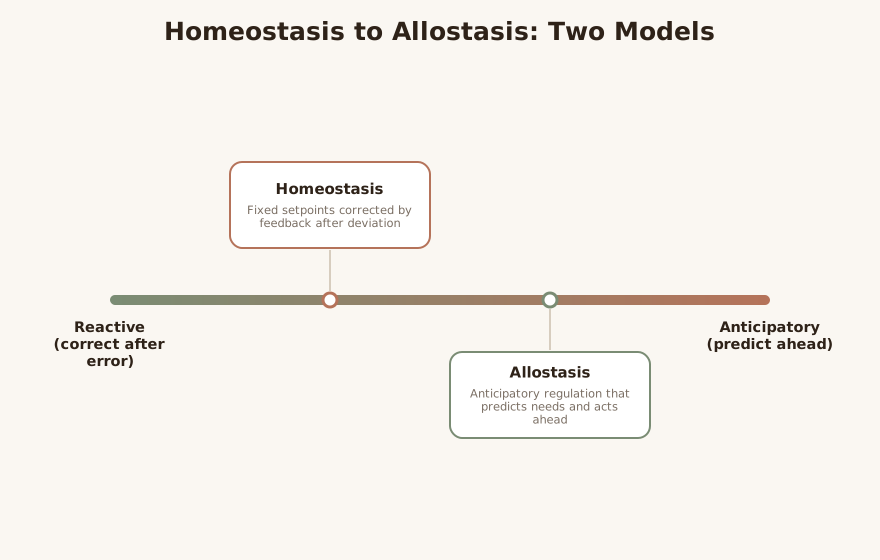
The foundational claim is that regulation is anticipatory: the brain predicts physiological needs and acts ahead of them rather than waiting for an error to correct 1. This distinguishes allostasis from classical homeostasis, which assumes fixed setpoints maintained by feedback after deviation occurs 1. Sterling describes anticipatory regulation as more efficient because it reduces the magnitude and frequency of physiological imbalances, coordinates systems to remove bottlenecks, allows organs to share resources rather than each holding reserves, and learns from past errors to reduce future ones 1. Barrett frames the same machinery as a budget: the brain forecasts demand for glucose, oxygen, salt, and water and redistributes them dynamically across bodily systems 3. A “body budget” can run a deficit, and chronic deficit registers as fatigue, distress, or malaise 6. Crucially, the model treats the brain’s primary job as regulating the body, with thought and emotion riding on top of that metabolic task 4.
The allostasis framework has also been mapped onto large-scale brain organization, with research describing it as a core feature of hierarchical gradients across cortex — agranular limbic regions issuing predictions that propagate toward sensory regions 2. This gives the model neuroanatomical grounding beyond metaphor 2.
Interventions & Techniques
There is no “allostasis therapy”; the model informs how a clinician frames and sequences existing interventions LLM. The most direct application is psychoeducation: explaining symptoms as outputs of an overdrawn body budget can reduce shame and reframe distress as a solvable resource problem LLM. Barrett’s clinical translation emphasizes “deposits and withdrawals” — sleep, nutrition, movement, social connection, and recovery as deposits; chronic stress, poor sleep, and rumination as withdrawals 45. Interventions therefore cluster around restoring the budget: protecting sleep, regularizing meals, graded movement, and reducing avoidable predictive load 56. A second cluster targets interoception — the sensing of internal bodily states — by building accurate, non-catastrophic interpretation of bodily signals, which intersects with interoceptive exposure in anxiety treatment LLM. A third uses the lens to reattribute meaning: a racing heart can be read as the brain’s prediction of demand rather than evidence of catastrophe LLM. These are delivered inside recognized modalities, not as freestanding techniques LLM.
LLM-generated illustrative example (not a guideline): A clinician working with a burned-out nurse reframes her 4 p.m. crash not as personal weakness but as a depleted body budget — too many withdrawals (broken sleep, skipped meals, hypervigilance on shift) against too few deposits. The intervention becomes concrete: protect a sleep window, eat on schedule, and schedule micro-recovery, rather than “try to relax” LLM.
Evidence Base
The maturity label here applies to the model, not to a treatment LLM. Allostasis as a theory of predictive regulation is established and influential within physiology and affective neuroscience, with a developed theoretical literature 1 and neuroimaging work locating allostatic prediction within the brain’s hierarchical organization 2. As an explanatory framework it is well-cited and integrated into mainstream accounts of emotion and interoception 4. However, there is no body of randomized controlled trials testing “body budgeting” or “allostasis-informed therapy” as a standalone intervention LLM. The clinically actionable behaviors it points toward — sleep regularization, physical activity, nutrition, stress reduction, interoceptive work — have their own independent evidence bases within CBT, behavioral activation, and lifestyle medicine, but that evidence is not evidence for the allostasis frame itself LLM. Clinicians should present body budgeting as a useful, neuroscience-grounded heuristic that motivates evidence-based behaviors, not as an empirically validated therapy in its own right LLM.
Populations & Indications
The model is most clinically useful where energy regulation, bodily signals, and chronic load are central to the presentation LLM. People with chronic illness and chronic fatigue often find the budget frame validating, because it locates fatigue in genuine physiological cost rather than in motivation or character LLM. Adults with anxiety disorders benefit from reattributing interoceptive sensations as predictions rather than threats LLM. People with chronic pain may use it to understand how a depleted budget and a predicting brain amplify pain signals, while taking care not to imply the pain is imaginary LLM. Caregivers and people with burnout often present with sustained budget deficits and few deposits, making the deposits-and-withdrawals language a practical planning tool 5. The framework also speaks to insomnia, somatic symptom disorder, and stress-related and depressive presentations, where metabolic depletion and disrupted interoception are prominent LLM. It is an adjunct lens across these groups, not a diagnosis-specific protocol LLM.
Problems-for-Work
In generalized anxiety disorder, the work is reinterpreting bodily arousal as the brain’s anticipatory budgeting rather than danger, paired with interoceptive tolerance — for example, helping a client label a tight chest as “my brain predicting demand” before reaching for catastrophic meaning LLM. In burnout and caregiver depletion, the work is auditing withdrawals and deliberately scheduling deposits — sleep, meals, movement, connection — to restore a chronically overdrawn budget 5. In chronic fatigue and chronic illness, the work is pacing and energy budgeting that respects real physiological limits while reducing the secondary anxiety that further drains resources LLM. In insomnia, the work is treating sleep as the single largest deposit and protecting it behaviorally 6. In somatic symptom disorder and interoceptive dysfunction, the work is rebuilding accurate, non-threatening interpretation of internal signals LLM. In depression, the frame supports behavioral activation by recasting low energy as budget state rather than fixed deficiency LLM.
LLM-generated illustrative example (not a guideline): A client with GAD keeps a brief log: situation, bodily sensation, automatic prediction (“something is wrong”), and an alternative (“my body budget is mobilizing for a demand”). Over weeks, the alternative interpretation competes more successfully with the catastrophic one LLM.
Contraindications, Cautions & Cultural Humility
Because allostasis is a model rather than a procedure, the cautions concern misapplication, not patient selection LLM. The gravest error is using “it’s just your brain’s predictions” or “your body budget is off” to minimize or invalidate genuine pain, fatigue, or organic pathology; this can be experienced as gaslighting, particularly by people with contested chronic illnesses and within disability communities LLM. The frame must never substitute for appropriate medical workup of somatic symptoms LLM. Clinicians should also resist overextending the metaphor into pseudoscientific certainty — the model is a useful heuristic, not a measured account of any individual’s metabolism LLM. Cultural humility matters: norms around rest, productivity, and what counts as a legitimate “deposit” vary across cultures, socioeconomic positions, and caregiving roles, and not all clients have the material latitude to add deposits on demand LLM. Recommendations to “rest more” or “sleep better” can be tone-deaf to clients facing economic precarity, shift work, or systemic stressors that no individual budget adjustment will fix LLM.
Treatment-Plan Suggestions & SMART Objectives
| Goal | SMART objective (example) | Mechanism |
|---|---|---|
| Reduce body-budget deficit | Client protects a consistent 7-hour sleep window on 6 of 7 nights for 4 weeks, logged daily | Restores the largest metabolic deposit, lowering chronic allostatic demand 6 |
| Build interoceptive accuracy | Client completes a daily sensation-and-interpretation log for 3 weeks, distinguishing prediction from threat | Recalibrates interpretation of internal signals away from catastrophic appraisal LLM |
| Increase deposits | Client schedules and completes 3 recovery activities per week (movement, connection, rest) for 6 weeks | Adds resources to an overdrawn budget, countering depletion 5 |
| Reduce avoidable withdrawals | Client identifies and reduces one recurring rumination trigger, tracked weekly for 4 weeks | Lowers predictive load that drains the budget 4 |
| Reattribute arousal | Client applies a reframe script to anxious bodily sensations in 80% of logged episodes over 4 weeks | Replaces threat appraisal with anticipatory-regulation framing LLM |
| Pace energy in chronic illness | Client uses an activity-pacing plan with rest breaks on 5 of 7 days for 6 weeks | Matches expenditure to real physiological capacity, reducing crash cycles LLM |
| Stabilize routine | Client eats at 3 regular times daily on 5 of 7 days for 4 weeks | Smooths metabolic supply, reducing prediction error and crash episodes 6 |
Common Misconceptions
The first misconception is that allostasis simply replaces or refutes homeostasis; rather, it reframes regulation as predictive and resource-matched while feedback still operates 1. A second is that “body budget” is mere metaphor with no scientific grounding — the principle has theoretical and neuroimaging support locating predictive regulation in the brain’s hierarchical organization 2. A third is treating body budgeting as a validated therapy; it is a framework that motivates evidence-based behaviors, not a tested treatment LLM. A fourth, clinically dangerous, misconception is that calling symptoms “predictions” means they are not real — predictions produce genuine, felt bodily states and genuine suffering 4. A fifth conflates the model with polyvagal theory or other regulation brands; they are distinct, and allostasis does not depend on those more contested claims LLM. Finally, some assume “deposits” are always within the client’s control, ignoring the structural and economic realities that constrain rest and recovery LLM.
Training & Certification
There is no certification in allostasis or body budgeting, and no credentialing body governs its use, because it is a scientific framework rather than a proprietary modality LLM. Clinicians typically encounter the concept through affective-neuroscience coursework, through Lisa Feldman Barrett’s writing and public talks, and through accessible explainers 45. The practical path is to absorb the framework as background theory and then apply it within whatever evidence-based modality the clinician is already trained and credentialed in LLM. No additional scope of practice is created by using the lens; competence in the host modality — CBT, ACT, behavioral activation, interoceptive exposure — remains the relevant qualification LLM.
Key Terms
Allostasis — stability through anticipatory change; regulation that predicts needs and mobilizes resources before deficits occur 1. Homeostasis — the contrasting model of maintaining fixed setpoints by correcting deviations after they happen 1. Body budget — Barrett’s plain-language term for the brain’s ongoing prediction and allocation of the body’s energy resources 3. Predictive regulation — the principle that the brain governs the body by forecasting demand rather than reacting to error 1. Allostatic load — the cumulative biological cost of sustained allostatic demand LLM. Interoception — the sensing and interpretation of internal bodily states, on which budget predictions partly rely 4. Deposits and withdrawals — the clinical shorthand for inputs that replenish (sleep, nutrition, movement, connection) versus drain (chronic stress, poor sleep, rumination) the body budget 5.
Resources & Further Reading
▶ Watch — a video introduction to this concept:
- Allostasis: a model of predictive regulation (Sterling, Physiology & Behavior, 2012) — PubMed
- Allostasis as a core feature of hierarchical gradients in the human brain (Network Neuroscience, 2022) — PMC
- Allostasis — How Emotions Are Made (notes by Lisa Feldman Barrett)
- How Emotions Are Made: The Secret Life of the Brain (Lisa Feldman Barrett)
- Dr. Lisa Feldman Barrett: How to Understand Emotions — Huberman Lab
- Body Budget: Intelligent Energy Management (Sewanee Psychology)
Reflective / Supervision Questions
- When you introduce the body-budget frame, how do you confirm the client experiences it as validating rather than dismissive of their suffering? LLM
- How do you distinguish a symptom that warrants medical workup from one you are willing to frame as a budget or prediction issue? LLM
- In which of your cases might “add more deposits” be impossible given the client’s material circumstances, and how do you adapt? LLM
- Are you using allostasis as a rationale that motivates an evidence-based modality, or have you let it drift into being the treatment itself? LLM
- How do you keep the metaphor honest — useful heuristic versus overclaimed neuroscience — when a client wants certainty? LLM
- What would tell you the frame is not helping this particular client, and what would you switch to? LLM