
Type & Discipline
Intensive Short-Term Dynamic Psychotherapy (ISTDP) is a brief, experiential psychodynamic treatment within clinical psychology and psychiatry 7. It belongs to the family of short-term dynamic therapies derived from psychoanalysis but reorganized around the rapid, active mobilization of warded-off emotion rather than free association and prolonged interpretation 7. The defining stance is therapeutic activity: rather than waiting for material to surface, the clinician works moment-to-moment to identify and address the patient’s defenses against feeling 3. Where classical psychoanalytic work “assiduously avoids interpretation until such time as the unconscious is open,” ISTDP front-loads emotional contact and reserves interpretation until previously unconscious affect has actually passed into awareness 7. The treatment is typically delivered in weekly individual sessions, often with an extended initial trial therapy, and is designed to be short in duration relative to open-ended dynamic work 4. In one large tertiary service, the average course was roughly 10 sessions, with a median of 5 2.
Creators & Lineage
ISTDP was developed by Habib Davanloo, a Montreal psychiatrist who video-recorded therapy sessions across the 1960s through the 1990s to study which interventions actually overcame patients’ resistance to emotional contact 7. His method extends the cathartic and psychoanalytic tradition while incorporating the Triangle of Conflict, a framework popularized by David Malan and originally proposed by Henry Ezriel 7. John Bowlby’s attachment theory supplied an empirical and developmental backbone, positing that early disruptions in the caregiving bond create lasting vulnerability to psychiatric disorder and relational difficulty 7. Patricia Coughlin (Della Selva) later systematized and disseminated the techniques for contemporary practitioners, and Allan Abbass has been a primary force in building the modern evidence base and training infrastructure 71. The lineage thus runs from Breuer and Freud’s cathartic method, through psychoanalytic and short-term dynamic psychotherapy, into an affect-focused, attachment-informed brief treatment 7.
Core Principles
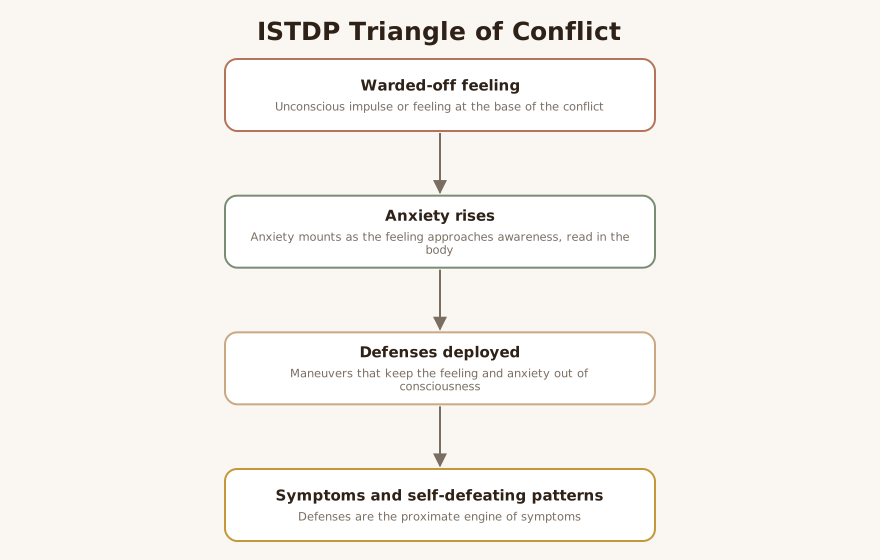
ISTDP organizes the clinical picture around two heuristics. The Triangle of Conflict links three elements: impulse or feeling at the base, the anxiety that rises as that feeling approaches awareness, and the defenses deployed to keep the feeling and anxiety out of consciousness 7. The Triangle of Persons maps how relational patterns formed with past figures (typically caregivers) replay in current relationships and in the relationship with the therapist 7. The core therapeutic theory holds that unconscious feelings generate anxiety, which defenses then manage, and that those defenses are the proximate engine of symptoms and self-defeating patterns 7.
A central clinical skill is reading the patient’s anxiety pathway in the body, since unconscious emotional activation is visible before it is verbalized 7. The therapist monitors physical anxiety signals such as sighing respiration, hand-wringing, and muscle tension as a real-time gauge of how much affect is being mobilized 73. The aim is to keep anxiety within a workable range while removing defenses, so that the warded-off feeling can be experienced rather than discharged into symptoms 3. Davanloo described a predictable central dynamic sequence that unfolds when resistance is worked through: mixed feelings toward the therapist, a breakthrough of rage with reduction in anxiety, guilt about the rage, deeper grief about thwarted attachment, and finally yearning for closeness 7. In this model, guilt that turns rage back on the self is treated as a key ingredient in symptom formation 7.
Interventions & Techniques
ISTDP uses a graded set of active interventions matched to the patient’s level of resistance and fragility 7. Pressure invites the patient toward authentic feeling through focused questions that decline to accept defensive narrative (for example, asking precisely how the patient felt toward a person who humiliated them) 7. Challenge is a two-stage move: first clarification, helping the patient see their own defense in operation, then an exhortation to relinquish that defense and contact the true feeling 7. Clarification must precede challenge, because challenging a defense the patient has not yet recognized is experienced as criticism 7. Head-on collision is reserved for moments of crystallized, massive resistance; it is an urgent summary of the stakes that simultaneously appeals to the patient’s will, the therapeutic task, and the alliance, naming how the defensive “wall” keeps both patient and therapist from the patient’s own feelings 7.
Throughout, the therapist titrates intervention against anxiety regulation, dialing back when anxiety spills into cognitive-perceptual disruption or excessive somatization and pressing forward when the patient can tolerate rising affect 3. Interpretation is deferred until affect has actually broken through, and frequently the patient generates their own linking insight once the unconscious is “open” 7. This emphasis on experienced emotion over explanation is what distinguishes ISTDP from cognitively oriented work, which targets distorted thoughts; ISTDP instead treats distorted cognition as itself a defensive product of blocked feeling 7.
LLM-generated illustrative example (not a guideline): A client describes a painful confrontation with a parent while smiling and intellectualizing. The therapist first clarifies the defense (“I notice you smile as you describe something that sounds devastating”), then applies gentle pressure toward the actual feeling, while watching for sighing breaths that signal anxiety. As the smile drops and grief and anger surface together, the client spontaneously connects the affect to a long-standing pattern of withdrawal in relationships. LLM
Evidence Base
The evidence base for ISTDP is established but methodologically mixed, and clinicians should hold both facts at once 1. The 2012 systematic review and meta-analysis by Abbass, Town, and Driessen pooled 21 studies (10 controlled, 11 uncontrolled) across mood, anxiety, personality, and somatic disorders 1. Pre- to post-treatment effect sizes were large, ranging from Cohen’s d of 0.84 for interpersonal problems to 1.51 for depression, with gains generally maintained at follow-up and signals of cost-effectiveness in eight studies 1. In controlled comparisons, ISTDP outperformed control conditions on general psychopathology (d ≈ 1.18) 1. The authors were explicit that study quality was variable and called for more rigorous, targeted trials 1.
A large naturalistic effectiveness study in a tertiary psychotherapy service analyzed 412 patients (mean age 41.5, 59% female), about half treated by trainees 2. The most common presentations were somatoform disorder (≈59%), anxiety disorders (≈53%), and major depression (≈39%), with substantial overlap of functional somatic conditions such as chronic headache, pain disorder, IBS, and fibromyalgia 2. Large effects emerged on the Brief Symptom Inventory (d = 0.87) and the Inventory of Interpersonal Problems (d = 0.83) 2. Notably, 37.2% of patients experienced a major “unlocking of the unconscious” during therapy, and this was associated with significantly larger outcomes, offering process support for the model’s central mechanism 2. Honesty requires noting the limits: this study had no control group, and roughly 39-48% of patients were missing post-treatment data, which can inflate apparent effects 2.
Populations & Indications
ISTDP has been applied across a broad range of adult presentations 1. The strongest accumulated data are in adults with mood and anxiety disorders, including major depressive disorder, generalized anxiety, and panic 17. It is frequently used with somatic and medically unexplained symptoms and functional neurological (conversion) presentations, which were the single largest diagnostic group in the tertiary-service sample 27. It is also indicated for personality disorders and broader character pathology, where Cluster B and C presentations were well represented in naturalistic data 27. Because the model targets the defenses underlying self-defeating and relational patterns, it is applied to interpersonal difficulties, emotional avoidance, and treatment-resistant conditions where prior symptom-focused work has stalled 71. Unresolved grief fits naturally within a framework that explicitly mobilizes blocked attachment-related affect 7.
Problems-for-Work
- Emotional avoidance and somatization: When feeling is converted into bodily symptoms, the work targets the defense of somatization while regulating the anxiety pathway, so affect can be experienced consciously rather than expressed physically 72.
- Self-defeating patterns and character pathology: ISTDP frames repetitive self-sabotage as defensively driven, working through the guilt-laden rage Davanloo placed at the center of symptom formation 7.
- Interpersonal difficulties: The Triangle of Persons makes the in-session relationship a live laboratory for the patterns the patient repeats elsewhere 7.
- Treatment-resistant depression and anxiety: Where symptom-focused work has plateaued, the emotion-focused approach offers an alternative mechanism, with meta-analytic effects for depression among the largest reported 1.
LLM-generated illustrative example (not a guideline): A client with recurrent panic and a “stuck” course of skills-based treatment is helped to notice that panic spikes whenever anger toward a partner nears awareness. Working at the Triangle of Conflict, the therapist helps the client tolerate the underlying anger and grief, and panic frequency declines as the warded-off feeling becomes accessible. LLM
Contraindications, Cautions & Cultural Humility
ISTDP’s most intensive techniques are not for everyone, and matching intervention to fragility is itself a core clinical judgment 4. The active, anxiety-mobilizing techniques such as challenge and head-on collision are intended for patients who can tolerate rising affect; applying them to fragile, dissociation-prone, or severely regressed patients can flood anxiety into cognitive-perceptual disruption and is contraindicated without first building anxiety-regulating capacity 34. Pressure works well with less-traumatized patients but meets and can harden resistance in more disturbed individuals if mistimed 7. Acute psychosis, significant suicide risk, and states requiring containment rather than confrontation call for stabilization first 4LLM. Premature challenge before clarification is experienced as criticism and can rupture the alliance 7.
Cultural humility is essential because the method’s confronting style and its assumptions about emotional expression, anger toward attachment figures, and directness are culturally loaded LLM. Norms around displaying anger toward parents, accepting therapist directiveness, and somatic versus verbal expression of distress vary widely, and what reads as “resistance” may be a culturally appropriate stance LLM. The therapist should calibrate intensity, language, and pacing to the individual rather than imposing a fixed sequence 3LLM.
Treatment-Plan Suggestions & SMART Objectives
| Goal | SMART objective (example) | Mechanism |
|---|---|---|
| Increase awareness of defenses | Within 6 sessions, client will identify and name at least 3 of their own recurring defenses in session without prompting | Clarification within the Triangle of Conflict 7 |
| Improve anxiety regulation | Within 8 weeks, client will report tolerating rising emotion in 2 of 3 sessions without escalation to panic or shutdown | Titration of the anxiety pathway 3 |
| Reduce somatic symptom burden | Over 10 sessions, client will show a clinically meaningful drop on a standardized somatic-symptom measure | Replacing somatization with conscious affect experience 2 |
| Access and tolerate warded-off feeling | Within 12 sessions, client will experience and verbalize a previously avoided feeling (e.g., grief, anger) toward a key figure | Working through defenses to mobilize affect 7 |
| Reduce depressive symptoms | Over the treatment course, client will achieve a reliable reduction on a depression measure (e.g., PHQ-9) | Resolving guilt-laden rage turned against the self 71 |
| Improve interpersonal functioning | Within 12 weeks, client will reduce one specific self-defeating relational pattern by a self-rated 50% | Linking past and present via the Triangle of Persons 72 |
| Consolidate insight into change | By termination, client will independently connect in-session emotional breakthroughs to outside-life patterns in 2 documented instances | Patient-generated interpretation after unlocking 7 |
Common Misconceptions
A frequent misconception is that “short-term” means a fixed brief protocol; in practice course length varies enormously, from a few sessions to many dozens, driven by the patient’s resistance and capacity rather than a session cap 2. Another is that ISTDP is simply aggressive confrontation; the techniques are graded and anxiety-regulated, and confrontation that is not preceded by clarification is considered a technical error 7. A third is that it is cathartic venting for its own sake; the goal is conscious experience and integration of feeling within the alliance, not mere discharge 7. Some assume the large published effect sizes settle the question of efficacy, but many trials are small, unblinded, or uncontrolled, and much of the literature originates from within the ISTDP community, so independent replication remains a live need 17. Finally, ISTDP is not anti-cognitive; it simply locates distorted cognition downstream of blocked affect rather than as the primary cause 7.
Training & Certification
ISTDP is a skill-intensive method historically taught through video-recorded sessions, since direct observation of moment-to-moment defense and anxiety is central to learning it 7. Davanloo taught the approach at McGill University, and training is now available internationally through university and post-graduate programs as well as dedicated institutes offering videos, exercises, and supervised “core training” groups 74. Skill development typically involves multi-year immersion with case video review under supervision, because the in-the-moment titration of anxiety and reading of bodily signals are difficult to acquire from text alone 45. Allan Abbass’s Reaching Through Resistance is a widely used advanced-technique reference for clinicians developing these skills 5.
Key Terms
- Triangle of Conflict: Feeling/impulse, anxiety, and defense, the core map of intrapsychic conflict 7.
- Triangle of Persons: Current relationships, the therapeutic relationship, and past (attachment) figures, showing where patterns repeat 7.
- Central dynamic sequence: The predictable progression (mixed feelings, rage, guilt, grief, yearning) seen as resistance is worked through 7.
- Pressure / Challenge / Head-on collision: The graded active interventions used to address defenses and mobilize affect 7.
- Clarification: Helping the patient recognize a defense before it is challenged 7.
- Anxiety pathway: The bodily channel through which unconscious anxiety is expressed and monitored in session 7.
- Unlocking the unconscious: A breakthrough of previously warded-off feeling, associated in naturalistic data with larger outcomes 2.
Resources & Further Reading
▶ Watch — a video introduction to this concept:
- Abbass, Town & Driessen (2012) systematic review and meta-analysis (PubMed)
- Davanloo’s ISTDP in a tertiary psychotherapy service (PMC4157301)
- What Is Intensive Short-Term Dynamic Psychotherapy? (Allan Abbass, Reaching Through Resistance)
- ISTDP — EFPT Psychotherapy Guidebook
- Reaching Through Resistance: Advanced Psychotherapy Techniques (Abbass, 2015)
- Allan Abbass — ISTDP: What is it and what’s the treatment plan? (YouTube)
- Intensive short-term dynamic psychotherapy (Wikipedia)
Reflective / Supervision Questions
- How do I distinguish workable anxiety from anxiety that is fragmenting a patient’s cognition, and what do I change in real time when I see the latter? 3
- When I label a behavior “resistance,” have I considered whether it is culturally appropriate caution, a rupture in the alliance, or a sign I challenged before clarifying? 7LLM
- Given that much of the evidence is unblinded or uncontrolled, how do I communicate ISTDP’s likely benefit to patients honestly without overselling it? 1
- Which of my patients are good candidates for active, emotion-mobilizing work, and which need stabilization and anxiety-regulation first? 4
- Am I reserving interpretation until affect has genuinely broken through, or am I explaining the patient’s experience to them prematurely? 7
- How would reviewing video of my own sessions change my read of the moment-to-moment interplay of feeling, anxiety, and defense? 7