
Type & Discipline
Short-Term Dynamic Psychotherapy (STDP) is a family of time-limited, psychodynamically grounded treatments practiced within clinical psychology and psychiatry 3. Its defining departure from open-ended psychoanalytic work is an active, focused therapist stance: rather than waiting for material to emerge, the clinician works deliberately toward a circumscribed dynamic focus and toward the patient’s avoided emotional experience 5. Intensive Short-Term Dynamic Psychotherapy (ISTDP), the most procedurally specified member of the family, was developed by Habib Davanloo as “an accelerated method of psychodynamic treatment” refined over roughly forty years of clinical work 5.
Within the broader landscape, STDP and ISTDP sit inside what is now often called the experiential dynamic therapies (EDT) — a grouping of emotion-focused, attachment-informed dynamic models united by their emphasis on in-session affective experience 4. The International Experiential Dynamic Therapy Association (IEDTA) functions as the global professional home for this cluster, framing these methods as “evidence-based psychodynamic” approaches and supporting their training and dissemination 4. For the practicing clinician, the practical signature is this: STDP is brief by design, relational and affect-focused in method, and explicitly tied to a formulation of how the patient avoids feeling 6.
Creators & Lineage
The short-term dynamic tradition has three principal architects, working largely in parallel from the late 1960s onward. David Malan contributed the conceptual scaffolding most clinicians still use — the triangle of conflict and the triangle of person — which organize how warded-off feeling, anxiety, and defense relate across the patient’s current, past, and therapeutic relationships 6. Peter Sifneos developed an anxiety-provoking short-term approach for circumscribed neurotic conflict. Habib Davanloo built the most aggressive and procedurally detailed variant, ISTDP 3 6.
Davanloo’s central methodological innovation was empirical and unusual for psychodynamic work: in the 1970s he “began video recording treatment sessions to discern key events” in cases where patients showed durable gains, then applied those interventions prospectively across new case series and followed them to test durability 5. From this videotape research he identified a reproducible central dynamic sequence of unlocking the unconscious 5. The lineage thus draws on classical psychoanalytic theory while reorganizing it around observable in-session phenomena, attachment-trauma–related emotion, and brevity 5. Conceptually it shares DNA with attachment theory and with the broader emotion-focused and experiential-dynamic currents now coordinated under IEDTA 4.
Core Principles
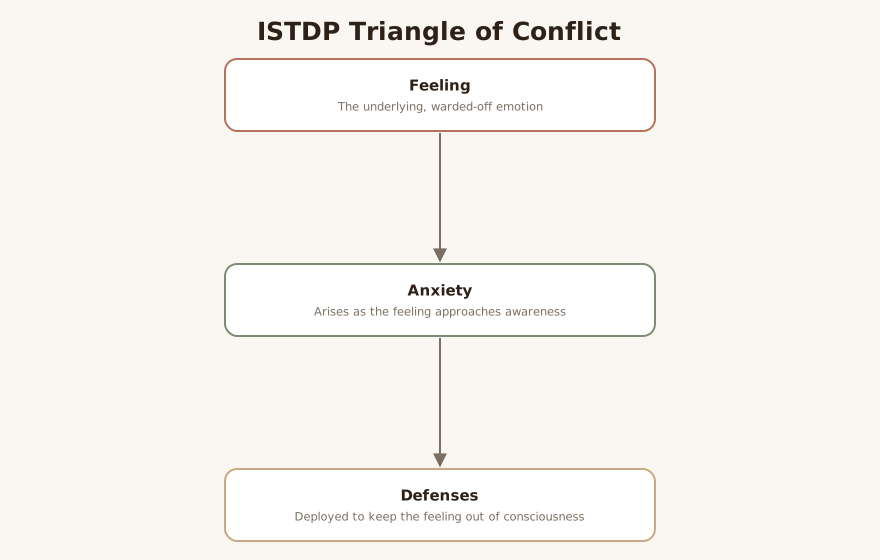
Two triangles do most of the organizing work. The triangle of conflict describes the interaction of underlying feeling, the anxiety that arises as the feeling approaches awareness, and the defenses the patient deploys to keep the feeling out of consciousness 6. The triangle of person maps how these emotional patterns recur across current relationships, past (often parental) relationships, and the transference relationship with the therapist 6. Together they let the clinician locate, in real time, what the patient is feeling, what they fear, and how they avoid — and to link the here-and-now to historical attachment figures 6.
A distinctive Davanloo contribution is the psychodiagnosis of anxiety pathways. He described three discharge routes for unconscious anxiety, each pairing with characteristic defenses 5. Striated (voluntary) muscle anxiety presents as hand-clenching and sighing respirations, typically alongside isolation of affect and intellectualization 5. Smooth (involuntary) muscle anxiety affects the gut, vasculature, and airways — producing migraine, irritable bowel syndrome, or hypertension — and pairs with instant repression of emotion and depressed presentations 5. Cognitive-perceptual disruption (visual blurring, mental confusion, even hallucination) pairs with projection and projective identification 5. This assessment is not academic: it dictates dosage. A patient with striated-muscle tension and isolation of affect can tolerate “a direct mobilization of the unconscious,” whereas a patient who goes flat with repression or cognitive disruption first needs work to “build capacity to tolerate unconscious anxiety” before the unconscious is approached 5.
The therapeutic engine is the interplay of two opposing forces: the unconscious therapeutic alliance, which seeks to bring avoided emotion forth, and unconscious resistance, which keeps it buried 5. Effective treatment helps the alliance dominate the resistance, at which point anxiety and defense drop and warded-off emotion — and the memories attached to it — become accessible 5.
Interventions & Techniques
ISTDP unfolds through an identifiable sequence. Inquiry and pressure open the work: the therapist asks the patient to identify and stay present with underlying feeling, which “mobilizes complex feelings related to past attachments” and, in turn, mobilizes anxiety and defense in the room 5. Pressure is not coercion; it is sustained, focused invitation to feel rather than to think or detach 5.
LLM-generated illustrative example (not a guideline): A patient describing a fight with her partner narrates events rapidly and analytically. The therapist gently presses: “I can hear the story — but right now, what is the feeling that comes up as you tell me this?” The shift from narrative to here-and-now affect is pressure in action LLM.
As complex transference feelings rise, secondary resistance against them crystallizes — visible as broken eye contact, slowing, and closing posture 5. Clarification names the cost of the defense (“notice you’re going away from me and slowing down”), and challenge invites the patient to set the defense aside (“so if you don’t detach or think, let’s see how you feel here”) 5. The head-on collision — a confronting clarification of how the patient’s resistance is defeating their own stated goals — is a hallmark Davanloo intervention used when defenses are entrenched 3.
When pressure and challenge succeed, the patient reaches a somatic experience of the warded-off emotion — Davanloo described rage as heat or energy rising from the body up to the chest, neck, and arms; guilt-about-rage as upper-body constriction and remorse; grief as a softer experience centered on loss 5. At this point anxiety and resistance drop “dramatically and abruptly,” and in this open state patients access images and memories of formative events 5. Recapitulation and consolidation then follow: repeated review of what was learned “strengthens the alliance and weakens the resistance,” and post-arousal patient insight is itself an independent predictor of outcome 5. The whole arc is what Davanloo called the central dynamic sequence of unlocking the unconscious 5.
Evidence Base
The evidence base for short-term dynamic therapy and ISTDP is best described as established but heterogeneous — broader than skeptics assume, but not uniformly high-quality across every indication LLM.
The strongest pooled signal is in somatic and functional presentations. Abbass and colleagues’ systematic review and meta-analysis of STDP for somatic disorders covered 23 studies — 13 randomized controlled trials and 10 pre-post case series 1. Significant effects on physical symptoms appeared in 21 of 23 studies (about 91%), on psychological symptoms in 11 of 12, on social-occupational functioning in 16 of 19 (~76%), and on reduced healthcare utilization in 7 of 9 (~78%) 1. The treatment group showed “a 54% greater treatment retention” than controls, and meta-analytic gains on physical, psychiatric, and social-adjustment outcomes were maintained at long-term follow-up — though random-effects modeling attenuated some effect sizes, and the authors explicitly called for higher-quality cost and effectiveness research 1.
Effectiveness (real-world) data come from a tertiary psychotherapy service that treated 412 patients (59% female, mean age 41.5) 2. Diagnoses were mixed and often comorbid: somatoform disorder in 58.7%, anxiety disorders in 53.4%, major depression in 39.3%, alongside chronic headache, pain disorder, IBS, and fibromyalgia 2. Treatment was genuinely brief — a mean of 10.2 sessions (median 5) 2. Pre-post effect sizes were large: Cohen’s d = 0.87 on the Brief Symptom Inventory and d = 0.83 on the Inventory of Interpersonal Problems 2. Critically for theory, the unlocking the unconscious phenomenon occurred in 37.2% of patients and predicted significantly better outcomes independent of other factors 2. The caveat for interpretation: this is uncontrolled effectiveness data, vulnerable to expectancy and natural-course confounds, and nearly half the patients were treated by trainees 2.
Honest framing for clinicians: ISTDP is a credentialed, manualizable approach with replicated process-outcome findings (e.g., focal adherence and accurate early formulation relate to outcome; cumulative early confrontation relates to reduced later defense) 5. But the literature is dominated by one research group, mixes RCTs with case series, and is uneven across diagnoses 1 2.
Populations & Indications
STDP and ISTDP are adult-oriented treatments 2. The most consistently supported indications are somatic and medically unexplained / functional symptoms — chronic headache, pain disorder, IBS, fibromyalgia, and conversion presentations — where the model’s explicit theory of emotion-into-body offers both a formulation and a target 1 2 5. Anxiety disorders, including generalized anxiety and panic, and depression are core indications, well represented in both the effectiveness cohort and the meta-analytic samples 2 6. The approach is also applied to personality disorders and character pathology, where Davanloo’s graded handling of resistance is most relevant 5. ISTDP is marketed and used for trauma-related conditions and relationship difficulties as well, consistent with its attachment-trauma framing 6. Across these, the unifying clinical picture is a patient whose difficulties are maintained by avoidance, repression, or suppression of conflicted emotion 5 6.
Problems-for-Work
The following presentations map cleanly onto the triangle of conflict, and each suggests a concrete in-session target LLM:
- Emotional avoidance and repression — the prototypical problem-for-work; the therapist tracks defenses (intellectualization, detachment) and presses toward the feeling beneath the anxiety 5.
- Inhibited anger and assertiveness — Davanloo’s somatic mapping of rage makes anger a frequent focus; helping a chronically deferential patient access and tolerate angry impulses toward attachment figures is a paradigmatic ISTDP move 5.
- Somatic symptom disorder and conversion — where smooth-muscle anxiety or motor conversion signals repressed emotion channeled into the body before reaching awareness 5.
- Unresolved grief — accessed as the “softer,” loss-focused emotion distinguished from guilt and rage during emotional breakthrough 5.
- Interpersonal conflict and self-defeating patterns — addressed through the triangle of person, linking transference reactions to recurring relational templates 6.
- Treatment-resistant depression — where prior failures may reflect untouched warded-off affect; the smooth-muscle / repression pathway is a common substrate 2 5.
LLM-generated illustrative example (not a guideline): A man with treatment-resistant depression presents flat and over-rational. Rather than pushing immediately for emotion, the clinician — recognizing a repression / smooth-muscle profile — first builds his capacity to notice and tolerate anxiety before approaching the underlying grief and anger LLM.
Contraindications, Cautions & Cultural Humility
The single most important caution is built into the method: anxiety regulation must precede mobilization 5. Patients who respond to pressure by going flat — with repression, cognitive-perceptual disruption, or projective defenses — should not be pushed toward the unconscious until capacity is built, or the clinician risks fragmentation, dissociation, or destabilization 5. The fragility of the cognitive-perceptual pathway (confusion, blurring, hallucination) is a clear signal to slow down and regulate rather than intensify 5. Active psychosis, severe dissociation, and acute crisis are situations where confrontive pressure is inappropriate without substantial modification LLM.
The technique’s confronting style — challenge, head-on collision, persistent pressure on defenses — carries real iatrogenic potential in unskilled hands; this is precisely why structured training and supervision are emphasized 3 5. Cultural humility matters here: direct emotional confrontation, the very expression of anger, and even sustained eye contact carry different meanings across cultures, and a patient’s “defense” may be a culturally adaptive norm rather than pathology LLM. Brevity itself is not universally appropriate — complex trauma, severe comorbidity, or limited safety may call for longer, more stabilizing work LLM. Much of the strongest evidence comes from a single research center and from uncontrolled or trainee-delivered cohorts, so clinicians should hold outcome claims with appropriate humility 1 2.
Treatment-Plan Suggestions & SMART Objectives
| Goal | SMART objective (example) | Mechanism |
|---|---|---|
| Increase emotional awareness | Within 6 sessions, patient will name the primary feeling beneath anxiety in ≥3 in-session moments per session | Pressure toward feeling; tracking the triangle of conflict 5 |
| Reduce reliance on defenses | Over 8 sessions, patient will identify and set aside intellectualization/detachment in-session on ≥50% of clarifications | Clarification and challenge of resistance 5 |
| Improve anxiety tolerance | Within 4 sessions, patient will sustain attention to bodily anxiety for ≥60 seconds without shifting to rumination | Capacity-building before mobilization (anxiety regulation) 5 |
| Access and tolerate inhibited anger | Over 10 sessions, patient will report and stay with angry impulses toward an attachment figure in ≥2 sessions | Somatic experiencing of rage in the central dynamic sequence 5 |
| Resolve a circumscribed grief | Within 12 sessions, patient will engage grief affect (loss-focused) without escalating somatic symptoms in ≥3 sessions | Emotional breakthrough; distinguishing grief from guilt/rage 5 |
| Reduce somatic symptom burden | Over 12 weeks, patient will report ≥30% reduction in targeted somatic complaint and ≤1 unplanned medical visit/month | Emotional processing reducing smooth-muscle discharge 1 5 |
| Improve interpersonal functioning | By session 12, patient will show measurable IIP improvement and report ≥2 assertive interpersonal acts | Triangle of person; transference-informed insight 2 6 |
| Consolidate insight | Each session, patient will recapitulate one emotion-to-pattern link aloud before close | Recapitulation/consolidation; post-arousal insight as outcome predictor 5 |
Common Misconceptions
“ISTDP is just aggressive confrontation.” The confronting techniques are real, but they are deployed only after psychodiagnosis confirms the patient can tolerate them; for repression- or projection-dominant patients, the work is capacity-building, not pressure 5. “Brief means superficial.” The model targets unprocessed attachment-trauma–related emotion directly, and the mean course in real-world data is around 10 sessions precisely because the focus is sharp, not because the work is shallow 2 5. “It’s not evidence-based — it’s old psychoanalysis.” Davanloo’s method was built from systematic videotape research, and there is a meta-analytic and process-outcome literature, even if heterogeneous 1 5. “The breakthrough is the cure.” Unlocking the unconscious predicts better outcome but occurs in only about a third of cases, and consolidation/recapitulation after arousal is itself essential to durable change 2 5. “It’s only for neurotic, high-functioning patients.” The effectiveness data span somatoform, personality, and depressive presentations, including comorbid and complex cases 2.
Training & Certification
ISTDP is a skill-intensive method whose practitioners train through structured programs, supervision, and — characteristically — review of one’s own videotaped sessions, mirroring Davanloo’s own research method 3 5. The European Federation of Psychiatric Trainees’ guidebook situates ISTDP within psychiatric and psychotherapy training curricula, reflecting its uptake in formal training settings 3. At the field level, the International Experiential Dynamic Therapy Association (IEDTA) serves as the global professional organization “dedicated to the development, training, and dissemination of Experiential Dynamic Therapies,” coordinating education, research, and practitioner directories across the EDT family that includes ISTDP 4. Clinicians seeking competence should expect a multi-year apprenticeship model with close supervision rather than a brief workshop credential LLM.
Key Terms
- Triangle of conflict — the relationship among warded-off feeling, anxiety, and defense 6.
- Triangle of person — recurring emotional patterns across current, past, and transference relationships 6.
- Central dynamic sequence / unlocking the unconscious — Davanloo’s reproducible sequence giving direct access to unresolved unconscious emotion 5.
- Pressure — focused effort encouraging the patient to identify and experience underlying emotion in the present 5.
- Clarification — naming the patient’s defense and its cost 5.
- Challenge — inviting the patient to relinquish the defense 5.
- Head-on collision — confronting how the patient’s resistance defeats their own goals 3.
- Anxiety pathways — striated muscle, smooth muscle, and cognitive-perceptual disruption 5.
- Unconscious therapeutic alliance vs. unconscious resistance — the opposing forces the treatment works to rebalance 5.
- Complex transference feelings — mixed appreciation and irritation toward the therapist, echoing attachment-trauma emotion 5.
Resources & Further Reading
▶ Watch — a video introduction to this concept:
- Abbass, Kisely & Kroenke — Short-term psychodynamic psychotherapy for somatic disorders: systematic review and meta-analysis (PubMed)
- Davanloo’s ISTDP in a tertiary psychotherapy service: effectiveness and unlocking the unconscious (PMC)
- Intensive Short-Term Dynamic Psychotherapy (ISTDP) — EFPT Psychotherapy Guidebook
- Abbass & Town — Key Clinical Processes in ISTDP (PDF)
- International Experiential Dynamic Therapy Association (IEDTA) — About
- ISTDP (Intensive Short-Term Dynamic Psychotherapy) — TherapyRoute
Reflective / Supervision Questions
- How do I distinguish a patient who can tolerate direct mobilization from one who needs anxiety-regulation first — and what specific signs (sighing vs. flatness vs. confusion) am I actually tracking? 5
- When I apply pressure, am I inviting feeling or imposing my agenda? How would I know the difference in the moment? 5
- Where might my patient’s “defense” be a culturally adaptive norm rather than pathology, and how does that change my formulation? LLM
- Given that unlocking occurs in only about a third of cases, how do I define success when no dramatic breakthrough happens? 2
- How honestly am I representing the evidence base — established but heterogeneous and group-dominated — to my patient and in my notes? 1 2
- After an emotional breakthrough, am I doing enough recapitulation and consolidation, or am I treating the catharsis as the endpoint? 5