
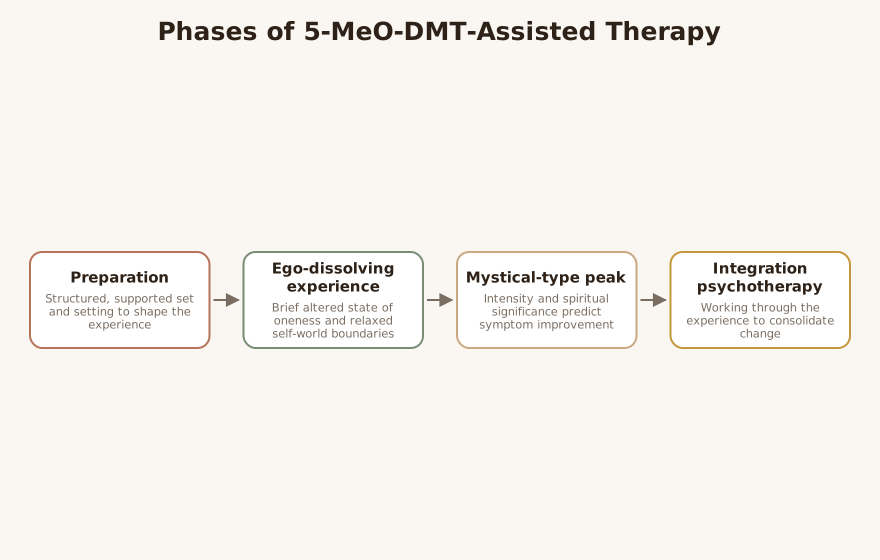
5-MeO-DMT-assisted therapy is an investigational treatment in which a short-acting, intensely ego-dissolving tryptamine is administered within a structured psychotherapeutic container of preparation and integration. The compound can be derived synthetically or from the secretion of the Sonoran Desert toad (Bufo alvarius), and is most often vaporized or inhaled 3. Its defining clinical feature is speed: peak effects arrive within seconds and resolve within roughly 30 minutes, compressing what other psychedelics deliver over many hours 3.
Type & Discipline
This is a psychedelic-assisted therapy modality sitting at the intersection of psychiatry, psychopharmacology, and psychotherapy LLM. As with psilocybin- and MDMA-assisted treatments, the drug is not conceived as a standalone medication but as a catalyst delivered inside a therapeutic relationship and protocol LLM. A central, honest caveat frames everything below: the controlled human evidence concerns drug administration, while the psychotherapeutic wrapper around dosing remains largely uncontrolled and unproven 26. Whether benefit derives from the molecule, the psychological support, or their interaction is explicitly unresolved in the literature 3.
Creators & Lineage
There is no single founder of 5-MeO-DMT-assisted therapy; the modality emerged from underground and naturalistic group practice that was later studied empirically LLM. Its clinical lineage borrows directly from psychedelic-assisted psychotherapy more broadly, including psilocybin- and MDMA-assisted models and the transpersonal-psychology tradition that frames mystical experience as therapeutically meaningful LLM. Much early clinical knowledge came from epidemiological survey work, notably Davis and colleagues’ study of users in a structured naturalistic group setting 15. Pharmaceutical development has since formalized delivery, with companies advancing standardized vaporized and injectable formulations for psychiatric indications 3.
Core Principles
The organizing principle is induction of a brief but profound altered state characterized by ego dissolution, described as a sense of oneness and relaxed boundaries between self and world, typically without the vivid visual imagery of related psychedelics 3. A second principle is the centrality of the mystical-type experience itself: across naturalistic data, the intensity of the mystical experience and its rated spiritual significance predicted symptom improvement, while acute challenging effects did not 1. A third principle is that set and setting govern outcomes, with structured, supported environments associated with stronger mystical and fewer challenging experiences 3. Finally, the short duration and absence of acute tolerance permit individualized, same-day dose escalation to reliably reach a peak experience 23.
Interventions & Techniques
In trial and naturalistic protocols, the intervention unfolds in three phases LLM. Preparation establishes intention, rapport, and expectations before any dosing 7. The dosing session is medically and psychologically monitored; in the GH001 program a single day used up to three escalating vaporized doses (6, 12, 18 mg) spaced about three hours apart, escalating only if a peak experience was not reached and patient and physician agreed 2. Because effects begin within 5-10 seconds and resolve within 5-30 minutes, sessions are markedly shorter than psilocybin or MDMA work 2. Integration follows, helping the person make meaning of the experience; the PTSD case combined body-scan meditation and post-experience integration discussion under clinical oversight 7. A separate, sub-perceptual approach is also under study: a sublingual microdosing regimen given weekly that modulates brain activity without producing full psychedelic effects 4.
Evidence Base
The evidence base is genuinely emerging and should be presented to patients as such 6. The strongest controlled signal is a Phase 1/2 open-label trial of vaporized GH001 in 16 patients with treatment-resistant depression, where an individualized escalating-dose regimen produced MADRS remission in 87.5% at day 7, with no serious adverse events and unchanged vital signs and ECG at 1 and 3 hours 2. Naturalistic survey data are supportive but weaker: among users reporting prior diagnoses, about 80% reported depression improvement and 79% anxiety improvement, with gains tied to mystical-experience intensity 15. Real-world signal for PTSD rests on a single longitudinal case, with the authors themselves stressing it is non-generalizable and relied on clinically unaccepted methods 7. A randomized, double-blind, placebo-controlled study of sublingual microdoses established short-term safety and tolerability without demonstrating full psychedelic or established efficacy effects 4. All sources converge on uncontrolled study designs, small samples, recall bias, and unknown durability as core limitations 13.
Populations & Indications
Studied and proposed populations center on adults with treatment-resistant depression, the focus of the only controlled efficacy trial to date 2. Naturalistic data describe people with depression and severe anxiety 1. A documented case extends interest to survivors with chronic, treatment-resistant PTSD who have failed prolonged exposure, cognitive processing therapy, and pharmacotherapy 7. Cross-sectional self-report further suggests perceived benefit in substance use disorders and anxiety, and the rapid format has prompted interest in existential and end-of-life distress where time and stamina are limited 3. None of these indications is yet supported by adequately powered controlled trials 36.
Problems-for-Work
Clinically, the modality is being explored for affective, anxiety, trauma, and existential presentations LLM.
- Treatment-resistant depression: the lead controlled indication, with rapid remission observed within hours in early data 2.
LLM-generated illustrative example (not a guideline): A patient with depression unresponsive to three antidepressant trials might, in a research setting, use preparation sessions to clarify intentions before a monitored dosing day, then integrate the experience into behavioral activation over subsequent weeks LLM.
- PTSD: explored where standard trauma therapies have failed, with one case showing a 75% PCL-5 reduction sustained to 12 months 7.
- Anxiety and demoralization: naturalistic improvement signals exist, plausibly mediated by shifts in self-other boundaries 13.
Contraindications, Cautions & Cultural Humility
The 5-HT2A component carries sympathomimetic potential to raise heart rate and blood pressure, so cardiovascular screening is prudent even though the controlled trial found vital signs unaffected 32. Rare psychotic reactions have been reported, supporting exclusion of personal or family histories of psychosis and bipolar disorder 36. Experiences are difficult to predict and can be overwhelming, and the PTSD case noted late-onset night terrors as a possible delayed risk 67. Self-administration without clinical safety controls is a recognized hazard, and toad-derived material has unknown dose and purity 7. Cultural humility also requires acknowledging that Bufo alvarius faces conservation pressure, and that toad-secretion smoking is a recent twentieth-century practice rather than an ancient Indigenous tradition, a point often misrepresented LLM.
Treatment-Plan Suggestions & SMART Objectives
| Goal | SMART objective (example) | Mechanism |
|---|---|---|
| Reduce depressive symptom burden | Patient reduces PHQ-9 by ≥5 points over 6 weeks of integration therapy following a monitored dosing session | Rapid mood shift plus meaning-making consolidation 2 |
| Strengthen integration of the experience | Patient completes weekly integration sessions for 8 weeks and logs 3 insights applied to daily life | Translating acute mystical content into durable change 1 |
| Lower trauma-related avoidance | Patient resumes 2 previously avoided activities within 12 weeks | Reduced threat reactivity post-experience 7 |
| Improve emotional self-monitoring | Patient records mood and triggers daily, reviewed biweekly | Stabilizing gains between/after sessions LLM |
| Reduce anxiety interference | Patient lowers GAD-7 by ≥4 points over 8 weeks | Shift in self-other boundary and rumination 13 |
| Build safety and informed consent | Patient and clinician complete cardiovascular and psychiatric screening before any research dosing | Risk mitigation for sympathomimetic and psychotic events 3 |
| Sustain relapse prevention | Patient develops a written maintenance plan within 4 weeks of dosing | Consolidating short-acting drug effects via psychotherapy 6 |
Common Misconceptions
A frequent misconception is that strong therapeutic benefit requires a frightening or “challenging” trip; naturalistic data instead link improvement to mystical-experience intensity, not to challenging effects 1. Another is that 5-MeO-DMT and DMT are interchangeable, whereas 5-MeO-DMT tends to produce ego dissolution with little visual imagery and binds with far higher affinity to the 5-HT1A receptor 3. A third is that toad-secretion smoking is an ancient ceremonial lineage, when it is a recent practice raising both authenticity and conservation concerns LLM. Finally, the rapid antidepressant signal is sometimes read as proven, when current data remain early and largely uncontrolled 6.
Training & Certification
There is no established, accredited certification pathway for 5-MeO-DMT-assisted therapy, reflecting its investigational and Schedule I status LLM. In trial settings, dosing occurs under medical and psychological monitoring rather than by a credentialed standalone modality 2. The AJP commentary underscores that clinical implementation will require infrastructure for safety monitoring and support given unpredictable experiences and rare psychotic reactions 6. Until controlled evidence and regulatory approval mature, clinicians are best positioned to develop competence in general psychedelic preparation and integration psychotherapy within their lawful scope LLM.
Key Terms
- Ego dissolution: loss of the ordinary sense of self, experienced as oneness or relaxed self-world boundaries 3.
- Mystical-type experience: a peak state whose intensity predicts reported symptom improvement 1.
- Individualized dosing regimen (IDR): same-day escalating doses titrated to reach a peak experience 2.
- Peak experience (PE) score: the trial threshold (≥75) used to decide whether to escalate dosing 2.
- Microdosing: sub-perceptual sublingual dosing that modulates brain activity without full psychedelic effects 4.
Resources & Further Reading
▶ Watch — a video introduction to this concept:
- The epidemiology and naturalistic outcomes of 5-MeO-DMT use (Davis et al.)
- Phase 1/2 trial of vaporized 5-MeO-DMT (GH001) in treatment-resistant depression
- The clinical pharmacology and potential therapeutic applications of 5-MeO-DMT
- Safety and tolerability of sublingual microdoses of 5-MeO-DMT (RCT)
- Johns Hopkins: Fast-acting psychedelic associated with improvements in depression/anxiety
- Benefits and Challenges of Ultra-Fast, Short-Acting Psychedelics in the Treatment of Depression
- 5-MeO-DMT for post-traumatic stress disorder: a real-world longitudinal case study
Reflective / Supervision Questions
- How do I communicate to a patient that the controlled evidence here covers drug administration, not the surrounding therapy, without either over-selling or dismissing their interest? LLM
- When a patient asks about toad-derived 5-MeO-DMT, how do I address legality, safety, dose uncertainty, and conservation honestly? 7
- What screening would I require for cardiovascular risk and psychosis history before supporting any research referral? 3
- How do I hold the tension between rapid symptom relief and the thin durability evidence in my treatment planning? 6
- Where does my own scope of practice end, and how do I refer responsibly given this modality’s investigational status? LLM