
Type & Discipline
Psilocybin-assisted therapy is a manualized treatment modality that combines a small number of supervised, high-dose psilocybin sessions with structured psychotherapeutic support delivered before, during, and after dosing LLM. It sits at the intersection of psychiatry and psychotherapy: the pharmacological agent is a controlled compound requiring medical screening and monitoring, while the active clinical work is delivered through psychological preparation, in-session support, and post-session integration LLM. It belongs to the broader family of psychedelic-assisted therapies, which share a common architecture in which a psychoactive substance is administered as a catalyst within a deliberately constructed psychotherapeutic container rather than as a standalone medication LLM. The modality is investigational in most jurisdictions and is currently practiced primarily within clinical trials and a small number of regulated state or compassionate-access programs LLM.
Creators & Lineage
Contemporary psilocybin-assisted therapy grew out of a second wave of academic psychedelic research that began in the early 2000s, after decades of regulatory dormancy following the criminalization of psychedelics LLM. Roland Griffiths and colleagues at Johns Hopkins were central to re-establishing rigorous human research, and their work on psilocybin for cancer-related distress helped legitimize the field 4. The Johns Hopkins Center for Psychedelic and Consciousness Research has been a hub for studies of psilocybin in depression, addiction, and existential distress 5. Robin Carhart-Harris, working in the United Kingdom, advanced both the clinical trials and the neuroscientific theory underpinning the modality, including the influential trial comparing psilocybin to escitalopram for depression 2.
Conceptually, the modality draws on several lineages LLM. Its emphasis on acceptance, willingness to contact difficult internal experience, and values-based meaning-making echoes acceptance and commitment therapy LLM. Its cultivation of present-moment, non-judgmental awareness during and after sessions draws directly on mindfulness-based interventions LLM. And its interest in self-transcendent, unitive, or “mystical-type” states links it to transpersonal psychology, a tradition that took altered states of consciousness as legitimate objects of clinical interest LLM.
Core Principles
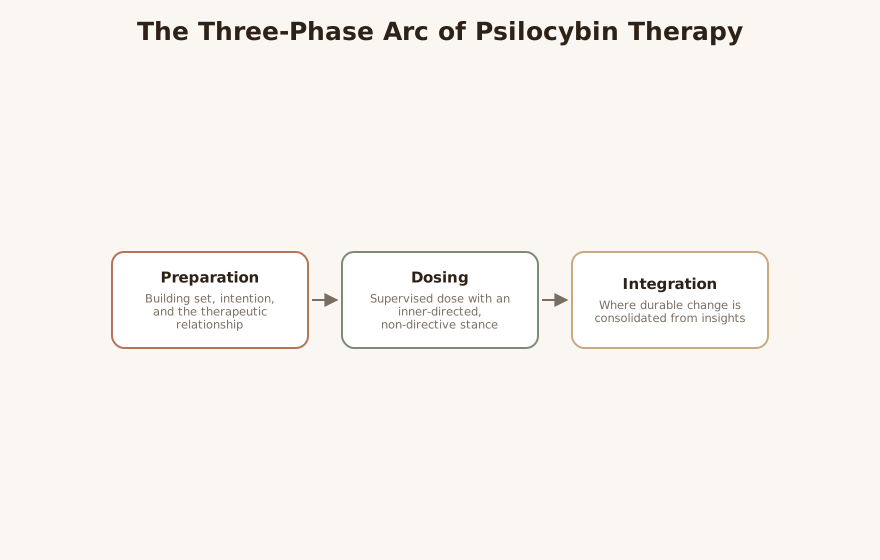
The organizing principle of psilocybin-assisted therapy is that the drug is necessary but not sufficient: therapeutic benefit is understood to arise from the interaction of the pharmacology with the psychological “set” (mindset, intention, expectancy) and “setting” (physical environment and interpersonal support) LLM. Treatment is structured as a three-phase arc of preparation, dosing, and integration, with the dosing session bracketed by psychotherapy on both sides LLM. Across protocols this typically involves one to three psilocybin sessions embedded within preparation and integration work 6.
A second principle is the inner-directed, non-directive stance during dosing: the clinician’s role is to support whatever emerges rather than to steer content, often inviting the client to “trust, let go, and be open” to the experience LLM. A third principle, articulated in early Hopkins work, is that the subjective quality of the session matters: Griffiths and colleagues found that the intensity of the mystical or transcendent experience during sessions predicted therapeutic outcome 6. A fourth principle is that durable change is consolidated in integration, where insights and emotional openings from the session are translated into shifts in self-narrative, relationships, and behavior LLM. Neurobiologically, psilocybin is a serotonin 2A receptor agonist, and its acute effects on large-scale brain network connectivity are hypothesized to create a transient window of increased psychological flexibility LLM.
Interventions & Techniques
Preparation. Over one or more sessions the dyad builds rapport, takes a history, sets intentions, and rehearses coping strategies for difficult moments, alongside medical and psychiatric screening LLM. Preparation explicitly addresses what to do when fear or distressing material arises, using acceptance-oriented framing rather than avoidance LLM.
Dosing session. A high dose is administered in a comfortable, aesthetically considered room, usually with the client reclining, wearing eyeshades, and listening to a curated music program, attended by one or two trained guides for several hours LLM. The supportive stance is largely non-verbal and reassuring; guides intervene minimally, offering grounding and reassurance during challenging passages and encouraging the client to move toward, rather than away from, intense experience LLM. Across major depression trials the active dose has typically been a single high dose, sometimes with a second session 3.
Integration. In the days and weeks after dosing, sessions help the client make meaning of the experience, metabolize difficult content, and link insights to concrete life changes, frequently drawing on mindfulness and acceptance-and-commitment techniques LLM. Integration is where the modality most resembles conventional psychotherapy and where relapse-prevention and values clarification occur LLM.
LLM-generated illustrative example (not a guideline): A clinician preparing a client with treatment-resistant depression might rehearse a simple anchor phrase (“this is the medicine, I can let it move through me”) to use if the client encounters fear during dosing, then in integration help the client connect a recurring image of “being held” to a values-based goal of accepting support from others LLM.
Evidence Base
The evidence base is best described as emerging and promising but immature LLM. The most rigorous depression trial, a phase 2b study by Goodwin and colleagues, randomized patients with treatment-resistant depression to single 25 mg, 10 mg, or 1 mg doses; the 25 mg dose produced a statistically significant reduction in depression scores versus the 1 mg control at week 3, with roughly 29% of the 25 mg group in remission 16. Importantly, the effect attenuated over the twelve-week follow-up, the 10 mg arm did not separate from control, and serious adverse events—including suicidal ideation in a small number of participants—were more common in the 25 mg group 16.
The Carhart-Harris trial comparing psilocybin to the SSRI escitalopram is frequently misremembered as a clear win for psilocybin; in fact it showed no statistically significant difference between groups on its primary depression outcome, with psilocybin numerically favored on several secondary measures that were not corrected for multiple comparisons 26. The Davis and colleagues randomized trial in major depressive disorder reported large effects, with about 71% of participants showing a clinically significant response and 54% meeting remission criteria at four weeks, but it used a small sample and a delayed-treatment (waitlist) comparison rather than an active control 36. The Griffiths cancer trial likewise reported substantial and sustained reductions in depression and anxiety in patients with life-threatening cancer, using a crossover design with relatively few participants 4.
Across these studies the recurring methodological limitations are small samples, short follow-up, and—most consequentially—functional unblinding: psilocybin’s unmistakable subjective effects make it nearly impossible to keep participants and raters blind to condition, which inflates the role of expectancy LLM. Until larger, longer, and better-controlled trials replicate these findings, effect-size estimates should be treated as preliminary LLM.
Populations & Indications
The populations with the most supportive data are adults with major depression and treatment-resistant depression, and patients with terminal or life-threatening illness experiencing depression and anxiety 14. Cancer patients facing end-of-life distress are a particularly well-studied group, where the target is existential suffering and demoralization rather than a discrete mood disorder 4. People with substance use disorders, including alcohol use disorder and tobacco use disorder, have been studied at centers such as Johns Hopkins, with early signals of benefit 5. Research interest also extends to veterans with PTSD and to anxiety and obsessive-compulsive disorder, though these indications are earlier in development LLM. Anhedonia is of specific mechanistic interest because psilocybin showed signals on anhedonia-related secondary measures in head-to-head depression work 2.
Problems-for-Work
- Major depressive disorder and treatment-resistant depression. The most studied targets; clinical work focuses on interrupting entrenched negative self-referential thinking and restoring affective range, with dosing followed by integration that consolidates a more flexible self-narrative 13.
- End-of-life and existential distress / demoralization. In patients with life-threatening illness, the work targets fear of death, loss of meaning, and disconnection, with integration oriented toward acceptance and reconnection to values and relationships 4.
- Alcohol use disorder and tobacco use disorder. Application centers on motivation, self-efficacy, and disrupting habitual craving-driven patterns, with integration linking session insights to relapse-prevention plans 5.
- Anhedonia. Work targets the capacity to experience pleasure and reward, using integration to help the client re-engage previously rewarding activities 2.
- Anxiety. Frequently addressed alongside depression in medically ill populations, where the focus is reducing anticipatory dread and increasing tolerance of uncertainty 4.
LLM-generated illustrative example (not a guideline): For a client with alcohol use disorder, integration sessions might revisit a session experience of “seeing the cost” of drinking on relationships and convert it into a concrete commitment device and a values statement the client rereads when craving spikes LLM.
Contraindications, Cautions & Cultural Humility
Psilocybin-assisted therapy is not appropriate for everyone, and the screening barrier is high LLM. Personal or strong family history of psychotic-spectrum disorders or bipolar I is generally treated as a contraindication because of the risk of precipitating psychosis or mania LLM. Certain cardiovascular conditions warrant caution given psilocybin’s transient effects on heart rate and blood pressure, and serotonergic and other psychiatric medications may require careful management before a dosing session LLM. Acute suicidality demands particular care: even in controlled trials, suicidal ideation emerged as a serious adverse event, underscoring that the modality is not a safe self-directed intervention 1.
Psychological risks include acute panic, prolonged distressing reactions, and—because of the heightened suggestibility and dependence on the guide during sessions—a real potential for boundary violations and therapist exploitation LLM. This places unusual weight on informed consent, clear touch policies, and ongoing supervision LLM. Cultural humility is essential: psilocybin-containing fungi have deep roots in Indigenous Mesoamerican healing traditions, and clinicians should acknowledge that lineage, avoid extractive appropriation of sacred practices, and attend to how concepts like “mystical experience” may not translate uniformly across spiritual and cultural frameworks LLM. Access equity is also a justice concern, since trial populations have skewed toward white, relatively advantaged participants, limiting generalizability LLM.
Treatment-Plan Suggestions & SMART Objectives
| Goal | SMART objective (example) | Mechanism |
|---|---|---|
| Reduce depressive symptom burden | Within 6 weeks of a supervised dosing session, client reduces a standardized depression score by a clinically meaningful margin and sustains it across two integration sessions | Acute serotonergic effects plus integration that loosens rigid negative self-referential thinking 1 |
| Increase psychological flexibility | Over 4 integration sessions, client identifies 3 previously avoided emotions and practices an acceptance-based response to each | Acceptance-oriented integration drawn from acceptance and commitment therapy LLM |
| Address existential distress | Within 8 weeks, client articulates a personally meaningful values statement and reports reduced death-related anxiety on a self-report measure | Self-transcendent session experience reframing meaning and connection 4 |
| Re-engage rewarding activity (anhedonia) | Over 6 weeks, client resumes at least 2 previously valued activities for a set frequency per week | Improved reward sensitivity consolidated through behavioral activation in integration 2 |
| Strengthen abstinence motivation | Within 4 weeks post-dosing, client completes a written relapse-prevention plan and reviews it in each integration session | Enhanced self-efficacy and disruption of habitual craving patterns 5 |
| Improve distress tolerance | Over 3 sessions, client demonstrates use of an agreed grounding strategy during a distressing memory without avoidance | Mindfulness-based present-moment skills rehearsed in preparation and integration LLM |
| Consolidate insight into behavior change | Within 8 weeks, client converts 2 session insights into specific, scheduled behavioral commitments | Integration translating acute insight into durable narrative and habit change LLM |
Common Misconceptions
A frequent misconception is that psilocybin “cures” depression in a single dose; the data show meaningful but often time-limited improvement, with attenuation over follow-up and a real adverse-event profile 1. Another is that the drug alone does the work; the modality is defined by its preparation and integration psychotherapy, not by the molecule in isolation 6. Clinicians sometimes overstate the escitalopram comparison as proving psilocybin’s superiority, when the primary endpoint showed no significant difference between the two 2. There is also a tendency to read small, waitlist-controlled trials such as Davis and colleagues as definitive, when their design and sample size warrant caution 3. Finally, the assumption that a “mystical” experience is required or universally interpretable overlooks both the variability of responses and the cultural specificity of how such experiences are understood LLM.
Training & Certification
There is no single universally recognized credential for psilocybin-assisted therapy, and pathways are still consolidating LLM. Most trained clinicians have come through clinical-trial roles or university and institute-based training programs that combine didactics, experiential or observational components, and supervised facilitation LLM. Programs typically emphasize the non-directive supportive stance, management of challenging experiences, ethics and boundaries given heightened vulnerability during sessions, and the psychotherapeutic skills required for preparation and integration LLM. Because the modality remains investigational in most settings, lawful practice is generally confined to research protocols or specific regulated state programs, and clinicians should verify the legal and licensing status in their jurisdiction before offering any service LLM.
Key Terms
- Set and setting — the client’s mindset and intentions (“set”) and the physical and interpersonal environment (“setting”), both considered central to outcome LLM.
- Preparation, dosing, integration — the three-phase therapeutic arc that brackets each psilocybin session with psychotherapy 6.
- Integration — the post-session psychotherapeutic work of making meaning and translating insight into behavior change LLM.
- Mystical-type / self-transcendent experience — an acute experience of unity, ineffability, and meaning whose intensity has predicted therapeutic outcome in early studies 6.
- Functional unblinding — loss of blinding because participants and raters can tell who received an active psychedelic, a key threat to trial validity LLM.
- Serotonin 2A receptor agonism — psilocybin’s primary pharmacological action, hypothesized to drive its acute psychological effects LLM.
- Treatment-resistant depression — depression that has not responded to adequate trials of standard treatments, the population in the strongest controlled trial 1.
Resources & Further Reading
▶ Watch — a video introduction to this concept:
- Goodwin et al. (2022). Single-Dose Psilocybin for a Treatment-Resistant Episode of Major Depression. NEJM
- Carhart-Harris et al. (2021). Trial of Psilocybin versus Escitalopram for Depression. NEJM
- Davis et al. (2021). Effects of Psilocybin-Assisted Therapy on Major Depressive Disorder: A Randomized Clinical Trial. JAMA Psychiatry
- Griffiths et al. (2016). Psilocybin produces substantial and sustained decreases in depression and anxiety in patients with life-threatening cancer. J Psychopharmacol
- Johns Hopkins Center for Psychedelic and Consciousness Research
- Psilocybin Therapy for Depression: What the Clinical Trials Show — Simply Psychology
Reflective / Supervision Questions
- How do I distinguish genuine therapeutic change in a client from expectancy effects, given how powerfully this modality activates hope and belief? LLM
- What is my plan if a client experiences acute panic, a distressing reaction, or emergent suicidal ideation during or after a session, and have I rehearsed it? LLM
- How do I hold the heightened suggestibility and dependence of a client in a dosing session without overstepping boundaries or imposing my own meaning? LLM
- Am I representing the evidence honestly to clients—including attenuation of effects, small samples, and the escitalopram non-difference—rather than overselling a “cure”? LLM
- How do I acknowledge the Indigenous and cultural roots of these practices and account for who has and has not had access to this treatment? LLM
- Where does my scope, licensure, and jurisdiction actually permit me to practice, and how do I keep that boundary clear? LLM