
Microdosing has moved from fringe forums into the clinical foreground. Clients increasingly arrive already taking sub-perceptual doses of psilocybin or LSD, often having read that it lifts mood, sharpens focus, or loosens a creative block 4. This article is not a how-to. A therapist does not prescribe, source, or administer psychedelics, and these substances remain federally illegal LLM. The clinician’s task is to assess what a client is already doing, provide accurate psychoeducation, screen for risk, reduce harm, and continue evidence-based treatment for the underlying condition LLM.
Type & Discipline
Microdosing is best classified as a self-administered psychopharmacological technique rather than a clinician-delivered modality LLM. It sits at the intersection of psychopharmacology and self-experimentation: individuals act as their own subject, titrating dose and schedule and tracking effects 1. The defining feature is the sub-perceptual or “sub-hallucinogenic” dose, commonly described as roughly one-fifth to one-twentieth of a recreational dose, intended to avoid overt intoxication while producing a claimed background benefit 4. Because the practice is unsupervised and the substances are Schedule I, it falls outside the scope of any service a clinician can deliver, which is precisely why the clinical posture is assessment and harm reduction rather than provision LLM.
It is worth distinguishing microdosing from psychedelic-assisted therapy at the outset. Psychedelic-assisted therapy uses a single full, psychoactive dose within a structured, supervised session and a defined preparation-integration arc; microdosing uses repeated tiny doses without supervision and without an intended acute experience LLM. Conflating the two is a common error that inflates expectations about microdosing’s evidence base LLM.
Creators & Lineage
The contemporary microdosing movement is most associated with psychologist James Fadiman, whose popularization of a structured dosing schedule gave the practice a recognizable protocol and lay vocabulary LLM. The broader lineage runs through psychopharmacology and the mid-twentieth-century study of low-dose psychedelics, which a 2022 systematic review traces back across research from 1955 to 2021 and characterizes as a field only now emerging into rigorous study 1.
More recently, large observational and citizen-science efforts have shaped how the practice is understood. Joseph Rootman has been associated with one of the largest microdosing cohorts assembled to date, using self-report data gathered from people already engaged in the practice 6. This observational lineage is important to understand because it is the source of most of the optimistic signal, and its self-selected, expectancy-laden design is also the reason that signal must be interpreted cautiously 1.
Core Principles
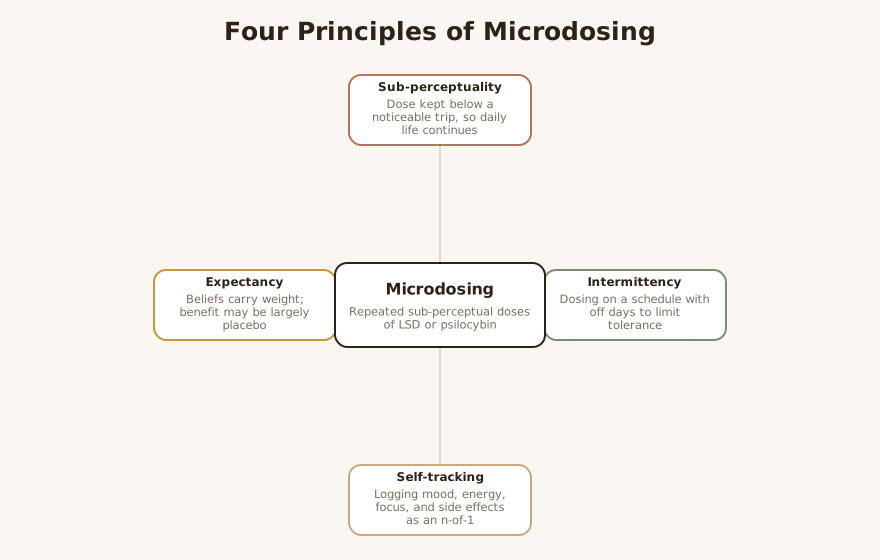
Several principles recur across how the practice is described. The first is sub-perceptuality: the dose is deliberately kept below the threshold of a noticeable “trip,” so the person can work, parent, or drive 4. The second is intermittency: doses are taken on a schedule with off days rather than daily, both to limit tolerance and to track contrast between dosed and non-dosed days 5. The third is self-tracking: practitioners typically log mood, energy, focus, and side effects, treating themselves as an n-of-1 experiment 1.
The fourth, and the most clinically consequential, is expectancy. Because the dose is by design barely perceptible, the practitioner’s beliefs and motivations carry substantial weight, and the best controlled evidence suggests much of the reported benefit may be an expectancy or placebo effect rather than a pharmacological one 34. A clinician who understands these four principles can have a grounded, non-judgmental conversation rather than either dismissing or endorsing the practice LLM.
Interventions & Techniques
For the clinician, the “techniques” are not dosing techniques but therapeutic ones applied to a client who is microdosing LLM. The core moves are: a thorough substance-use and motivation assessment; transparent psychoeducation about what the controlled evidence does and does not show; harm-reduction counseling; contraindication screening; and integration of these conversations into ongoing evidence-based treatment for the presenting problem LLM.
Assessment should establish what substance, what dose, what schedule, what source, what the client is hoping to achieve, and what they have noticed LLM. Source matters because, with psilcybin mushrooms, misidentification carries a real poisoning risk 4. Psychoeducation should be even-handed: acknowledge that many people report feeling better while being clear that randomized trials have largely not separated those benefits from placebo 34.
LLM-generated illustrative example (not a guideline): A client with persistent low mood mentions she has been microdosing psilocybin twice a week and feels “lighter.” Rather than approving or forbidding, the clinician explores her goals, reviews what controlled studies have found, screens for bipolarity and medication interactions, and frames her depression treatment plan around therapies with established support, while keeping the conversation open and non-shaming. LLM
Motivational interviewing techniques are often a better fit than confrontation, because most clients are not in distress about the practice and will disengage if they feel judged LLM.
Evidence Base
The honest summary is that the evidence is emerging and, where it is most rigorous, largely unsupportive of specific benefit beyond placebo 13. The systematic review covering 1955 to 2021 frames the field as early-stage and methodologically thin, calling for better-controlled research 1. A 2024 rapid review explicitly poses the question of whether microdosing is a placebo, signaling that this remains the central unresolved issue in the literature 2.
The strongest single piece of evidence is a double-blind, placebo-controlled study in which 34 participants took 0.5 grams of dried Psilocybe cubensis versus placebo in capsules 37. It found no benefit of microdosing on creativity, well-being, or most cognitive measures, and detected a few small changes in the direction of cognitive impairment, including slowed response times 3. Crucially, acute effects were significantly more intense for the active dose only among participants who correctly guessed they had received it, which led the authors to conclude that expectation underlies at least some of the anecdotal benefits 3.
This sits in tension with observational and self-report cohorts, which report small-to-medium improvements in mood and mental health 4. Those designs are confounded by selection (people who already believe in the practice), expectancy, and lack of blinding, so they cannot establish that the substance itself is responsible 14. The practical bottom line for clinicians is the Harvard Health conclusion: there is not yet definitive proof that microdosing is helpful, or that it is safe over the long term 4.
Populations & Indications
The populations who present microdosing are adults across a wide range, including people with depression, people with anxiety, people seeking cognitive enhancement, people with attention difficulties or ADHD, and creative professionals 45. It is essential to read these as the populations who use microdosing to self-treat, not populations for whom microdosing is an indicated treatment LLM.
Because controlled trials have not demonstrated benefit over placebo, there is no condition for which microdosing can be presented as an evidence-based indication 34. The clinical “indication,” properly understood, is the indication to assess and educate whenever a client discloses the practice, and to ensure their actual diagnosis is being treated with methods that have empirical support LLM.
Problems-for-Work
In practice, clients tie microdosing to specific problems-for-work, and each offers an opening for legitimate clinical work LLM. With low mood and major depressive disorder, a client may report microdosing “instead of” starting therapy or medication; the work is to validate the wish to feel better while building an evidence-based depression plan 4. With anhedonia and low energy, a client may credit microdosing for small gains; the work is to track those gains honestly, including the possibility they reflect expectancy, and to add behavioral activation 3.
With anxiety, the clinician screens carefully, because serotonergic agents can in some people heighten rather than soothe activation, and anxious clients are often acutely attuned to subtle bodily change LLM. With attention difficulties, a client seeking cognitive enhancement should hear that the best-controlled data showed if anything a small move toward impairment, not enhancement 3. With creativity blocks, the clinician can explore the meaning and pressure behind the block rather than locating the solution in a substance LLM. With treatment-resistant depression, disclosure of microdosing is a prompt to re-examine the full treatment history and to coordinate care, not to endorse an unproven route 4.
Contraindications, Cautions & Cultural Humility
The clearest cautions are medical and psychiatric. Microdosing may be dangerous for people with serious mental illness such as schizophrenia or bipolar disorder, and clinicians should screen for personal and family history of psychosis and mania before any reassurance is offered 4. Long-term safety data are lacking because of historical research restrictions, so the absence of documented harm is not the same as documented safety 4. With psilocybin mushrooms specifically, there is a real risk of poisoning from misidentified or contaminated material 4.
Pharmacological interactions deserve attention given serotonergic activity, so a careful medication review is warranted, particularly for clients on serotonergic antidepressants LLM. There is also the legal reality: these substances remain federally illegal in the United States despite local decriminalization in some jurisdictions, which has implications for client safety, disclosure, and documentation 4. Cultural humility matters too: psychedelic plants and fungi carry deep significance in some Indigenous and spiritual traditions, and the clinician should neither pathologize a meaning-making practice nor flatten it into mere “drug use,” while still being honest about risk LLM.
Treatment-Plan Suggestions & SMART Objectives
The plan never treats microdosing as the intervention; the intervention is the legitimate therapeutic work surrounding it LLM.
| Goal | SMART objective (example) | Mechanism |
|---|---|---|
| Reduce depressive symptoms with evidence-based care | Client will attend weekly Cognitive Behavioral Therapy and reduce PHQ-9 by 5 points within 8 weeks | Cognitive restructuring and behavioral activation targeting low mood 4 |
| Make an informed, non-coerced decision about the practice | Client will articulate, in 2 sessions, the placebo-vs-active uncertainty in the controlled evidence | Psychoeducation correcting expectancy-driven beliefs 3 |
| Screen for and mitigate psychiatric risk | Clinician will complete a bipolar/psychosis screen within the first 2 sessions and document findings | Early identification of contraindications to serotonergic exposure 4 |
| Address anhedonia behaviorally | Client will schedule and complete 3 valued activities per week for 4 weeks and rate enjoyment | Behavioral activation reducing reliance on substance for reward 3 |
| Reduce harm where the client continues | Client will verify substance source and review interaction risks with prescriber within 2 weeks | Harm-reduction counseling lowering poisoning and interaction risk 4 |
| Resolve ambivalence about treatment direction | Client will complete a decisional balance on microdosing vs. evidence-based options in 1 session | Motivational interviewing strengthening intrinsic change talk LLM |
| Reframe a creativity block | Client will identify 2 non-pharmacological contributors to the block within 3 sessions | Exploration of meaning and performance pressure LLM |
Common Misconceptions
The most common misconception is that microdosing is a proven treatment for depression or anxiety; the most rigorous trial to date found no benefit over placebo 3. A second is that the benefits people report prove the drug works, when in fact expectancy plausibly accounts for much of that reported benefit 34. A third is that microdosing reliably enhances cognition, whereas controlled data showed, if anything, a small shift toward impairment 3.
A fourth misconception conflates microdosing with supervised psychedelic-assisted therapy, importing the latter’s more promising single-session evidence onto a different practice LLM. A fifth is that “natural” or low-dose means safe; long-term safety is simply unstudied, and mushroom misidentification is a concrete hazard 4. Correcting these gently, without shaming the client, is itself a therapeutic act LLM.
Training & Certification
There is no certification in microdosing, and clinicians should be wary of anything presenting itself as such, because the practice is not a deliverable clinical service LLM. The relevant clinical competencies are transferable: substance-use assessment, motivational interviewing, harm-reduction frameworks, and psychopharmacology literacy sufficient to recognize interaction and contraindication risks LLM. Staying current with the emerging literature, including systematic reviews and the placebo question, is the most useful form of “training” here 12. Clinicians interested in supervised psychedelic work should pursue that as a separate, distinct training track and not assume it transfers to advising on unsupervised microdosing LLM.
Key Terms
Sub-perceptual (sub-hallucinogenic) dose: a dose low enough to avoid a noticeable acute experience, often cited as roughly 1/5 to 1/20 of a recreational dose 4. Expectancy/placebo effect: improvement attributable to belief and expectation rather than the substance, a leading explanation for reported microdosing benefits 3. n-of-1 self-experimentation: treating oneself as the single subject of an informal experiment by tracking outcomes across dosed and non-dosed days 1. Psychedelic-assisted therapy: a distinct, supervised modality using a single full dose, not to be conflated with microdosing LLM. Harm reduction: a non-judgmental clinical stance aimed at reducing risk for a client who continues a behavior LLM. Schedule I: the U.S. federal classification under which these substances remain illegal despite some local decriminalization 4.
Resources & Further Reading
▶ Watch — a video introduction to this concept:
- The emerging science of microdosing: A systematic review (1955-2021)
- Is microdosing a placebo? A rapid review of low-dose LSD and psilocybin research
- Microdosing with psilocybin mushrooms: a double-blind placebo-controlled study (Translational Psychiatry)
- Same RCT via PubMed (35918311)
- The popularity of microdosing of psychedelics: What does the science say? (Harvard Health)
- What Is Microdosing? Here’s Everything You Need to Know (GoodRx)
- Joseph Rootman: Microdosing Psychedelics: Small is Big (TED)
Reflective / Supervision Questions
- How do I respond when a client credits a practice I cannot endorse for genuine improvement they are experiencing, without either validating an unproven claim or shaming them? LLM
- Where is my own bias, toward enthusiasm or toward dismissal, shaping the assessment? LLM
- Have I actually screened this client for bipolarity, psychosis history, and serotonergic medication interactions, or have I assumed low dose means low risk? LLM
- Am I keeping the treatment plan anchored to evidence-based care for the presenting condition, rather than letting the microdosing conversation crowd it out? LLM
- How do I document a client’s disclosure in a way that is clinically honest and protective of the client given the legal context? LLM