
Poetry therapy is the deliberate use of poems and the spoken or written word — reading existing literature and creating one’s own — as instruments of healing, insight, and growth LLM. For practicing clinicians, it sits within the expressive arts family alongside art, music, drama, and dance/movement therapy, and shares a direct lineage with bibliotherapy and journal therapy 5. This article frames poetry therapy honestly: as a discipline with deep historical roots and mature professional infrastructure, but with a controlled-trial evidence base that is thinner than its institutional standing might suggest LLM.
Type & Discipline
Poetry therapy is best classified as an expressive/creative-arts modality rather than a standalone, independently reimbursable psychotherapy LLM. It is one branch of the broader field of writing therapy — “a form of expressive therapy that uses the act of writing and processing the written word in clinical interventions for healing and personal growth” — which also encompasses journal therapy and the expressive-writing paradigm 5. In contemporary practice the term biblio/poetry therapy is often used to signal its kinship with bibliotherapy, the structured therapeutic use of literature 2. Clinically, most therapists fold poetry-therapy techniques into individual or group psychotherapy as a method or adjunct, not as a discrete treatment unto itself LLM.
Creators & Lineage
The modern field grew out of bibliotherapy, a term coined by Samuel Crothers in 1916 to name literature’s healing potential 1. The pivotal mid-century figure was Eli Greifer, a pharmacist and poet who launched a “poemtherapy” movement in 1928 and ran groups at Creedmoor State Hospital 1. Greifer collaborated with psychiatrist Dr. Jack J. Leedy, who is widely credited with spearheading the field’s professionalization 1. On the West Coast, Arthur Lerner, PhD, founded the Poetry Therapy Institute and authored several of the field’s foundational texts 1. In 1969 Leedy, Ann White, and Gil Schloss founded the Association for Poetry Therapy, which in 1980 was restructured into the National Association for Poetry Therapy (NAPT), a 501(c)(3) nonprofit 1. The 1970s also saw Arleen Hynes, Morris Morrison, and Jennifer Bosveld establish training institutes, broadening the discipline’s reach 2. The lineage thus runs from bibliotherapy and journal therapy through poetry therapy, and overlaps conceptually with narrative therapy’s emphasis on re-authoring personal stories LLM.
Core Principles
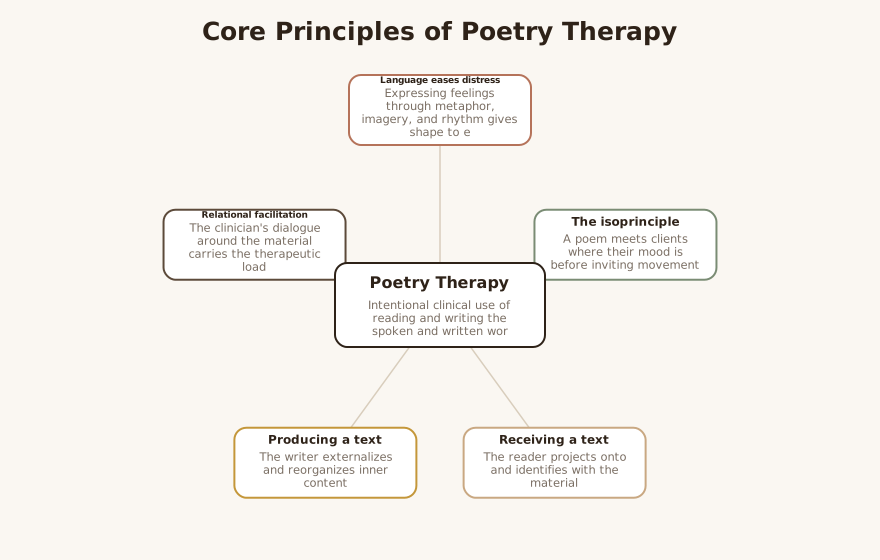
Poetry therapy rests on the premise that expressing feelings through language gradually eases emotional distress, and that engagement with a poem’s metaphor, imagery, and rhythm can give shape to experience that is otherwise hard to name 5. A second principle is the isoprinciple: a chosen poem should first meet clients where their mood actually is before gently inviting movement, an idea with ancient antecedents in the Roman physician Soranus prescribing tragedy for manic patients and comedy for depressed ones 1. Third, the method assumes that both receiving a text and producing one are therapeutic acts — the reader projects onto and identifies with the material, while the writer externalizes and reorganizes inner content LLM. Finally, the work is relational: the clinician’s facilitation of dialogue around the material, not the text in isolation, is what carries the therapeutic load LLM.
Interventions & Techniques
Practitioners commonly distinguish three families of technique LLM. The receptive/prescriptive mode introduces an existing poem and invites the client to respond — what they noticed, resisted, or recognized in it — using the text as a projective mirror and conversation starter LLM. The expressive/creative mode has the client generate their own writing, drawing directly on the expressive-writing tradition in which participants write about their deepest thoughts and feelings without concern for grammar or form 5. A common research-derived structure asks for roughly 20 minutes of writing across several sessions, a protocol adapted from controlled trials of emotional writing 6. The symbolic/ceremonial mode uses writing within rituals — a letter never sent, a poem read aloud at a loss, a list burned or kept — to mark transitions LLM. Group formats add a layer: members write or respond to a shared poem and then witness one another, which can reduce isolation and normalize affect LLM. Techniques are typically sequenced from lower-disclosure receptive work toward higher-disclosure expressive work as safety builds LLM.
Evidence Base
Here honesty matters. Poetry therapy is established as a profession — it has a national association dating to 1969, an independent credentialing body, and a dedicated peer-reviewed outlet, the Journal of Poetry Therapy, published by Taylor & Francis 13. But its standing as a discrete, controlled-trial-backed intervention is immature, and most of its empirical warrant is borrowed from the adjacent expressive-writing literature LLM. That literature is itself modest. The most directly relevant trial is Baikie, Geerligs, and Wilhelm’s online randomized controlled trial of expressive writing and positive writing in participants with mood disorders 6. Participants were randomized to expressive writing, positive writing, or a time-management control, writing for 20 minutes on four occasions 6. The key — and sobering — finding is that all three groups, including the control, reported significantly fewer mental and physical symptoms for at least four months, with no significant differences between groups 6. Only when expressive and positive writing were combined into an “emotional writing” group did that group show significantly lower DASS stress scores than controls 6. Broader reviews of expressive writing report benefits such as fewer physician visits, improved immune markers, and reduced depressive symptoms, but note the mechanism is unclear, since writing about imagined traumas can also produce gains 5. The clinical takeaway: structured therapeutic writing appears broadly and mildly helpful, the specific superiority of any one form is hard to demonstrate, and claims that “poetry therapy is evidence-based” overstate what trials actually show LLM.
Populations & Indications
Poetry therapy has been applied across the lifespan — with adolescents, adults, and older adults — and adapts readily to group as well as individual formats LLM. It is frequently used with people facing chronic illness, bereaved individuals, and trauma survivors, where putting unspoken experience into words is itself a goal of care LLM. Indications cluster around conditions with strong affective and meaning-making components: depression, anxiety, grief, adjustment difficulties, low self-esteem, and stress LLM. The expressive-writing trial that anchors the evidence specifically enrolled participants with a range of mood disorders, and notably found that demographic factors, personality, and coping style did not moderate outcomes — suggesting fairly broad applicability when the modality is appropriate 6. Poetry therapy tends to fit clients who find verbal-only processing difficult but respond to imagery, metaphor, and the indirection a poem allows LLM.
Problems-for-Work
Practitioners typically apply poetry therapy to circumscribed clinical problems rather than as a global cure LLM. For grief, a receptive poem that names loss can give a bereaved client permission to feel, followed by writing a letter to the person who died LLM. For emotional dysregulation, brief structured writing can slow and organize affect between sessions LLM. For self-expression difficulties and low self-esteem, generating one’s own short pieces can build a sense of voice and agency LLM. For existential distress, engaging poems about mortality or meaning can open conversations that direct questioning forecloses LLM.
LLM-generated illustrative example (not a guideline): A clinician working with an adult in early bereavement reads aloud a short poem about absence, asks “what line stayed with you?”, and over subsequent sessions invites the client to write their own unsent letter — using the receptive text to lower the threshold for the harder expressive task LLM.
These applications are best understood as targeted techniques layered onto an established treatment frame, with the specific problem and goal named in the chart LLM.
Contraindications, Cautions & Cultural Humility
Expressive writing is not benign for everyone LLM. Asking a recently traumatized client to write in detail about the trauma before stabilization can flood and retraumatize, so disclosure should be titrated and paced LLM. Clients in acute crisis, with active psychosis, or with significant cognitive impairment may not be appropriate candidates for deep expressive work without modification LLM. The evidence is also a caution in itself: because controlled data show only modest, non-specific effects, clinicians should avoid presenting poetry therapy as a substitute for indicated first-line treatments 6. Cultural humility is essential — poetic form, metaphor, literacy level, and the very willingness to write are culturally and educationally shaped, and a poem meaningful to the therapist may be alien or alienating to the client LLM. Inviting clients to bring texts, song lyrics, or oral forms from their own tradition respects this, as does never assuming written English fluency LLM.
Treatment-Plan Suggestions & SMART Objectives
| Goal | SMART objective (example) | Mechanism |
|---|---|---|
| Increase emotional expression | Client will complete 3 brief (20-min) expressive-writing entries over 4 weeks and discuss one in session | Externalization and labeling of affect 6 |
| Reduce subjective stress | Client will report a 3-point drop on a stress self-rating after 4 weeks of structured writing | Emotional processing reduces stress load 6 |
| Process grief | Client will write and read aloud one letter to the deceased within 6 sessions | Ritualized symbolic expression of loss LLM |
| Build self-efficacy / voice | Client will author and share 2 original short poems over 8 weeks | Agency and mastery through creation LLM |
| Improve emotion regulation | Client will use a receptive poem as a grounding prompt during 2 distress episodes/week | Metaphor as containment and distancing LLM |
| Decrease isolation (group) | Client will respond to a shared poem and offer feedback in 4 of 6 group sessions | Witnessing and normalization LLM |
| Enhance insight | Client will identify one recurring theme across journal entries by week 6 | Pattern recognition via re-reading 5 |
Common Misconceptions
A first misconception is that poetry therapy requires the client — or the therapist — to be a “good” poet; in practice, aesthetic quality is irrelevant and the process, not the product, is therapeutic LLM. A second is that the modality is unstructured or purely intuitive, when in fact it has formal credentialing, training standards, and a research literature 23. A third, and the most important to correct, is that “an RCT proved poetry therapy works” — the relevant trial showed broad, non-specific improvement across writing conditions including the control, not a clean demonstration of poetry therapy’s specific efficacy 6. Finally, some assume it is only for verbal, literary clients, whereas its appeal is often greatest for those who struggle with direct verbal processing LLM.
Training & Certification
Credentialing is handled not by the membership association but by an independent body — a separation made because membership organizations cannot legally serve as credentialing bodies 2. The National Federation for Biblio/Poetry Therapy was established in 1983 and took full responsibility for credentialing in 2002, becoming the International Federation for Biblio/Poetry Therapy (IFBPT) in 2014 2. It positions itself as the sole autonomous entity authorized to grant professional credentials in biblio/poetry therapy 2. The associated credentials include the Certified Poetry Therapist (CPT) and Registered Poetry Therapist (RPT) designations, awarded after defined training and supervision requirements 1. Licensed mental-health clinicians can incorporate poetry-therapy techniques within their existing scope of practice without holding a CPT/RPT, but formal credentialing signals specialized competence LLM.
Key Terms
Bibliotherapy — the structured therapeutic use of literature; the parent discipline from which poetry therapy emerged 1. Expressive writing — the Pennebaker-derived paradigm of writing about one’s deepest thoughts and feelings, usually for short timed periods over several sessions 5. Receptive (prescriptive) mode — therapeutic use of an existing, clinician-selected text LLM. Expressive (creative) mode — therapeutic use of client-generated writing LLM. Isoprinciple — matching the chosen material to the client’s current mood before guiding movement LLM. Journal therapy — the oldest writing-therapy form, using personal journaling to record meaningful thoughts and feelings 5.
Resources & Further Reading
▶ Watch — a video introduction to this concept:
- National Association for Poetry Therapy — History
- International Federation for Biblio/Poetry Therapy — History
- Journal of Poetry Therapy — Taylor & Francis
- Poetry Therapy: Benefits, Techniques & How It Works — GoodTherapy
- Writing therapy — Wikipedia
- Baikie, Geerligs & Wilhelm (2012), Expressive writing and positive writing for participants with mood disorders: An online RCT — ScienceDirect
Reflective / Supervision Questions
- When I introduce a poem, whose voice and culture does it center — mine or the client’s — and have I invited them to bring their own texts? LLM
- How am I titrating disclosure so expressive writing processes rather than floods a trauma-affected client? LLM
- Given that controlled trials show non-specific effects, how do I describe poetry therapy’s role to clients without overstating its evidence? LLM
- Am I documenting this as a technique within a recognized billable modality, with a clear medical-necessity target? LLM
- For which of my clients is the indirection of metaphor an asset, and for which might it be an avoidance? LLM